
You've got a Permanent Marker build on the bench, the distillate is clean, the cart hardware is already chosen, and now the hard part starts, making the flavor land like the flower without turning the SKU into a quarterly rework. That's the job with permanent marker strain terpenes. The profile is loud enough to matter, but it isn't static, and if you treat it like a fixed formula instead of a moving chemotype, you end up chasing the wrong target.
Permanent Marker is useful precisely because it sits in the premium, terpene-forward lane. Independent guides place total terpene content around 2.0% to 3.5% by weight, with premium indoor runs reaching 2.5% to 4.0% Joint Commerce, and verified batches have landed at 1.93% total terpenes with 25.605% total THC and 28.965% total major cannabinoids One Day Cannabis COA. That combination explains why formulators keep coming back to it for carts, extracts, and other flavor-forward products. It's not just about matching a strain name, it's about matching a high-intensity aroma stack that can survive production.
What a Permanent Marker-Inspired Build Actually Requires
A Permanent Marker-inspired cart starts with a simple question, what are you trying to replicate, the flower's chemistry or the shelf impression? Those are not the same target. In production, the goal is usually a strain-inspired terpene blend that captures the recognizable gas-sweet-spice signature without pretending a cartridge can behave like cured flower.

What the profile needs to do on the shelf
Permanent Marker has become a benchmark because it doesn't read like a flat “gas” cultivar. Its identity sits in the overlap of sharp marker-like aroma, candy sweetness, pepper, and a darker musky base, which is why it shows up in premium adult-use flower, rosin, and vape SKUs. The practical takeaway is that a successful build needs recognizable front-end aroma and enough depth to keep the inhale from feeling thin or one-dimensional.
That matters more than trying to chase every volatile in flower. In a cartridge, the user gets a compressed flavor window, so the formulation has to present the same broad impression fast. If the blend opens too citrusy, it loses the “marker” character. If it leans too heavy into earthy base notes, the profile turns muddy and loses the candy gas edge that buyers expect.
Practical rule: build for the first three seconds of inhale, not for the flower jar note that appears after grinding.
The shelf outcome depends on whether the cartridge reads as Permanent Marker-inspired or just “generic gassy.” The strain's reputation gives you permission to be precise. Use that advantage, but don't overbuild the recipe trying to force flower realism into hardware that can't hold it.
Dominant and Minor Terpenes in Permanent Marker
A Permanent Marker cart can drift fast from one run to the next. One batch shows a louder gas top, another pulls more floral, and a third lands in that musky, inky zone that makes the strain recognizable in the first place. That is why the terpene profile has to be read as a moving target across chemotypes, not a fixed recipe.
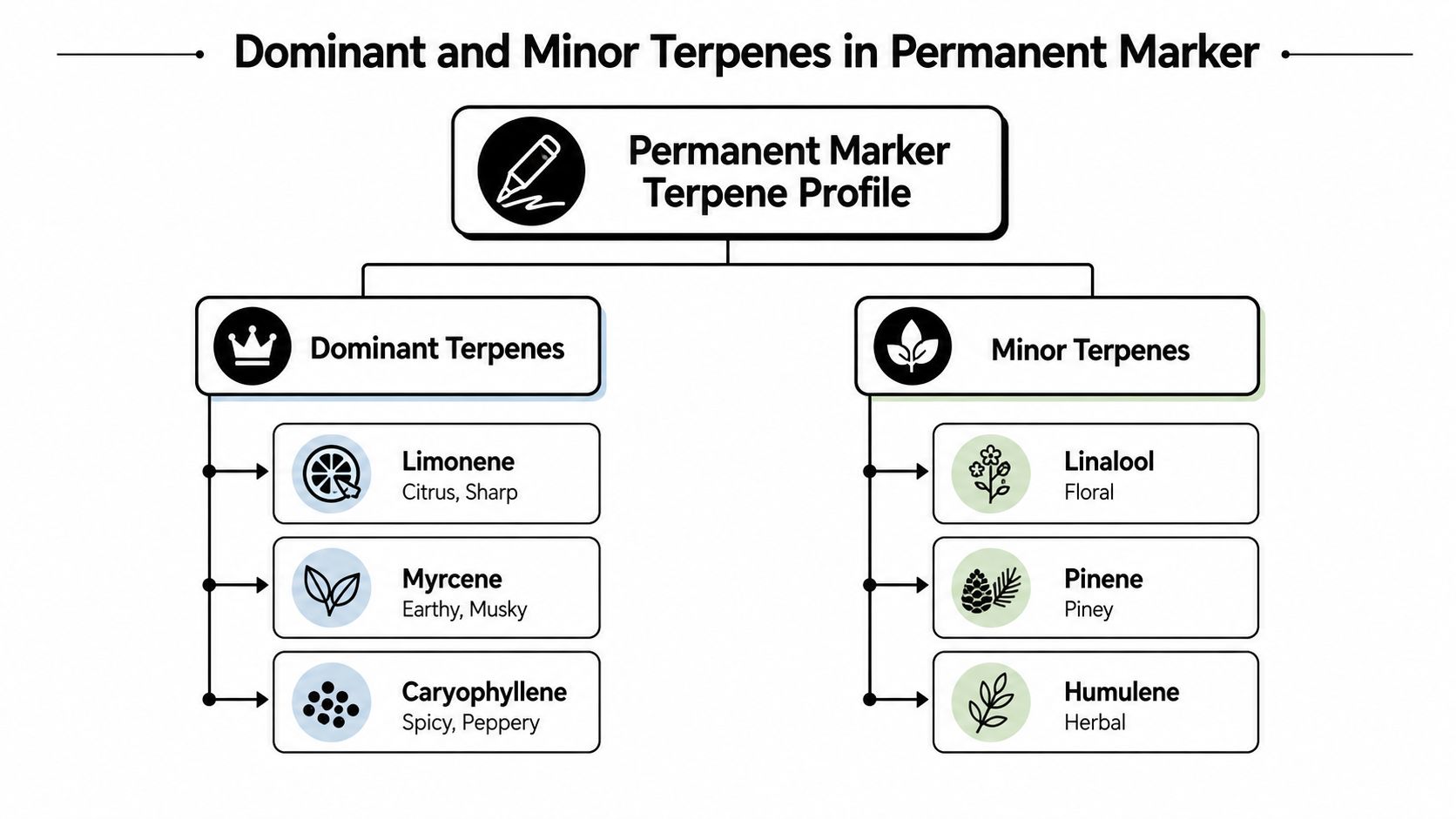
Across strain references and market reporting, the core trio is caryophyllene, limonene, and myrcene Leafly, while other guides place caryophyllene, limonene, and linalool at the top Joint Commerce. The split is useful, because it shows where the batch is likely to lean before you commit to a blend. Gas-heavy lots want one approach, floral lots need another, and musky lots usually need a cleaner base so the finish does not turn muddy.
The major players and what they contribute
Batch-level examples show caryophyllene around 0.4% to 0.7%, limonene around 0.4% to 0.8%, and myrcene around 0.6% to 1.0% Joint Commerce. One independent COA measured limonene at 0.53%, β-caryophyllene at 0.48%, and 1.93% total terpenes in a Permanent Marker flower sample One Day Cannabis COA. That spread is the practical warning sign. Permanent Marker is not one terpene signature, it is a layered gas-candy system that shifts with the cut, the grow, and the post-harvest handling.
- Caryophyllene gives the peppery spine. In a cart, it keeps the flavor from collapsing into sweet top notes.
- Limonene pushes the sharp opening, which helps the inhale feel lifted instead of flat.
- Myrcene anchors the earthy, musky bottom end, which is why some batches read heavier and darker.
- Linalool, when present, softens the profile and adds a floral or soapy trace that can change the finish more than the headline aroma suggests.
A practical way to size the aroma load is to read the terpene percentage against the finished format. At 2.0% to 3.5% total terpenes, a 1 gram flower sample contains roughly 20 to 40 mg of terpenes Joint Commerce. That is enough density to matter in flavor formulation, especially when the goal is to keep the strain's punch intact inside a diluted matrix. For a broader method on turning lab data into formulation decisions, see this lab report interpretation guide.
Permanent Marker works best when the aroma stack is treated like a ratio problem, not a single terpene problem.
Caryophyllene, limonene, and myrcene cover the full sensory arc, from opening brightness to mid-palate spice to finish weight. If one batch runs limonene-led and the next leans myrcene-led, the cartridge needs a different balance even though the strain name stays the same.
Reading Lab Reports Without Misreading the Strain
A Permanent Marker COA can look authoritative and still steer you wrong if you read it like a shopper instead of a blender. The useful numbers are the ones that show how much aroma you can carry into a finished cart, and how much room you have before the profile turns harsh or starts drifting in hardware. In practice, the lab report works like a formulation map, not a marketing sheet.
How to read the numbers that matter
Start with total terpene content. A flower sample at 1.93% total terpenes tells you the biomass is aromatic, but it does not tell you how that aroma will hold up in a 0.5 mL or 1 mL cart One Day Cannabis COA. The next layer is individual terpene weight, because a terpene-heavy sample with limonene dominance behaves differently from one that leans on myrcene. Batch handling changes fast when the dominant note shifts from bright to heavy.
The cannabinoid side matters too. That same sample posted 25.605% total THC and 28.965% total major cannabinoids One Day Cannabis COA. Another batch guide says labels often show THCA 25% to 32%, with some select lots above 32% THCA pre-decarboxylation, while listed total THC commonly falls in the 23% to 30% range after conversion Joint Commerce. That tells you the starting material is potent enough for flavor work, but the chemistry still has to be managed in the final blend.
The trap is assuming flower percentages transfer directly to finished product. They do not. Once you move into distillate, the terpene load has to be set for hardware, viscosity, and sensory impact. A batch that looks loud on paper can still taste muted if the base is wrong or the add-back is too low.
Use this terpene report interpretation guide to train buyers and production staff on what to extract from a COA and what to ignore. The practical check is simple, qualify every new batch against dominant terpene balance, total terpene density, and whether the flavor still reads like Permanent Marker after dilution.
Bench note: if the COA looks strong but the first puff tastes thin, the problem is usually matrix choice, not missing terpene identity.
Building a Top, Mid, and Base Note Architecture
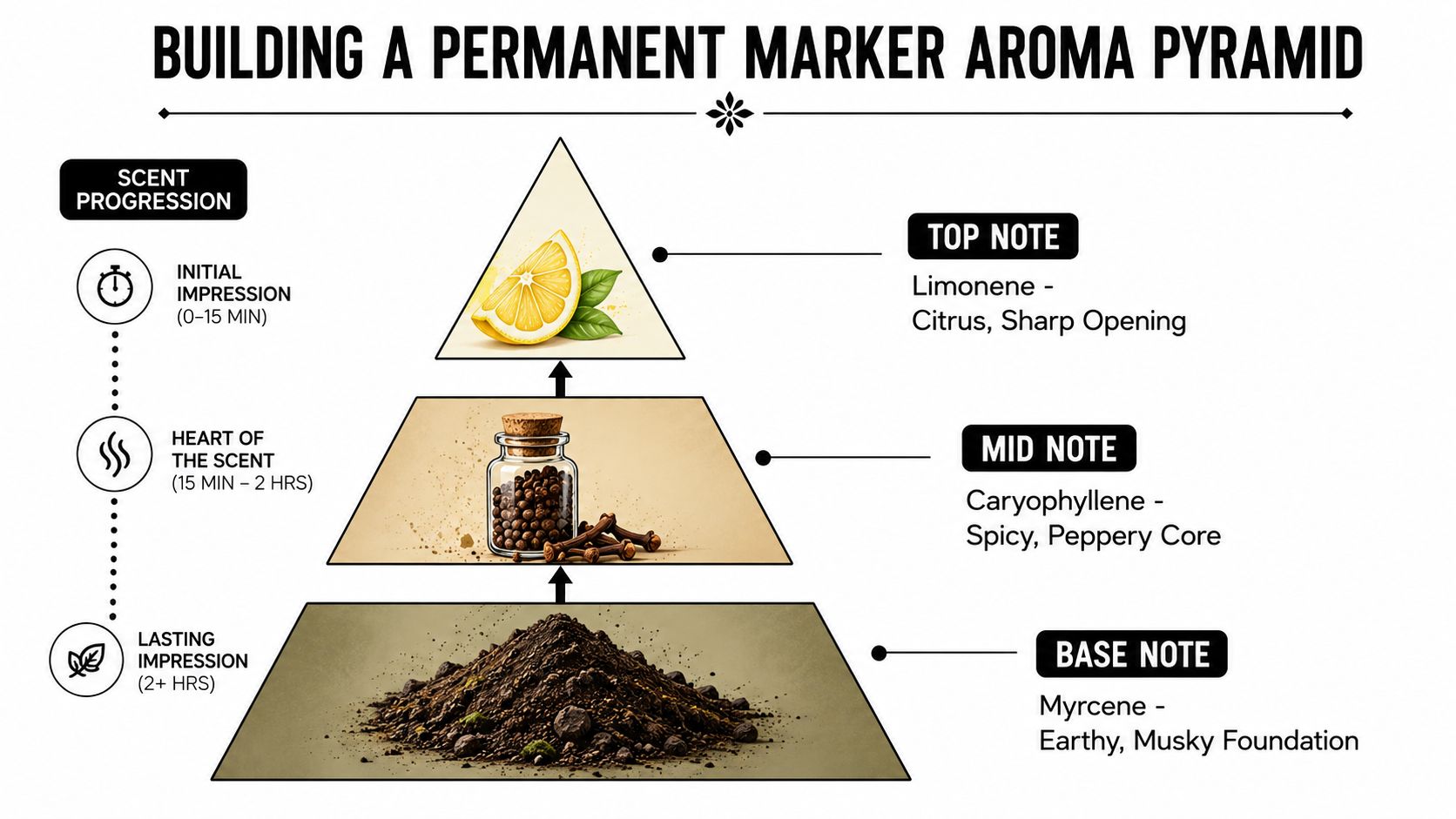
A Permanent Marker formula gets easier to hold together once you treat it as a layered profile instead of a single flavor target. In practice, the strain can swing from gas-heavy to floral or musky across batches, so the build has to preserve the order of perception as much as the note set itself. The goal is a cart that still reads as Permanent Marker even when the flower input drifts.
How the layers translate to formulation
The top note usually comes from limonene. It brings the sharp, citrus-bright lift that makes the first inhale feel immediate. Without enough of it, the blend can smell loud in the jar and still fall flat once it hits hardware.
The mid note sits with caryophyllene and the spicy minors that support it. This is the layer that gives Permanent Marker weight without turning it sugary. It also carries the marker-like impression after the top note starts to fade, which matters when the batch runs more floral than gassy.
The base note is where myrcene does the heavy work. It lays down the earthy, musky foundation that keeps the profile from turning into a top-note-only blend. If a lot brings more linalool, that floral or slightly soapy edge usually belongs between the top and mid layers, not as the headline.
This terpene flavor chart helps teams separate aroma roles before they start weighing components. I use that kind of framework to keep the opening, middle, and finish in the right order, because consumers notice the sequence even when they cannot name each terpene.
A Permanent Marker cart fails when every note lands together. It works when the inhale unfolds in stages.
That layered approach also speeds up troubleshooting. If the build feels too clean, the base is likely underweighted. If it feels muddy, the mid and base are overpowering the limonene lift. If it smells strong in bulk but fades after fill, the top note is not carrying enough volatility into the first draw.
Isolate and Blend Recipes for Distillate Carts
A Permanent Marker cart recipe works best when it starts with a small pilot batch and a clear sensory target. I separate the isolate path from the blended path because they solve different problems. Isolates give tighter ratio control, while a prebuilt strain-inspired mix preserves more of the profile without forcing every note to be rebuilt from zero.
A practical starting point for isolate-based builds
For a Permanent Marker-inspired terpene blend for distillate, I start with a caryophyllene-led core, then fill in the brighter and heavier notes around it. A workable starting ratio is caryophyllene 35%, limonene 25%, myrcene 20%, and supporting minors 20% split across linalool or other trace floral and balancing components if the batch needs softness. That keeps the profile grounded in the dominant compounds commonly associated with the strain, as noted earlier in the strain references and in a practical terpene reference like this distillate mixing guide.
For the first pilot, I keep total terpene loading inside the usual production window for flavor add-back, then adjust from sensory result rather than theory. Too much limonene can make the cart read citrus-first. Too much myrcene can flatten the finish and make the product feel heavy before the user gets the marker note.
A batch that leans gas-heavy can usually take a little more limonene on the top and a firmer caryophyllene spine. A floral batch needs the opposite treatment. Pull the bright notes back, let the spice sit lower, and keep the musky base from getting washed out.
A blended option for production flexibility
The other route is to use a strain-inspired terpene blend as the base, then tune it with isolates. That works well when you want consistency across fills, because the bulk blend already carries a structured gas-candy backbone. You can tighten the top note with limonene or reinforce the dry spice with caryophyllene as needed.
That approach is usually easier when phenotype drift keeps changing the target. A musky lot, a sweeter lot, and a sharper floral lot do not need three separate SKUs if the core blend is built to accept small corrections. The point is not to chase one perfect lab report, it is to keep the cart readable across batches.
Pre-dissolve solid or semi-solid components like β-caryophyllene in a compatible diluent before final blending, especially if your process needs smoother incorporation. The mix has to stay homogenous through warm fills, cool-down, and storage, or the first few carts will not taste like the rest. I have seen more problems come from poor incorporation than from the terpene ratio itself.
What to test before scaling
Run the pilot through a simple bench check.
- Smell the cold blend first. If the jar note is too floral or too piney, the top layer is off.
- Check the warm viscosity. If the oil moves too fast, the aroma ceiling may be too diluted for hardware.
- Taste after a short rest. Some profiles open up after settling, and Permanent Marker often needs that rest before the musky base fully reads.
- Fill only a few carts. Hardware can change perceived spice and sweetness, so use the actual device before committing to a run.
The trade-off is speed versus precision. A pure isolate recipe gives more control, but it takes more tuning. A blended base gets you to market faster, but the recipe needs watching for drift whenever a supplier changes the underlying lot.
Choosing the Right Base for Permanent Marker Formulas
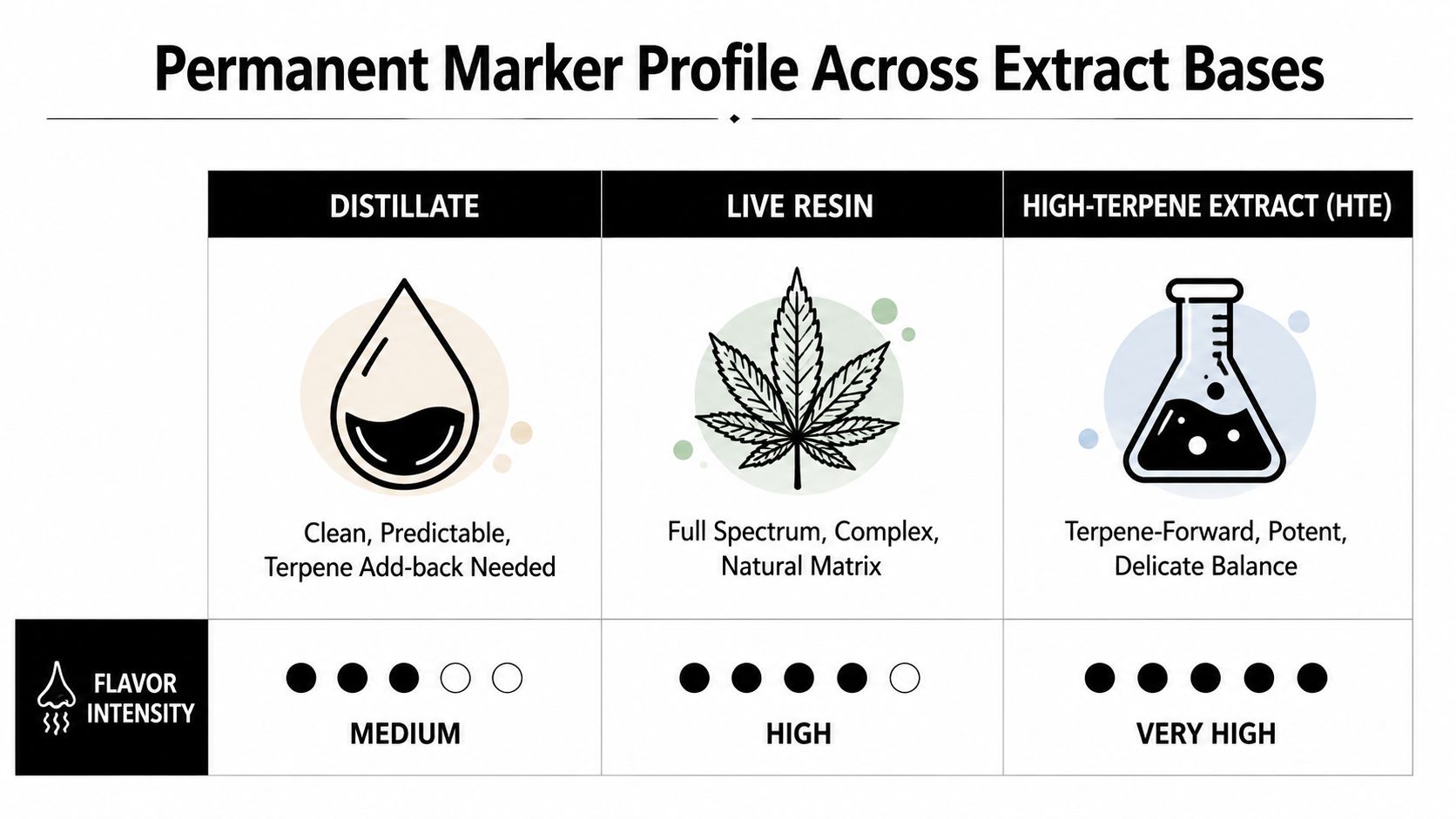
The same terpene recipe behaves differently in distillate, live resin, and high-terpene extract. That's why base selection matters as much as the aroma stack. If the matrix fights the flavor, the finished cart can feel muted, harsh, or unstable even when the terpene percentages are technically correct.
Distillate versus resin-forward matrices
Distillate is the cleanest base for strain replication because it gives you a neutral cannabinoid canvas. That makes it easier to dial in Permanent Marker's candy gas profile, but it also means the terpene add-back has to do all the sensory work. If the ratio is off, the cart tastes assembled instead of natural.
Live resin already carries a richer native matrix, so it can make Permanent Marker feel fuller and more complex. The trade-off is that the base can amplify the heavier myrcene side and push the profile darker than intended. That's useful if the target is a musky batch, less useful if the SKU is supposed to stay bright and candy-forward.
High-terpene extract, or HTE, gives you the loudest starting point, but it's the least forgiving. The flavor ceiling is high, yet the blend needs careful balancing so the top note doesn't disappear under its own intensity. In practice, HTE works best when the goal is a terpene-forward expression rather than a neutralized replica.
This distillate thinning reference is useful when viscosity becomes the limiting factor. The base should support the flavor system, not force you into a diluent choice that changes the taste more than the terpene blend itself.
Decision rule: pick the matrix that matches the batch you're trying to sell, not the one that looks easiest on paper.
For a candy-gas Permanent Marker build, distillate usually gives the most control. For a darker, resinier expression, live resin can be the better fit. For a loud, terpene-heavy SKU where aroma intensity is the selling point, HTE can work, but only if the hardware and dilution strategy can handle it.
Phenotype Drift and the Case for a Flexible Recipe
Permanent Marker is a moving target, not a fixed flavor target, and the source disagreement shows why. One guide puts the profile around myrcene, limonene, and caryophyllene, while another pushes caryophyllene, limonene, and linalool to the top. Leafly Joint Commerce That spread is the commercial reality, not an edge case.
Why a single recipe breaks under real production
If incoming biomass leans gas-heavy, floral-soapy, or musky-earthy, a fixed formula will miss part of the target on at least some releases. The same strain name can still give materially different results across cultivators, harvest windows, and curing methods. The practical answer is to keep two or three sub-recipes ready so you can match the lot instead of forcing the lot to match the recipe.
One version should favor gas-heavy output, with caryophyllene and limonene leading the blend. Another should lean floral-soapy, with a little more linalool presence and a lighter myrcene hand. A third should handle musky-earthy lots by reinforcing the base without burying the sharper opening.
That flexibility also improves sourcing discipline. Check lab verification before every scale-up, and make sure the terpene feedstock is THC-free and compatible with the hardware spec you are filling. If a supplier swap changes the batch character, the recipe should absorb the shift instead of forcing a rebrand or a rushed relaunch.
Gold Coast Terpenes supplies strain-specific terpene blends and isolated compounds for carts, concentrates, and formulation testing. If you are matching Permanent Marker across different chemotypes, review the terpene options at Gold Coast Terpenes, then build the version that fits the batch you have.