
You're staring at a bench sample that smells close, but not close enough. The fruit is there, the candy note flashes on the first pull, and then the cart turns flat or muddy because the blend was built like a generic sweet profile instead of a Pink Zkittlez target. For cart manufacturers, that's the expensive mistake, a terpene formula that sounds right on paper and misses the actual sensory architecture that buyers notice in the hardware.
The pink zkittlez strain sits in a useful but tricky spot for formulation work. It's widely treated as a high-THC, low-CBD flower target, with lab summaries commonly landing in the 17% to 24% THC range and CBD usually at or below 1%. Some retail lots go much higher, with reported samples at 30.28% THC and 30.62% THC in regulated listings, which tells you the profile isn't a soft dessert note, it's a potency-forward aroma target that still has to read as candy-fruit. The terpene side matters just as much, because the best batches are built around a layered aroma instead of one-note sweetness.
Why Pink Zkittlez Demands a Precision Formulation Approach
A formulator can usually get away with a loose approximation on a generic fruit strain. Pink Zkittlez is different, because the market expects a candy opening, a berry-citrus middle, and a slightly earthy finish that still feels polished in a cartridge. A lazy blend built around only limonene and myrcene often comes out loud on top and empty underneath, which is exactly how a promising R&D sample turns into a shelf complaint.
What the product has to do in hardware
In vape formats, the profile has to survive heat, storage, and the customer's first impression. That means the blend needs enough top-note lift to read immediately, but enough structure underneath to avoid tasting like flavored air. For a terpene-only cartridge, the job is to recreate sensory identity, not cannabinoid effects, so the blend has to stand on aroma balance alone.
Practical rule: If the first impression is candy but the finish disappears, the formula is underbuilt. Add structure before you add more sweetness.
The reason this strain attracts serious product teams is simple. It gives you a commercially familiar dessert profile with enough complexity to reward precise blending, and it's widely available enough that buyers already have a mental reference point. That makes it a strong candidate for a terpene profile for vape cartridges where the brand wants something recognizable without leaning on a generic fruit label.
For formulation teams, the right starting question isn't “How sweet can this taste?” It's “What has to be present so the sweetness feels like Pink Zkittlez instead of fruit candy in general?” That distinction drives isolate selection, ratio design, and the stability work that follows. For process discipline and batch handling, a useful reference is industry best practices for terpene handling, because the target profile only matters if the production method can preserve it.
Genetic Lineage and Its Impact on Terpene Composition
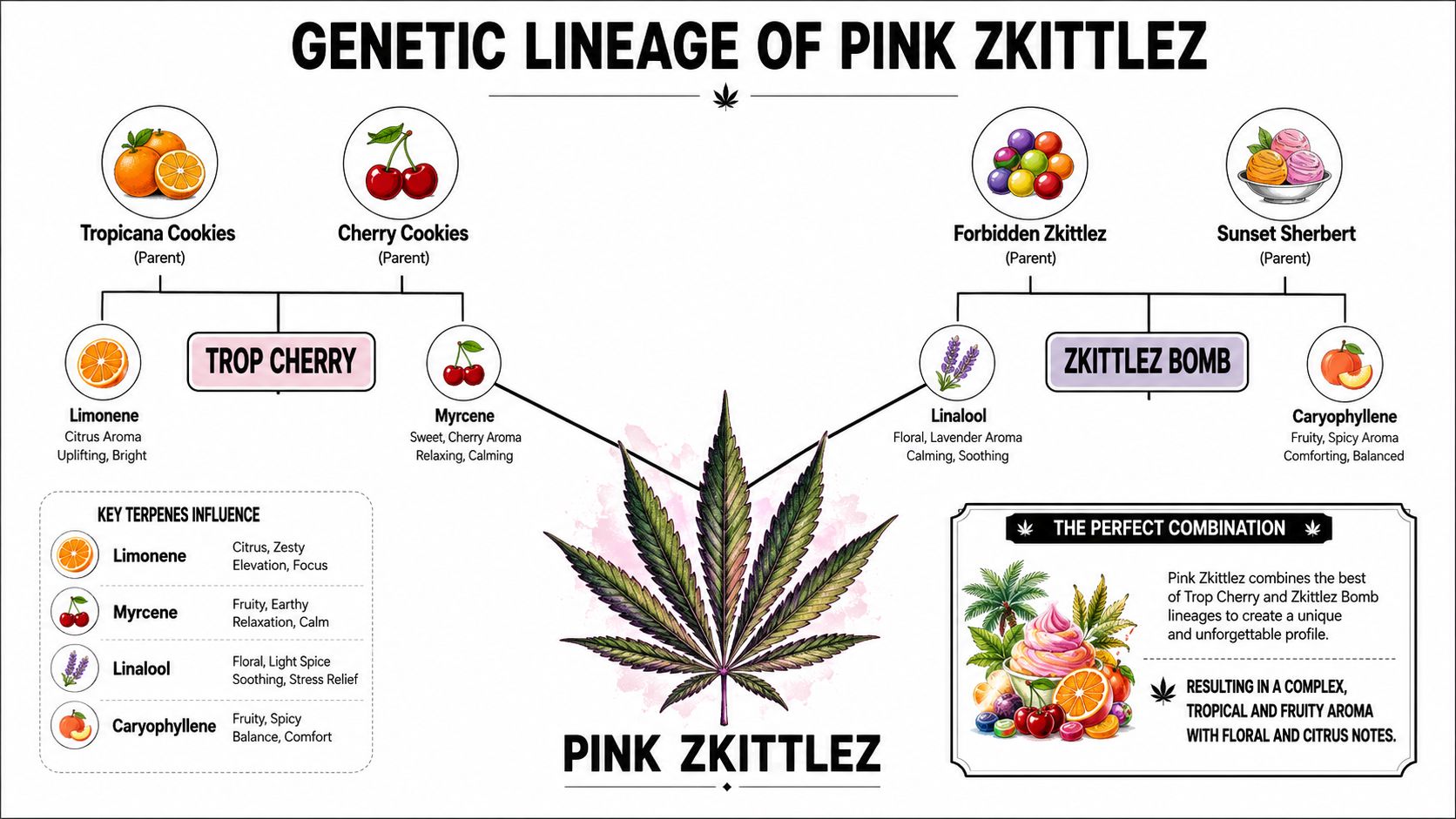
The lineage tells you why this profile is more than a candy scent. Wholesale strain sheets describe Pink Zkittlez as a balanced hybrid descended from Trop Cherry and Zkittlez Bomb, with Trop Cherry itself tied to Tropicana x Cherry Cookies and Zkittlez Bomb tied to Forbidden Zkittlez x Sunset Sherbert. That background matters because the named parents aren't just breeder trivia, they point to the kind of aromatic architecture a formulator has to recreate.
What each branch suggests in a blend
Trop Cherry is used to explain the brighter side of the profile, especially tangerine and sour-cherry notes. Zkittlez Bomb contributes the heavier layer, with sweet, fruity, and earthy undertones that keep the aroma from collapsing into simple citrus. In practical formulation terms, that means the top notes need lift, but the base can't be thin.
A lot of cartridge work fails because the blend only mirrors the loudest parent. If you build toward citrus alone, the profile feels sharp and fleeting. If you overbuild the earthy side, the blend turns dull and loses the confectionary identity that makes the strain label useful in the first place. The useful middle ground is a layered profile that lets the candy note open first and the fruit-gas finish hang around long enough to register.
The other issue is standardization. Pink Zkittlez is not a single fixed cultivar in the market. It's a label applied to related phenotypes and breeder lines, and that's why lab outcomes and terpene emphasis vary. For a manufacturer, that means you're not replicating one universal flower sample, you're building against a target family of sensory traits.
For a quick comparison against a related Zkittlez family profile, the strain archive at Zkittlez-related terpene notes is useful as a reference point. It helps teams think in terms of shared candy-fruit structure instead of overfitting to one batch description.
Deconstructing the Terpene Profile by Note Layer
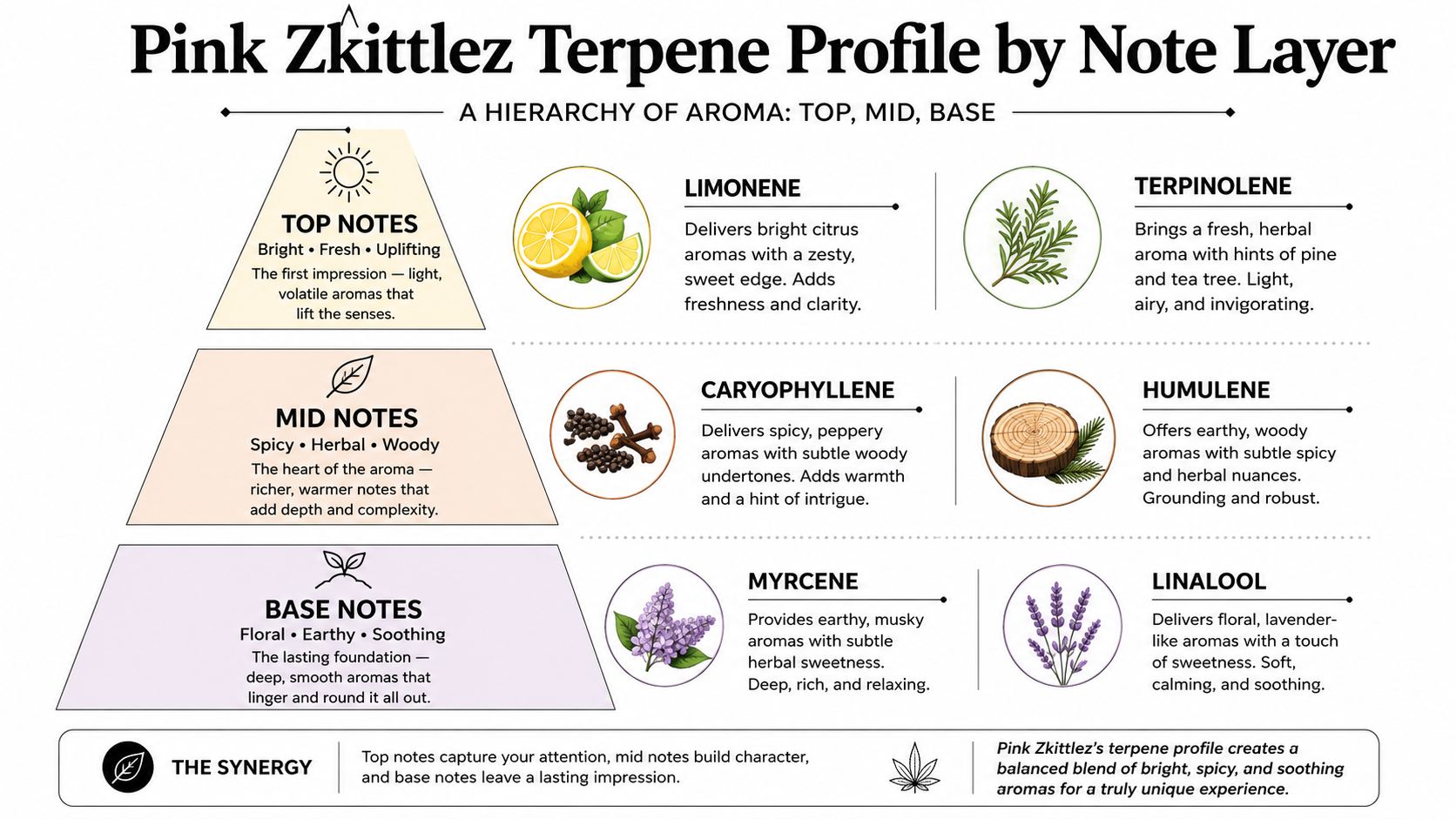
The profile works because the notes are stacked, not blended flat. Published summaries place total terpene content around 1.5% to 3.0%, with myrcene, limonene, and beta-caryophyllene frequently leading, so the strain gives formulators enough signal to build a layered reconstruction rather than guessing from a vague sweet descriptor. The job is to map each note layer to a functional role in the cart.
Top notes need immediate brightness
Limonene and terpinolene carry the opening. In a vaporized product, that top layer is what tells the buyer “this is the right profile” before the finish has time to develop. Too little limonene and the blend feels dull. Too much and it turns into generic citrus cleaner, which is a common failure in fruit-forward carts.
Mid notes need body, not noise
The middle is where linalool and beta-pinene usually help, because they soften the candy edge and add a more floral-fruity transition. In this kind of profile, the mid-palate is what separates a novelty flavor from a product that feels deliberately composed. If the middle disappears, the blend reads like a top-note spray with no depth.
Formulation rule: Build the middle so the top note has somewhere to land. A bright opening without a stable midsection usually fades fast in hardware.
Base notes keep the profile believable
Myrcene and beta-caryophyllene anchor the finish with earthy and slightly gassy depth. That base matters because pure fruit candy gets thin fast under heat, while a peppery, earthy finish gives the blend a more complete arc. Beta-caryophyllene is especially useful when the goal is to avoid a sugary profile that tastes synthetic once the cart warms up.
For teams working from isolates, the archive at strain terpene reference material is a practical starting point. It gives a point of comparison when you're checking whether your top, mid, and base notes are balanced or whether one layer is carrying the whole blend.
Formulation Behavior Across Distillate and Hemp Carriers
The same terpene blend behaves differently depending on the oil it's sitting in. Winterized distillate usually needs more aromatic correction because stripping away native flavor leaves the added terpenes carrying almost all of the sensory load. Hemp-derived distillate often brings its own earthy background, so the blend has to work with that base instead of fighting it.
| Carrier Base | Starting Terpene % | Key Adjustment | Viscosity Note |
|---|---|---|---|
| Winterized distillate | Moderate | Push top notes slightly harder so the profile opens fast | Often thick and can mute subtle aromatics |
| Live resin blend | Lower | Reduce aggressive top notes to avoid overpowering native flavor | Usually more expressive, but less forgiving |
| Hemp-derived distillate | Moderate | Trim earthy components if the base already reads woody | Can carry stronger background notes |
| High-potency distillate cart | Conservative | Watch for separation and harshness during warming | Stability matters more than loudness |
The practical issue is not only flavor, it's physical behavior in the cart. Heavier oils can hold fragrance well but still separate if the terpene load is pushed too hard. Thinner carriers may mix cleanly but expose harsh edges faster, especially if the profile leans too far into terpene brightness without enough base structure.
A useful habit is to smell the carrier before blending. If the oil already smells earthy, don't overbuild myrcene just because the target profile mentions it. If the base oil is nearly neutral, then the top and mid notes have to do more work or the blend feels washed out in the first few draws.
Building a Pink Zkittlez Strain-Inspired Terpene Blend from Isolates
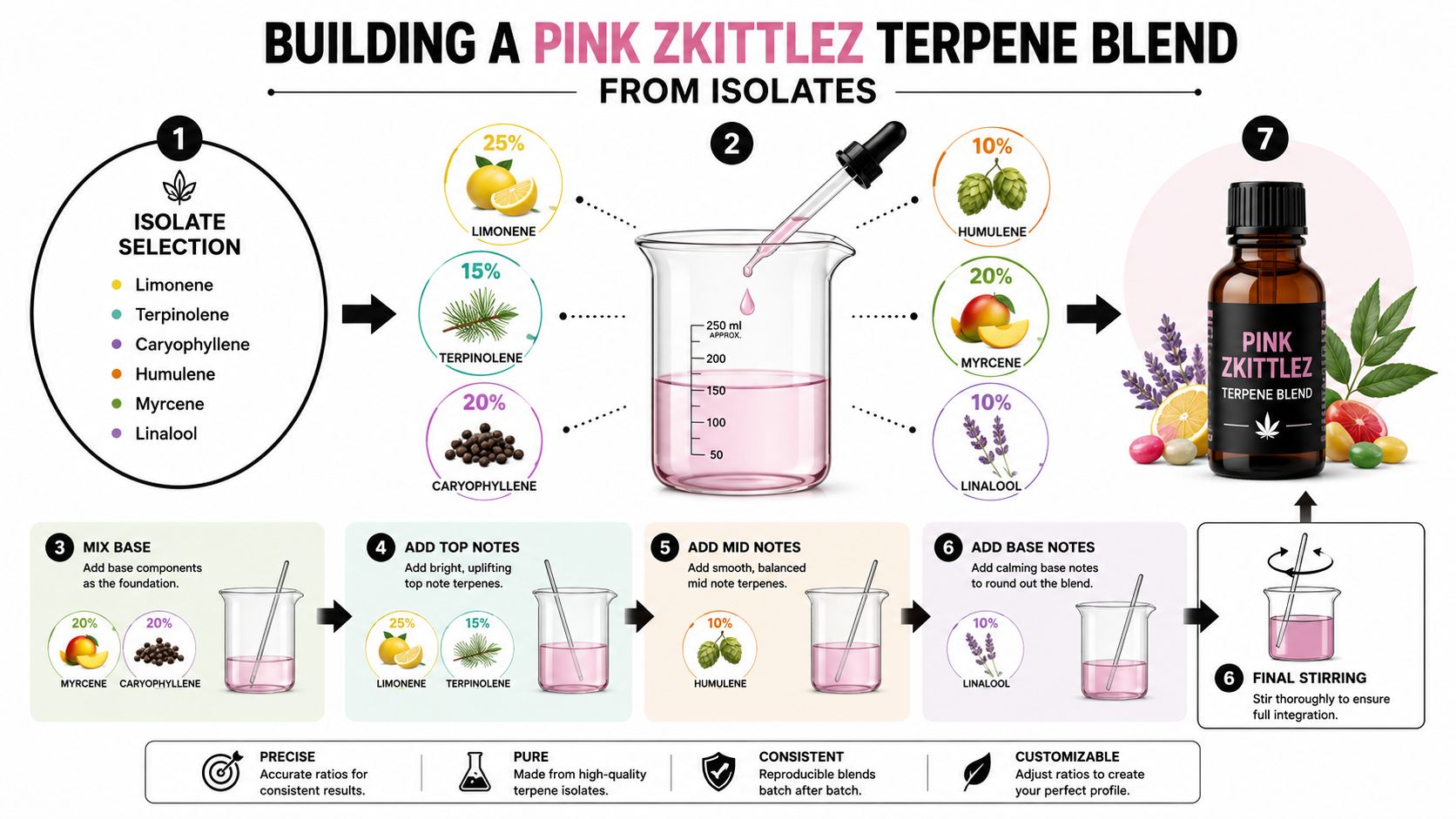
A workable starting point is to build the blend from the note stack rather than from a single strain name. For a Pink Zkittlez strain-inspired terpene blend, a practical isolate framework starts with limonene 25%, terpinolene 15%, caryophyllene 20%, humulene 10%, myrcene 20%, and linalool 10%. That gives you a bright opening, enough spice and wood to hold the center, and a soft floral-earth finish that keeps the candy impression from getting too sharp.
How to mix without flattening the profile
Start with the base and mid notes, then layer the brighter compounds last. That order helps prevent the top notes from dominating the bench sample before you've judged the structure underneath. Once mixed, let the blend rest long enough to evaluate how the aroma settles, because some fruit-forward formulas smell perfect immediately and then turn thin after the initial volatility passes.
A small-batch testing log should record the carrier, mix order, sensory note at room temperature, and sensory note after heat exposure. That sounds basic, but it's where most replication work gets honest. If the blend smells right in the beaker and wrong in the cartridge, the problem is usually not the target profile, it's the way the profile behaves under hardware heat.
Practical advice: Change one variable at a time. If you raise limonene and lower myrcene in the same pass, you won't know which adjustment fixed the blend.
For teams that want a more systematic starting point, a tool like the mixing ratios calculator helps keep test batches consistent while you fine-tune against sensory feedback. Gold Coast Terpenes also supplies strain-specific profiles and isolates, which makes it easier to compare a custom blend against a known reference without guessing at the foundation.
The final adjustment should always match the format. A cart that hits softly may tolerate a slightly louder top note, while a concentrate meant for higher heat may need more base support to keep the finish from collapsing. That's the formulation work, not copying a strain description, but tuning the profile so it survives the product it lives in.
Separating Flavor Replication from Cannabinoid Effects
A lot of market confusion comes from treating Pink Zkittlez like one thing when it's really three different product ideas. There's the high-THC flower version, there's the Pink Zkittlez CBD hemp version that stays non-intoxicating and must remain under 0.3% Delta-9 THC to qualify as hemp, and there's the terpene-only flavor reconstruction that contains no cannabinoids at all. Those are not interchangeable, and brands get into trouble when they talk about them as if they are.
The key distinction is straightforward. Cannabinoid content determines intoxication and legal classification, while terpene content mainly shapes aroma and sensory perception. A THC-free terpene blend can recreate the flavor arc, but it cannot replicate the psychoactive profile of a high-THC flower cultivar. That's not a limitation, it's the point when you're building compliant products for hemp markets or jurisdictions that restrict THC.
How to talk about it in product language
Use flavor and aroma language for the terpene-only product. Keep effect language attached only to cannabinoid-containing products that are legally formulated for that purpose. If the goal is a compliant cart, say the blend is Pink Zkittlez-inspired or strain-inspired, not that it delivers the same effect as flower.
The parentage helps explain the aroma, but it doesn't change the legal reality of the finished SKU. That's why formulators need clean internal documentation and plain external copy. Buyers don't need a cannabinoid claim attached to a flavor target, and regulators don't want implied intoxication where none exists.
Testing and Safety Protocols for Production-Ready Blends
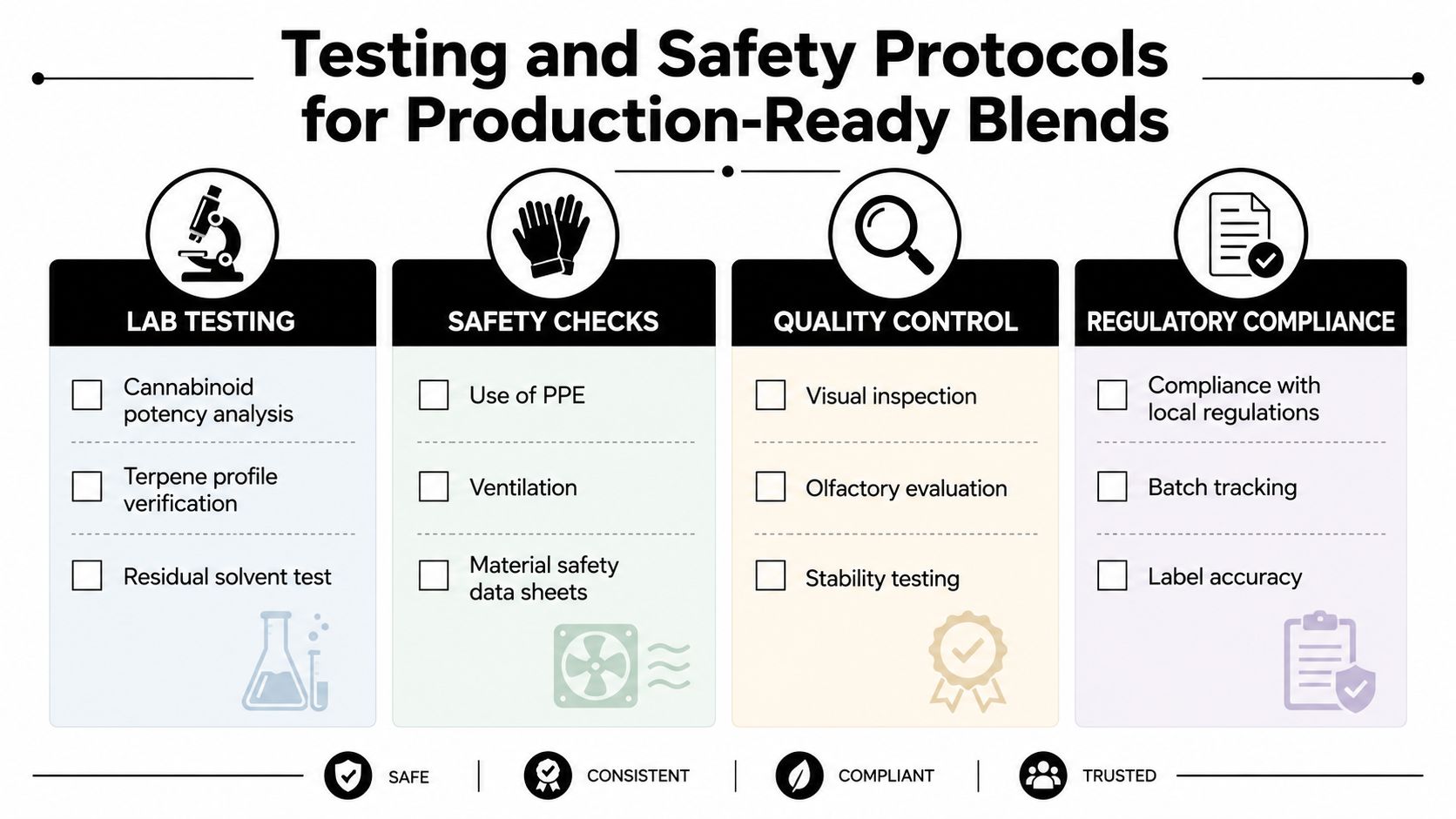
Before a Pink Zkittlez blend goes into production, the batch needs more than a good nose. It needs verification, because terpene-forward cartridges can fail for reasons that have nothing to do with flavor design, from contamination to instability to bad labeling.
What to check before scale-up
- Lab testing. Confirm cannabinoid potency, verify the terpene profile, and screen for residual solvents.
- Safety checks. Use PPE, keep ventilation active, and keep material safety data sheets on hand.
- Quality control. Inspect visual clarity, evaluate aroma consistency, and run stability checks.
- Regulatory compliance. Match local rules, track batches carefully, and keep labels accurate.
The biggest operational mistake is treating terpene work like pure flavoring instead of a regulated formulation step. Even a good-sounding blend can become a production issue if the batch varies too much from tank to tank or if the oil changes character after storage. Consistency is the quality marker in this category.
For formulators who want a compliant terpene supply chain with THC-free documentation, Gold Coast Terpenes is one available source for strain-specific profiles and isolated compounds. Use it the same way you'd use any technical input, as a starting material that still needs in-house validation before it ships.
If you're building a compliant Pink Zkittlez strain-inspired terpene blend for vape cartridges, start with a small test batch, document every adjustment, and compare the result against your carrier oil under real fill conditions. Visit Gold Coast Terpenes to review strain-specific terpene options, isolates, and formulation resources, then use them to tighten your next R&D run before you commit to scale.