
Most advice about the Dynasty OG strain starts in the wrong place. It treats the name like a fixed promise, then tries to reverse-engineer flavor from branding. For formulators, that approach creates avoidable risk, because the useful part of Dynasty OG is not the label, it's the repeatable terpene architecture you can measure, match, and hold across batches.
That matters more in cartridges and distillate than in flower. The same product name can hide a lot of variation, while the lab report tells you what you can build around. If the goal is a terpene profile for vape cartridges that reads as OG, the right question isn't “what is the lineage,” it's “what sensory structure does the oil need to reproduce.”
Why Dynasty OG Genetics Matter Less Than the Terpene Architecture
The genetics conversation around Dynasty OG gets messy fast. Even the broader meaning of “OG” is still disputed across the industry, with origin stories that compete more than they clarify, and the available coverage for Dynasty OG leans heavily on aroma talk rather than documented lineage. For a formulation team, that uncertainty is a problem, because a name with unclear parentage can drift from cut to cut while the sensory target stays the same.
That's why a genetics-first workflow often fails in production. If the lineage isn't verified, then the label can't carry the formulation brief by itself. A better frame is to treat Dynasty OG as a sensory-chemistry reference, then build against measurable terpene behavior, not breeder folklore. A broader OG-family explainer also notes that the name itself remains contested, which is exactly why a hard lineage claim is a weak anchor for product development. See the OG-family context in this strain terpene profile archive.
What to prioritize instead
The practical target is consistency. If two batches both read as Dynasty OG on a menu, but one leans lemon and the other leans raw fuel, the formulators still need a clear internal standard for what “close enough” means.
Practical rule: when the lineage is fuzzy, build the SKU from the lab signature first and the cultivar name second.
That approach also scales better across formats. In flower, the grower can lean on phenotype and cure. In cartridges, the extractor and formulator have to recreate a profile using raw oil, added terpenes, and a controlled process. That means the architecture matters more than the story, because architecture is what survives batch variation.
If you're evaluating a Dynasty OG-inspired SKU for launch, ask three things. Is the profile OG-descended in structure, does it stay recognizable after dilution, and can your team recreate it without chasing a perfect clone? Those questions are more useful than a search for an unverified family tree.
Breaking Down the Dynasty OG Terpene Profile for Formulation
Dynasty OG's market identity often sounds broader than its lab behavior. The reproducible profile usually comes back to a familiar OG trio, limonene, beta-caryophyllene, and myrcene. In lab-tested OG-family batches, total terpenes often land between 1.5% and 3.0% by weight, or 15–30 mg/g. That range is high enough to shape cartridge flavor because, once terpene load reaches that level, the profile stops acting like a neutral carrier and starts steering the full sensory read. For a broader reference on how terpene classes behave in oil systems, see this chemistry of terpenes resource. The same OG-family guidance also describes the strain as a terpene-forward profile rather than a single-note citrus build, which is the more useful framing for formulation work (Dynasty OG strain guide).
The working numbers matter more than the label. Limonene commonly sits at 5–8 mg/g, beta-caryophyllene at 3–6 mg/g, and myrcene at 2–5 mg/g in those lab-tested OG-family batches. Those levels support a layered profile, not a simple lemon oil, which is what formulators need if they want the cart to read as OG rather than just citrus.
Dynasty OG terpene targets by role
| Terpene | Range (mg/g) | Note Position | Sensory Contribution |
|---|---|---|---|
| Limonene | 5–8 | Top note | Bright citrus lift, sharpens the opening aroma |
| Beta-caryophyllene | 3–6 | Middle note | Pepper, spice, and dry warmth |
| Myrcene | 2–5 | Base note | Earth, musk, and soft depth |
The table keeps the blend logic honest. Limonene should register first, but it cannot dominate so hard that the cart turns into generic lemon. Beta-caryophyllene gives the mid-palate grip, while myrcene supplies the grounding effect that keeps the profile from feeling thin or top-heavy.
The order of perception matters in real use. A good terpene profile for Cannabis product formulation opens with lift, holds structure in the middle, and leaves a base that survives heat, dilution, and the first few pulls from a cart. Dynasty OG works best when the citrus reads as an opening layer, not the whole profile. That is the practical gap between the marketed name and the repeatable terpene architecture.
Building the Citrus Diesel Earth Flavor Architecture
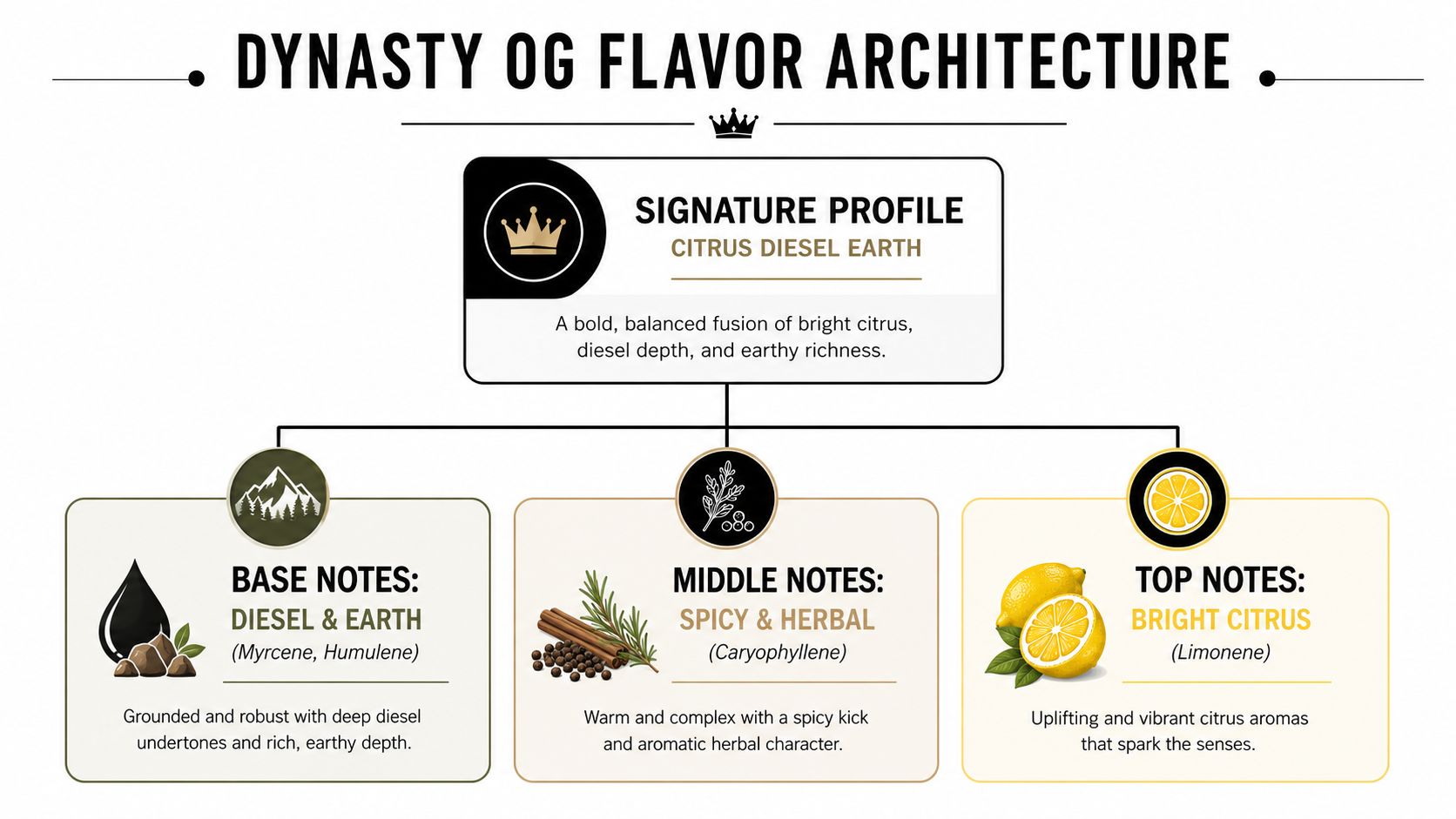
Dynasty OG is usually described with earthy, pine, citrus, and diesel undertones, plus spice, lemon, and wood. That combination only works when the blend is layered correctly. If the citrus sits too low, the cart feels flat. If the diesel sits too high, the profile gets harsh and loses the OG polish.
Build from the base upward
Start with the base notes first. Myrcene anchors the earthy, musky floor, and that support is what keeps the finish from collapsing into citrus water. The base should not smell loud on its own, but it has to be present enough that the top notes don't float away.
Next comes the middle. Beta-caryophyllene adds dry spice and a faint pepper edge, which is what keeps the profile from sounding sweet or candy-like. It also bridges the gap between citrus brightness and woody depth, so the aroma reads as a composed blend instead of a split personality.
The top note is where limonene earns its place. It should hit first, but only as a lift over the other layers. Too much limonene and the profile turns generic, too little and the cart loses the recognizable OG opening that buyers expect.
For a useful reference on citrus behavior in terpene systems, review the limonene guide. It's helpful when you're deciding how bright the top note can get before the whole blend starts reading as lemon-forward instead of strain-faithful.
The cleanest Dynasty OG carts usually smell like citrus over wood, not citrus instead of wood.
That distinction matters in product development. The gas and diesel impression should be restrained, because the goal is a layered OG character, not a solvent-heavy nose. If the aromatic sequence feels like citrus, then spice, then earth, you're close to the target architecture.
Aligning Potency Data with Terpene Load in Cartridge Systems
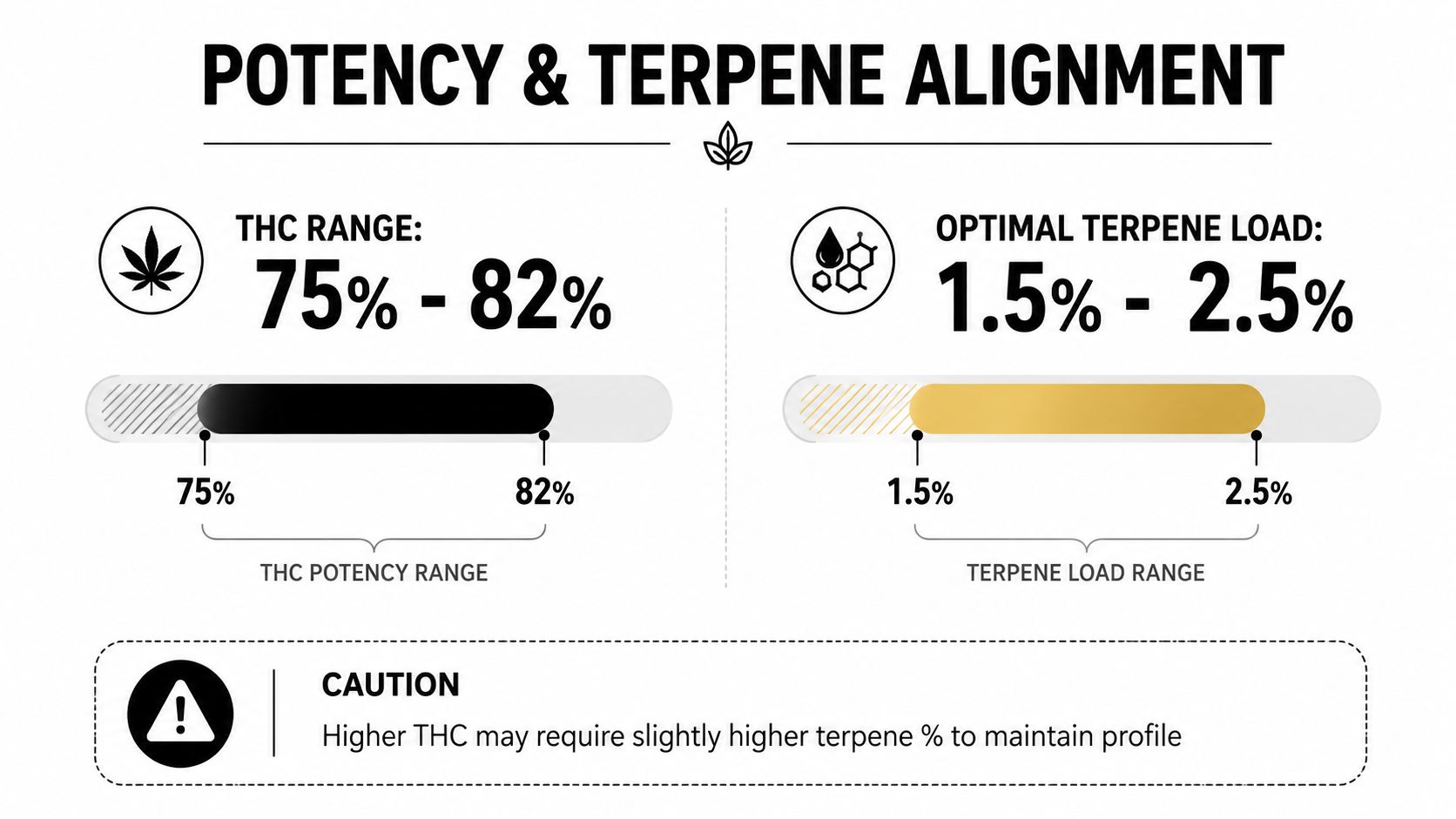
Dynasty OG cartridges on the market tend to sit in a very high-THC, very low-CBD range. One retail lab listing reported 81.651% to 88.16% total THC and 0.118% to 0.18% total CBD, while another cartridge listing reported 81.8% THC (Curaleaf Daytona cartridge listing). A separate commercial Dynasty OG CO2 cartridge reported 3.31% total terpenes, 83.93% total THC, and 0.19% CBD (Curaleaf Lakeland cartridge listing). That potency range is not just a label detail. It changes how the oil carries aroma, how much terpene load it can tolerate, and how far you can push the flavor before the cartridge turns sharp.
Why high-THC oil behaves differently
High-THC distillate does not accept terpene load the same way a softer oil does. Viscosity shifts, aroma release changes, and the flavor can flatten if the blend is underbuilt. The mistake is to keep adding citrus until the nose wakes up, because that usually pushes the profile past balance and into a thin, generic top note.
The better move is to treat potency as process context, then set terpene load by how the oil behaves in the cart. A cartridge can still stay readable at a terpene level like the 3.31% total terpenes example above, while the broader OG-family guidance in the lab report interpretation notes helps frame how to read potency and aroma together. Read the THC number and the terpene number as one system, not as separate scorecards.
Formulation insight: in a THC-forward cart, aroma stability depends as much on oil behavior as on the terpene recipe itself.
That is the constraint with Dynasty OG. The profile has to hold together in a high-potency system where the carrier already does a lot of sensory work. If the base is too heavy, the terpenes disappear. If the base is too thin, the cart gets loud but unstable.
Formulating Dynasty OG for Distillate with Gold Coast Terpenes
A workable distillate build starts with a clean oil base, then layers terpene components in a controlled order. For Dynasty OG, the target is not maximum aroma intensity. The target is recognizable OG architecture, stable viscosity, and a finish that doesn't go sharp or solvent-like.
A practical blending sequence
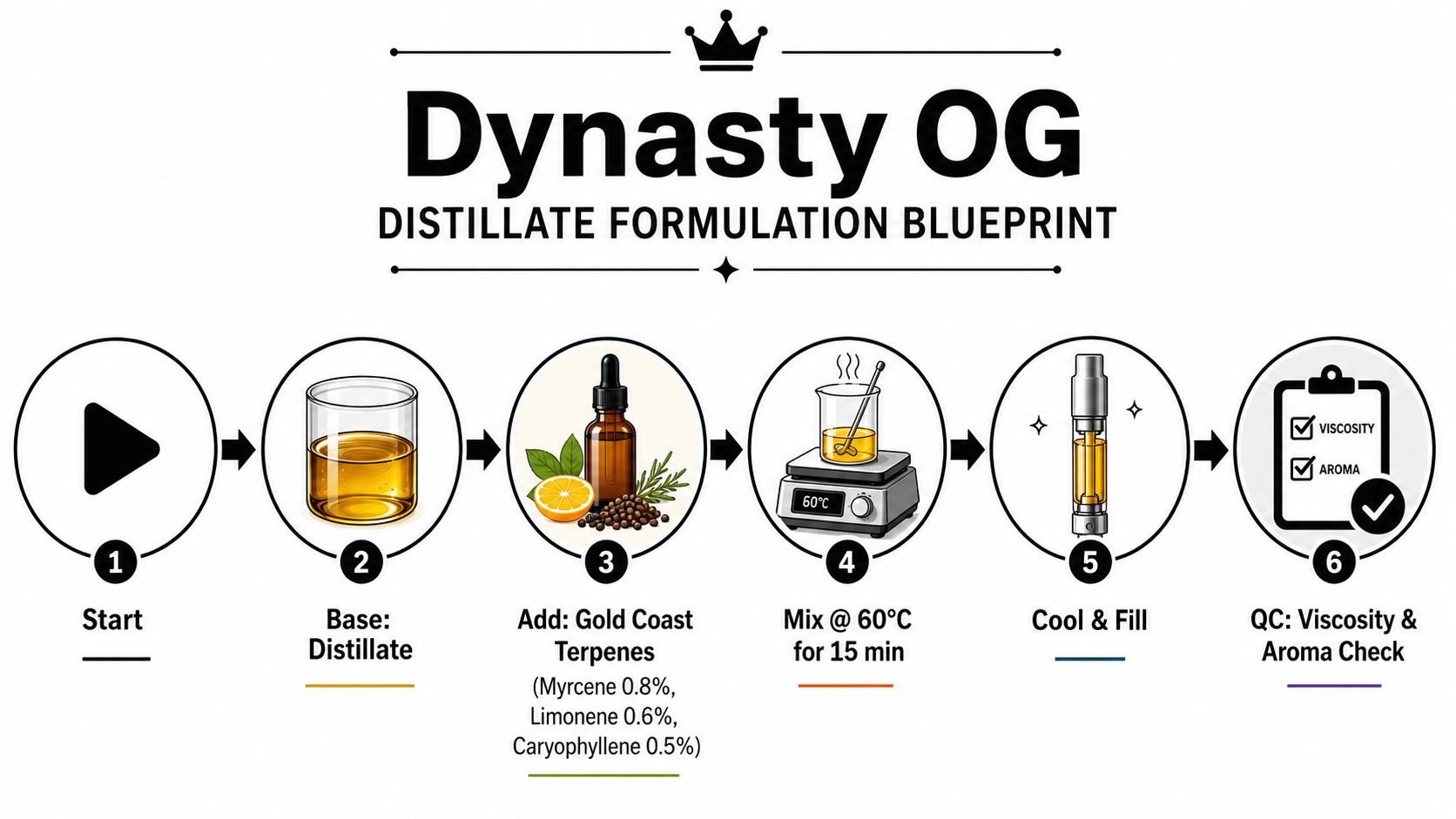
Start with your distillate and confirm that the oil is fully homogenized before adding terpenes. Then introduce the profile in a stepped way. A useful test matrix is to begin with a base of myrcene 0.8%, limonene 0.6%, and beta-caryophyllene 0.5%, then adjust after sensory review and fill tests.
That approach is useful because it mirrors the role order in the aroma. Myrcene keeps the base grounded, limonene gives the opening lift, and beta-caryophyllene prevents the blend from becoming too bright. If your first pass smells too citrus-heavy, reduce the limonene fraction before touching the base notes.
Mixing temperature matters. Hold the blend at 60°C for 15 min for initial homogenization, then cool before filling. That keeps the oil mobile without overexposing the more volatile top notes to unnecessary heat. A cleaner process also makes it easier to judge whether the issue is formulation or processing.
One option in the terpene supply chain is Gold Coast Terpenes, which offers strain-specific profiles and isolated compounds that can be used for cartridge development. In this context, the value is practical, not promotional, because a formulation team can compare a strain-specific blend against single isolates and decide which route gives the better sensory match.
QC checkpoints that matter
- Viscosity check: confirm the oil still flows cleanly after blending and cool-down.
- Aroma check: smell the bulk blend before fill, not just the finished cart.
- Batch notes: record exact terpene ratios, temperature, and dwell time.
- Third-party testing: verify terpene content and cannabinoid profile on every serious production run.
For process discipline, the SC Lab-tested and THC-free terpene standard is a strong baseline, especially when you want to avoid VG, PG, PEG, and MCT in clean cartridge systems. Those exclusions keep the formulation simpler and reduce avoidable variables at the fill stage.
Common Formulation Mistakes That Flatten the OG Profile
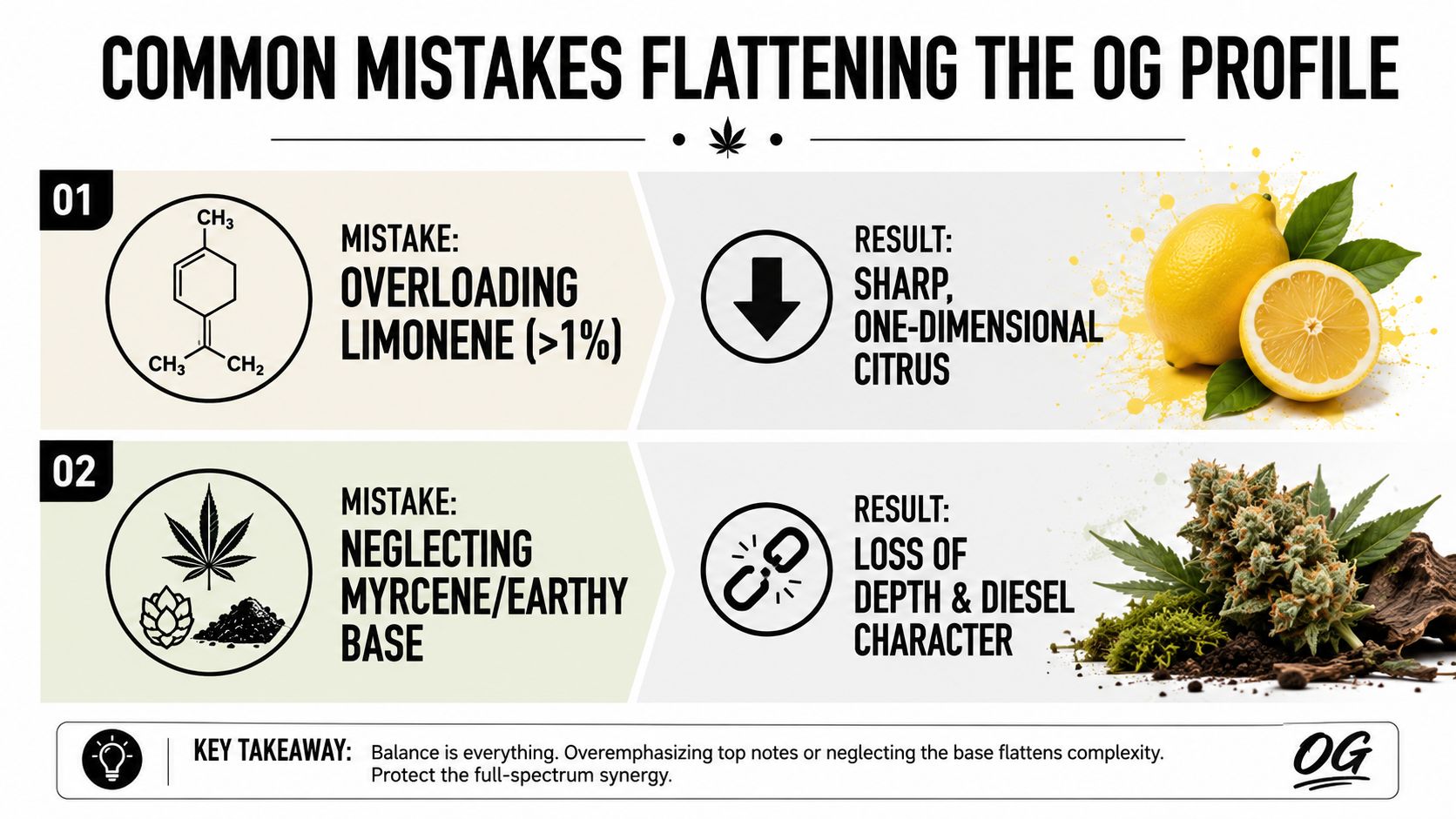
The fastest way to ruin a Dynasty OG-inspired cart is to chase the lemon note too hard. Limonene is useful, but once it gets pushed too far, the profile stops reading as OG and starts reading like a generic citrus SKU. The product may still smell bright, but it loses the diesel-earth depth that makes the strain recognizable.
The two failures that show up most often
Mistake 1, overloading limonene above 1%. The result is a sharp, one-dimensional citrus line that burns off fast and leaves little structure behind. The fix is simple, reduce the top-note load and let beta-caryophyllene and myrcene reassert themselves.
Mistake 2, neglecting the earthy base. When myrcene is too low, the cart loses depth and the finish turns thin. That's when the product starts smelling like lemon candy instead of an OG hybrid.
Another common issue is heat abuse during blending. If the mix is held too hot for too long, volatile top notes can fade before fill, and the aroma on paper doesn't match the aroma in the cartridge. That mismatch creates false confidence in pilot batches and usually leads to a disappointing retail run.
If the bench sample smells right but the cart doesn't, suspect process first, not the flavor system.
The cleanest way to troubleshoot is to compare the bulk blend against the filled cart after cooling. If citrus drops off, the top-note load or heat exposure is probably too aggressive. If the cart feels muddy, the base may be overweighted or the terpene system may need more separation between citrus and spice.
A Dynasty OG cart should never feel crowded. The profile works because the notes are distinct, then integrated. When everything hits at once, the strain identity disappears.
Your Dynasty OG Formulation Checklist and Next Steps
A stable Dynasty OG blueprint is easier to manage when the team treats it as a sequence, not a flavor guess. The profile should open with limonene, carry a dry spicy center from beta-caryophyllene, and settle into a grounded myrcene base. Keep the working target in the lab-tested OG-family range, with total terpenes around 1.5% to 3.0%, limonene at 5–8 mg/g, beta-caryophyllene at 3–6 mg/g, and myrcene at 2–5 mg/g.
Use that as a production checklist, not a marketing description. If the aroma reads too bright, the limonene layer is probably overweighted. If the finish feels hollow, the base note is too weak. If the cart smells correct but fills poorly, check viscosity and temperature before changing the recipe.
A strong development workflow usually looks like this.
- Confirm the oil base: verify distillate potency and consistency before terpene addition.
- Build in layers: base notes first, then mid notes, then top notes.
- Track every pilot batch: keep exact ratios, dwell time, and fill temperature.
- Test the finished cartridge: judge aroma after cool-down, not only at the bench.
- Compare against reference profiles: use an OG-family benchmark when the cut varies.
For scale-up, keep the same logic across pilot, bench, and production fills. The recipe should not change every time the tank size changes. What should change is confidence in the measurements, because larger runs expose small errors faster than pilot batches do.
If you need a practical starting point for strain-specific development, the Gold Coast Terpenes library includes terpene guides, strain profiles, and formulation tools that can help translate a sensory target into a repeatable cart spec. Use those resources alongside your own COAs, then lock the final blend only after aroma, viscosity, and fill behavior all agree.
If you are building a Dynasty OG cart, compare the current oil against a lab-checked OG target and tighten the recipe around the citrus, spice, and earth layers that survive production. Visit Gold Coast Terpenes to review strain-specific profiles, isolates, and formulation resources that can support the next pilot run.