
Most advice treats liquid THC like a single ingredient with a simple job. That's the wrong starting point for formulators. Liquid THC is a formulation class, and once you stop treating tinctures, vape oils, nano-emulsions, and concentrated extracts as the same thing, the work becomes obvious, carrier choice, viscosity control, terpene integration, and dose consistency all decide whether a SKU performs or fails.
The market also pushed this category in a very specific direction. THC products have trended toward higher potency over time, and public-health sources show why that matters. NIDA reports seized U.S. cannabis rose from 3.96% THC in 1995 to 16.14% in 2022, and dispensary flower and concentrates can exceed 40% THC (NIDA cannabis overview). That's the environment liquid THC grew up in, a market where concentration, portability, and repeatable delivery matter as much as flavor.
Liquid THC Is a Formulation Class Not a Single Product
The biggest mistake in product development is calling everything “liquid THC” and assuming the same rules apply. They don't. A tincture, a vape oil, a nano-emulsified beverage, and a concentrated extract can all be liquid, but they behave differently in the tank, on the tongue, and on the lab bench.
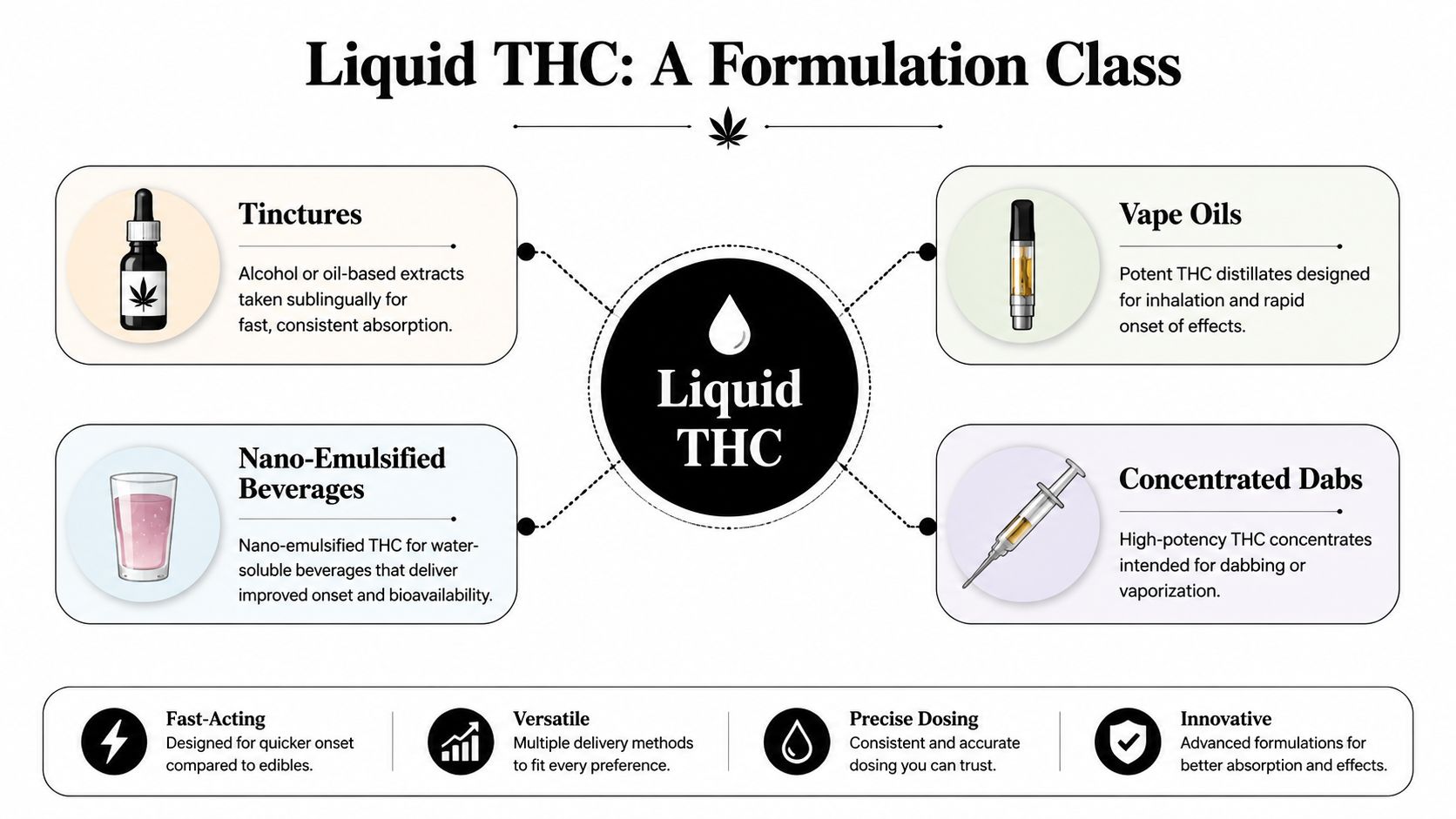
The carrier defines the product
A liquid THC formula starts with the carrier, not the label. If the active is dissolved in oil, ethanol, propylene glycol, or a blended system, you're already making different decisions about mouthfeel, wicking, stability, and terpene compatibility. WHO's extracts-and-tinctures guidance notes that vape-liquid style formulations commonly use cannabis extract plus propylene glycol, which is a good reminder that the same cannabinoid can be packaged for very different delivery routes (WHO extracts and tinctures PDF).
That distinction matters because a one-size-fits-all terpene strategy usually fails. What works in a dropper bottle may clog a cartridge, and what sprays cleanly in a beverage system may be useless in a high-viscosity cart oil. A formulation team that collapses those formats into one bucket ends up with inconsistent dosing and avoidable complaints.
Practical rule: decide the delivery route first, then choose the carrier, then build the terpene system around that base.
For a more technical baseline on distillate as a starting material, see the internal resource on distillate basics.
Why the category gets mislabeled
Consumers and even some suppliers use “liquid THC” as a catch-all. That shorthand hides very different risk profiles, because inhaled products, oral products, and emulsified beverages don't behave the same way during manufacturing or use. One form may demand heat control, another may demand emulsifier stability, and a third may demand careful solvent balance.
That's why a formulators' definition is more useful than a retail definition. Liquid THC is best understood as THC presented in a fluid system designed for a specific delivery path, not as a single ingredient class. Once you define it that way, formulation errors get easier to spot before they become batch failures.
Major Liquid THC Forms and Their Extraction Origins
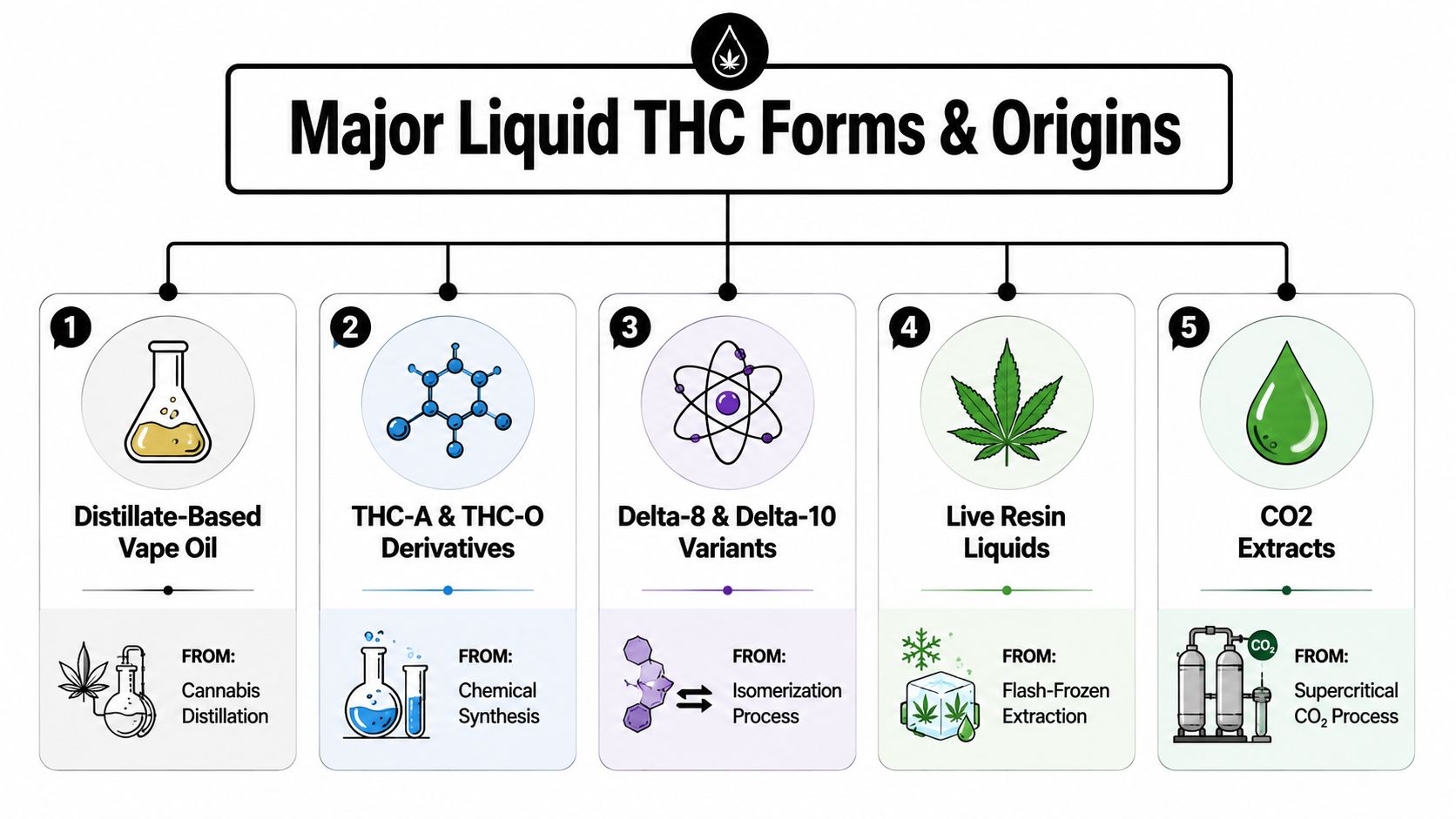
Formulation teams working on cartridge SKUs typically encounter a small set of liquid THC bases, and the origin of each base matters as much as the cannabinoid label. Distillate-based vape oil is the easiest to standardize because it gives a predictable starting point. THC-A and THC-O derivatives, delta-8 and delta-10 variants, live resin liquids, and CO2 extracts all come from different upstream processes, so they do not behave the same way once carriers or terpenes enter the blend.
Distillate and resin-led formats
Distillate is the default for cartridge work because it gives manufacturers a more predictable base. For teams that want a neutral canvas for flavor replication, it is the most straightforward starting point, especially when the target is a clean strain-inspired profile instead of a loud botanical signature. For a practical contrast between resin-heavy inputs and more refined bases, the internal guide on resin versus rosin is useful.
Live resin liquids present a different set of trade-offs. They hold more of the plant's original aromatic character, so terpene design often shifts from reconstruction toward restraint. That does not make the work easier. It changes the problem from building character into the base to preserving what is already there without muddying it.
Derivatives and emulsified systems
THC-A and THC-O derivatives raise separate heat-management questions, because the formulation has to respect the conversion behavior or stability profile of the active. Delta-8 and delta-10 variants often enter a product line through isomerized inputs, which makes purity and batch consistency important before blending starts. None of these formats should be treated as a simple flavor carrier.
Nano-emulsified beverages sit in a different class again. Harvard notes that cannabis beverages use cannabinoids formulated to dissolve in liquid and are absorbed differently than other forms, which is why the stabilizer system matters as much as the taste layer (Harvard Health on cannabis drinks). If the emulsion is unstable, the formula fails long before the consumer notices the flavor.
Choosing the right origin for the SKU
The formulation origin should match the commercial job. Cartridge SKUs usually favor distillate or other concentrated oil bases. Beverage SKUs usually need emulsified inputs. Tincture lines usually live or die on carrier feel and taste neutrality. If the upstream process does not match the downstream hardware, the formula starts with a disadvantage.
The cleanest decision-making question is direct. What form will the customer consume, and what physical system can carry THC there without distorting the intended sensory profile? Once that is clear, the extraction conversation becomes more practical and the formulation path gets easier to define.
Carrier Selection and Viscosity Management for Liquid THC
Liquid THC formulation is mostly a carrier chemistry problem. THC is nonpolar, so it plays well with organic solvents and poorly with water, which is why oil-based tinctures, vape liquids, and emulsified drinks all start with different solubility assumptions. A technical cannabinoid table lists THC with molecular formula C21H30O2, molecular weight about 314.2 g/mol, and boiling point around 157°C, which helps explain why formulators keep reaching for oil or alcohol systems rather than water alone (technical extraction data).
Common carrier systems
Different carriers solve different problems. MCT oil gives a familiar oral delivery base. Propylene glycol helps thinning and wicking in some vapor applications. Vegetable glycerin brings thickness and vapor character but can complicate cartridge flow. Ethanol is useful where rapid dissolution matters. PEG shows up in some legacy systems, but many formulators avoid it when cleaner label positioning is a priority.
The goal isn't to pick the most popular carrier, it's to choose the one that matches the target hardware and sensory outcome. If the liquid is too thick, cartridges starve and burn. If it's too thin, leakage and flooding become more likely. If the solvent system fights the terpene load, separation or haze follows.
| Carrier | Viscosity Profile | THC Solubility | Best Use Case |
|---|---|---|---|
| MCT Oil | Medium to heavier | Good in oil systems | Oral tinctures and some non-cartridge products |
| Propylene Glycol | Light | Good for certain vapor blends | Thinning cartridge oils and some e-liquid style systems |
| Vegetable Glycerin | Heavy | Limited without support | Vaping systems that can handle thicker fluid |
| Ethanol | Light | Strong solvent behavior | Tinctures and certain extraction-based formulas |
| PEG | Light to medium | Useful in some blends | Legacy vapor formulations where allowed |
Managing flow without wrecking the blend
For cartridges, viscosity has to match the hardware, not just the recipe. A well-made oil can still fail if the wick can't keep up, or if the terpene phase shifts the fluid beyond the cartridge's comfort zone. That's why thinning a formula is never just about adding more diluent, it's about preserving flow while keeping flavor and potency intact.
Avoid forcing a high-load concentrate into a system that was designed for a lower-viscosity oil. The more concentrated the liquid, the more likely you are to face crystallization, unstable flow, or poor atomization if the carrier system isn't built for it. For a practical walkthrough on thinning distillate for cartridges, the internal guide on how to thin distillate for cartridges is directly relevant.
Practical rule: if the liquid looks perfect in a beaker but fails in hardware, the problem is usually viscosity, not potency.
Integrating Terpene Blends into Liquid THC Formulations
Terpenes do more than make a formula smell right. In liquid THC, they can act as natural diluents, influence viscosity, and shape whether the final product feels strain-inspired or generic. They also help separate a usable cartridge profile from a bland, one-note oil.
Build the profile around top, mid, and base notes
A good terpene system behaves like a fragrance pyramid. Top notes give the first impression, usually the sharpest and most volatile aromas. Mid notes carry the recognizable body of the blend. Base notes anchor the profile and keep it from disappearing too quickly. In a distillate base, that balance usually needs more reconstruction because the starting oil is neutral. In a live resin base, the base already contributes character, so the terpene load should support rather than fight it.
Strain-inspired terpene blends become commercially useful here. They let a brand reproduce a recognizable sensory identity without relying on the plant material itself. For developers working on flavor accuracy and cartridge performance, the internal guide on how to use terpenes is a practical reference.
Why verification matters
Compliance and consistency depend on using terpene inputs you can document. Gold Coast Terpenes offers lab-verified, THC-free terpene blends that are formulated without VG, PG, PEG, or MCT, which makes them easier to position in clean-formula development work when those carriers are unwanted in the terpene input itself. That matters because the terpene layer should support the liquid THC system, not introduce new unknowns.
Use the terpene percentage as a formulation decision, not an afterthought. Too little and the flavor disappears under the oil. Too much and the blend can become overly thin, unstable, or hard on hardware. The right level depends on the base, the cartridge, and the intended flavor intensity.
What actually works in production
Keep the blend focused. One or two dominant top notes, a clear mid-note bridge, and a restrained base often outperform a crowded aroma stack. Overbuilt profiles can smell impressive in the lab and flatten in use. Underbuilt profiles feel vague and get lost in the oil.
If you're building for strain replication, start with sensory accuracy before chasing novelty. If you're building for product differentiation, start with stability and repeatability before chasing a louder aroma. Terpenes should make the SKU more usable, not just more aromatic.
Comparing Liquid THC Formats Across Dosing and Onset
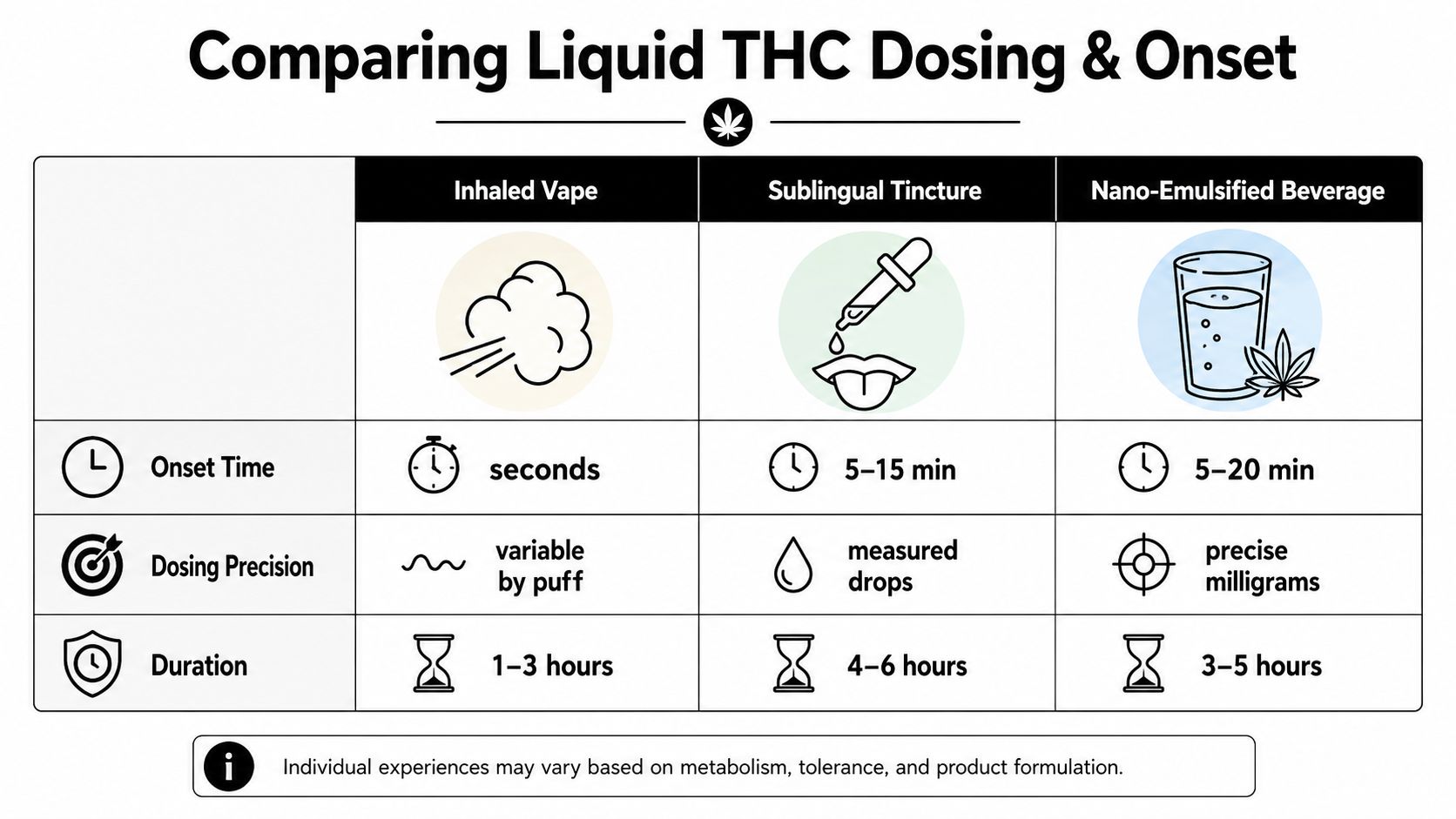
Liquid THC is not a single delivery type. Vape liquids, sublingual tinctures, and nano-emulsified beverages each move cannabinoids through a different carrier system, which changes onset, dose control, and how hard the product is to manufacture. The formulation choice matters as much as the market position, because a format that looks simple on a shelf may be demanding in the filling room.
Vape, tincture, and beverage behave differently
Vape liquids act quickly because the product is inhaled. That speed makes them attractive for rapid-use positioning, but the dose is tied to hardware behavior, puff size, and user technique, so output is never identical from one person to the next. Tinctures are more controlled because the dose is measured, which is why brands use them when they want clear milligram logic in a dropper format. Beverages are the most complex of the three because they depend on emulsification, package integrity, and a serving model that stays consistent over time.
The formulation guidance in the WHO extracts and tinctures PDF shows how concentrated a vape-liquid system can become. In that example, if BHO contains about 80% Δ9-THC and the mixture is BHO:PG at 1:3 by weight, a single 5 mg puff of e-liquid can deliver up to about 1.3 mg Δ9-THC. That is a formulation example, not a consumer promise, and it shows how strongly delivery depends on the carrier system.
What product developers should optimize for
Vape liquids fit when hardware speed and aromatic impact matter most. Tinctures fit when controlled administration and simpler manufacturing are the priority. Beverages fit when the brand wants a familiar drink format and can support emulsification, packaging discipline, and shelf-stability work.
For beverage positioning, Harvard Health notes that research studies often use 5 mg THC, that low-dose beverages can contain 2-4 mg per 8-ounce serving, and that some products contain as much as 200 mg THC. Poison Control notes the same spread in plain manufacturing terms, since some products marketed as low-dose contain 2-4 mg THC per 8-ounce container, while others can contain 100-200 mg THC in an 8.5-ounce bottle (Harvard Health on cannabis drinks, Poison Control on cannabis drinks). The range is the point. Products can look similar while actual exposure differs sharply.
Practical rule: if the serving format hides the dose, the product line needs tighter formulation control, not louder branding.
Testing Labeling and Compliance for Liquid THC Products
Liquid THC products fail fastest when the label promises something the batch can't repeat. That's a formulation problem as much as a compliance problem, because potency, carrier behavior, and serving format all influence the final claim. Products that look standardized on paper can still vary meaningfully in actual THC exposure if the system isn't controlled.
Build the lab workflow first
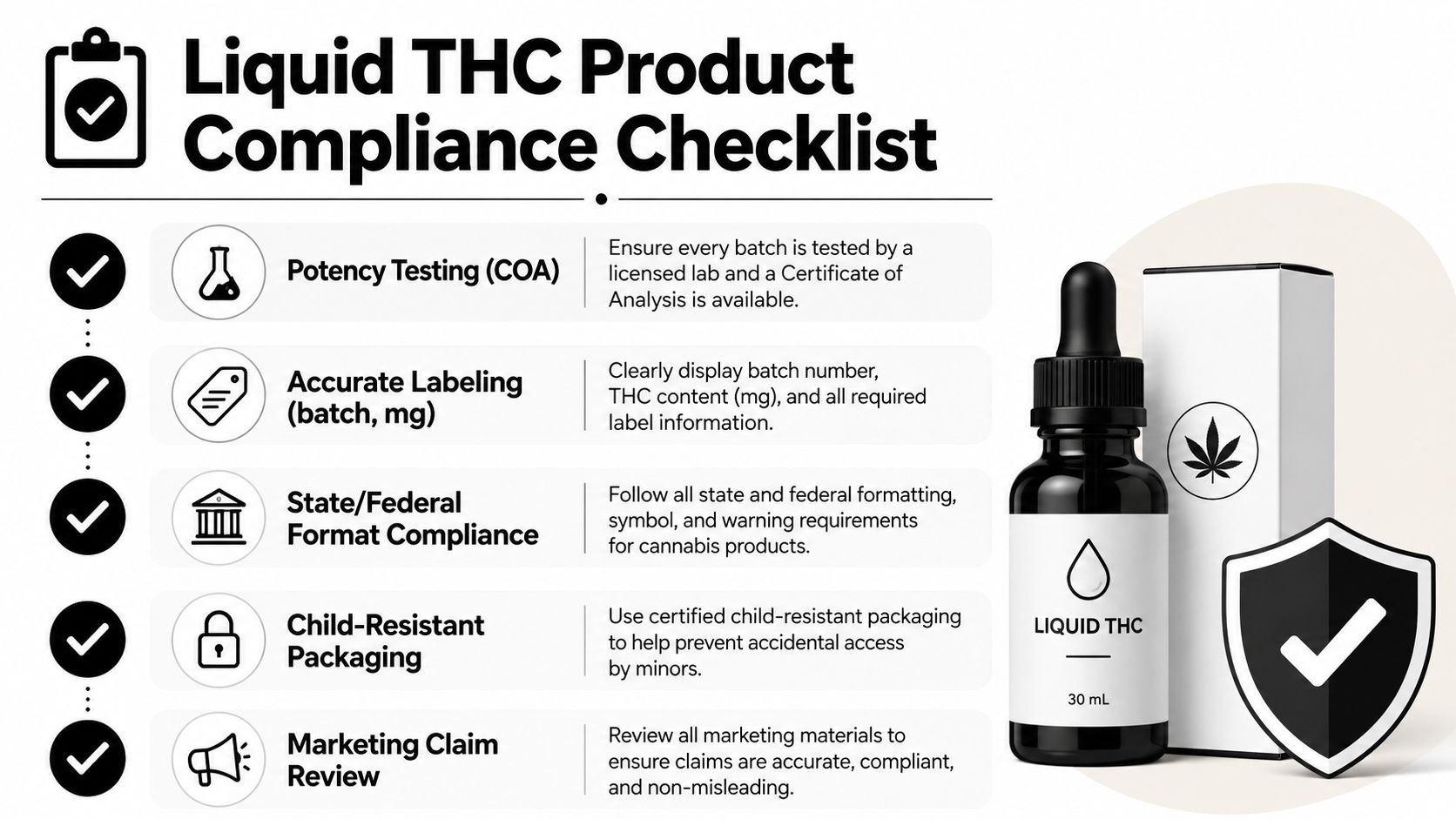
Every liquid THC SKU should have a clear testing path for potency testing, residual solvent screening, and final label verification. The point isn't just to satisfy regulators. It's to make sure the blend that leaves the filling line is the same blend the buyer can reorder next month. Without that, formulation work gets expensive fast.
Use certificates of analysis as operational documents, not marketing props. Wholesale buyers care about whether the numbers match the lot they're receiving, and regulators care about whether the product claims are defensible. If the lab report and the finished package don't line up, trust drops immediately.
Label for the format, not just the content
A liquid THC label should tell the buyer exactly what system they're looking at. A tincture, vape oil, and beverage are not interchangeable just because they share the same cannabinoid. Batch number, milligram declaration, and format-specific compliance language all help prevent confusion when the same brand sells across channels.
The strongest labeling practice is simple. State the product format clearly, declare the potency in a way that matches the serving logic, and keep the packaging aligned with the actual delivery route. That matters even more when the same company sells both low-dose and high-load SKUs.
Where most brands get tripped up
The common failure isn't a missing logo or awkward flavor name. It's inconsistent internal standards. One batch is blended for easy filling, the next is blended for a different hardware platform, and the label doesn't tell that story. That's how returns and rework start.
For teams that need a stable terpene input alongside the rest of the workflow, a documented supply chain helps. The formulation tools and terpene documentation available through Gold Coast Terpenes can fit into that kind of record-keeping without changing the basic compliance logic. Advantage is not flash, it's repeatability.
Building a Liquid THC Product Line with Formulation Precision
The brands that do well in liquid THC treat it like a precision discipline. They start with the delivery route, choose the carrier for the hardware, tune viscosity, and only then layer in terpene design and testing. That sequence sounds basic, but most product failures happen when teams reverse it and try to flavor their way out of a structural problem.
Sequence the work in the right order
Start with the base system. If the SKU is for a cartridge, decide what viscosity the hardware can support. If it's a tincture, decide what oral feel and flavor neutrality the brand wants. If it's a beverage, choose the emulsion model before anyone starts talking about final flavor notes.
Then build the terpene profile around the base. Use top, mid, and base notes deliberately, because each note family behaves differently once it's in distillate, live resin, or an emulsified matrix. What sounds balanced in a sample vial can change once heat, pressure, or suspension chemistry enters the picture.
Use tools that reduce variation
A good mixing calculator, a repeatable sourcing plan, and lab-verified terpene inputs do more for product quality than improvisation ever will. Gold Coast Terpenes offers strain-specific profiles, isolated compounds, and a mixing calculator that can support that workflow when you're dialing in cartridge, concentrate, or product-formulation work. That kind of tooling matters because repeatability is what lets a brand expand beyond one-off batches.
You also need a ruthless definition of acceptable variation. If the formula drifts, the flavor shifts, and the hardware response changes, the SKU loses its identity. Precision in liquid THC isn't a luxury, it's the difference between a product line and a pile of near-matches.
Build for scale, not just pilot success
Pilot batches can hide problems. Production batches expose them. That's why the best development teams document carrier ratios, terpene load, fill temperature, and testing checkpoints before they scale. Once those variables are locked, the line becomes easier to defend and easier to expand.
Liquid THC will keep moving toward more specialized formats, not fewer. Brands that win will be the ones that respect the chemistry, respect the hardware, and build each SKU as a reproducible system rather than a guess.
If you're developing vape cartridges, tinctures, or beverage SKUs and need terpene inputs that support flavor accuracy and repeatable formulation, explore the strain-specific profiles, isolated compounds, and mixing tools at Gold Coast Terpenes. Their lab-verified terpene options are built for formulation work where consistency matters.