
Most Gelato Mint advice starts with the wrong question. It asks which plant is the “real” one, then treats the answer like a genetics puzzle. In formulation work, that mindset wastes time, because the commercial target is the mint-forward dessert profile, not a single romanticized cut.
That matters for carts and distillate more than for flower. The label Gelato Mint gets used across multiple crosses and phenotype sets, and the public descriptions don't agree on structure or potency. For a formulator, that ambiguity is useful. It means you can build a strain-inspired terpene blend that captures the sensory signature consistently, instead of chasing a moving botanical target.
Why Gelato Mint Is a Formulation Target Not a Single Strain
The biggest mistake brands make is assuming Gelato Mint names one stable cultivar. It doesn't. Public references use the term loosely across related mint-dessert offerings, and the lineage descriptions vary, including Gelato 41 × Kush Mints, Animal Mints × Gelato 41, and It's It × Cookies & Cream. That kind of overlap is exactly why product teams should think in terms of flavor architecture, not plant mythology.
The label is broader than the genotype
The data on potency and structure also cuts in different directions. Seed-market material describes an indica-dominant feminised strain with 28% THC, 9-week indoor flowering, and 550 g/m² yield, while other strain references frame Gelato Mints as more balanced, with THC described anywhere from 19% to 28% depending on source and testing context. One independent source also lists a similar 56 to 63 day finish and 550 to 600 g/m² yield window for a comparable seed-market offering, which reinforces the idea that this is a fast, productive family of mint-leaning dessert chemotypes rather than a single locked genotype. See the documented seed-market record for the faster-finishing, high-potency profile in the Gelato Mint strain cultivation reference.
For formulation, that ambiguity changes the workflow. You're not trying to clone one flower room. You're trying to recreate a recognizable sensory event, a cool mint opening, a creamy mid-palate, and a dessert finish that survives dilution and hardware stress.
Practical rule: If the brand brief says “Gelato Mint,” treat it like a flavor family. Build for the consumer expectation, then tune the batch to match the actual oil base.
That approach is more reliable than overfitting to a single lab report. It also scales better across distillate lots, because the botanical source may shift while the market-facing profile stays the same. The job is consistency, not pedigree purity.
Breaking Down the Gelato Mint Terpene Profile
The usable formulation data points to a multi-terpene profile, not one dominant note doing all the work. In a lab-style breakdown for Gelato Mints, caryophyllene landed at 40.80% of the terpene pool, followed by limonene at 20.85%, humulene at 12.53%, linalool at 11.87%, and myrcene at 4.54%. Another source in the same family also shows pinene in the mix, which matters when you're trying to preserve a fresh opening in vapor.
| Terpene | Approximate % | Sensory Role | Formulation Note |
|---|---|---|---|
| Caryophyllene | 40.80% | Spicy, peppery backbone | Stable anchor for carts and a strong mid-note base |
| Limonene | 20.85% | Bright citrus lift | Volatile top note, handle carefully during heat and fill |
| Humulene | 12.53% | Earthy, woody depth | Supports body and prevents the profile from feeling thin |
| Linalool | 11.87% | Floral, creamy sweetness | Rounds the dessert character and softens sharp edges |
| Myrcene | 4.54% | Herbal, soft earth | Adds fullness and a slightly mellow finish |
The full lab-style terpene layout is worth comparing against a broader flavor reference like Gold Coast Terpenes' terpene flavor chart. I use charts like that as a sanity check, not as a recipe. The chart helps me map sensory intent, then the actual batch work starts with the target oil and the hardware.
Caryophyllene is the anchor because it gives the blend a grounded, slightly peppery body that reads as polished rather than candy-like. Limonene brings the bright edge that makes the profile feel alive on first contact. Humulene and myrcene stop the formula from collapsing into a sharp citrus note, while linalool supplies the creamy softness that people associate with dessert strains.
Caryophyllene carries the blend. Limonene sells the first impression. Linalool makes the finish feel expensive.
That ranking matters in carts. If limonene dominates too early, the profile can feel thin and volatile. If caryophyllene overwhelms the mix, you get a heavy, flat result that loses the mint-dessert identity.
Layering Top Mid and Base Notes for Mint Cream Accuracy
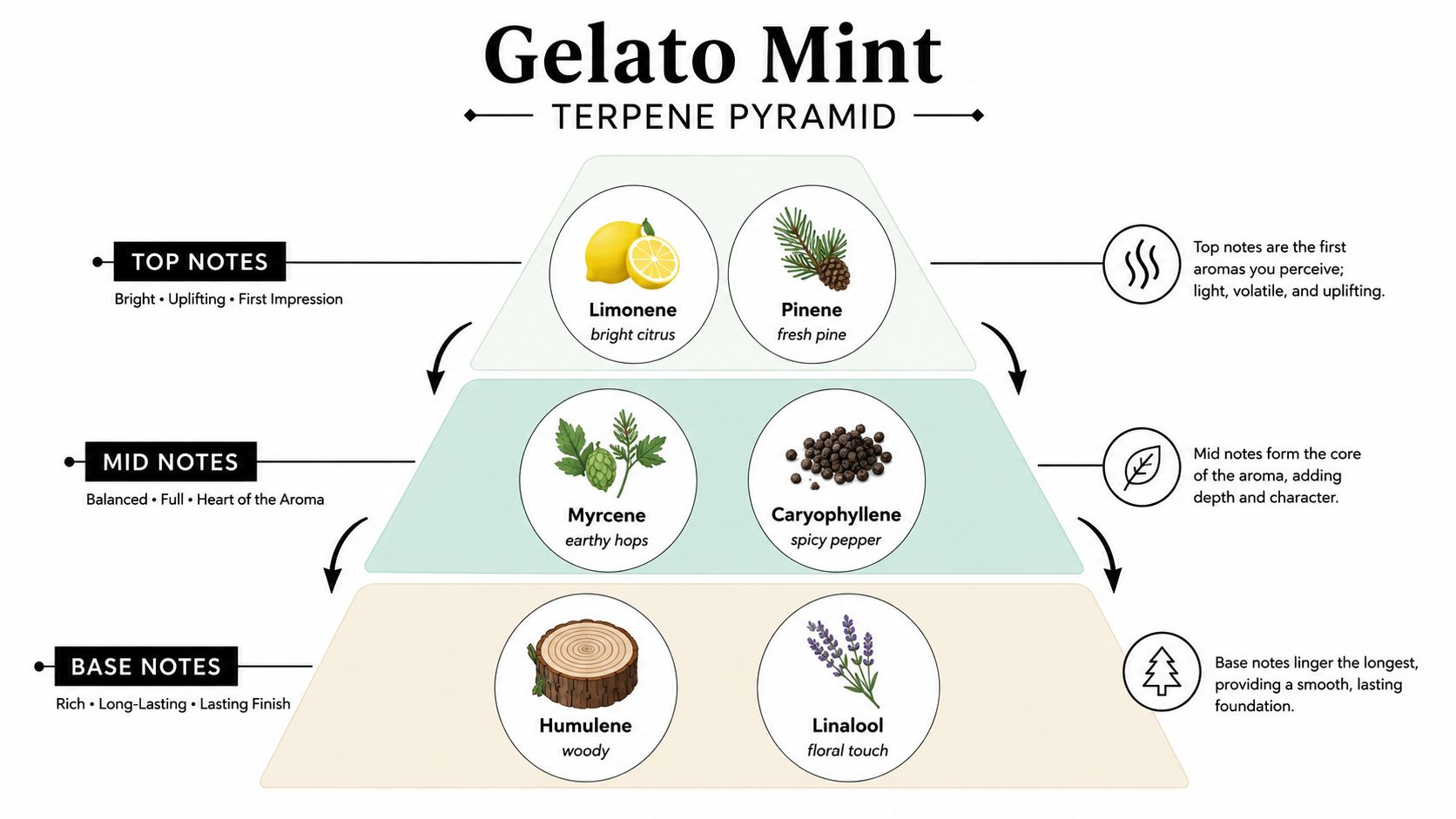
A good Gelato Mint cart is built like a fragrance, not a spreadsheet. The sensory arc needs a top note, a mid note, and a base note, and each layer has a job. If you only match the loudest compounds, the blend feels unfinished.
Top notes should open the cart cleanly
The first inhale should read as fresh and bright, not sugary. That's where limonene and pinene do the heavy lifting. In disposable hardware, the first puff matters more than the last one, so I bias the top layer slightly higher when the brand wants a crisp entry that signals mint before the creamy body arrives.
Mid notes keep it from tasting like candy extract
The middle layer is where caryophyllene and humulene earn their place. They create the spicy-herbal frame that stops the profile from tasting like a generic peppermint oil plus vanilla note. This is also where the blend gains realism, because a dessert strain usually has texture, not just sweetness.
Base notes finish the job
The bottom layer is mostly linalool and myrcene, and that's where the cart gets its rounded, creamy finish. These compounds make the flavor linger in a smoother way, which is why base notes matter more in cartridges than many teams expect. If the base is weak, the formula may taste bright for two pulls and then collapse into a thin citrus spike.
For formulating the note balance, a cartridge that needs immediate impact can tolerate a little more top-note emphasis. A fill where the customer is likely to take repeated draws benefits from a slightly fuller base. That's one reason I don't treat every Gelato Mint brief the same.
A practical blending guide for this note structure works well alongside Gold Coast Terpenes' crafting your signature scent terpene blending guide. The point isn't to copy a recipe. It's to train the nose to separate the bright opening from the creamy finish so you can control each part deliberately.
Mixing Ratios and Dilution Guidelines for Distillate Carts
Distillate is forgiving in one sense and unforgiving in another. It takes added terpenes well, but it also exposes every imbalance in the formula. For a Gelato Mint cart, I usually start with a 7% to 8% terpene ratio in the final oil as a baseline, then adjust by hardware and taste.
Keep the blend inside a workable window
The practical working range is 5% to 12% by volume in the finished oil. Below 5%, the profile often goes flat and loses the layered mint-cream character. Above 12%, harshness becomes a real issue, and some systems start to show separation or an overly aggressive throat feel. Those are not theoretical concerns, they show up on the fill line and in the first consumer complaints.
A simple process keeps the batch controlled.
- Select the terpene set that matches the sensory target, with limonene, pinene, myrcene, caryophyllene, and linalool as the core.
- Pre-blend at low heat, and keep the mixing environment below 50°C so the volatile top notes don't flash off early.
- Combine with distillate slowly, not all at once, so the oil can homogenize without creating hot spots.
- Let the batch rest for 24 to 48 hours before fill, because the aroma rounds out after the components settle.
- Test in the exact hardware you plan to ship, since a blend that sounds right on paper can read very differently in a final cart.
The operational step that gets ignored most often is temperature control. Heat helps viscosity, but it also strips the bright top of the profile. That is why I prefer clean, VG-free, PG-free, and MCT-free terpene formulations when the product brief calls for a cleaner label and a more direct flavor expression.
If your team wants a calculator-driven workflow, Gold Coast Terpenes also publishes a mixing ratios calculator that fits this kind of distillate work. I still recommend small-batch trials before scaling, because calculator output doesn't replace actual sensory checkouts.
For safety, use proper PPE, keep ventilation moving, and don't treat concentrated terpenes casually. The more accurate the blend, the easier it is to overdo it if the handling isn't disciplined.
How the Profile Holds Up Across Extraction and Format Types
Gelato Mint behaves differently depending on what survives the extraction path. Distillate starts from the cleanest slate, so you're rebuilding the whole sensory profile from scratch. That gives you the most control, but it also means the terpene ratios have to do all the work that the native matrix would normally handle.
Distillate needs full reconstitution
With distillate, I treat the blend like a full reconstitution system. The terpene package has to recreate the bright first impression, the spicy body, and the creamy finish without relying on hidden native compounds. That's why a balanced note structure matters so much in this format.
Live resin and sauce need correction, not reconstruction
Live resin and sauce retain more of the original chemistry, so the job shifts. In those oils, I'm usually correcting specific gaps rather than rebuilding the full aroma. Often that means nudging limonene or linalool upward if the batch tastes muted, while leaving the rest of the profile mostly intact.
Heat stress is the other variable that changes the outcome. The brighter compounds, especially limonene and pinene, are the first to fade when the cart runs hot. If hardware overcooks the oil, the blend loses its front-end brightness and what remains is mostly the heavier caryophyllene-humulene base.
That's why hardware selection matters as much as the formula itself. Ceramic coils generally give you more room to preserve the note structure than sloppy high-heat setups, and a moderate voltage setting is safer for terpene fidelity than pushing for maximum vapor density. A cart that feels powerful but tastes dull isn't winning any formulation award.
The broader issue is retention. The mint-forward dessert profile only works if the top notes survive long enough for the customer to notice them. If the system strips them out too fast, the formula stops reading like Gelato Mint and starts tasting like generic spice and earth.
Lab Testing and Quality Control for Batch Consistency
A commercial Gelato Mint blend lives or dies on repeatability. One floral, one citrus-heavy, and one pepper-forward batch can all be sold under the same name if QC is weak, and that's how brands lose trust. The fix is boring, but it works, a strict analytical and sensory standard.
Build the blend around a reference standard
The first thing I keep is a sealed reference sample of the approved blend. That sample becomes the sensory benchmark for every new run, and it keeps the team from drifting when a supplier lot changes. Without a reference standard, everyone ends up arguing from memory.
Test what actually drifts
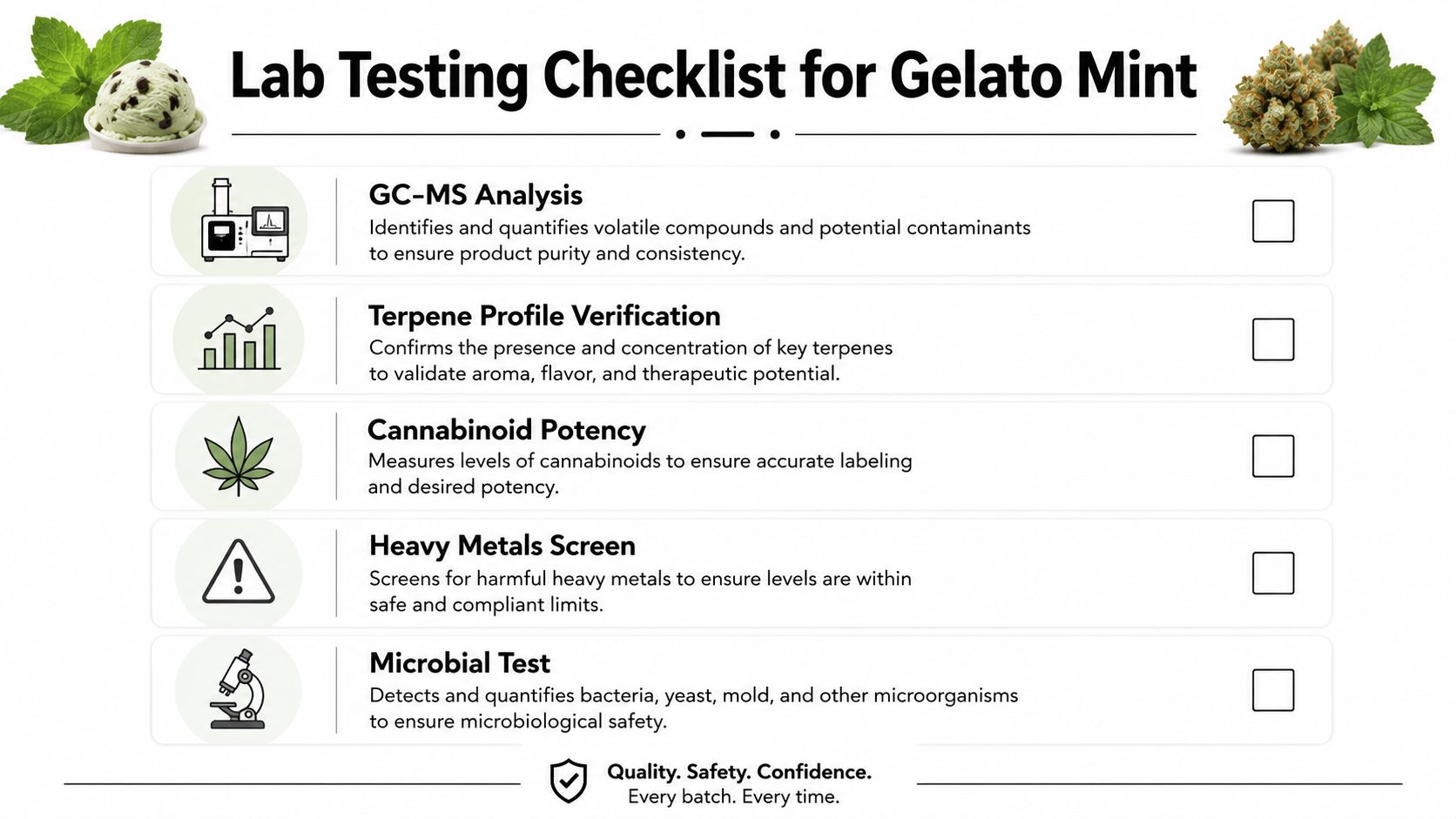
The core lab work should include GC-MS analysis for terpene ratios, residual solvent screening, and heavy metal testing for compliance in regulated markets. Those tests are the difference between a formula that looks consistent on a spreadsheet and one that holds under production pressure. They also protect you from guessing when a batch smells slightly off.
Batch-to-batch variation in botanical terpene sources can shift key compounds by 5% to 15%. That's enough to move a profile from fresh mint cream to woody spice if you aren't watching closely. The risk is highest when teams buy raw material opportunistically instead of locking a verified supply chain.
Storage matters just as much as testing. I prefer amber glass, nitrogen headspace, and refrigeration when the material needs to sit before use. Those choices slow oxidation, especially for volatile compounds like limonene, and they keep the blend closer to the approved target.
A practical QA workflow sits well alongside Gold Coast Terpenes' quality assurance process guide. That kind of documentation helps teams stay aligned on what “on spec” means from lot to lot.
From Prototype to Production with a Gelato Mint Cart Blend
A real Gelato Mint project usually starts with a small prototype, not a perfect formula. The first pass might be an 8% terpene concentration in distillate, tested in the exact cart hardware the brand plans to use. At that stage, I care less about elegance and more about whether the mint opening survives the first few pulls.
The next adjustment is usually ratio work. If the prototype feels too sharp, I pull back limonene and let linalool carry more of the creamy finish. If the cart tastes dull, I do the opposite and restore the bright top without letting the blend get harsh.
Pilot scale is where the formula stops being theoretical. The batch gets expanded to something like a 500mL run, homogenized carefully, and checked under accelerated stability conditions, often 40°C for two weeks, to see how the flavor behaves under stress. That's where weak blends usually reveal themselves.
Production handoff is mostly documentation. The final percentages need to be locked, the temperature window has to be clear, and the filling team needs the viscosity target spelled out. Most blends need two to four rounds of adjustment before flavor, smoothness, and hardware performance all line up.
That's the core lesson with Gelato Mint. It's not a mystery strain to decode, it's a sensory target to engineer. When the blend is built with the right note structure and tested like a production asset, the profile becomes repeatable across batches, formats, and market cycles.
If you're building a Gelato Mint cart, a distillate blend, or a broader mint-dessert SKU, Gold Coast Terpenes can supply strain-inspired profiles and isolated compounds that fit a controlled formulation workflow. Review the options at Gold Coast Terpenes, then match the blend to your hardware, your oil base, and the flavor target you want on the shelf.