
Most guides get water soluble THC wrong from the first sentence. If the product still depends on an oil phase, a carrier powder, or a loose kitchen mix, it's not magically water soluble, it's a dispersion system that may behave better in a drink, or it may separate, haze, and dose unevenly. The job is to engineer particle size, carrier chemistry, and stability so THC can move through water-based products without acting like fat floating in the tank.
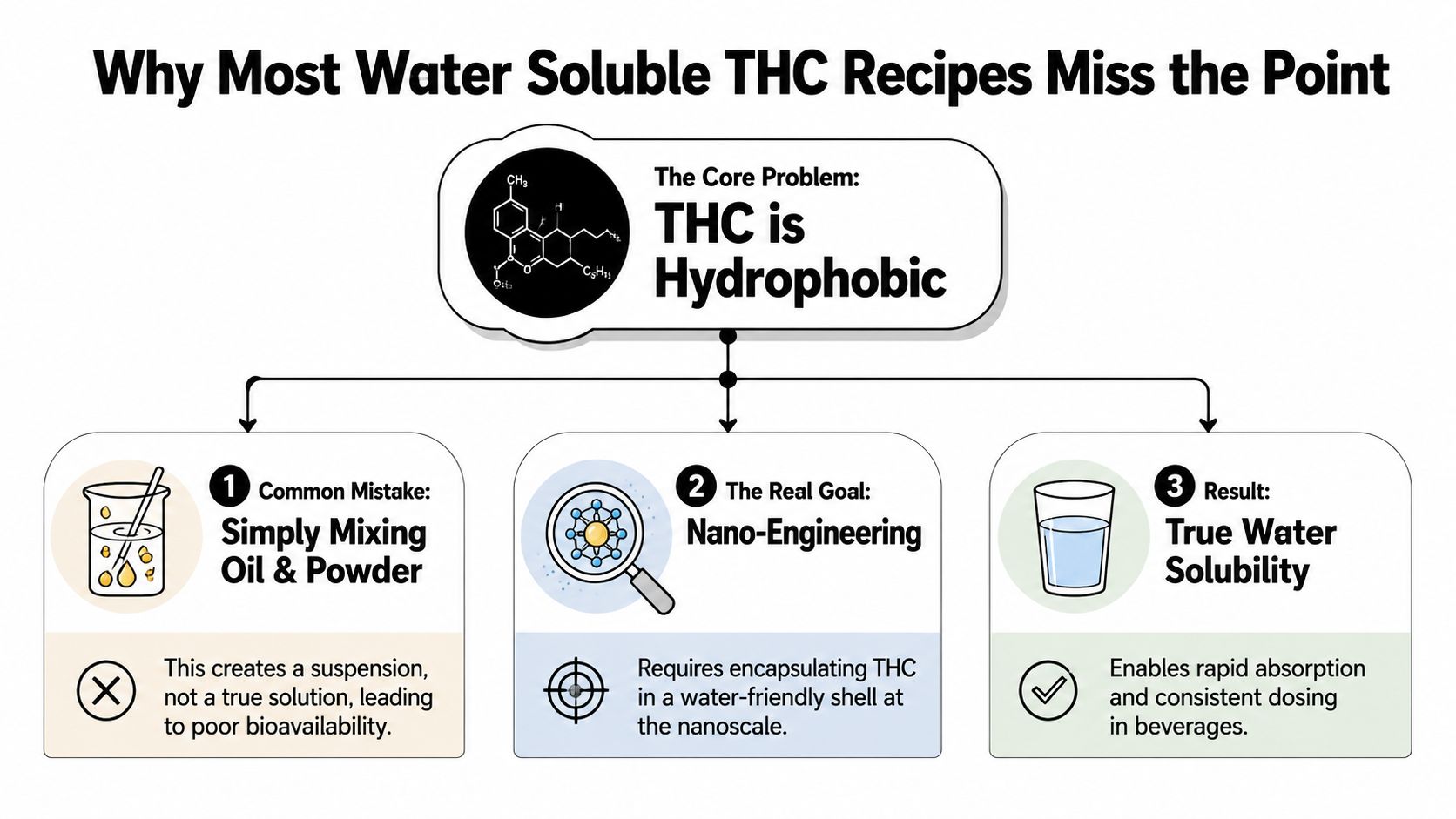
That distinction matters in formulation. True molecular solubility is rare, and the better-known commercial routes are nanoemulsions and carrier-encapsulated powders that disperse well, not kitchen-style mixtures that only look unified for a minute. Independent industry coverage describes nanoemulsions as droplets typically less than 100 nm in the technical version of the process, while broader guidance often describes 20 to 200 nm droplets for commercial products, which is why droplet control is the spec, not the label claim alone. Industry description of nanoemulsion powder development, industry explanation of nanoemulsion droplet range
The myth that keeps showing up in DIY recipes
A powder made with maltodextrin can be useful, but it does not automatically mean the THC has become water soluble. In many home methods, the powder is just a carrier that locks up oil, then disperses when stirred. That's why these products can clump, foam, haze, or separate in a beverage matrix.
A better mental model is simple. The product must either keep THC inside a small, stable droplet system or bind it into a carrier complex that survives drying and reconstitution. Anything less is just a prettier oil delivery format.
Practical rule: if the product needs a hard shake every time, the formulation still isn't doing enough of the work.
Why Most Water Soluble THC Recipes Miss the Point
The popular shortcut is to treat how to make water soluble THC like a kitchen conversion problem. Mix oil with powder, stir, and call it done. That approach confuses a temporary suspension with a formulation that can hold up in a beverage line, a shelf-stable powder, or a standardized finished good.
THC is naturally hydrophobic, so the formulation has to create a structure that water can tolerate. Industry sources describe that structure as a nanoemulsion, a spray-dried powder, or a carrier complex that keeps the active phase small enough, coated enough, or locked up enough to move through water-based systems without separating immediately. Industry description of spray-dried and freeze-dried nanoemulsion powders, technical review of nanoemulsion THC products
What the chemistry is really doing
In practical terms, the process works only when the THC is reduced to nanoscale droplets or associated with a carrier system strongly enough that the water phase no longer rejects it. That is why formulators rely on lecithin, gum arabic, modified starch, surfactants, hydrocolloids, and cyclodextrins. The ingredients aren't decoration, they are the bridge between oil chemistry and water behavior. Industry description of emulsifiers and high-shear or ultrasonic equipment, patent disclosure on carrier, hydrocolloid, and surfactant powder conversion
A peer-reviewed solubilization study also makes the point bluntly. RAMEB was the only tested cyclodextrin that significantly increased THC's aqueous solubility, reaching about 14 mg/mL with a 24% (187 mM) RAMEB solution, a result described as roughly four orders of magnitude higher. That's the kind of number that tells a formulator the chemistry changed, not just the label copy. Cyclodextrin solubilization study
Why kitchen ratios keep failing
DIY recipes often quote maltodextrin-to-oil ratios or small oil-and-lecithin blends, and those ratios can produce a powder-like ingredient. They still don't guarantee real beverage performance. A process can absorb oil into a dry matrix and still leave the end product prone to sediment, uneven mixing, or flavor collapse once it hits acid, sugar, or carbonation.
Practical rule: if the product only looks dry, it isn't finished. It has to redispense cleanly in the target beverage or the batch still isn't ready.
Building a Nanoemulsion from Cannabis Oil or Distillate
The common commercial route starts with cannabis oil or distillate, then turns that input into a dispersed aqueous system. The process stays broadly the same in lab and production work. Pre-mix the cannabinoid phase with an emulsifier, hydrate the water phase, then apply enough shear or sonication to push the droplets into the nanoscale. Technical review of nanoemulsion-based THC products
A formulator still has to decide what the batch is supposed to do. A liquid input for beverages, a concentrate for drying, and a powder that will later be reconstituted all start from the same basic emulsion logic, but the target behavior changes the process details. For a practical beverage reference, this THC drink formulation guide is useful because it shows how the emulsion stage affects the finished drink, not just the tank or beaker.
The equipment does the real work
A stick blender is not the same thing as high-shear homogenization, high-pressure homogenization, or ultrasonic processing. Those systems are used because they break the oil phase into much smaller particles and give the emulsifier time to coat those particles before they rebound and merge. Industry descriptions consistently tie the process to emulsifiers such as lecithin, gum arabic, or modified starch, plus high-energy mixing to keep the droplet size stable. Industry description of nanoemulsion processing
Temperature control matters too. One home method recommends keeping the oil around 80°C to avoid cannabinoid degradation before powder conversion, and that caution matches what many formulation labs see in practice. Heat, shear, and surfactant loading have to work together, or the emulsion creames, breaks, or stays too coarse to behave well in a beverage.
What a useful bench setup looks like
For small batches, a lab can often validate the concept with:
- A controlled oil phase, distillate or decarbed oil with known potency.
- A hydrated water phase, built around the selected emulsifier or stabilizer.
- A high-energy mixer, preferably sonication or a real homogenizer, not a kitchen wand.
- A temperature check, so the batch never drifts into cannabinoid damage territory.
- A size readout, because visual smoothness is not proof.
For production, the same logic holds, but the machine selection changes. High-pressure systems fit better when throughput and repeatability matter, while ultrasonication is often easier to use in pilot work and process development. If you are building beverage-ready formats, that route gives you a stable liquid input before any drying step.
A practical process note
One common formulation mistake is underloading the emulsifier and then trying to compensate with more mixing time. That usually makes the batch more fragile, not more stable. The droplet size target and the emulsifier balance need to be designed together, because the mixing step can only refine a system that is chemically capable of holding together.
Comparing the Four Practical Pathways
There are four ways formulators usually approach water compatible THC systems, and they don't solve the same problem. Liquid nanoemulsion, spray-dried powder, cyclodextrin complexation, and melt-carrier powder all have a place, but they answer different production needs. The right choice depends on whether you're making a beverage input, a dry sachet, or a powder that has to survive shipping and storage.
| Pathway | Droplet / Particle Size | Equipment Intensity | Best Fit For | Key Limitation |
|---|---|---|---|---|
| Liquid nanoemulsion | Typically 20 to 200 nm in industry descriptions, with sub-100 nm often treated as the benchmark | High, because it needs real shear or sonication | Ready-to-drink beverages, dosing trials, pilot runs | Can separate if the formulation is underbuilt or poorly stored |
| Spray-dried nanoemulsion powder | Based on a nanoemulsion feed, then converted to dry powder | High, due to atomization and drying control | Beverage sticks, dry blends, reconstitution formats | Sensitive to carrier design and drying conditions |
| Cyclodextrin complexation | Molecular or quasi-molecular association, not a droplet system | Moderate to high, depending on complexation method | Dry ingredients where true carrier binding matters | Loading capacity and solubility window can be tight |
| Melt-carrier powder | Particle size varies after cooling and grinding | Moderate, but still process-sensitive | Dry powder formats with hydrocolloid systems | Can agglomerate or behave like a fat-based extract if the association is weak |
The simplest commercial truth is that liquid nanoemulsion is usually the most direct route for beverages, while spray drying turns that same liquid into something easier to store and ship. Cyclodextrin systems are the most interesting when the chemistry has to be tighter, especially if the goal is a dry ingredient with a more defined association between cannabinoid and carrier. Patent literature on cannabinoid, polymer, and cyclodextrin water-soluble particles, peer-reviewed RAMEB solubilization data
A clean-looking powder can still fail fast in acid, heat, or storage. The real decision point is whether the product redisperses the same way in the actual beverage matrix you sell into.
For formulating terpene-compatible beverages or distillate systems, a supplier like Gold Coast Terpenes can sit on the flavor side of the workflow while the THC delivery system is built separately. That separation matters, because it lets the cannabinoid system stay focused on stability while the aromatic system is tuned for the finished profile.
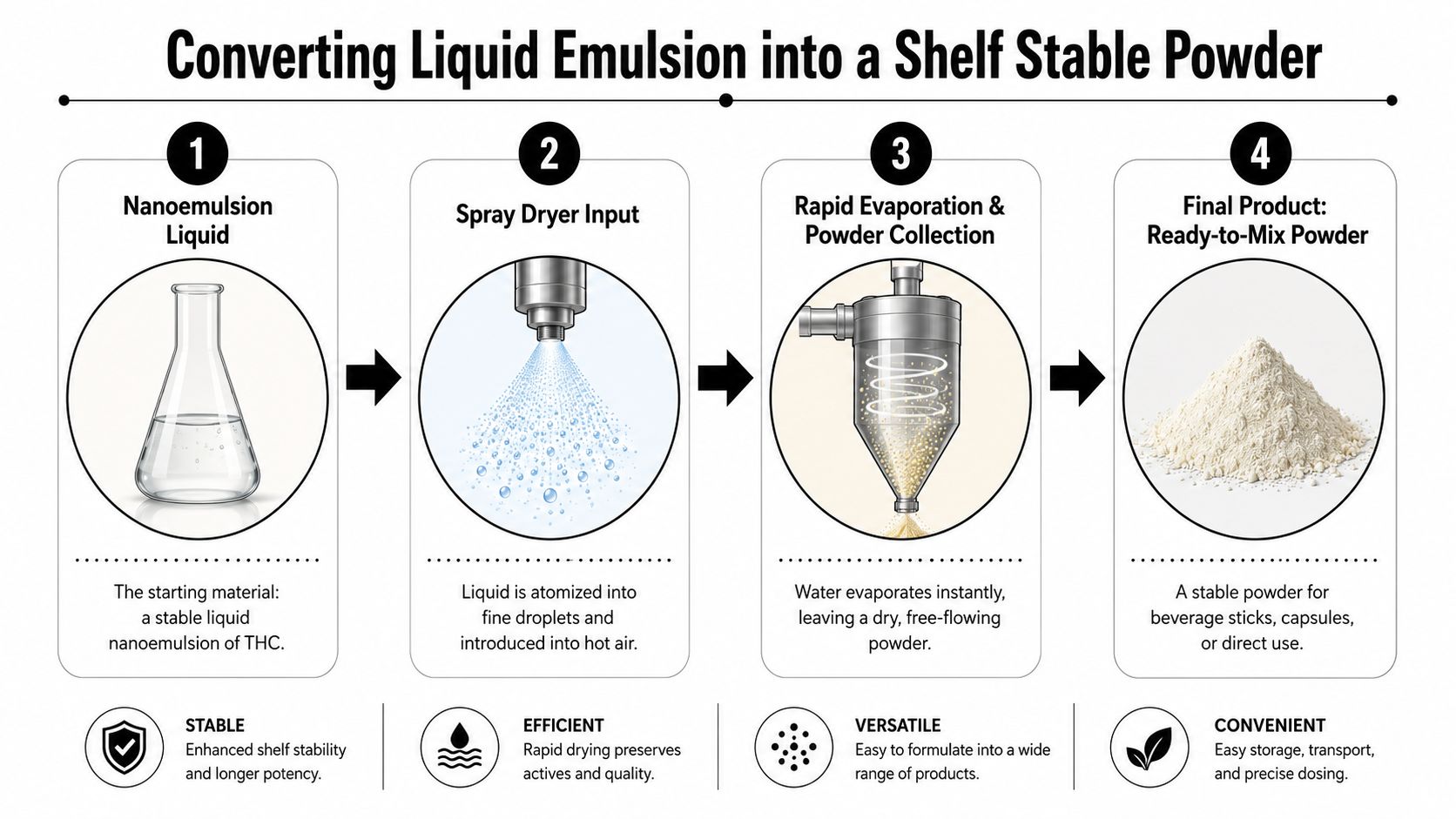
Converting Liquid Emulsion into a Shelf Stable Powder
Once a liquid emulsion is behaving, the next challenge is drying it without wrecking the dispersion. Spray drying is the dominant route because it turns a liquid nanoemulsion into a ready-to-mix powder that can go into beverage sticks, dry sachets, capsules, or reconstituted drink systems. Industry coverage describes this move from liquid emulsion to shelf-stable powder as a key milestone in the field. Industry description of spray-dried and freeze-dried nanoemulsion powders
Carrier design comes first
The carrier matrix usually leans on maltodextrin, modified starch, or a related water-soluble wall material. That matrix has two jobs. It protects the droplets during drying and gives the powder enough body to flow, meter, and reconstitute later. A common DIY-style route uses a 2:1 maltodextrin-to-oil ratio, and published home methods also describe combining about 3 grams of distillate with 15 to 20 grams of coconut oil before absorbing it into roughly 2/3 cup of maltodextrin and lecithin. DIY powdering ratios and gentle heating guidance
That doesn't make the result equivalent to a commercial powder. It just shows the carrier role clearly. Maltodextrin is there to hold the oil, not to change the chemistry of THC itself.
Drying is where many batches break
Spray drying can produce a useful ingredient, but it's sensitive to thermal and mechanical abuse. If the inlet and outlet conditions are too aggressive, cannabinoids can suffer, droplets can collapse, and the resulting powder can become sticky or poorly flowing. The published guidance around gentle heating near 80°C is a useful reminder that thermal history still matters before and during drying. DIY heating guidance
Common failure signs show up quickly on the bench:
- Creaming before drying, which means the emulsion was too weak.
- Phase separation, which usually points to poor emulsifier loading or poor shear.
- Poor powder flow, often caused by excess residual moisture or an overloaded carrier system.
- Agglomeration during storage, which usually means the powder still needs better wall design or humidity control.
Patent literature also describes a different dry route. One disclosure mixes a cannabinoid with a molten composition of water-soluble carrier, hydrocolloid, and surfactant, then cools and grinds the material into powder. That route is valuable when a formulator wants a dry ingredient without relying on a classic spray-dry tower, but it still depends on the cannabinoid being properly associated with the carrier system before solidification. Patent disclosure for water-soluble cannabinoid powder manufacturing
Testing Particle Size, Stability, and Dose Consistency
A batch can look clean on the bench and still fail in the market. Water-soluble THC formulation lives or dies by testing, not by appearance. The release gate should start with droplet size and end with what happens after the product enters the actual beverage matrix you plan to sell into.
The minimum QA stack
A formulation-grade program usually checks four things. First, droplet or particle size, often by dynamic light scattering (DLS), to verify that the emulsion or dispersion sits in the nanoscale range. Second, zeta potential, which gives a read on surface charge and helps predict whether the system is likely to stay colloidally stable. Third, accelerated stability under heat, acid, and freeze-thaw stress. Fourth, re-dispersion behavior, because a powder that rehydrates badly creates production problems fast. If you need a practical reference point for what a release review should cover, the QA checklist at Gold Coast Terpenes' quality control testing resource is a useful place to compare notes.
If the test panel stops at potency, the batch still isn't fully qualified.
What to ask before you buy or scale
Use these questions with a contract lab or supplier:
- Can you verify droplet size by DLS? A number matters more than a visual claim.
- Does the system stay stable in acidic drinks? Beverage compatibility is not optional for RTD products.
- How does it handle storage and humidity? Powders that clump in transit cost money later.
- Is the dosage consistent after reconstitution? Uniformity matters more than initial clarity.
- What happens after freeze-thaw or heat exposure? Shelf behavior can expose a weak emulsion quickly.
Commercial producers care about these checkpoints for a simple reason. Industry material stresses that nanoemulsion systems rely on high-shear, ultrasonic, or spray-drying processes, then need testing for strength and stability before release. DIY recipes usually skip that second half of the workflow, so they can look fine while still failing as a product platform. Industry note on manufacturing and testing emphasis
For formulation work tied to flavor systems, keep the cannabinoid and terpene workflows separate during QA. Test the THC delivery system on its own first, then layer aroma and strain character later without muddying the stability data.
Layering Terpene Blends into the Finished Product
Water compatibility solves the delivery problem, not the flavor problem. A neutral THC dispersion can taste flat, especially in beverage shots or dry-mix products, so the aroma system still needs deliberate design. In practice, the terpene layer should be built after the THC delivery structure is stable, not thrown in early as an afterthought.
Match the terpene job to the format
A top-note terpene brings the first impression, usually bright citrus or fresh lift. A mid-note rounds the body of the profile, often adding herbal or floral depth. A base-note gives the finish and persistence, which matters a lot in powders and ready-to-mix formats that can otherwise taste thin. That's why a strain-inspired terpene blend works better than a single aroma note when you're trying to mimic a recognized profile in a finished product.
For beverage shots, a limonene-forward blend keeps the top note crisp and avoids the muddy flavor that can happen when heavy notes dominate too soon. For ready-to-mix powders, a dessert-leaning tune built around beta-caryophyllene and linalool gives the product a softer finish and a more complete aroma arc. Gold Coast Terpenes offers THC-free, lab-verified terpene profiles and isolates that can be used in this flavor layer without changing the cannabinoid load.
Keep the loading controlled
Terpenes are strong, so the loading window stays tight. In dilute systems, the addition is usually a fraction of a percent by weight, not a free pour. Too much terpene can overpower the profile, destabilize the emulsion, or create a harsh finish that masks the intended flavor.
A practical formulation pass usually looks like this:
- Choose the profile direction: bright, dessert-like, gassy, or herbal.
- Assign the note structure: top for lift, mid for body, base for finish.
- Check compatibility with the matrix: beverage, powder, capsule, or sachet.
- Blend after the THC system is stable: avoid disturbing the emulsion early.
The goal is not to make the terpene layer do the cannabinoid layer's job. It's to give the finished product a recognizable aroma signature while the water-soluble THC system handles dispersion. Terpene blending and usage guidance
Safety, Labeling, and a Release Ready Checklist
A product is only ready when the paperwork, hygiene, and label match the formulation. That starts with checking jurisdiction and legality, then running the batch under GMP-style hygiene practices if shared equipment is involved. It also means labeling the active dose accurately and accounting for processing loss, because a beautiful emulsion with the wrong mg-per-serving declaration is still a bad release.
What belongs on the release checklist
- Legal and compliance review: confirm the product is allowed in the target market and document the basis for that decision.
- Potency accuracy: verify mg-per-serving against the final batch, not the pre-loss starting material.
- Ingredient disclosure: list carriers such as maltodextrin, lecithin, or coconut-derived surfactants when present.
- Allergen and process notes: capture any inputs that matter to downstream buyers or co-packers.
- Packaging and handling: make sure the product stays protected from moisture, heat, and contamination.
One regulatory pass can save a lot of rework. The checklist in this compliance resource is useful if you're trying to line up product development with a real release process instead of a lab-only trial.
A short practical FAQ
Will water-soluble THC behave like an oil-based edible? No. Beverage-style systems generally behave differently because the active phase is dispersed more efficiently in water-based matrices.
Will the powder survive acidic drinks? Some systems will, some won't. Acid compatibility has to be tested in the actual beverage, not assumed from the bench jar.
How should it be stored? Keep finished powder or liquid systems protected from heat, moisture, and repeated opening. If the pack clumps or separates, the storage conditions need a second look.
What about dosing confidence? Release only after potency and dispersion both check out. A consistent label means little if the product doesn't reconstitute the same way every time.
Gold Coast Terpenes supplies strain-specific terpene profiles, isolated terpenes, and formulation-ready blends that fit beverage, concentrate, and cartridge workflows. If you're building a water-soluble THC product and want the flavor layer to stay separate from the delivery system, visit Gold Coast Terpenes to review terpene options, blending resources, and formulation tools for your next run.