
Why do so many affiliates chase easy niches and then wonder why regulated markets punish sloppy content? The answer is simple, the barrier isn't traffic, it's judgment. In terpene and cannabis-adjacent affiliate work, the people who win are the ones who can read a product spec, understand compliance limits, and speak to formulators instead of trying to sell to everyone.
That matters because affiliate marketing is already a mature channel. 81% of brands worldwide now run active affiliate programs, the global average commission rate is 9.2% of sale value in 2026, and recurring commission models have grown 68% in popularity since 2023 (SearchLab statistics on affiliate marketing in 2026). In other words, the channel is crowded, but the terpene space still rewards people who can explain formulation value with precision and stay inside the rules.
For brand owners and formulators, that creates a real opening. A focused affiliate can earn trust by talking about replicating flavor of a strain-inspired blend, matching technical needs for vape cartridges or distillate, and pointing buyers toward the right product pages and formulation resources. The opportunity isn't generic promotion, it's being useful enough that a technical buyer clicks.
The Untapped Potential in Terpene Affiliate Marketing
Most affiliates fail in regulated niches because they write like opportunists instead of operators. They pick a keyword, copy a product feed, and hope the click does the work. In a terpene or cannabis-adjacent category, that approach usually collapses fast because the audience is looking for technical clarity, not hype.
The broader market, though, keeps expanding. One industry roundup places the global affiliate market at just over $20 billion in 2026, with the US alone at $13.81 billion in 2026, up 11.3% from $12.42 billion in 2025 (Post Affiliate Pro industry size roundup). That growth matters because it shows affiliate is no longer a side channel. It's an established revenue system that can support specialized B2B publishing, including terpene formulation content.
Why specialized niches outperform generic ones
The best opportunity isn't “affiliate marketing” in general. It's a narrow lane where product knowledge filters out casual competitors. In terpene work, that filter is real, because the reader wants to know whether a blend is suitable for a target use case, whether the profile feels accurate, and whether the vendor understands formulation constraints.
Practical rule: if the content could be published unchanged on a lifestyle blog, it's probably too generic for this niche.
That's why the terpene angle is stronger than many people assume. The channel already has enough adoption to support a serious ecosystem, but the content surface area is still underdeveloped. A well-written article about affiliate program opportunities in terpene formulation can rank, convert, and stay relevant longer than trend-chasing content in saturated consumer categories.
Read the terpene industry outlook from Gold Coast Terpenes
How to Discover High-Value Terpene Affiliate Programs
The fastest way to find strong programs is not to start with affiliate networks. Start with the companies that already sell to formulators, extractors, and brand owners, because those are the businesses that usually understand the value of a technical audience. Supplier sites, industry forums, and B2B social groups are where the useful programs tend to appear first, sometimes before they're visible on bigger networks.
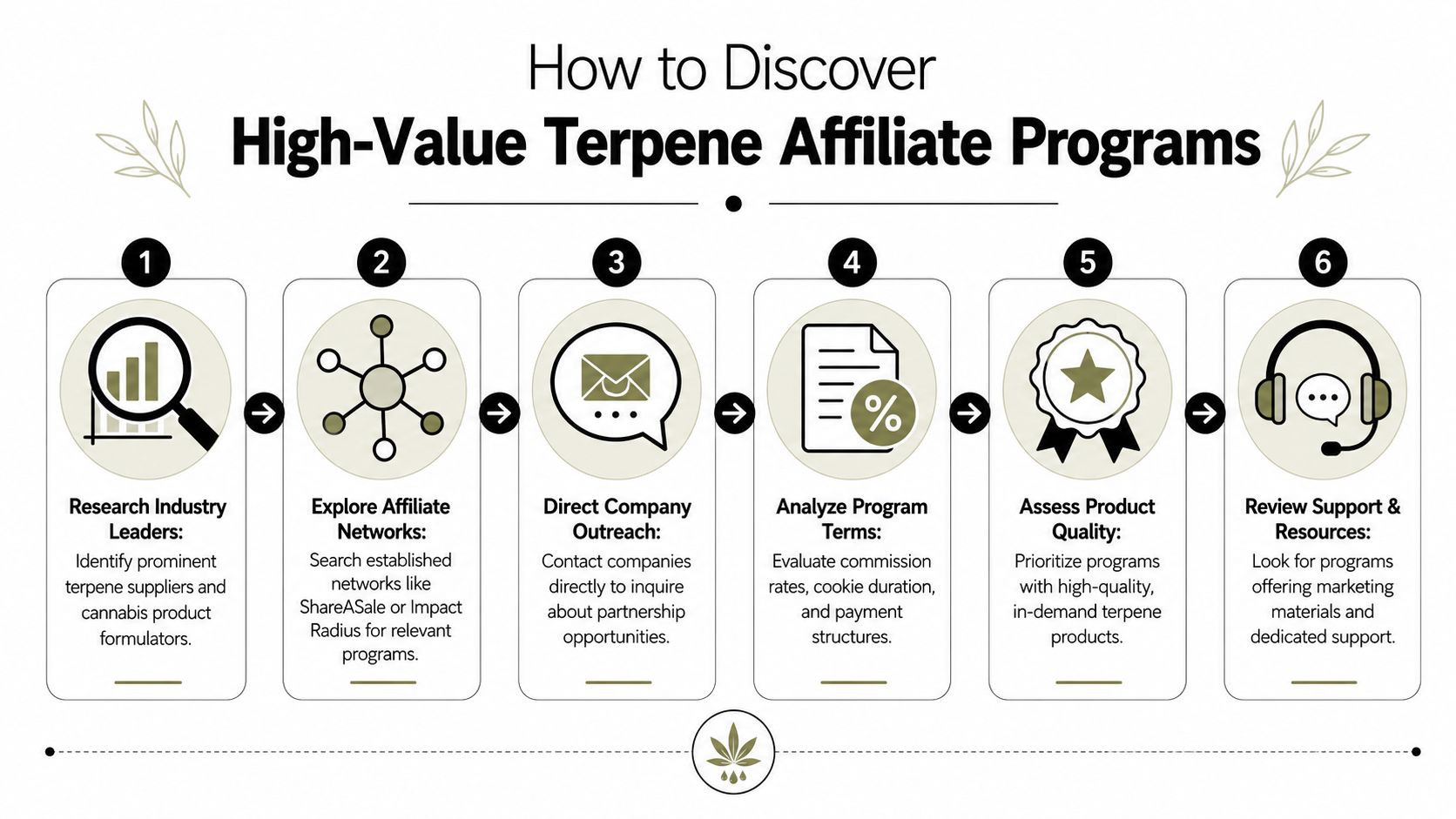
Search where buyers already ask technical questions
Start by looking for companies that publish formulation content, strain-specific terpene guidance, or product education for brands. Those signals tell you the company is already marketing to professionals, which usually means the affiliate program, if it exists, is meant to support sales conversations instead of mass consumer traffic. A seller that talks openly about blending, mixing, and product use is often easier to work with than a brand that only sells on price.
Then move into professional communities. Trade forums, niche LinkedIn groups, and private Facebook groups often reveal affiliate opportunities that never make it onto public comparison lists. That's where you'll see which vendors are respected, which ones respond to partner questions, and which ones support content creators with usable assets.
Use compliance as part of discovery
In regulated categories, discovery isn't only about finding a program, it's about finding one you can promote without risking your site or ad accounts. The strongest micro-niche opportunities often come from content gaps ignored by larger sites, but the content still has to respect platform rules and audience restrictions (Rank Rocket on low-competition affiliate niches). That means your keyword research should favor low-difficulty, clear-intent phrases tied to formulation, product comparison, and buying decisions.
A direct outreach email still works well here. Ask whether the company offers an affiliate or partner program, whether they provide marketing assets, and whether they support approved landing pages for technical content. If the brand answers clearly and quickly, that's often a better sign than a flashy public commission claim.
A vendor that can explain its partner terms without hand-waving usually knows how to support affiliates after signup too.
See where terpene buyers are directed on Gold Coast Terpenes
Evaluating Programs Beyond the Commission Rate
A high commission rate can hide a weak program. That's the first thing to remember when you're sorting through offers in this niche. A partner that pays well today but changes terms unpredictably later can be worse than a calmer program with cleaner economics and stronger support.
That risk is real enough that one affiliate guidance source says your assessment should include company longevity, payment reliability, and whether commission rates are likely to be reduced as the program matures, with the practical question being whether it will still be worth promoting in 6-12 months (Post Affiliate Pro on high commission affiliate niches). In terpene marketing, that matters because your content takes time to rank and compound. You don't want to build around a partner that changes the game after you've invested the work.
What a durable program usually includes
A durable program tends to be boring in the right ways. It has clear rules, a payment schedule you can understand, creative assets that don't feel generic, and a tracking system that tells you what transpired. It also gives you enough operational confidence to keep sending traffic without worrying that commissions will vanish into a dispute queue.
| Affiliate Program Evaluation Checklist | What to Look For | Red Flag |
|---|---|---|
| Payment reliability | Clear payout timing and consistent history | Vague payout language or repeated delays |
| Cookie terms | Terms that are easy to understand and documented | Hidden exclusions or unclear attribution rules |
| Creative support | Product visuals, copy, and landing-page guidance | No assets or recycled generic banners |
| Partner communication | Fast, specific responses from the team | Slow replies and inconsistent answers |
| Commission stability | Terms that don't look like a temporary promo | Rates that seem likely to be cut later |
That checklist is more useful than a headline percentage because it reflects actual program durability. If you're promoting a technical product, support and trust matter more than a short-term spike.
Why payout structure matters in this niche
The payout model also tells you how the company thinks. CPA makes sense for short campaigns and immediate response offers, while revenue share is often better for repeat-buyer categories or content that keeps earning over time. If the product has a replenishment cycle, a revenue-share structure can align the brand and the affiliate more cleanly.
Review the affiliate commission framework from Gold Coast Terpenes
Navigating Compliance and Promotional Guidelines
Compliance isn't a drag in this space, it's a moat. The affiliates who understand what they can't say can publish more confidently, keep accounts cleaner, and build content that lasts longer than a policy loophole. That's especially useful in cannabis-adjacent markets, where search, ad, and social rules can change your distribution plan overnight.

What to avoid in promotional copy
Don't write medical claims. Don't turn formulation content into consumer-style effect claims. Don't promise outcomes you can't verify. In this category, the safer and stronger angle is technical utility, such as blend structure, flavor accuracy, and how a product fits into a manufacturing workflow.
That means your copy should focus on product properties and use context. A terpene profile page can discuss aroma balance, profile notes, and formulation use, while leaving personal or therapeutic claims out of the pitch. If a platform or ad network is sensitive to cannabis terminology, tighten the language further and keep the page centered on formulation, sourcing, and product compatibility.
How to build compliance into the workflow
Treat compliance like a pre-publication checklist. Confirm the landing page, review allowed traffic sources, and keep your disclosure language visible and consistent. If a brand gives you approved language, use it. If it doesn't, write more conservatively than you think you need to.
That conservative style usually performs better anyway. Technical buyers trust a page that sounds like it was written by someone who's used the product spec sheet. Overstated copy may get attention, but it also creates policy risk and weakens credibility with the exact audience that buys.
Why regulation can help affiliates
Restricted categories force better discipline. Weak affiliates get filtered out because they rely on shortcuts. Strong affiliates get an edge because they can publish content that still converts without crossing platform lines.
Learn the formulation context behind Gold Coast Terpenes' product line
Crafting Content That Converts a B2B Audience
A formulators' audience doesn't want a sales pitch. It wants a reason the product fits the job. That changes the content format completely. You're not writing for curiosity clicks, you're writing for people who are comparing profiles, checking ingredient fit, and trying to avoid waste in production.

Translate features into operational value
A terpene profile isn't just a flavor label. It affects how a brand thinks about sensory consistency, batch planning, and product positioning. If you're writing for a manufacturer, connect the dots between a specific profile and the commercial use case, such as a cartridge line that needs a recognizable strain-inspired aroma or a distillate blend that needs cleaner flavor balance.
That's where the top note, mid note, and base note language earns its keep. Top notes help frame the first impression, mid notes carry the main body, and base notes anchor the profile during use. You don't need to overexplain the chemistry, but you do need to show that you understand how the blend behaves in a finished product.
Use formats that fit B2B buying behavior
Good B2B affiliate content often looks like one of these:
- Formulation guides, for readers comparing terpene ratios or choosing between blend types.
- Technical comparisons, for readers deciding whether one profile fits better in a vape cartridge or in a distillate application.
- Ingredient breakdowns, for readers who want to understand what each note contributes to the final aroma.
- Vendor selection guides, for readers who need support, documentation, and reliable supply.
Those formats work because they answer procurement questions instead of lifestyle questions. They also make it easier to link naturally to product pages and education resources without sounding promotional.
Strong affiliate content in this niche teaches before it sells.
Keep the tone calm and precise. Avoid dispensary language, avoid slang, and avoid writing like the end customer is the buyer. The buyer is usually a professional who needs enough confidence to test, order, and potentially scale a formulation.
A Program in Action The Gold Coast Terpenes Opportunity
A real affiliate example in this space starts with the product, not the link. The Blue Dream profile is a useful case because its formulation story gives you a reason to write an in-depth technical article. One lab-tested guide reports a terpene stack led by myrcene at 40-50%, with pinene at 15-20% and caryophyllene at 10-15%, and says 2.5% by weight is a common target for vape and distillate blends (Entour Brand's Blue Dream terpene guide).
That gives an affiliate clear content angles. A post about replicating flavor of a Blue Dream-inspired blend can explain how the dominant earthy-sweet base comes from myrcene, how pine and spice layers help shape the finish, and why those notes matter in cartridge or distillate development. That's the kind of article a manufacturer, extractor, or product developer can use.
Open the affiliate area for Gold Coast Terpenes
The video below is useful for showing how a product-focused page can be positioned around education instead of hype.
What the affiliate should highlight
The strongest angle is not “this smells good.” It's “this profile is structured for formulation work.” That keeps the content aligned with buyer intent and avoids the shallow promotional language that usually underperforms in technical categories.
If you're building a review, comparison, or formulation guide, keep the copy grounded in the profile's role inside the finished product. That means discussing blend consistency, how the profile supports a strain-inspired product line, and why the formulation needs accurate note balance rather than a vague aroma claim. It also means pointing readers toward a supplier with education resources, product pages, and a clear partner path.
Measuring Success and Optimizing Your Strategy
The simplest way to measure an affiliate program in this niche is to start with CTR, then move to conversion rate. Across industries, 0.5% to 1% CTR is average, while 1% to 3% conversion rates are typical and top performers can hit 5%+ (Gold Coast Terpenes on affiliate marketing success). That order matters because it tells you whether the issue is traffic quality or the offer itself.
Read the numbers in the right order
If traffic gets clicks but doesn't convert, the problem may be mismatched intent, weak landing pages, or an offer that doesn't fit the audience. If traffic barely gets clicks, the content probably isn't matching the reader's commercial intent. You fix those two problems differently.
A clean process is enough:
- Check CTR first to see whether the content is attracting the right buyer.
- Check conversion rate next to see whether the landing page and offer are doing their part.
- Compare content types to learn whether guides, comparisons, or product pages are producing the best commercial results.
That framework keeps you from guessing. It also helps you identify which terpene topics deserve more depth and which ones should be retired.
The best affiliate operators in this space don't chase more content. They chase better alignment between buyer intent and product fit.
Track what the audience responds to, then refine the pages that are already earning attention. In regulated, technical markets, that's usually the fastest path to better revenue without increasing risk.
A CTA for Gold Coast Terpenes.