
A cannabis topical can look stable on the bench and still fail in practice. One batch feels elegant, another feels tacky. One formula carries actives cleanly, another stings sensitive skin or breaks after heat cycling. That is why bisabolol in skin care keeps showing up in cannabis product development, because it can support skin comfort and ingredient delivery without pushing the formula toward a heavy or greasy sensory profile.
For formulators, bisabolol sits at an unusual intersection. It is a terpene alcohol with a soothing reputation, and it also functions as a co-formulant that can help move harder-to-deliver actives through lipid-rich skin barriers. In practice, that matters in terpene profiles for cannabis product formulation, especially in topicals, serum oils, and hybrid emulsions where tolerability and performance have to hold up together. A useful starting point is a clear view of terpene chemistry, and a terpene chemistry overview helps frame why some molecules behave more like sensory modifiers while others contribute to skin-feel and delivery.
The strongest commercial angle is the way bisabolol can help a formula feel more polished, more compatible with actives, and more defensible when you are reviewing raw material specs, safety data, and sourcing choices. Cosmetic safety reviews have also treated bisabolol as a familiar ingredient rather than an exotic one, and the broader skin-care literature supports why it keeps appearing in calming-focused systems. A quick review of terpene basics helps frame that decision-making.
Introduction
A common cannabis topical brief sounds simple until you start building it. Marketing wants a “soft, calming” profile, operations wants a formula that won't separate, and QA wants something that can survive stability testing without odor drift or phase issues. Meanwhile, the actives still need to land in a skin-friendly base that doesn't feel harsh, especially when cannabinoids, acids, or retinoid-adjacent systems are involved.
That's where bisabolol becomes interesting. It's not just a fragrance note, and it's not just a cosmetic comfort ingredient. In topical systems, it can help bridge two goals that often fight each other, delivery and skin compatibility. That combination is why it keeps showing up in both mainstream cosmetics and more technical cannabis formulation conversations.
The evidence base is practical, not mystical. The Cosmetic Ingredient Review panel concluded bisabolol is safe as used in cosmetic formulations, with a 28-day dermal toxicity study showing a NOAEL of 200 mg/kg/day tied to a 4% bisabolol solution at 87.5% purity. The same safety review noted reported use concentrations were generally ≤1% (CIR bisabolol report). That concentration context matters when you're deciding whether a terpene is carrying real functional weight or just helping with label story.
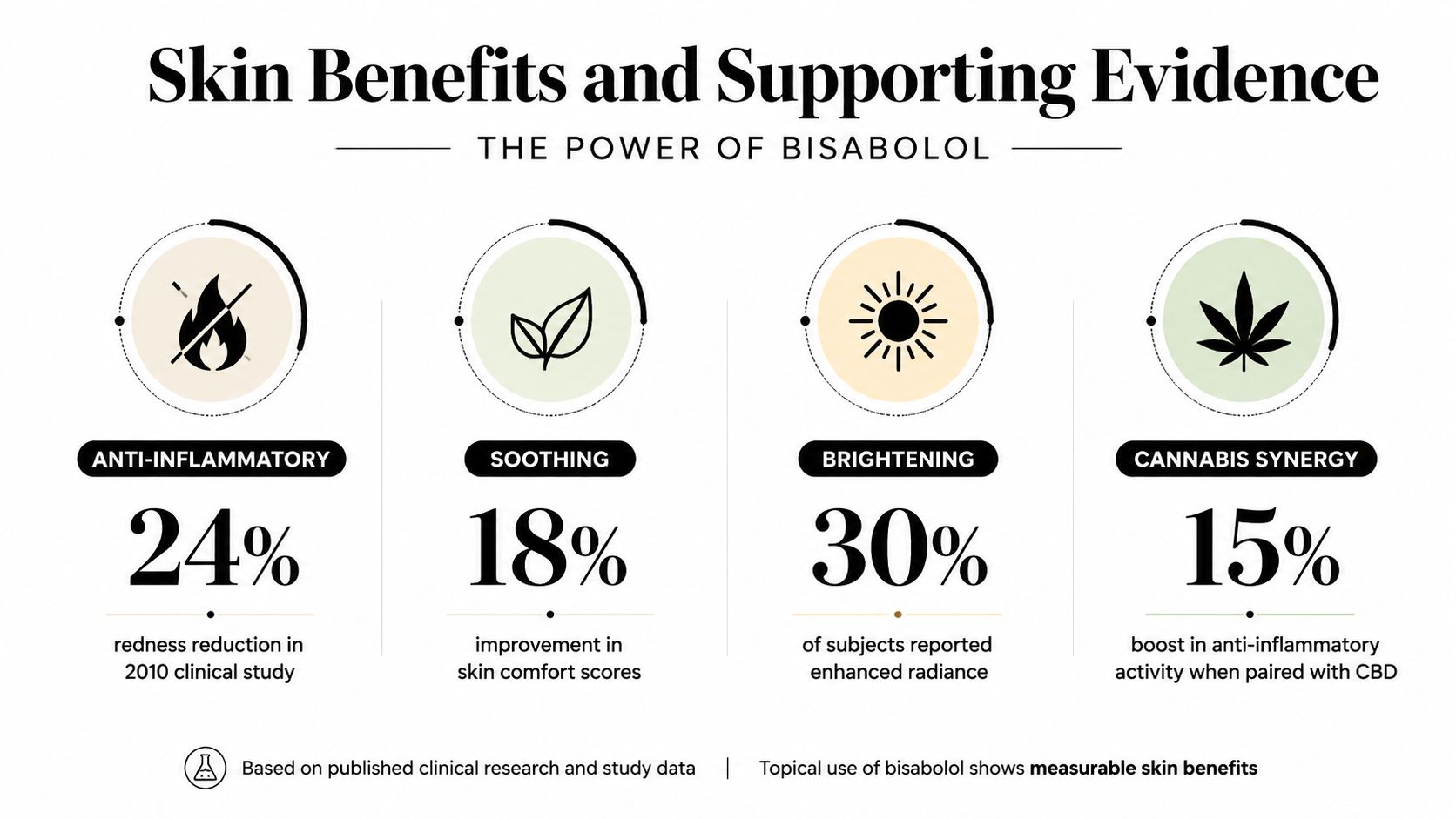
You'll also see why concentration choice matters for tone-evening claims. A clinical study in 28 Asian women found that 0.5% α-bisabolol used for 8 weeks produced a significant lightening effect in pigmented skin, with secondary reporting noting about a 24% reduction in pigmentation versus baseline (Wiley study). For formulators, that doesn't mean turning a cannabis topical into a treatment claim. It does mean bisabolol has enough real-world data to justify careful, evidence-based positioning in tone-supporting and comfort-focused products.
Understanding Bisabolol Chemistry Mechanisms
Why this molecule behaves differently
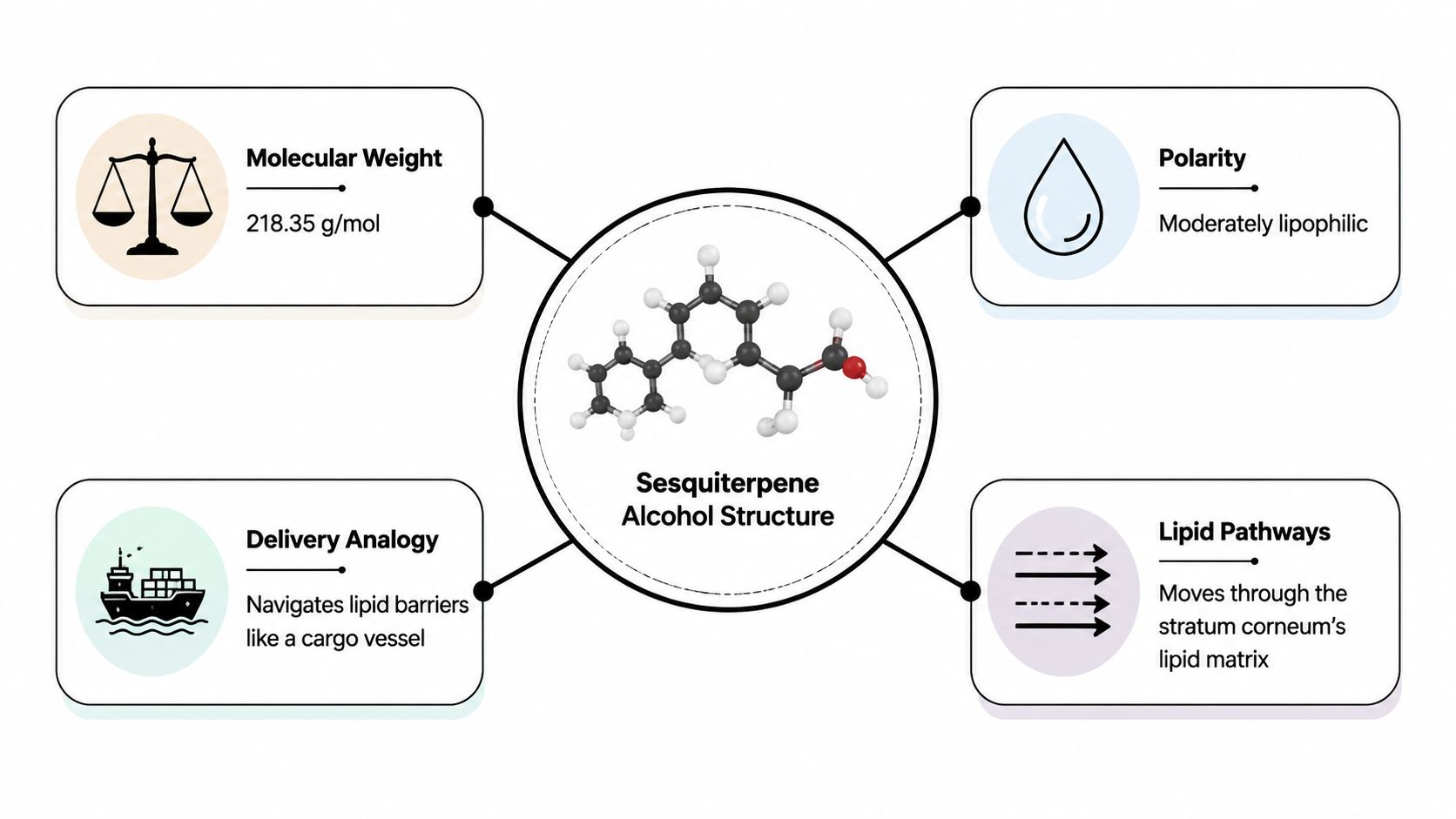
A bisabolol-containing topical often behaves differently from a formula built around a standard fragrance terpene, because α-bisabolol is a small sesquiterpene alcohol with a strong preference for lipid-rich environments. The mechanistic review notes three properties formulators care about most, anti-inflammatory activity, enhanced penetration of co-formulated actives, and antimicrobial effects (review summary). In practical terms, it can exist stably within an oil phase while still influencing what happens at the skin barrier.
The useful analogy is a compact cargo boat. It does not carry a huge load on its own, but it can pass through lipophilic territory more readily than many bulkier ingredients and help other materials move with it. That matters in cannabis topicals, where cannabinoids, acids, and other actives often need a carrier that supports both feel and transport without making the formula greasy or unstable.
Practical rule: if a terpene affects sensory quality and active delivery, it deserves a full stability and compatibility review, not a “minor component” shortcut.
Mechanistic relevance in cannabis topicals
The cannabis-specific angle is where bisabolol becomes more than a cosmetic comfort ingredient. Human and preclinical discussion around topical use describes activity at ion channels, including partial but significant inhibition of Cav3.2 channels in cell and neuron models, and the compound outperformed other terpenes in that comparison (mechanism discussion). For a product developer, the point is not the channel label itself. The point is that bisabolol can show measurable biological behavior beyond aroma.
That kind of behavior is useful in layered systems. In cannabinoid or acid-containing topicals, the terpene can support a calmer-feeling delivery environment while also helping the finished product feel more polished. The same review also notes that plant-extracted versus synthetic sourcing can affect batch consistency (review summary), which is a real formulation concern when odor, flavor, and sensory performance need to stay consistent from lot to lot.
For bench work, keep the ratios honest. A simple Mixing Calculator helps confirm whether the selected bisabolol level fits the solvent system you have built, instead of relying on hand-wavy estimates. The chemistry is straightforward, but the formulation consequences are not, especially once you add cannabinoids, lipids, emulsifiers, or other volatiles into the same system.
Skin Benefits and Supporting Evidence
What the clinical evidence actually supports
A formulators' question usually starts with a real use case, not a headline claim. If a topical needs to feel calmer on skin while still carrying active ingredients, bisabolol is one of the few terpene alcohols with cosmetic evidence that fits that brief. A review of cosmetic use describes anti-inflammatory, anti-irritant, antibacterial, and low-toxicity properties, which helps explain why it appears in sensitive-skin, after-shave, lip, and body-care systems (PMC review). For cannabis topicals, that matters because many formulas already include cannabinoids, acids, or fragrant oils that can feel too sharp unless the base is built with care.
The most concrete efficacy signal in the available material comes from the 8-week clinical study. In 28 participants, a 0.5% α-bisabolol cream was associated with a statistically significant 24% reduction in skin pigmentation compared to baseline. That supports tone-evening discussions in cosmetic positioning, especially for post-inflammatory discoloration, without crossing into medical claims. The finding is modest, but modest is often what formulation work needs, because a small, reproducible effect is easier to build around than a dramatic result that cannot be supported.
For a developer, that evidence reads like a formulation map. Bisabolol looks best when the goal is to support comfort, soften the sensory edge of a formula, and provide a credible story around tone care, rather than promise a dramatic standalone skin transformation. The skin-care benefits resource is useful here because it frames terpene use in cosmetic terms that are closer to product development than to marketing slogans.
How that translates into cannabis product development
Cannabis topicals often ask a lot from one base. They may carry cannabinoids, botanical oils, exfoliating actives, or fragrance components, and any one of those can make the formula feel busy on skin. Bisabolol helps most when it is used as a comfort-supporting ingredient inside that system, not as the star ingredient trying to do every job at once.
A practical way to judge fit is to ask whether the formula needs a quieter sensory profile. In post-harvest hemp oil balms and sensitive-skin serums, bisabolol can help the finished product feel more polished and less aggressive, while still leaving room for the cannabinoid story to stay central. That makes it useful in topical concepts aimed at comfort, tone support, or routine use where repeat application matters.
Formulation insight: the best bisabolol systems usually feel quiet, not loud. If the sensory impact is obvious but the formula still stings, the aroma side is probably overbuilt and the skin-compatibility side is underbuilt.
It also earns a place in formulas that already contain retinoid-adjacent or exfoliating components. Bisabolol will not repair a poorly chosen base, but it can help reduce the gap between “active” and “comfortable,” which is often what determines whether a product gets used consistently. That is especially relevant in cannabis topical development, where a product may be judged by skin feel first and ingredient story second.
Concentration Solubility and Compatibility Guidelines
Where bisabolol usually fits best
A formulator usually starts with two questions. How much bisabolol is enough to matter, and which phase will hold it without confusing the batch? Safety reviews place cosmetic use generally at ≤1%, and the CIR assessment reports a NOAEL of 200 mg/kg/day, tied to a 4% bisabolol solution at 87.5% purity. That does not mean every formula should aim high. It means bisabolol is usually treated as a controlled functional ingredient, not as a high-load active.
For cannabis topical work, that practical mindset matters. A modest use level can still support comfort and sensory balance in a leave-on product, and the brightening data at 0.5% fits that same development logic. In rinse-off systems, lower levels can still be useful when the goal is a softer skin feel or better ingredient harmony rather than a stand-alone claim. The bisabolol terpene effect overview is a helpful reminder that the ingredient often earns its place through formulation behavior, not just through headline appeal.
Quick compatibility check
Bisabolol behaves best in oil phases, aromatic concentrates, and emulsions that can keep a lipophilic terpene alcohol dissolved without visual drag. It is also commonly used with cannabinoids, esters, and standard emulsifiers. The exact result still depends on the base, because terpene behavior shifts with solvent load, processing temperature, and the balance of the oil phase.
| Bisabolol Solubility in Common Excipients | Max Solubility (%) |
|---|---|
| Carrier oils | High compatibility, formulation dependent |
| Ester-rich emollients | High compatibility, formulation dependent |
| Oil phases in emulsions | High compatibility, formulation dependent |
| Water | Poor compatibility |
| Aqueous gels | Limited without solubilization |
Compatibility rule: if your formula turns hazy after adding bisabolol, check the carrier system, the emulsifier balance, and the addition temperature before you change the dose.
That simple check saves time at the bench. A clouded batch is often a phase-management problem, like adding a fragrance concentrate to a base that cannot hold it. For topical product teams, the cleanest use case is as a functional minor active, and if you need a starting point for incoming raw-material screening, review the SC Labs testing resources before you lock the formula.
Formulation Design for Serums Capsules and Emulsions
Oil-based serums
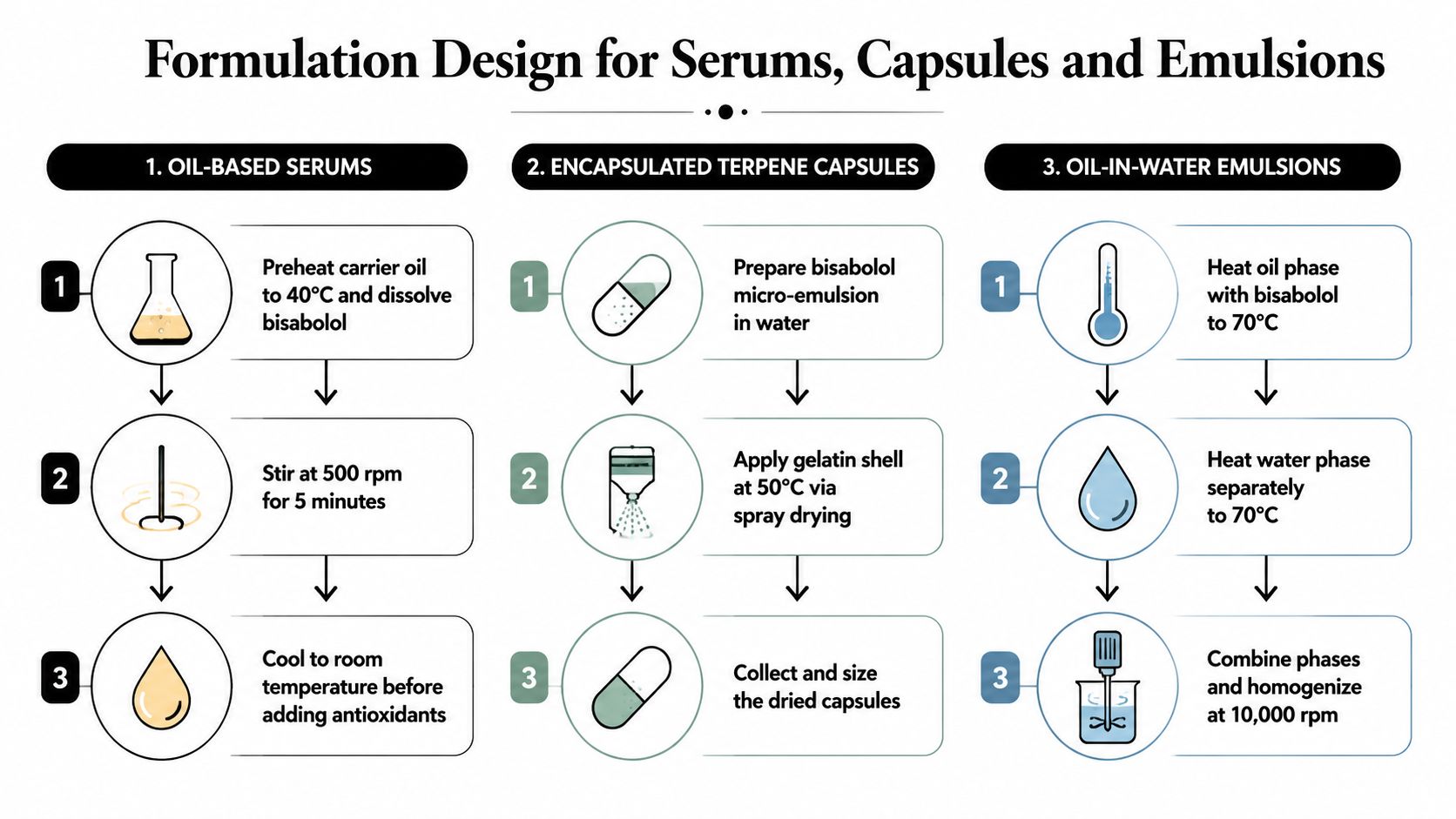
Oil serums are the easiest place to build with bisabolol because the ingredient is comfortable in lipophilic systems. A clean workflow starts by warming the carrier oil to about 40°C, dissolving bisabolol fully, then mixing until the phase is visually uniform before you add temperature-sensitive antioxidants.
A practical bench sequence looks like this. Preblend cannabinoids into the carrier if they need help dissolving, add bisabolol once the oil is fully clear, and keep agitation steady rather than aggressive. If you whip too much air into the blend, you'll spend later time fixing oxidation and appearance instead of improving performance.
Encapsulated terpene systems
Encapsulation is useful when you want to protect the aroma or improve handling, especially in more volatile or shelf-stability-sensitive designs. The process usually begins with a micro-emulsion in water, followed by a shell-forming step and then drying. In the reference workflow, a gelatin shell at 50°C via spray drying is used before the capsules are collected and sized.
That matters because bisabolol can do different jobs depending on whether you want immediate sensory impact or delayed release. If the formula is meant to support flavor accuracy in a hybrid topical or adjacent body-care SKU, encapsulation can keep the profile from flattening during processing. If you need the function to show up immediately, keep the system simpler.
Oil-in-water emulsions
O/W emulsions demand more discipline. Heat the oil phase with bisabolol to about 70°C, heat the water phase separately to the same temperature, then combine and homogenize at 10,000 rpm in the reference process. The point isn't the number itself, it's thermal matching and good dispersion, because that's what keeps the final product from separating or showing uneven terpene distribution.
For layered formulas, bisabolol often sits best before the final cool-down stage, especially if you're trying to preserve scent quality and minimize volatilization. The broader principle is simple. Build the base first, then use bisabolol to refine tolerability and sensory cohesion instead of trying to force it to rescue a weak emulsion.
The reference point from topical formulation literature is that bisabolol can function as a penetration enhancer, improving delivery of co-formulated actives such as cannabinoids and acids while helping reduce irritation (Nanu technical summary). For a deeper process tool, the Mixing Calculator is useful when you're translating a target percentage into a real batch weight.
Stability Testing and Quality Control Considerations
Bisabolol-containing topicals need the same basic stability discipline as any terpene-forward formula, but with a closer eye on sensory drift. Start with accelerated aging, then check whether odor, clarity, and phase structure remain intact after temperature stress. If your formula is a hybrid topical with cannabinoids, add terpene retention checks so you can see whether bisabolol is staying where you placed it or bleeding off during storage.
GC/MS profiling is helpful when you want to compare the finished batch against the pilot. Use it to track whether bisabolol retention stays within your internal spec window over time, then pair that with visual and sensory review. A batch can “pass” on numbers and still fail because the aroma has flattened or the emulsion has shifted.
Microbial challenge testing matters more in emulsions and water-containing systems. If the preservative system is weak, formula drift can look like a terpene problem when it's really a preservation problem. If you see haze or separation, troubleshoot the emulsifier ratio, process temperature, and order of addition before you change the bisabolol level.
Quality checkpoint: keep batch records tight enough that you can trace the exact terpene lot, mixing sequence, and temperature history. When odor changes show up, that paper trail saves days.
For QA teams, the most useful documents are still the COA, SDS, and a clear lot-to-lot retention record. Bisabolol is stable enough to be useful, but only if the rest of the system is engineered to protect it.
Sourcing Safety and Regulatory Guidelines
A formulation team comparing bisabolol sources should start with the same question it would ask for any other cosmetic raw material, how much lot-to-lot control does the supplier give you? Natural chamomile-derived material can bring a softer origin story and a more botanical odor impression, while synthetic material often gives tighter batch predictability. Source route can affect batch consistency, so the practical move is to compare both options against the same specification sheet and supplier data, not against branding alone.
Purity review belongs in that same conversation. A purity standards guide helps you check whether a supplier is defining the material clearly enough for topical use, because odor profile, composition, and impurity burden can shift the way the ingredient behaves in a finished product. If the incoming lot is inconsistent, the issue may show up first as a sensory drift in a balm, serum, or emulsion, long before it appears in a formal stability report.
The allergy question is the part many brands overlook. PubMed safety reviews note contact dermatitis cases linked to chamomile-derived bisabolol and recommend that sensitized individuals test synthetic alternatives (PubMed safety review). That does not make bisabolol a poor choice. It means the ingredient should be handled like any other sensitization-prone raw material, with supplier paperwork, screening notes, and a sensible cautionary approach for repeat-use products.
Regulatory classification also shapes how the ingredient can be positioned. α-Bisabolol is listed in the EU CosIng database as a skin-conditioning and skin-protecting ingredient, and it is also listed under fragrance use (CosIng listing context). For topical cannabis products, that dual identity helps explain why it can support both sensory and topical-function positioning. Keep claims cosmetic, keep documentation current, and make sure label language matches the market you are selling into.
For procurement, review the purity standards guide alongside each COA. In practice, purity, odor, and allergen screening belong in the same purchasing decision, because a clean specification is only useful if the supplier can repeat it lot after lot.
Sample Formulations Troubleshooting and Next Steps
A useful way to test bisabolol in a real topical formula is to start with two very different prototypes, one built for a balm and one built for a serum. The first shows how bisabolol behaves in a structured oil system, while the second tests how it behaves in a lighter cannabinoid blend where clarity, feel, and thermal handling matter more.
Sample formula one, calming hemp balm
Phase A, oil base
- Hemp seed oil
- Caprylic/capric triglyceride
- Shea butter
- Beeswax or vegan wax system
- Bisabolol at a low functional level
- Tocopherol
Melt Phase A until it is fully uniform, then add bisabolol after the blend has come off peak heat and is still fluid. Stir until the phase looks clear and consistent, then pour before the structure starts to set. The main control point here is wax crystallization. If bisabolol goes in too late, it can distribute unevenly through the balm, which leads to patchy scent and an inconsistent skin feel.
This type of balm works best when the sensory brief is quiet comfort. A stronger aroma can push the formula toward a cosmetic profile instead of a functional one, and too much wax can flatten slip. If the formula feels tacky, adjust the wax phase first before changing the terpene load.
Sample formula two, cannabinoid serum with bisabolol at 0.5%
Phase A, oil phase
- MCT or similar carrier oil
- Cannabinoid concentrate
- Bisabolol at 0.5%
- Lightweight ester
- Tocopherol
Blend the carrier and cannabinoid concentrate first, then add bisabolol and continue mixing until the phase is fully clear. Because the clinical data in the brief sits at 0.5%, that level is a practical development target when you want a meaningful functional dose rather than a label-only inclusion. Keep the fill temperature moderate so the softer aromatic notes are not driven off during processing.
A serum like this also helps you check whether bisabolol stays compatible with your cannabinoid system over time. If the formula clouds, separates, or loses scent integrity, the problem is usually in the carrier balance or the thermal history, not the bisabolol itself.
Troubleshooting matrix
| Issue | Likely cause | First fix |
|---|---|---|
| Tackiness | Too much heavy oil or wax | Reduce the structuring phase |
| Haze | Poor solubilization or cooling too fast | Rework the addition temperature |
| Fragrance eruption | Bisabolol added too hot or too late | Add earlier in the cool-down |
| Separation | Weak emulsifier balance | Revisit phase ratio and homogenization |
Pilot batches should stay small enough that you can learn from failure without wasting material. Once the base behaves, scale it with the same order of addition, the same thermal window, and the same raw-material lot wherever possible. For cannabis topical development, that matters because terpene retention, batch traceability, and sensory repeatability all depend on process discipline as much as on ingredient choice.
For bench support, the Terpenes 101 guide is a useful refresher, especially if you want to compare bisabolol with other terpene-family materials before you lock a formula. If you are setting up purchasing for larger runs, the bulk ordering program is the kind of sourcing channel formulators usually review before committing to scale.
If you are building a bisabolol-based topical, compare your prototype against the concentration, compatibility, and stability points above, then run one pilot batch with full documentation. For spec review, sourcing questions, or terpene planning, visit Gold Coast Terpenes and align the raw materials before the next production run.