
Most advice on OG Kush strain effects gets the sequence backward. People start with the name, the lore, or the expected vibe, then try to force a cartridge or distillate blend to match it. In production, that approach usually fails. You don't formulate a classic profile by chasing mythology. You formulate it by identifying a repeatable aromatic structure, then tuning the sensory and functional output around that structure.
For product developers, OG Kush isn't a monolith. It's a target profile with recognizable top notes, a distinct mid-body, and a base that carries through the exhale and into the perceived effect. If the cartridge opens too bright, the result reads lemon-forward but not OG. If the body is too soft, it tastes generic. If the base is too sharp or too heavy, the effect drifts away from the balanced hybrid lane that made OG Kush commercially durable in the first place.
That's why strain-inspired work belongs in the lab, not in brand storytelling. Replication means deciding what must remain fixed, what can flex for hardware or distillate behavior, and which compromises are acceptable in a finished vape.
Beyond the Hype Replicating OG Kush in the Lab
A lot of formulators hear “OG Kush” and assume they need to reproduce a famous flower exactly. That's rarely practical, and it's not even the right benchmark. Flower varies by cultivation, cure, storage, and extraction path. A vape formula needs a stable aromatic architecture that survives mixing, filling, and actual device performance.
The better question is simpler. What makes a blend read as OG Kush across batches and across hardware? The answer sits in chemistry, not in branding language. If you want a useful refresher on how these molecules behave in mixtures, review the chemistry of terpenes.
Why the name alone doesn't help
“OG Kush” is commercially powerful, but the name doesn't tell you enough for formulation. It doesn't specify whether your target leans citrus-forward, earthy-forward, or gas-forward. It doesn't tell you how the profile should sit inside a neutral distillate, or how much harshness your hardware will amplify.
In practice, successful strain-inspired terpene blends for vape cartridges are built from three decisions:
- Define the sensory anchor: Decide what the first inhale must communicate. With OG, that usually means the profile can't open like candy or fruit punch.
- Define the body of the profile: The middle has to feel grounded and resinous rather than thin.
- Define the finish: The exhale should leave a recognizable kush-like persistence, not vanish into generic citrus.
Practical rule: If a formula only captures the aroma but misses the carry-through on the finish, it won't deliver convincing OG Kush strain effects in a vape format.
Replication is an engineering problem
A formulator's job is to rebuild the experience inside a different delivery system. Distillate is not flower. Cartridges heat differently than dab applications. Ceramic hardware presents one profile; cotton and metal can push another. The formula has to account for that.
That's why the most useful mindset is this: replicating flavor of OG Kush for cannabis product formulation means preserving recognizable sensory cues while engineering for stability, consistency, and effect direction. Once you frame it that way, the profile becomes tractable.
Deconstructing the Classic OG Kush Effects Profile
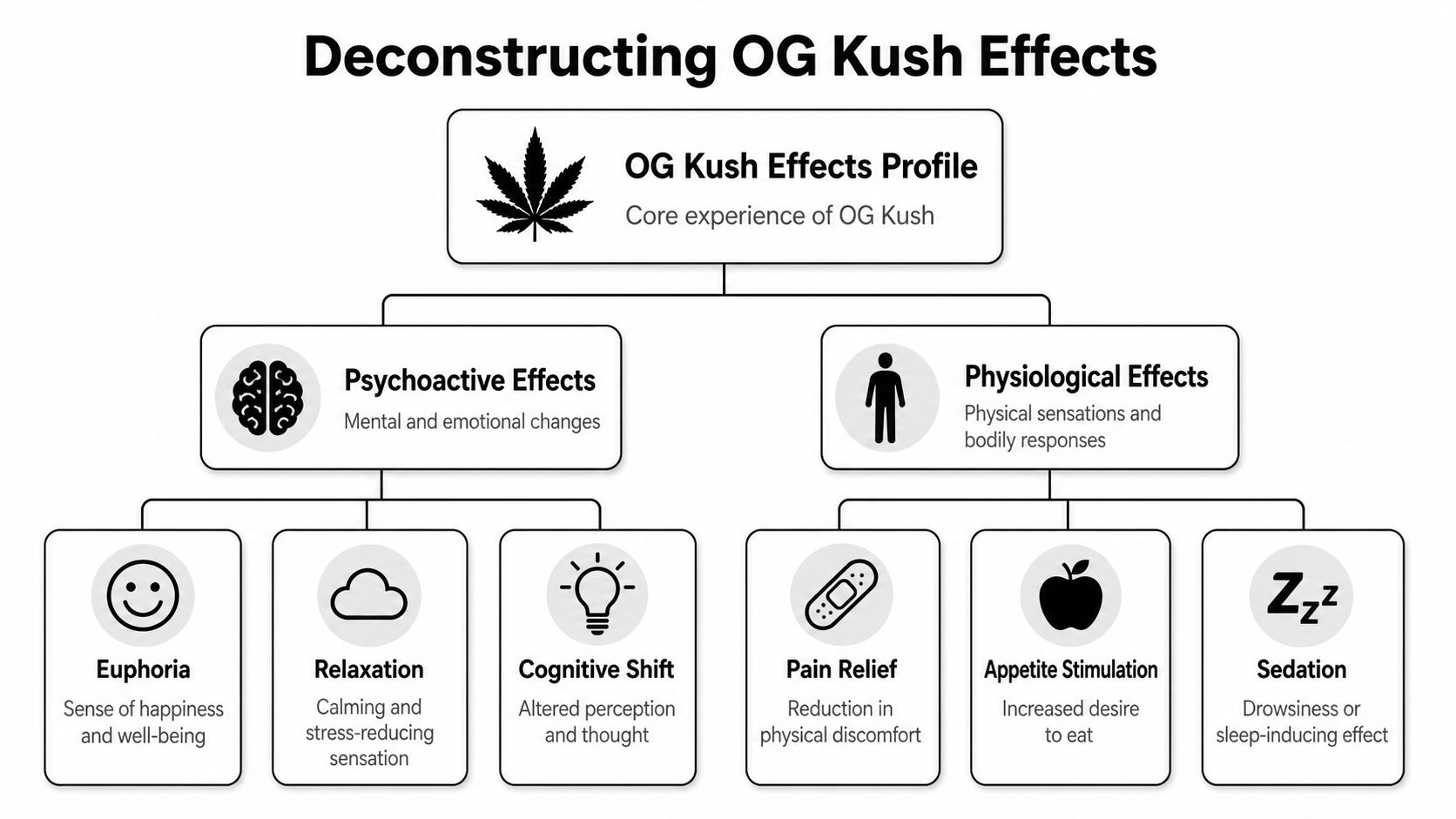
Before adjusting ratios, it helps to define what people usually mean when they talk about OG Kush strain effects. From a formulation standpoint, the target isn't “strong.” That's too vague to be actionable. The target is a specific balance between mental lift and physical ease, with enough body to feel kush-derived but not so much weight that the product collapses into a one-note sedative.
The psychoactive side
In a well-built OG-style formula, the onset shouldn't feel flat. There's usually a noticeable shift in mood and perception. For formulators, that translates into a profile that opens with some brightness and movement instead of landing immediately in a dense herbal wall.
That doesn't mean making it sharp. Overloading the top notes can push the blend into a lemon cleaner direction, which reads “citrus strain” instead of OG. The goal is a controlled lift. The profile should feel mentally active without becoming racy, distracting, or too thin.
A lot of teams miss this by formulating only for aroma resemblance. They hit earthy, peppery, and fuel-like notes, but they strip away the part of the profile that gives users the impression of uplift. The result tastes darker than OG Kush should feel.
A potent but balanced experience combining mental euphoria with functional physical relief.
For a deeper discussion of how terpene differences shape perceived effects, the article on whether different strains have different highs is useful context.
The physical side
The second half of the target is where OG earns its staying power. There's a distinct body component, but in the most useful formulations it doesn't immediately drag the user into inactivity. It rounds the experience out. That distinction matters for product positioning.
For formulating OG Kush for distillate, I think of the physical side in three layers:
- Immediate body feel: The inhale and first exhale should register some weight, not just aroma.
- Muscular relaxation impression: The blend should feel calming in the body without reading as syrupy or narcotic.
- Finish persistence: OG profiles benefit from a lingering, grounded aftertaste that supports the perception of depth.
Where formulators get it wrong
Two common mistakes show up in production runs.
- Too much top-note brightness: This creates a cleaner, lighter profile that may smell attractive in a bottle but loses the kush identity once vaporized.
- Too much sedative body: This makes the profile muddy and blunt. It can also flatten the sensory arc so the cartridge feels heavy from the first draw.
Formulation note: If the profile tastes louder than it feels, the mid and base are underbuilt. If it feels heavier than it smells, the top is underrepresented.
The “hybrid” read that brands often want from OG doesn't come from splitting the difference blindly. It comes from preserving tension between uplift and relaxation. That tension is the primary target.
The OG Kush Terpene Profile for Formulation
The core of any credible terpene profile for OG Kush starts with three primary components. In most lab-verified OG Kush profiles, the terpene composition is dominated by Myrcene (often >0.5%), Limonene (around 0.25%), and Beta-Caryophyllene (0.1-0.2%), which collectively define its signature aroma and effects, as noted in Terpenes 101.
That fact matters because it gives formulators a real center of gravity. Not a myth. Not a mood board. A chemical spine.
The three-part structure
A practical OG build usually works because each dominant terpene carries a different part of the profile.
Limonene acts like the opening signal. It gives the formula a bright entry and helps keep the blend from collapsing into a flat earthy block. In OG work, it usually performs best when it lifts the profile without dominating it.
Myrcene fills in the body. It's the part that helps the formula feel herbal, earthy, and grounded. In cartridge development, this is often the terpene that determines whether the result feels kush-like or just generally botanical.
Beta-Caryophyllene anchors the finish. Aromatically, it contributes peppery, spicy depth. Functionally, formulators often value it because it helps the base feel structured instead of vague. When the base is missing, the blend may smell acceptable in a concentrate jar but fall apart in vapor.
For a broader reference on the building blocks involved in strain replication, see this guide to common cannabis terpenes.
OG Kush Primary Terpene Breakdown for Formulation
| Terpene | Typical % Range | Aromatic Note | Contribution to Effect |
|---|---|---|---|
| Myrcene | often >0.5% | Mid note | Grounds the profile with earthy, herbal body and supports a relaxing character |
| Limonene | around 0.25% | Top note | Adds brightness and helps shape the uplifting side of the experience |
| Beta-Caryophyllene | 0.1-0.2% | Base note | Adds spicy, peppery depth and supports a firmer, more structured finish |
Top, mid, and base note logic
If you're replicating flavor of OG Kush for vape cartridges, don't think of these as isolated ingredients. Think in note hierarchy.
Top note behavior
Top notes create first impression. In OG Kush, that opening should be noticeable but controlled. If the top note blooms too aggressively, the profile reads like a citrus strain with kush accents. That's backward.
Mid note behavior
The mid is where realism lives. A lot of “OG” formulas fail here because they smell good in the bottle but don't maintain body once heated. Myrcene-centered middle structure helps the vapor feel complete rather than skeletal.
Base note behavior
The base decides whether the profile lingers in a recognizable way. Beta-Caryophyllene is especially valuable here because it keeps the back end from becoming hollow. Without that peppery structure, many blends finish sweet, vague, or abruptly clean.
Good OG formulation is less about chasing every minor nuance and more about protecting the relationship between brightness, body, and base.
What works in actual development
I've found that the best strain-inspired terpene blend for cannabis product formulation doesn't try to make every note equally loud. OG isn't built on symmetry. It's built on contrast held in place by a disciplined base.
What usually works:
- A restrained citrus opening that signals lift without becoming candy-like
- A dense herbal center that carries through the full draw
- A peppery, resinous finish that stays identifiable after exhale
What usually doesn't:
- Soft generic earthiness with no clear top
- Excessive lemon that erases the kush identity
- Weak base structure that disappears in hardware
Formulation Guide for OG Kush Vape Cartridges
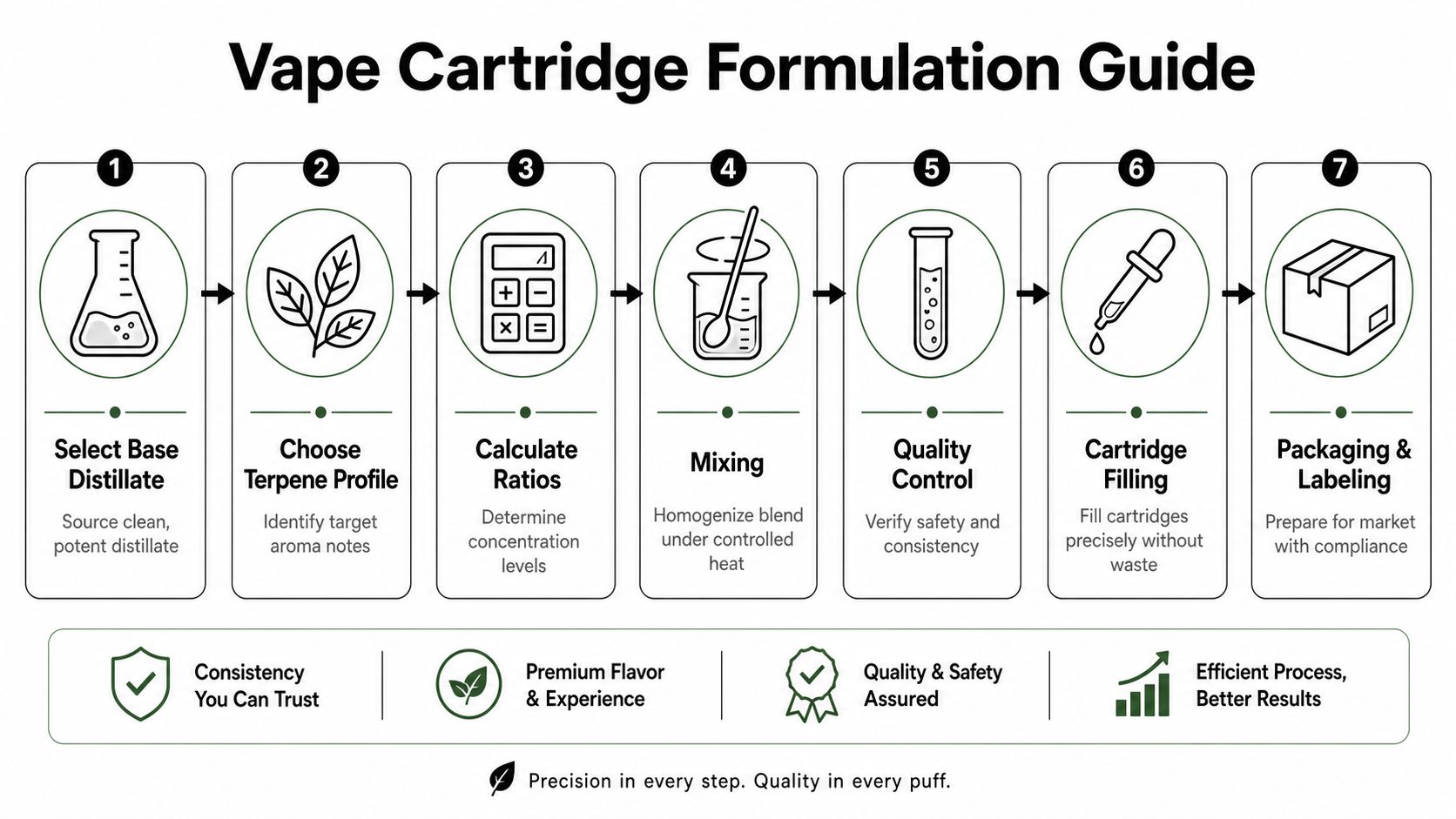
The fastest way to ruin an OG build is to start with a loud terpene blend and hope the distillate will tame it. Distillate rarely fixes a bad aromatic structure. It usually exposes it. Start with a clean, neutral base, then build the profile deliberately.
Start with the base material
For formulating OG Kush for vape cartridges, use a cannabinoid base that doesn't carry a strong competing aroma. If the distillate already leans grassy, burnt, or sulfurous, the final profile will force you into corrective blending. That almost always produces a less elegant result.
A neutral base gives you room to make cleaner decisions. You can judge whether the top note is doing enough, whether the body is thickening appropriately, and whether the finish is holding.
Build the blend in sequence
There's a practical order that reduces mistakes.
- Warm the base gently: The material should be workable, not overheated. Excessive heat strips delicate aromatic character and can skew your sensory read.
- Add the terpene blend with control: Don't dump everything in and chase the mix afterward. Introduce it in a way that allows evaluation.
- Homogenize thoroughly: Uneven incorporation creates false positives during bench testing. One draw tastes bright, another tastes flat.
- Test in the actual hardware: Bench aroma alone won't tell you whether the OG character survives atomization.
This overview of cannabis vape liquid is a useful reference if you're standardizing a cartridge workflow.
Why the terpene load matters
In real manufacturing, formulators often work within a terpene inclusion range that balances flavor presence, hardware performance, and user comfort. The production graphic above references a typical working range for cartridges, and that's a familiar operational guideline in the industry. The key point isn't to chase the top end. The key point is to add enough terpene content to express OG clearly without making the vapor sharp, unstable, or visually suspect.
If your first pass tastes harsh, don't assume the profile is “more authentic.” Harshness often means the blend is over-concentrated, under-integrated, or mismatched to the hardware.
Bench rule: A convincing OG cartridge should smell cohesive in the tank and stay cohesive on repeated pulls. If the first hit is kushy and the third turns thin or acrid, the blend or process needs work.
A quick visual walkthrough of a mixing workflow can help during SOP training:
Resting and re-evaluation
Freshly mixed material can give a misleading impression. Right after blending, the top notes often seem more pronounced than they will in the finished cartridge. Letting the formulation rest before final evaluation usually gives a truer picture of integration.
During re-evaluation, check for these issues:
- Top-note drift: The blend opens brighter than intended after filling.
- Muted middle: The vapor carries aroma but lacks kush body.
- Base harshness: The finish feels peppery in a sharp way rather than a structured way.
- Hardware mismatch: The profile performs well in one cartridge platform and poorly in another.
What to modify first
If the formula misses the target, don't change everything at once.
- If it feels too bright, reduce the emphasis on the opening and reinforce the center.
- If it feels muddy, clean up the middle before adding more top.
- If it lacks OG identity, the issue is often the base note architecture rather than total terpene intensity.
That's the practical discipline behind a strong formulation guide for OG Kush for distillate. Small changes, tested in the final device, beat dramatic revisions made from bottle aroma alone.
Advanced Formulation Tweaking and Variations
Once the base profile is credible, the interesting work starts. Replication gets you into the category. Variation gives you product line logic. A good OG platform can support multiple SKUs if you treat the original profile as a framework instead of a finished endpoint.

Tweaking for directional effects
The safest modifications are directional, not a complete overhaul. You want the user to recognize the kush backbone even when the effect lane shifts.
A brighter daytime-leaning OG
If a brand wants a more active version, increase the influence of the top note. In practice, that usually means leaning further into limonene-led brightness while protecting the earthy middle. Push too far, and the formula stops reading as OG.
This kind of variation works best when the change is obvious in the first inhale but still resolves into a kush finish.
A denser evening-style OG
For a heavier version, the adjustment usually happens in the middle and lower register. More body, more floral-softening support, and a rounder finish can move the profile toward a slower, more settling experience.
One common move is to support the earthy core and add a touch of a softer floral component such as linalool. The key word is touch. Overdo it and the profile leaves OG territory.
Don't “improve” OG Kush by sanding off its tension. The profile needs some brightness on top and some bite on the back end, or it turns generic.
Using isolates without losing identity
Isolates are useful, but they can tempt overcorrection. A small adjustment can sharpen intent. A larger one can fracture the profile.
That's especially true when building strain-inspired terpene blends for distillate. Distillate doesn't hide over-tweaking well. It magnifies imbalance.
A disciplined isolate strategy usually follows this logic:
- Adjust the opening with care: Bright modifiers should create lift, not dominate the label claim.
- Support the middle before rebuilding it: If the body feels thin, reinforce what's already there rather than replacing it with unrelated notes.
- Anchor the finish intentionally: Spicy or woody support can improve persistence, but too much turns the exhale abrasive.
Commercial variation versus technical variation
Brands often ask for a “more premium” OG. That phrase usually means one of two things.
Sometimes they want more complexity. Sometimes they want more impact. Those aren't the same job. More complexity can come from nuanced supporting notes. More impact often comes from stronger contrast between top, mid, and base.
If you're developing a family of OG-adjacent SKUs, separate those goals clearly:
| Variation Goal | Better Approach |
|---|---|
| More uplifting | Increase perceived brightness while preserving the kush body |
| More relaxing | Add density to the middle and soften the finish without flattening the whole profile |
| More premium | Improve note separation and realism rather than simply making the blend louder |
That's where terpene isolates earn their place in a product line. They let you create a daytime OG, a heavier OG, or a more polished OG without abandoning the recognizable template.
Dosing Safety and Product Stability Notes
Terpene formulation isn't just flavor design. It's materials handling, inhalation safety, and batch control. That's why sloppy dosing is one of the quickest ways to damage an otherwise good cartridge.
A blend can be technically accurate and still fail in use if it's too concentrated, too harsh, or poorly integrated into the base. Users don't experience your bench notes. They experience the finished vapor through a heated device. If the formula irritates, separates, darkens prematurely, or loses its top note quickly, the profile won't matter.
What stable production looks like
Stable OG-style manufacturing usually comes down to a few habits:
- Use verified, high-purity terpene inputs: Avoid unnecessary fillers and non-terpene additives that complicate inhalation and consistency.
- Control heat exposure: Excessive heat during mixing or filling can damage the profile you spent time building.
- Protect against oxidation and contamination: Tight handling procedures preserve both aroma fidelity and batch repeatability.
- Re-test after filling: The cartridge is the primary product, not the beaker.
Why sourcing quality matters
Cheap inputs create expensive problems. They can add off-notes, distort the finish, and produce inconsistent results from lot to lot. For formulating OG Kush for cannabis product formulation, consistency is part of the effect. If the top note shifts from batch to batch, users read that as a different strain experience, even if the label stays the same.
Final lab note: Precision in terpene dosing isn't optional. It's the difference between a profile that tastes intentional and one that tastes improvised.
The best OG Kush-inspired products aren't the loudest. They're the most disciplined. They hold their identity from mix tank to cartridge to final pull.
If you're building an OG Kush strain-inspired terpene blend for vape cartridges or distillate, Gold Coast Terpenes offers strain-specific profiles, isolates such as Limonene, Myrcene, and Beta-Caryophyllene, plus formulation resources that help teams dial in flavor accuracy, stability, and batch consistency.