
You can be holding two COAs labeled Gelato and still be nowhere near the same sensory result in a cartridge or concentrate. One lot reads creamy and peppery with a soft citrus lift. The next leans brighter, thinner, and more generic, or swings toward earth, mint, and gas. That gap is where most formulation problems start.
For brands, Gelato isn't just a strain name. It's a commercial flavor target with unusually high consumer recognition and unusually inconsistent agricultural inputs. If you're building a repeatable SKU, the job isn't to copy one plant perfectly. It's to define the Gelato strain terpene profile for cannabis product formulation as a stable aroma architecture you can reproduce across batches, hardware, and extract bases.
Beyond the Hype Why the Gelato Profile Matters for Formulators
A common production scenario goes like this. The first pilot batch lands well because the source extract carries a sweet, creamy, slightly spicy profile that everyone on the team agrees feels like Gelato. Then the next lot arrives, still labeled Gelato, but the sensory balance has shifted enough that the same formulation tastes off in the cart. The citrus sits too high, the cream note disappears, or the back end turns woody and dry.
That problem exists because Gelato became a benchmark faster than many teams could standardize around it. Paradise Seeds notes that Gelato has been around since 2014 and became a global “titan” in roughly the following five years, with THC levels typically in the 17% to 25% range, which helps explain why it became such an important flavor reference in vape and concentrate development (Gelato history and potency context).
Why formulators keep coming back to Gelato
Gelato matters because it sits in the sweet spot between novelty and familiarity. It reads dessert-forward without becoming candy-like, and it carries enough spice and earth to stay recognizably cannabis-derived instead of drifting into a generic fruit profile.
For product teams, that creates three practical advantages:
- Consumer recognition: Gelato is one of the profiles buyers already understand.
- Versatile positioning: It fits carts, live-resin-inspired SKUs, cured concentrate lines, and blend-forward products.
- Useful formulation structure: It gives you top, mid, and base note contrast instead of a flat one-note aroma.
Practical rule: Treat Gelato like a house accord, not a cultivar shortcut.
If your team still frames terpene work as “adding strain flavor back in,” it helps to revisit the chemistry behind cannabis aroma and how recurring compounds shape recognizable profiles in commercial products. Gold Coast Terpenes' guide on terpenes in weed is a useful refresher before you lock a replication target.
What works and what fails
What works is defining the profile in sensory layers, then validating it against batch data. What fails is assuming the strain name alone gives you a fixed recipe. With Gelato, that assumption creates inconsistency faster than almost any other dessert-style profile because the market expects something specific, while the source material often delivers something broader.
Deconstructing the Gelato Terpene Signature
Leafly describes Gelato as originating in the San Francisco Bay Area from Sunset Sherbet crossed with Thin Mint Girl Scout Cookies, and notes that the profile is dominated by caryophyllene, followed by limonene and humulene. That matters because Gelato's identity comes from a recurring terpene cluster, not a single hero molecule (Leafly's Gelato profile).

Build it as top, mid, and base notes
A good Gelato strain-inspired terpene blend should be approached the way a perfumer builds an accord. The recognizable result comes from balance, not from maximizing whichever terpene sounds most “dessert-like.”
- Base note, caryophyllene: This is the anchor. It supplies pepper, wood, and dry spice. Without enough caryophyllene, Gelato loses its cannabis realism and starts reading like sweet citrus candy.
- Top note, limonene: This gives lift and first impression. It brightens the profile and keeps the cream from turning dull, but too much pushes the whole blend toward generic lemon-orange.
- Mid note, linalool or humulene: These compounds shape the profile differently. Linalool softens and rounds the blend with floral cream character. Humulene tightens it with earth and hop-like dryness.
- Supporting notes, myrcene, pinene, ocimene, terpinolene: These aren't always dominant, but they influence how “fresh,” “dense,” or “cultivar-specific” the profile feels.
Typical Gelato terpene profile breakdown
The exact percentages aren't consistently verified across the provided sources, so the most responsible way to use a table here is qualitatively.
| Terpene | Typical Range (%) | Aroma Contribution | Note |
|---|---|---|---|
| Caryophyllene | Varies by phenotype and source | Peppery, woody, spicy | Core base note that keeps Gelato grounded |
| Limonene | Varies by phenotype and source | Bright citrus, lifted sweetness | Main top-note driver |
| Linalool | Varies by phenotype and source | Floral, soft, creamy | Often supports the dessert-like finish |
| Humulene | Varies by phenotype and source | Earthy, woody, hop-like | Common alternative to linalool in dominant stack |
| Myrcene | Varies by phenotype and source | Musky, earthy, rounded fruit | Can deepen the body of the blend |
| Pinene | Smaller amounts | Fresh, green, piney | Adds lift and definition in some cuts |
| Ocimene | Smaller amounts | Sweet, herbaceous | Adds brightness and nuance |
| Terpinolene | Smaller amounts | Herbal, floral, pine-like | Can make some lots feel sharper |
The best Gelato blends don't smell loud in one direction. They smell integrated.
The chemistry mistake most teams make
Teams often chase the creamy side and underbuild the spice. That usually happens when they focus on limonene and floral support while neglecting caryophyllene. The result may smell pleasant in a bottle, but once it's diluted into distillate or exposed to cart hardware, it loses identity and collapses into a broad citrus-sweet profile.
For replicating flavor of Gelato for distillate, start with the base note architecture first. Then tune the opening brightness and the cream finish. Not the other way around.
Understanding Profile Variation in Gelato Phenotypes
The biggest mistake in Gelato replication is assuming variation is noise. It isn't. Variation is part of the profile's market reality.
Abstrax notes that Gelato expression shifts with weather, farming techniques, and genetics, and that one Gelato product can lean sweet berry and cream while another turns minty, spicy, and earthy. That's exactly why consumer expectations often don't match a generic strain label, and why controlled formulation matters so much (how environmental and genetic factors influence Gelato expression).

What variation actually looks like in production
In practical terms, Gelato usually breaks into a few sensory families:
- Creamy berry expression: Softer, fuller, and more dessert-forward. These lots often feel rounded in the middle and less sharp on the nose.
- Citrus-forward expression: Brighter and more lifted. Easy to like, but also easy to push into a non-specific citrus dessert direction.
- Mint spice earth expression: Drier, more structured, sometimes closer to the Cookies side of the lineage than the Sherbet side.
Those differences show up before and after extraction. A flower lot may smell balanced, then lose enough top note in processing that the retained profile skews woody. Another lot may come through extraction with a bright front end but very little creamy body.
What drives the inconsistency
For formulators, it helps to sort causes into two buckets.
First, genetic variation. Different cuts and phenotype selections don't express the same dominant stack in the same order every time.
Second, process variation. Harvest timing, cure, storage, and extraction decisions all shift the final aroma. If your team works from inconsistent source material, the same nominal target can drift from batch to batch.
A useful background read here is Gold Coast Terpenes' article on terpene transformation and environmental influence on flavor, because it mirrors what many labs see when comparing lots that share a strain name but not a sensory result.
If your target is “Gelato,” decide which Gelato you mean before you write the batch sheet.
A better way to set the target
Don't brief your flavor team with just the strain label. Brief them with a sensory target such as “creamy-spice Gelato with moderate citrus lift” or “brighter Sherbet-leaning Gelato with preserved pepper base.” That small change reduces revision loops because everyone is optimizing toward the same expression.
Formulating a Consistent Gelato Profile for Vape Cartridges
Cartridges are unforgiving. A blend that smells balanced in a vial can become harsh, thin, or top-heavy once it's heated through a coil. That's why formulating a Gelato terpene profile for vape cartridges needs a tighter workflow than flower mimicry alone.
Caliterpenes notes that Gelato is typically dominated by caryophyllene, limonene, and linalool, and warns that over-weighting limonene creates a generic citrus result, while preserving the spicy caryophyllene base is what keeps the profile recognizable as Gelato (Gelato terpene formulation considerations).

A workflow that holds up in hardware
For carts, I'd keep the process disciplined and sensory-led.
- Choose the target expression first. Decide whether your SKU should land creamy, bright, or slightly gassy. Don't start from “Gelato” as a vague umbrella.
- Build the base note before the top note. Get caryophyllene and the woody-spice floor where you want it. If the base is wrong, all later adjustments are cosmetic.
- Add limonene carefully. You want lift, not dominance. The profile should open with citrus, not finish as citrus.
- Use linalool or humulene to tune the middle. Linalool makes the profile read softer and more dessert-like. Humulene pushes it drier and more structured.
- Bench test in the actual oil and hardware. Bottle aroma is not enough. The same blend can perform differently in different distillates and cartridges.
What usually causes failure in carts
The main failure modes are familiar:
- Too much top note: The first puff smells promising, then the profile burns off into something flat.
- Insufficient base structure: The blend tastes sweet but not strain-specific.
- Poor matrix testing: A profile that works in one distillate doesn't necessarily transfer cleanly to another.
- Ignoring hardware behavior: Some carts emphasize brightness and suppress body. Others do the opposite.
Gold Coast Terpenes' guide on how to use terpenes is a practical reference for teams building repeatable mixing procedures and evaluating terpene integration in finished oil. If you're sourcing a ready-made option, Gold Coast Terpenes offers strain-specific blends and isolates that can be used as a starting point or adjusted for custom cart development.
Bench advice: If the profile only smells like Gelato before filling, you do not have a Gelato cart yet.
A cartridge-specific sensory checkpoint
Before approving a pilot, ask three questions after a heated pull:
- Does the opening read citrus-spice rather than simple citrus?
- Is there a creamy or rounded middle, not just sweetness?
- Does the finish stay woody-peppery enough to signal Gelato rather than sherbet candy?
If one of those drops out, the blend isn't finished.
Replicating the Gelato Flavor for Concentrates
Concentrates ask for a different strategy because texture matters as much as aroma. In a cart, the formulation challenge is heat behavior and hardware expression. In shatter, wax, badder, or post-processed extract, the challenge is getting the Gelato strain terpene profile for cannabis product formulation back into the product without destabilizing the physical form.
Cartridges versus concentrates
A cart can tolerate a profile that's slightly more top-note expressive because heat delivery helps volatilize the aroma. Concentrates don't get that advantage in the same way. If the blend is too bright or too thin, the concentrate can smell disconnected from its texture and visual identity.
A few practical differences matter:
- For shatter: Keep the profile tight and controlled. Too much reintroduced aroma can make the product feel artificial or compromise the brittle texture.
- For wax and badder: You have more room to build a rounded middle and richer finish because the matrix already supports a fuller sensory impression.
- For sauce-style applications: You can lean further into aromatic intensity, but the product still needs structure. A loud top note without a cannabis base reads novelty, not Gelato.
What works in post-extraction reintroduction
For hydrocarbon extracts or terpene-stripped material, reintroduction works best when you match the aroma to the product format rather than trying to force one universal blend across every concentrate SKU.
A useful comparison is this:
| Format | Best Gelato emphasis | Common mistake |
|---|---|---|
| Shatter | Spice-citrus with controlled cream | Over-softening the profile |
| Wax | Balanced body with moderate lift | Letting citrus dominate |
| Badder | Creamy middle with preserved woody finish | Flattening the finish |
| Sauce fraction | Layered aromatic impact | Building only for smell, not identity |
Texture is part of flavor perception
Concentrate teams sometimes evaluate flavor in isolation. That misses how strongly texture changes interpretation. The same terpene blend can feel creamier in badder, sharper in shatter, and more volatile in a sauce layer. Because of that, replicating flavor of Gelato for concentrates should always include side-by-side sensory review in the intended final form.
Build the profile to the texture. Don't assume the texture will carry the profile for you.
Advanced Modulation and Flavor Pairing Strategies
Once the core architecture is stable, Gelato becomes a very flexible platform for line extension. Cannavative notes that the dominant stack can vary between caryophyllene + limonene + humulene and caryophyllene + limonene + myrcene, which is a useful reminder that commercial Gelato should be treated as a target aroma architecture, not a single fixed recipe, with QA comparing COAs across lots to keep the profile consistent (Gelato variability and QA framing).
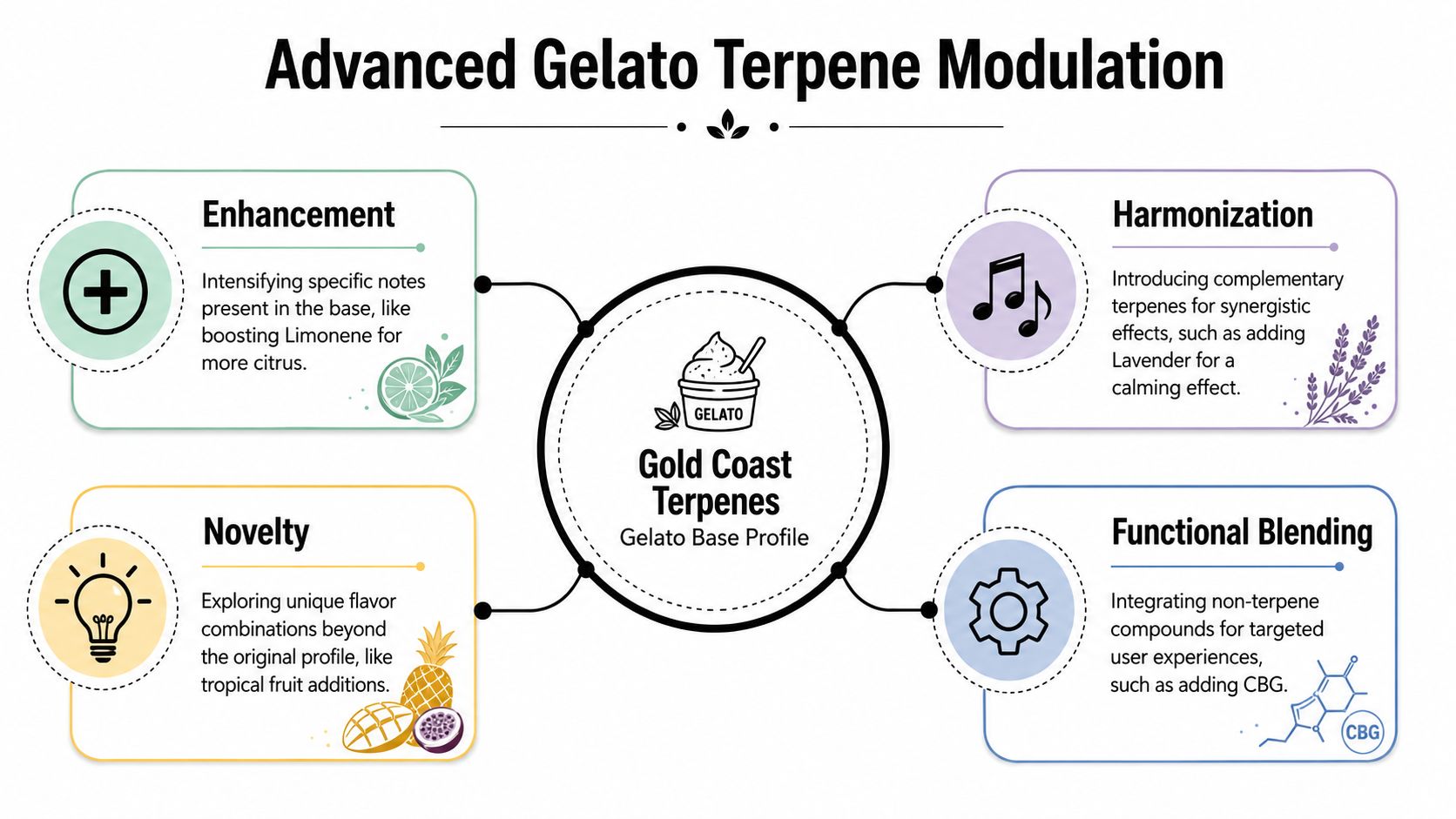
Four useful modulation directions
Instead of rebuilding from zero every time, keep a validated Gelato base and modulate around it.
- Citrus lift: Raise the opening carefully for a brighter, Sherbet-leaning expression. This works for brands that want a cleaner first impression, but it fails fast if the pepper base falls behind.
- Cream extension: Increase the soft floral middle so the profile reads more dessert-forward. This is useful for brands pursuing a richer finish in badder or all-in-one devices.
- Earth and gas support: Strengthen the dry woody side to hold up under heat or in formats where sweetness tends to dominate perception.
- Freshness accent: A small green or pine-like accent can make a blend feel more natural and less syrupy, especially when the base is otherwise very rounded.
Pairing Gelato with adjacent profiles
Gelato also works well as a bridge profile when you're developing hybrids or house blends.
Examples of commercially sensible pairing logic:
- With cake-style profiles: This deepens the baked-dessert direction and can support a richer exhale.
- With fruit-forward profiles: This adds accessibility, but the risk is losing the strain-specific core if the fruit side gets too loud.
- With gas-forward profiles: This creates a more mature SKU for buyers who want dessert structure without a sweet finish.
The key is restraint. Gelato already contains contrast. If you pair it with another profile, use the second profile to steer the direction, not replace the architecture.
A practical modulation rule
If a modulation removes the caryophyllene-led frame, the product may still smell good, but it won't smell like Gelato anymore. That distinction matters when the SKU name carries a strong consumer expectation.
Lab Testing Safety and Achieving Final Consistency
The operational goal isn't finding a mythical perfect Gelato flower lot. The goal is controlling a repeatable output. That means lab verification, lot review, and sensory sign-off need to work together.
What to verify before release
A strong QC routine for Gelato formulation should include:
- COA review: Check whether the dominant stack still matches your approved sensory target.
- Chromatography interpretation: Confirm that the profile hasn't drifted in a way that would change how the product reads in use.
- Finished-goods evaluation: Smell and test the actual SKU, not just the input blend.
- Lot-to-lot comparison: Keep retained samples so drift is obvious, not anecdotal.
For teams that need a refresher on interpreting terpene analytical data, Gold Coast Terpenes has a useful primer on chromatography testing.
Why controlled formulation wins
Agricultural variability isn't going away. Weather shifts, cultivation choices change expression, and extraction removes or distorts parts of the original aroma. If you rely on the plant alone to deliver a stable Gelato experience, your SKU will drift.
If you define the target properly and validate it with testing, you can give customers the same sensory profile every time. That's the key commercial value of a well-built Gelato strain-inspired terpene blend. It turns a variable cultivar reference into a stable manufactured product.
Consistency comes from deciding what Gelato means for your brand, then proving each batch still matches that definition.
If you're building or refining a Gelato profile for carts, distillate, or concentrates, Gold Coast Terpenes offers strain-specific blends, isolates, and formulation resources that can help you translate a variable plant profile into a repeatable production standard.