
A brand asks for a White Truffle SKU because savory profiles are moving faster than another generic fruit cart. The request sounds simple until the first set of samples lands on the bench. One supplier leans earthy and peppery. Another pushes citrus over gas. A third smells closer to damp nut and skunk than anything anyone would call “clean.”
That's the core problem with White Truffle strain terpenes for cannabis product formulation. You're not cloning one fixed aroma. You're choosing which version of White Truffle you want to commercialize, then building a blend that survives scale, hardware, and batch-to-batch production.
For formulators, White Truffle matters because it sits in a valuable lane. It's not candy, not straight diesel, and not a simple kush profile. It lives in the savory category that brands often want when they need something more premium, more adult, and less interchangeable. But it also punishes lazy formulation. If the balance slips, the profile turns muddy, sulfur-adjacent, or flat.
That's why the best approach isn't chasing a single mythical recipe. It's building a method for replicating the flavor of White Truffle for vape cartridges with controlled trade-offs. If you're already working through other high-terpene strain profiles in commercial product development, you know the pattern. The winning SKU usually comes from a stable target profile, not from romantic ideas about what the flower “should” smell like.
The Formulator's Challenge Replicating White Truffle
A White Truffle brief usually starts the same way. The brand wants something current, savory, and unmistakably premium. They don't want candy. They don't want a generic OG. They want the earthy, spicy, skunky, nutty character people associate with White Truffle, but they also want it to be consistent enough for repeat purchase.
That's where the strain stops behaving like a marketing name and starts behaving like a formulation problem.
Why this profile is harder than it looks
White Truffle is widely described as an indica-dominant hybrid from the Gorilla Butter family, with reported THC levels typically in the 23% to 30% range, and sources differ on whether the split is closer to 80% indica / 20% sativa or 60% / 40% according to this White Truffle strain review and terpene summary. For product developers, the more useful takeaway isn't the label. It's that the profile is generally treated as strongly indica-leaning and built around an earthy, spicy, skunky, nutty identity rather than a bright fruit-forward one.
That “gourmet” positioning is commercially attractive. It also creates risk. Savory profiles have less room for error than candy or citrus-forward blends. When sweetness is low and earthy notes are high, every imbalance shows up faster.
Bench reality: If you overbuild the heavy notes, the blend loses definition. If you overcorrect with brightness, it stops reading as White Truffle and starts reading as a citrus-earth hybrid with the wrong finish.
What works and what fails in production
What works is picking a sensory lane early. Decide whether your White Truffle target is more peppery-earth, more humulene-forward savory, or more musky-gas. Then tune for that lane.
What usually fails is asking three people to approve the profile using three different references. One person is remembering flower. Another is thinking about a live resin cart. Another is comparing against a botanical recreation. That's how teams end up revising a profile for weeks and still missing launch.
The commercial version of White Truffle has to do three things at once:
- Read clearly on first pull: It needs immediate recognition, not a delayed “maybe that's close.”
- Hold its center through heat: Savory notes can collapse or distort depending on hardware.
- Stay reproducible: A premium SKU that drifts by batch won't stay premium for long.
Deconstructing the White Truffle Terpene Signature
A White Truffle brief usually breaks down at the same point. The team agrees on the name, but the source material does not agree on the chemistry. One sample reads peppery and dry. Another leans musky, woody, and almost hop-like. A third picks up enough citrus to change the whole opening. For a formulator, that means the job is not finding one true recipe. The job is defining the repeatable sensory architecture behind a variable cultivar.
The recurring backbone is still clear. Across strain references, beta-caryophyllene, limonene, humulene, and myrcene show up repeatedly in White Truffle discussions, with smaller contributors such as nerolidol and borneol appearing in some writeups. The practical implication is straightforward. White Truffle is built on a dry savory frame, then shifted warmer, brighter, or heavier depending on how those major compounds trade places.
That trade-off matters more here than it does in a fruit profile.
A caryophyllene-led version feels sharper and more pepper-forward. Push humulene higher and the blend gets woodier, drier, and more bitter in the finish. Let myrcene take too much space and the profile loses definition fast, especially in vapor where heavy herbal body can smear the savory center. Limonene is the control point. In the right amount, it separates notes and keeps the profile from reading flat. In excess, it pulls the blend away from White Truffle and into a brighter hybrid profile.
Some public strain references also conflict on which terpene leads, which is why formula teams should treat White Truffle as a family of related expressions rather than a single fixed fingerprint, as noted in this White Truffle variability analysis.
White Truffle is a structure, not a single ratio
The safest way to build this profile is to define note roles first, then assign target ranges after sensory trials and analytical review. If your team needs a refresher on how chromatographic reports support that process, this guide to chromatography testing for terpene analysis is useful background before you start matching samples.
Here is the working framework I use for White Truffle-inspired commercial blends:
| Terpene | Typical Range (%) | Note Category | Aroma Contribution |
|---|---|---|---|
| Beta-Caryophyllene | Variable, often core dominant zone | Base to mid | Pepper, dry spice, woody bite |
| Limonene | Variable, commonly meaningful secondary presence | Top to mid | Citrus lift, brightness, cleaner opening |
| Humulene | Variable, often core dominant zone | Base | Earth, dry wood, savory bitterness |
| Myrcene | Variable, sometimes major contributor | Mid to base | Musky herb, soft body, heavy cushion |
| Nerolidol | Trace to minor expression | Base | Woody floral depth, muted softness |
| Borneol | Trace to minor expression | Top to mid | Herbal coolness, camphor-like accent |
| Linalool | Occasionally reported in broader discussions of the profile | Top | Soft floral edge that can round aggression |
Functional note map for formulation
Use the profile in layers:
- Base structure: beta-caryophyllene and humulene
- Top-note lift: limonene
- Body and diffusion: myrcene
- Secondary shaping: nerolidol, borneol, linalool, and other trace modifiers that fit your house style
That hierarchy gives you a usable method. Start by setting the savory frame with caryophyllene and humulene. Add only enough limonene to create definition on the first pull. Then adjust myrcene carefully, because it can either make the blend feel full and expensive or make it read muddy and generic. Trace modifiers should stay in support. If they become obvious, the profile usually loses the dense nutty-earth character that makes White Truffle recognizable.
The commercial target is consistency, not botanical perfection. A successful White Truffle blend keeps the dry, savory center intact across batches and hardware, while allowing enough flexibility to match the expression your brand wants to sell.
Interpreting GC-MS Data for Accurate Replication
A GC-MS report only helps if you read it as a sensory map, not as a leaderboard. Too many teams grab the top three terpenes, match them roughly, and wonder why the result feels generic. White Truffle is exactly where that shortcut breaks down.
The better analogy is orchestration. A GC-MS report tells you which instruments are present, how loud they are, and which background parts make the lead melody believable. If you only copy the loudest instruments, the whole arrangement changes.
For a deeper primer on the lab side, this guide to chromatography testing in terpene analysis is useful context before you start comparing cannabis samples against a replication blend.
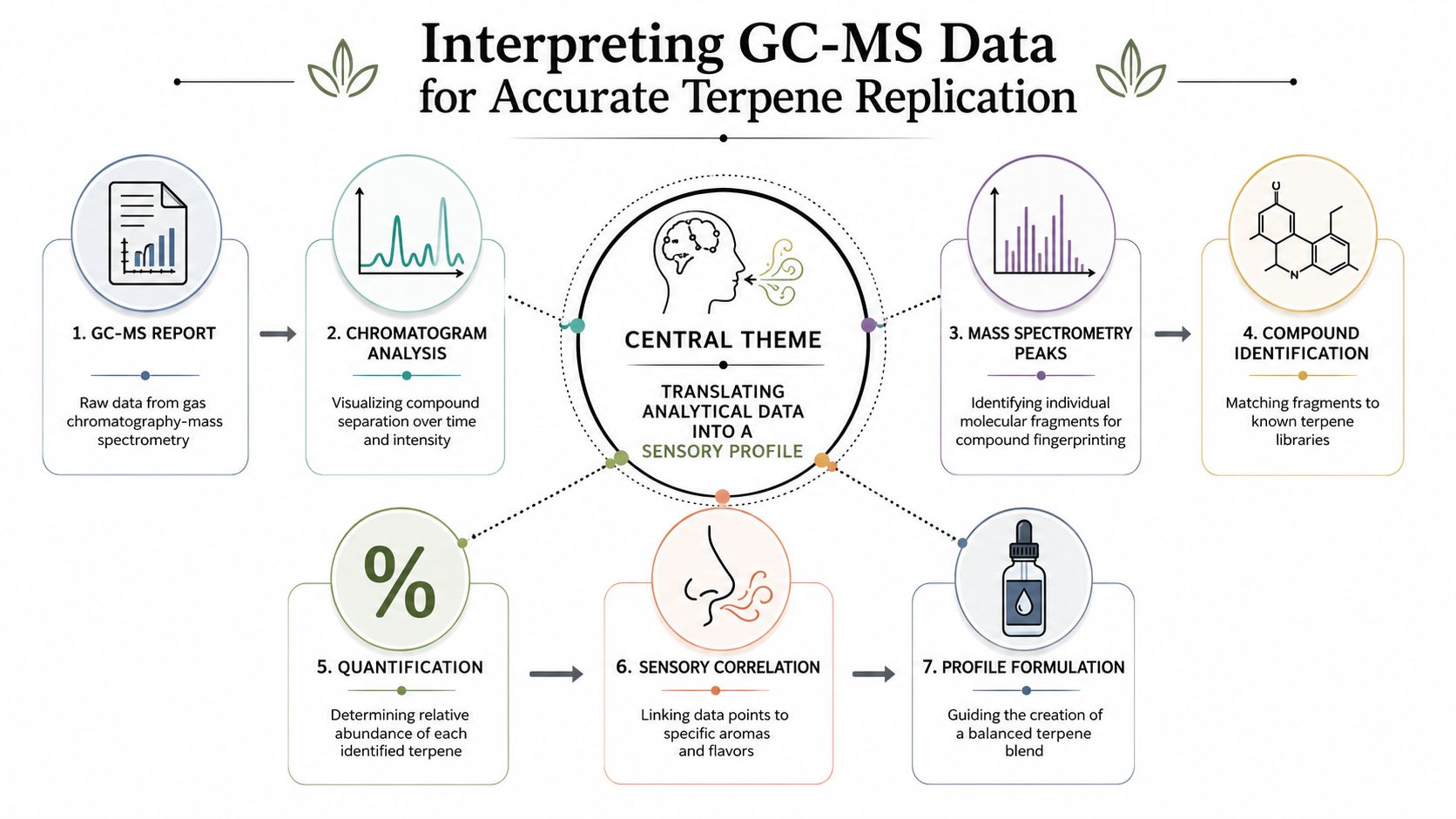
The seven checks that matter
Start with relative abundance
Don't ask only which terpene is first. Ask how far apart the top group sits. A profile where the top three compounds are close together behaves very differently from one where the lead terpene dominates.Read the middle of the profile
White Truffle often gets its identity from secondary compounds and the interaction between them. Mid-level compounds shape dryness, funk, and persistence.Watch for missing structure
If a sample has limonene and caryophyllene but little grounding support, the vapor may feel thin even if the bottle aroma looks promising.Check for “brightness inflation”
Some samples smell appealing on first open because top notes are exaggerated. That can fool evaluation panels, especially early in development.
What formulators often miss
Minor compounds aren't minor in effect. A small amount of a woody, herbal, or floral terpene can decide whether the blend reads as refined or unfinished.
Look for these practical signals:
- Compressed top end: The profile opens flat and never separates.
- Overweighted body notes: Everything lands in the same earthy register.
- Trace-note mismatch: The blend smells “close” in bulk, but wrong in the finish.
- Poor carry into vapor: Bottle evaluation passes, hardware testing fails.
A clean chromatogram still doesn't guarantee a useful White Truffle reference. You need a sample that performs sensorially, not just analytically.
A working review sequence
When I review a report for White Truffle replication, I use this order:
- First pass: Identify the structural core
- Second pass: Mark compounds responsible for lift or relief
- Third pass: Find what gives the profile its savory identity instead of generic earth
- Final pass: Compare the report to actual vapor behavior, not bottle aroma alone
That last step matters most. Some reports look ideal until the cart turns the profile hot, dry, and one-dimensional. GC-MS guides formulation. It doesn't replace sensory validation.
Formulation Guide for White Truffle Inspired Blends
A bench sample lands on the table smelling rich, earthy, and expensive. Then production scales it, puts it into oil, and the profile turns muddy or dries out into generic pepper and wood. That is the White Truffle problem. The target is not a single flower sample. The target is a repeatable commercial interpretation of a strain family that shows wide genetic and chemical variation from lot to lot.
A usable White Truffle strain-inspired terpene blend for distillate starts with structure. Build a profile that survives sourcing changes, dilution into oil, and routine manufacturing variance. If the foundation is unstable, adding more "funk" usually makes the blend less convincing, not more.
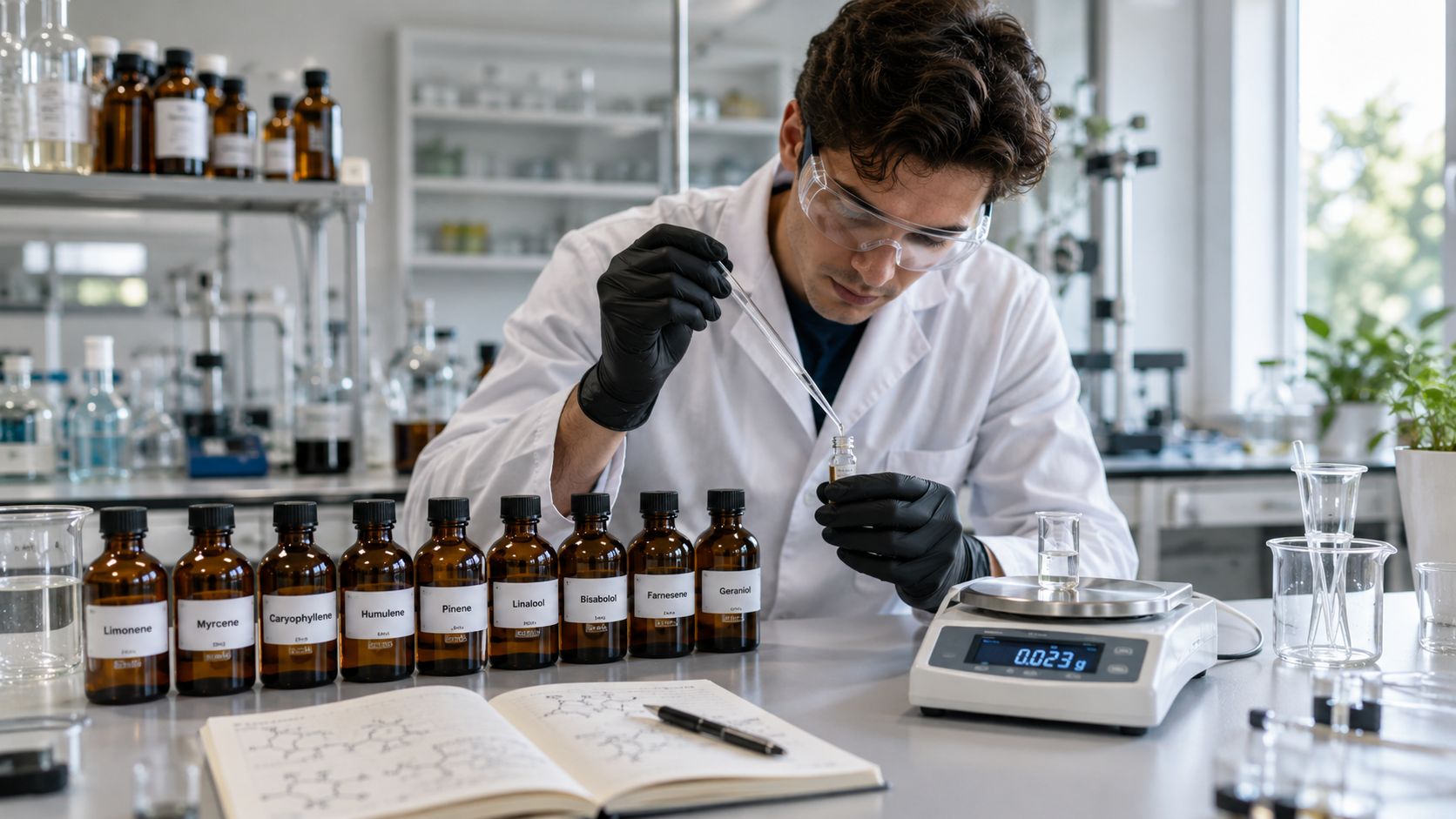
Build the structural core first
Start with beta-caryophyllene, humulene, and limonene. For White Truffle, these are usually the control points that determine whether the blend reads dry and savory or collapses into a dull earthy mass.
Use this as a bench starting ratio:
- 4 parts beta-caryophyllene
- 2 parts humulene
- 1.5 parts limonene
This is a framework, not a fixed recipe. Caryophyllene gives pepper, dry wood, and a slightly resinous bite. Humulene contributes bitter earth and a hop-like dryness that keeps the profile from drifting sweet. Limonene provides separation and lift, but too much shifts the result toward a cleaner citrus-wood profile that no longer reads White Truffle.
That trade-off matters in commercial work. A brighter formula often tests better in a quick aroma panel. A drier formula usually holds the category better once it is diluted and vaped.
Control brightness before you add complexity
Limonene is the easiest way to improve first impression. It is also the easiest way to lose the profile.
If the blend feels buried, increase limonene in small steps. If it becomes thin, restore body with caryophyllene or humulene before adding anything else. Teams often chase realism by stacking minor compounds too early, when the fundamental issue is that the top-to-base balance is still wrong.
A practical rule in development is simple. Do not add trace modifiers until the three-part core already smells believable at room temperature and after dilution into your target matrix.
For note mapping during R&D, a terpene flavor chart for formulation work can help convert a compound list into a sensory target your bench team can evaluate consistently.
Use myrcene carefully
Myrcene can help, but White Truffle is one of the profiles where it causes expensive mistakes. In small amounts, it adds weight and softens transitions between the dry base and brighter top note. In excess, it makes the blend feel wet, heavy, and indistinct.
I usually treat myrcene as a late-stage correction. If added too early, it hides weak architecture and creates a false sense of completeness.
A good working rule is to add myrcene only after the caryophyllene, humulene, and limonene relationship is close to target. Then test whether the body improved or whether the finish became flatter. Those are very different outcomes, and they require different fixes.
Add savory accents in trace amounts
The gourmet, truffle-like impression rarely comes from one dominant minor terpene. It comes from controlled use of low-level modifiers that shape the finish and after-aroma.
Useful trace-direction tools include:
- Nerolidol: adds depth and a subdued woody softness
- Borneol: sharpens the herbal edge and can improve definition
- Linalool at very low level: rounds harshness, but too much pushes the blend floral and away from the savory center
Discipline pays off. A trace note that smells elegant at 0.05% can smell stale or perfumed at 0.2%. White Truffle does not forgive overshooting.
Work from a method, not a single recipe
For commercial replication, use a staged process:
- Set the structural core with caryophyllene, humulene, and limonene
- Adjust body with restrained myrcene only if the profile still feels too lean
- Add trace accents to shape the savory identity and finish
- Re-test after dilution in the actual oil system
- Lock a tolerance window for each key terpene so purchasing can source within usable limits
That last step is what separates a bench success from a manufacturable product. White Truffle inputs vary. Suppliers vary. Even lots of the same isolated terpene can shift slightly in odor quality. A formula that depends on one perfect raw material is not ready for production.
After the first successful bench blend, test it in three forms:
- Neat aroma in glass
- Mixed into target oil
- Evaluated through intended hardware
A quick visual walkthrough of terpene mixing workflow can help during scaling and bench transfer:
What a commercially viable version looks like
The best commercial White Truffle formula usually does not match every White Truffle flower sample in the market. It delivers a stable interpretation of the category that still feels dry, savory, and slightly lifted.
Choose the compromise on purpose:
- For broader retail appeal: keep the citrus lift cleaner and reduce oppressive density
- For connoisseur positioning: allow more dryness, bitterness, and savory depth
- For repeat-use vape products: keep enough contrast to stay interesting without coating the palate after a few pulls
A good White Truffle formula is one your production team can make again, your hardware can carry, and your customers can recognize from batch to batch.
Applying the Profile to Vape Cartridges and Distillate
A White Truffle blend that smells right in the lab can still fail in a cart. This profile is unusually sensitive to hardware and matrix. The same formula can present as refined in one setup and rough, muddy, or strangely thin in another.
That's why formulating White Truffle strain terpenes for vape cartridges isn't just a flavor exercise. It's a transfer problem. You're translating a complex savory profile through hot metal, thick oil, and short consumer sessions.
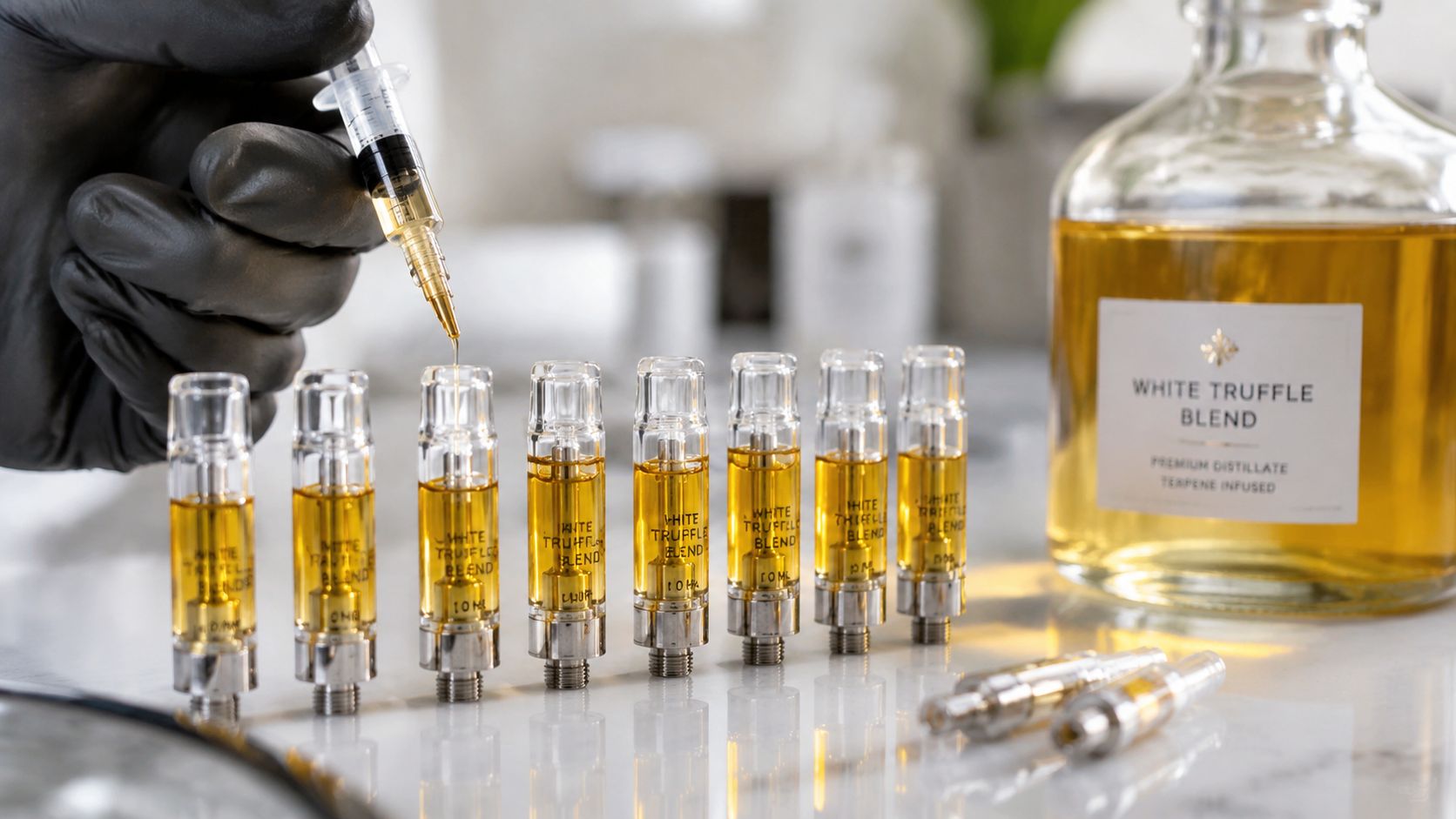
Why White Truffle is unforgiving in vapor
Fruit-heavy blends often tolerate some imbalance because sweetness and bright top notes hide rough edges. White Truffle doesn't. Its appeal depends on contrast between dry base notes, moderate lift, and a savory center. If the hardware overcooks the top notes, the blend goes blunt. If the oil suppresses the lighter fraction, all that remains is a dark earthy mass.
Use a disciplined process when you move from bench blend to finished oil:
- Match the formula to the base oil: Distillate viscosity changes how quickly top notes show up.
- Test more than bottle aroma: The first pull, the third pull, and the near-empty cart can all smell different.
- Evaluate persistence, not just impact: Savory profiles often start strong but become tiring if the finish is too dense.
Hardware changes the profile
Ceramic systems often preserve nuance better. More aggressive setups can flatten the distinction between caryophyllene, humulene, and the trace layer. The result is a louder but less recognizable White Truffle.
Teams often waste time blaming the formula when the actual problem is the cartridge system. Before revising your blend, test the same oil across your intended hardware options. You may find the profile issue is delivery, not chemistry.
A practical guide to using terpenes in finished products is useful here because the mixing procedure, homogenization, and downstream handling all affect how a profile behaves after fill.
Best practices for finished product performance
For White Truffle-style carts, these habits usually produce cleaner outcomes:
- Keep the blend focused: More compounds don't automatically mean more realism.
- Let the profile breathe in oil before final judgment: Immediate post-mix evaluation can be misleading.
- Use hardware validation as part of approval: A formula that only wins in a sample vial isn't production-ready.
The sensory target isn't “most pungent.” It's “most recognizable after filling, capping, storage, and vaporization.”
That's the standard that matters commercially. White Truffle can be an excellent cart profile, but only if the formula was built to survive the delivery system.
Professional Safety Handling and Storage Protocols
Concentrated terpenes deserve lab discipline. Teams sometimes get casual because the materials smell familiar. That's exactly how contamination, oxidation, and avoidable handling mistakes happen.
Non-negotiable handling rules
Use appropriate PPE, including gloves and eye protection, when working with concentrated terpene materials. Work in a well-ventilated area and keep containers closed when they're not actively in use. Open beakers sitting on a hot bench will cost you aroma fidelity before they cost you yield.
A few habits matter more than people think:
- Use clean glassware: Residual notes from prior blends can distort savory profiles quickly.
- Label every intermediate: White Truffle builds often include small trace additions that are easy to lose track of.
- Control exposure time: Oxidation changes aroma character, especially in the brighter fraction.
Storage that protects the profile
Store terpene materials in airtight containers, away from light and heat. Cool, dark storage slows degradation and helps preserve the balance between top, mid, and base notes. This matters even more for White Truffle-style formulations because the profile depends on fine note separation rather than blunt impact.
Use a simple storage standard for active production lots:
- Dedicated container for working stock
- Minimal headspace where practical
- Limited open-close cycles
- Routine sensory review before critical production runs
If a blend starts smelling flatter, dustier, or less defined than its original approval sample, don't force it into a production batch just because the top line still looks acceptable. Reconfirm the sensory profile before release.
Advanced Formulation FAQs for Savory Profiles
How do you keep a White Truffle blend from turning muddy?
Muddiness usually comes from stacking too many body notes before the profile has enough separation. Start by checking the relationship between caryophyllene, humulene, and limonene. If the center is already heavy, adding more myrcene or trace modifiers won't fix it.
A practical correction sequence works better:
- reduce the densest body contributor slightly
- restore edge definition with a small brightness adjustment
- re-test in vapor, not just in the bottle
Why does the blend smell accurate in glass but harsh in a cart?
Because aroma accuracy and vape performance are not the same test. Harshness can come from thermal behavior, poor hardware fit, or a formula whose top-end volatility is out of balance with the oil matrix.
Check the cartridge system before you assume the recipe is wrong. White Truffle-style profiles expose hardware weaknesses faster than sweeter blends do.
If the first puff is acceptable but repeat pulls get dry and abrasive, investigate the delivery system and heat behavior before rewriting the entire formula.
Can you adapt this profile for non-inhalable products?
Yes, but the sensory result won't map one-to-one. Savory terpene systems behave differently in tinctures, edible applications, and other formats because aroma release and flavor perception change with the matrix.
In non-inhalable formats, White Truffle often needs simplification. What reads as nuanced in vapor can read as oddly bitter or overly herbal in oral formats. Keep the structure recognizable, then adjust for the product rather than insisting on identical expression.
Why will a botanical recreation still differ from flower?
Because flower isn't just a terpene list. It includes minor volatiles, matrix effects, cultivar variation, and process history. Even a strong technical recreation is still an interpretation.
That isn't a flaw. It's a product development reality. The better question is whether your blend captures the recognizable White Truffle identity in a stable and commercially workable form.
What's the biggest mistake in savory strain replication?
Chasing authenticity so aggressively that you ignore usability. A White Truffle cart has to be distinctive, but it also has to stay pleasant across repeated use. If the profile becomes too dense, too bitter, or too dry, repeat purchase suffers even if the bench team admires the realism.
The strongest formulas usually sit one step cleaner than raw flower memory. That small adjustment often makes the difference between a cult favorite and a difficult SKU.
If you're building White Truffle strain terpenes for vape cartridges, a strain-inspired terpene blend for distillate, or a broader savory lineup for cannabis product formulation, Gold Coast Terpenes offers terpene blends, isolates, and formulation resources that help teams move from bench concept to stable commercial production.