
A brand team brings you a simple request. They want a Soda Pop vape. They already know the name, the packaging direction, and the flavor story they want to tell.
What they usually don't have is the chemical target.
That's where most soda pop strain projects start going sideways. Consumer-facing strain pages talk about sweetness, fruit, candy, and effects. Formulators need something else entirely. They need a sensory map, a terpene hierarchy, a mixing sequence, and a clear idea of what will still taste right once the blend is diluted into a real oil and pushed through hardware.
A usable formula starts when you stop treating the strain name as the formula. The name is only the brief. The work is turning that brief into a profile that is recognizable, stable, and repeatable in production.
Why Formulating a Soda Pop Strain Profile Matters
A lot of teams approach a soda pop strain concept backwards. They start with a catchy strain name, add broad citrus terpenes, then try to force a “soda” impression with sweetness cues. That often produces a cart that smells bright in the bottle but flattens on the inhale or turns harsh once heat is applied.
A central problem concerns target definition. For formulators, the gap between a strain's marketing and its chemical reality is a major hurdle. Consumers searching “Soda Pop strain” are often seeking to replicate its unique orange/soda-citrus character in vapes, but most online content fails to translate strain descriptions into actionable terpene compositions or sensory targets for product development, as discussed in this strain selection guide based on terpene profiles.
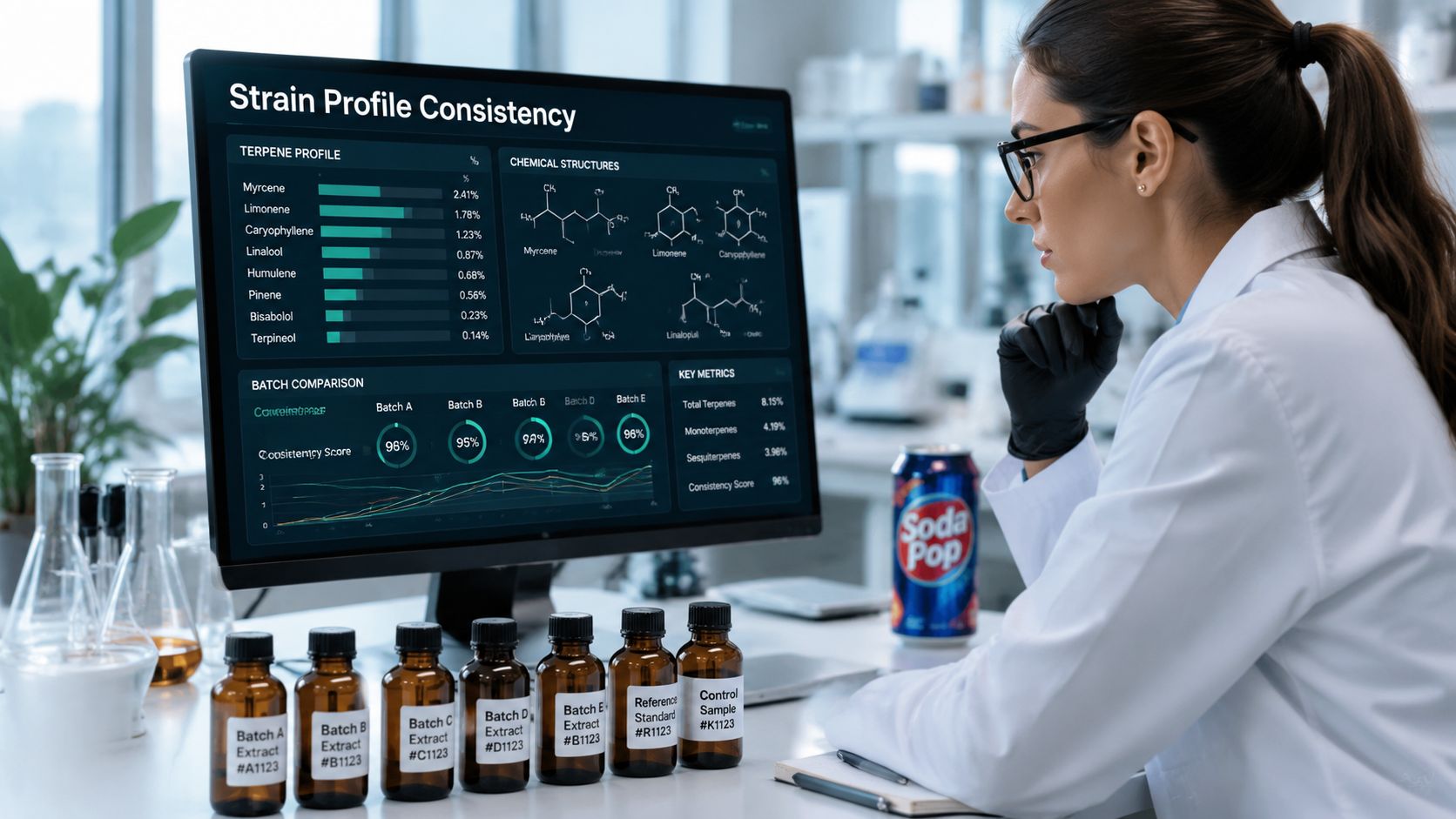
What brands usually miss
A flower description and a vape formulation brief are not the same thing.
In flower, subtle terpene interactions can carry the profile. In a cartridge, the user expects immediate recognition. If the first second doesn't read as citrus soda, cream soda, or cherry-lime style brightness, the product misses its mark even if the blend is technically strain-inspired.
Three issues show up repeatedly:
- Undefined flavor target: “Soda” can mean orange-citrus, dark cherry, confectionary cream, or fizzy citrus peel.
- Overbuilt top notes: Too much limonene-style brightness can make the profile smell cleaner-like instead of beverage-like.
- Weak mid-palate structure: Without enough body, the profile tastes thin and disappears under distillate weight.
Practical rule: Don't formulate for the jar aroma first. Formulate for recognition on the first inhale and persistence on the exhale.
What works in production
A workable soda pop strain-inspired terpene blend starts with constraints. You need to decide whether the product is trying to mirror cultivar lineage, retail flavor expectation, or a modern beverage trend. Those aren't identical goals.
For commercial vape work, the best results usually come from treating the strain as a sensory direction with botanical boundaries. That means preserving the fruit-forward cannabis identity while engineering enough top-note clarity and mid-note roundness to survive hardware variation, storage, and batch scale-up.
If you don't define that up front, you end up chasing revisions instead of building a repeatable SKU.
Analyzing the Soda Pop Cultivar Profile
A formulator usually sees the problem at the first bench run. The brief says “Soda Pop strain,” the team builds a bright fruit blend, and the result tastes like generic citrus candy once it hits hot hardware. That happens because the cultivar name is being treated like a flavor description instead of a source profile.
For this SKU, the useful starting point is the plant's lineage and market identity. Rocket Seeds lists Soda Pop as a cross of LA Confidential and Black Cherry Soda, which gives a practical framework for product development rather than a vague retail story. That matters because lineage helps define what should carry over into vape oil and what needs to be reconstructed through terpene selection, as explained in this breakdown of how terpene strain profiles define cannabis strains.
What the lineage means in formulation work
LA Confidential points to heavier body, resinous depth, and a darker backbone. Black Cherry Soda points to sweeter fruit character, brighter lift, and a more expressive top note. Put together, those parents suggest a profile with contrast. The blend needs sparkle, but it also needs weight.
That has direct formulation consequences. If the top note dominates, the cart reads as lemon-lime flavoring. If the base gets too dense, the profile loses the “soda” impression and turns muddy under distillate.
A workable sensory structure usually includes:
- Fast fruit lift on the first inhale
- Round cherry or berry body through the mid-palate
- Dry resinous support on the finish so the profile still reads as cannabis-derived
Why this cultivar keeps showing up in product planning
Cultivators and brands keep returning to Soda Pop because it sits in a commercially recognizable zone. It is positioned as a fruit-forward, moderately potent cultivar with strong retail naming appeal and practical production characteristics already noted elsewhere in this article.
That combination matters for formulators. A profile does not become a cartridge SKU just because it smells good in flower. It becomes a SKU when sales, extraction, and branding teams all see enough upside to justify repeated batch work, sensory testing, and hardware validation.
I treat Soda Pop as a translation job. The flower concept has to survive dilution into oil, thermal stress in the coil, and the narrower flavor window of a cartridge. Some cultivar profiles collapse under that process. This one usually does not, if the fruit note is built with restraint and the base is given enough texture.
Sensory target for a vape-ready interpretation
The target profile is specific. It should open with a fruit-soda impression, carry darker cherry or mixed-berry character through the center, and finish with enough dry spice or resin to keep it out of candy territory.
That is a tighter brief than “sweet” or “fruity,” and it saves time in R&D.
A practical target brief looks like this:
- Primary impression: bright citrus-fruit pop
- Secondary impression: cherry, berry, or dark fruit roundness
- Finish: soft peppery, resinous, or woody grounding note
- Overall feel: polished, recognizable, and beverage-inspired without tasting artificial
One warning matters here. Soda Pop is easy to oversimplify. Teams often push the high note because it sells in the smelling jar, then wonder why the filled cart tastes thin after a week on the shelf. The better approach is to define the cultivar's structural cues first, then decide how much commercial sweetness the market can tolerate without losing strain credibility.
The Terpene Blueprint for Replicating Flavor
Once the target is clear, the blend needs a note structure. For soda pop strain-inspired formulation, I treat the profile like a layered beverage flavor with a cannabis base. That's different from copying a fresh flower nose exactly. A cart has to project faster and hold together under heat.
The core architecture usually centers on limonene, myrcene, and beta-caryophyllene. That combination gives you the fastest route to a believable soda-like profile without losing the plant-derived feel. A useful reference when tuning those relationships is a terpene flavor chart for aroma and taste mapping.
Top, mid, and base roles
Limonene does the obvious work. It supplies bright citrus and gives the profile immediate recognition. But limonene alone won't read as soda. Used too aggressively, it skews into peel, solventy brightness, or a candy-citrus note that feels detached from cannabis.
Myrcene is what makes the profile feel full. It adds ripe fruit weight and softens sharp edges. In a Soda Pop-style blend, myrcene is often the terpene that stops the cart from tasting thin.
Beta-caryophyllene is the structure piece many teams underuse. It doesn't make the blend “spicy” in an obvious way unless you push it too hard. At lower support levels, it creates a dry, textured mid-to-base note that helps mimic the bite and lift people often interpret as fizz.
Minor terpenes then shape the authentic quality:
- Pinene can add air and lift if the blend feels syrupy.
- Humulene can dry the finish if the fruit is too soft.
- Additional citrus-adjacent minors can sharpen recognition, but they need restraint.
Soda Pop Profile Terpene Components
| Terpene Isolate | Flavor Contribution | Note Classification |
|---|---|---|
| Limonene | Bright citrus, sweet orange-like lift, fast palate recognition | Top note |
| Myrcene | Ripe fruit body, soft sweetness, roundness | Base note |
| Beta-Caryophyllene | Dry spice, structure, subtle fizzy bite impression | Mid to base note |
| Pinene | Freshness, lift, airy edge | Top to mid note |
| Humulene | Drying finish, herbal restraint | Base note |
How to think about the blend
Don't think of the profile as “orange plus sweetness.” Think of it as brightness over fruit body over dry structure.
That order matters because vape perception is compressed. The user gets a quick front-end flash, then the blend either opens or collapses. If the top note is loud but the middle is weak, the cart tastes flashy and empty. If the base is too heavy, the cart tastes muddy and old.
Build the profile so each inhale moves in sequence. Bright entry, rounded center, dry finish.
Common formulation errors
The most common errors in soda pop strain replication are easy to spot in sensory review:
- Too much limonene: sharp, thin, sometimes cleaner-like
- Too much myrcene: syrupy, sleepy, dark, and less “soda”
- Too much caryophyllene: peppery, woody, and no longer fruit-forward
- Too much pinene: green, conifer-forward, less beverage-like
A stronger result comes from keeping minor terpenes in support roles. The profile should read as fruit soda first, cannabis second, and terpene complexity third. If any one isolate announces itself too strongly, the blend loses the illusion.
A Step-by-Step Guide to Formulation
Bench work is where soda pop strain ideas either become a product or stay in a brand deck. The fastest way to waste time is to add all your bright terpenes first and try to “fix” harshness later. Start with structure instead.
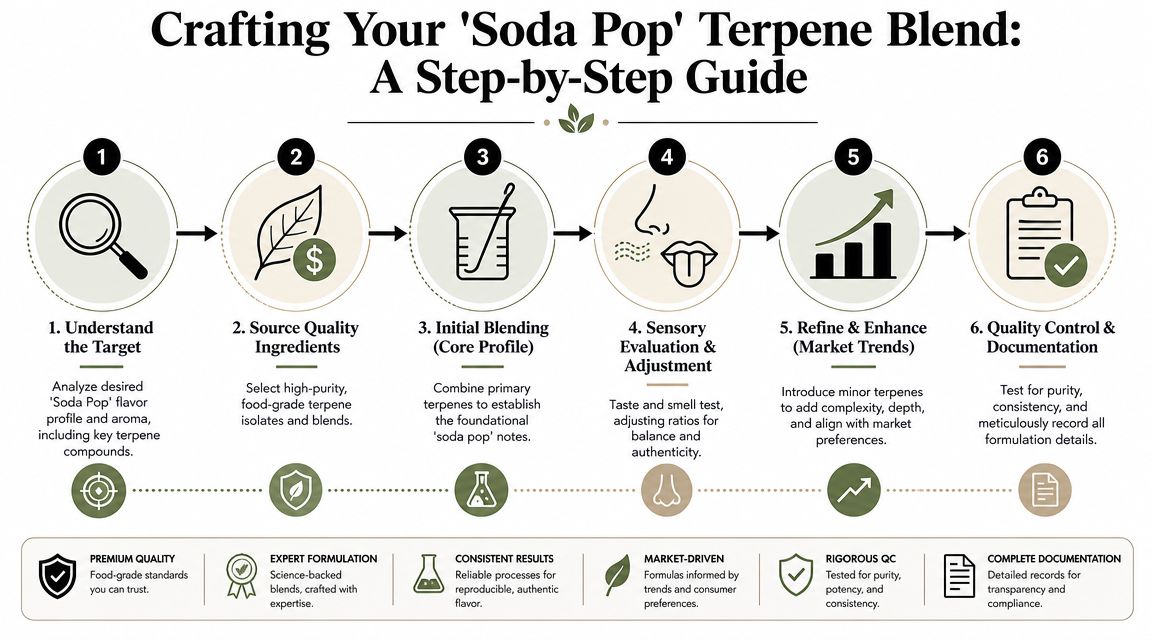
Start with a neutral matrix
Use a neutral, winterized distillate or another clean oil base that won't impose too much residual flavor. If the base already carries heavy sulfur, burnt notes, or dark plant carryover, your evaluation of the terpene blend won't be clean.
Before adding anything, define your sensory brief in one sentence. Example: bright citrus soda opening, ripe fruit center, dry sparkling finish.
That sentence keeps revisions disciplined.
Build the blend in layers
I recommend building the terpene blend separately before introducing it to the oil. For a first-pass bench prototype, a simple 4-3-2-1 style relationship works as a directional model:
- Four parts limonene for the primary citrus lift
- Three parts myrcene for body and fruit roundness
- Two parts beta-caryophyllene for structure and fizz-like bite
- One part mixed minors such as pinene or humulene for lift or dryness
This is not a locked formula. It's a sensory starting point.
What matters is the order of adjustment. If the blend feels thin, don't automatically add more citrus. Increase body first. If the blend feels heavy, reduce the base or use a small amount of a drying terpene before increasing the top note again.
Sensory checkpoints that matter
After the initial mix, evaluate three moments separately:
- Cold aroma: what the filled cart smells like before use
- First inhale: whether the product reads as soda-like immediately
- Exhale finish: whether fruit remains or drops out into generic spice
A profile can smell excellent in the beaker and still fail in hardware. That's why bench tasting only from the blend bottle is not enough.
Bench note: If the profile disappears after the first puff, the issue is usually not “more flavor.” It's poor note distribution.
Practical workflow for repeatable batches
Use a documented workflow every time:
- Pre-blend isolates: Mix the terpene system first and let it settle before adding to oil.
- Add slowly to the matrix: Avoid dumping the full load at once. Homogenize in stages.
- Test in the target hardware: The same blend behaves differently across cartridge designs.
- Record sensory language consistently: “Bright,” “thin,” and “harsh” are useful only if your team defines them the same way.
For teams calculating component proportions, a tool like the Gold Coast Terpenes mixing calculator can help convert bench ratios into production quantities without rewriting the formula by hand.
What doesn't work
A few shortcuts fail over and over:
- Copying flower descriptors directly into a formula brief
- Trying to create soda with sweetness cues alone
- Using too many minor terpenes in the first bench round
- Judging the blend before it has been tested in a real cartridge
Simple blends usually beat overcomplicated ones during early R&D. Get the core note architecture right first. Complexity only helps once the product already tastes recognizable.
Fine-Tuning the Flavor for Market Trends
A technically correct Soda Pop formulation can still miss the shelf if it feels dated. The broader beverage market matters here because many buyers no longer separate strain inspiration from mainstream flavor cues. They expect overlap.
The current opportunity is the crossover between a fruit-forward cannabis profile and the broader dirty soda style of flavor thinking. That trend leans fruity, creamy, and easy to recognize. For formulators, that matters because the target is no longer just “strain authenticity.” It's also immediate flavor comprehension.

What the market is really asking for
The useful takeaway from dirty soda isn't that every vape should taste creamy. It's that consumers respond to fast-recognition flavor architecture. The fruity, creamy, and socially shareable framing around dirty soda creates a market angle for Soda Pop-inspired products when formulators focus on notes that align with creamy-citrus concepts and translate well into manufactured products, as described in this dirty soda cannabis beverage trend article.
For vape cartridges, that means tuning the profile toward one of three lanes:
- Citrus soda lane: sharper, brighter, cleaner finish
- Cream soda lane: softer top, fuller middle, smoother finish
- Cherry-lime lane: darker fruit center with a higher-contrast opening
Each lane can still sit under a Soda Pop strain-inspired concept. What changes is the note balance.
Creating the fizzy impression
“Fizz” is not a single terpene note. It's a sensory effect produced by contrast.
To create it, I usually look for:
- A quick citrus top that appears immediately
- A drier middle so the blend doesn't feel flat
- A controlled finish that stops the profile from becoming syrupy
If the blend feels too rounded, it loses the soda impression. If it feels too sharp, it becomes generic citrus. The sweet spot sits in the tension between lift and dryness.
Here's a useful visual reference for that product-thinking mindset:
Hardware changes the flavor
The same terpene blend won't present identically in every cartridge. Some hardware pushes top notes hard and burns off nuance quickly. Other systems mute the opening and exaggerate body.
That means fine-tuning can't happen only in a vial. It has to happen in the actual delivery format. A blend that feels perfectly “soda-like” in one cart may taste muted or too dry in another.
If the brand wants one profile across multiple hardware platforms, formulate for the weakest-presenting device first, then confirm the stronger device doesn't overexpose the top note.
That approach usually protects consistency better than optimizing for the most flattering test setup.
Ensuring Safety and Consistency in Production
A Soda Pop profile can smell right in a beaker and still fail after filling. I see that gap often with soda-style formulas because the target is narrow. The product has to hold a bright top note, a controlled sweetness, and a clean finish after dilution, cartridge fill, storage, and real use.
For formulators, safety and consistency start with a simple rule. Treat the cultivar story as a sensory reference, then lock commercial decisions to measurable inputs and repeatable process controls. Earlier cultivar notes can help define the target. They should not be the foundation of batch release.
Purity controls the outcome
Input quality sets the ceiling for the formula. If the d-limonene lot is slightly oxidized, the opening loses freshness and picks up harshness. If a supporting isolate carries trace off-notes, the whole blend can shift from "fizzy soda" to cleaner fluid or candy.
Use terpene inputs with lot-level documentation, identity testing, and storage history. Teams that need a practical reference for screening materials should review these terpene quality standards and purity benchmarks.
The common failure points are predictable:
- Lot drift in key top notes: Small changes in citrus-heavy materials show up fast in finished vapor.
- Supplier substitutions without revalidation: A material can meet a spec sheet and still miss the sensory target.
- Poor storage discipline: Oxygen, heat, and light flatten delicate notes and can increase throat irritation.
- Uncontrolled diluent or base interactions: The same terpene blend can present differently depending on the oil matrix.
Process variation causes more problems than formulators expect
Many off-spec batches are not bad formulas. They are badly repeated formulas.
Mix temperature matters. Hold time matters. Fill timing matters. A Soda Pop-style profile is especially sensitive because the top note does a lot of the work. If production leaves the blend exposed too long before filling, the first thing to fade is usually the note the customer remembers.
Use an SOP that defines:
- Incoming lot review for each terpene and cannabinoid input
- Exact pre-blend weights with second-person verification
- Mixing order and temperature range for every batch size
- Defined rest period before evaluation and filling
- Retained samples from bulk oil and filled hardware for comparison
Release against a sensory window, not a hunch
A stable commercial profile needs acceptance criteria. That includes analytical checks where available, but it also needs a trained sensory standard in the actual device.
I recommend keeping a locked retain that represents the approved Soda Pop target and comparing every production lot against it in hardware. Evaluate fresh fill and short-term hold. Some blends open nicely on day one, then lose the snap that made them sell.
Consistency means the customer gets the same recognizable impression batch after batch. Procurement controls what enters the building. Production controls what happens to it. QA confirms the finished oil still fits the formula you intended to make.
Turning Your Formulation into a Market Success
The practical challenge with a soda pop strain-inspired vape isn't finding a catchy flavor direction. It's turning that direction into a product that stays recognizable from bench sample to filled cartridge.
The path is straightforward when the team stays disciplined. Define the target from lineage and sensory intent. Build the blend with clear top, mid, and base roles. Test in real hardware. Then lock the process down so the profile survives scale.
The strongest Soda Pop-style products usually don't try to be everything at once. They choose a lane. Citrus-forward, cream-adjacent, or darker fruit soda. That single decision makes terpene selection, revision cycles, and brand positioning much easier.
If you're developing for vape cartridges or distillate, think like a formulator first and a marketer second. The strain name gets attention. The note structure keeps the SKU alive.
If you're building a soda pop strain-inspired terpene blend for vape cartridges, concentrates, or distillate, Gold Coast Terpenes offers strain-style profiles, individual isolates, and formulation resources that can help you move from concept to bench sample with a more controlled process.