
A new batch of distillate lands on the bench. Potency is acceptable. Color is close enough. Then the aroma test fails.
The last production run opened with a bright citrus top note and settled into a clean, familiar finish. This one smells flatter, heavier, and slightly off-profile. If that SKU is supposed to be consistent across cartridges, jars, or infused products, the problem isn't cosmetic. It affects customer recognition, repeat orders, and how much rework your team has to do before fill day.
That's usually when the question comes up: what is terpene blend in a professional formulation context? It isn't just a flavor additive. It's a controlled mixture of terpene compounds used to shape aroma, flavor, and the product character buyers associate with a specific SKU.
The Formulator's Challenge Inconsistent Products
A batch can pass potency, viscosity, and color, then still fail the one test that determines whether the SKU is fill-ready. It does not smell like itself.
That is usually where terpene work becomes a formulation discipline instead of an afterthought. In commercial production, inconsistency rarely comes from one dramatic error. It comes from small shifts that stack up across extraction, distillation, storage, and terpene addition until the finished oil no longer matches the profile your customers expect.
Why consistency is the primary goal
Junior formulators often focus on making a batch smell better. Production teams need a tighter standard than that. The target is a repeatable sensory profile that survives raw material variation, processing stress, and scale-up.
A terpene blend is a controlled combination of terpene compounds used to set aroma, flavor, and product identity. That control matters because buyers do not judge a cartridge by assay alone. They judge whether the opening note, mid-palate, and finish match the last unit they bought. If the profile drifts, the SKU starts to feel unreliable even when the cannabinoid panel stays within spec.
I treat terpene blending as a standardization tool first. Flavor improvement is part of the job, but commercial value comes from batch-to-batch recognition, fewer holdbacks, and less rework before filling.
Teams building house profiles usually benefit from a documented terpene blending framework for signature scent development rather than selecting blends by aroma alone.
Practical rule: If cannabinoid results are stable but sensory results are not, fix the formulation process before you blame the market response.
Where batches usually go off course
The same failure points show up again and again on production floors:
- Relying on native extract aroma alone: Distillate can carry residual character, but it is rarely consistent enough to anchor a branded SKU across multiple lots.
- Adding terpenes too late in development: Last-minute correction work usually masks defects instead of defining a stable profile.
- Ignoring process conditions: Heat exposure, hold time, vessel conditions, and mixing order can flatten top notes or push a blend out of balance before the oil reaches the filling line.
- Chasing one dominant note: A loud limonene or myrcene note may smell attractive in a beaker, but commercial products are judged on the full profile, not one terpene shouting over the rest.
There is also a business cost. Every off-profile batch creates extra sensory review, slows release, increases the chance of internal debate about whether the oil is still sellable, and makes forecasting harder because your flagship SKU stops behaving like a standard product.
Good formulators define the profile first, then build a process that protects it. That is what terpene blending is for.
Deconstructing Terpene Blends The Three Core Types
A terpene blend isn't one thing. In production, you'll usually deal with three practical categories. Each solves a different problem, and each comes with different sourcing and positioning trade-offs.
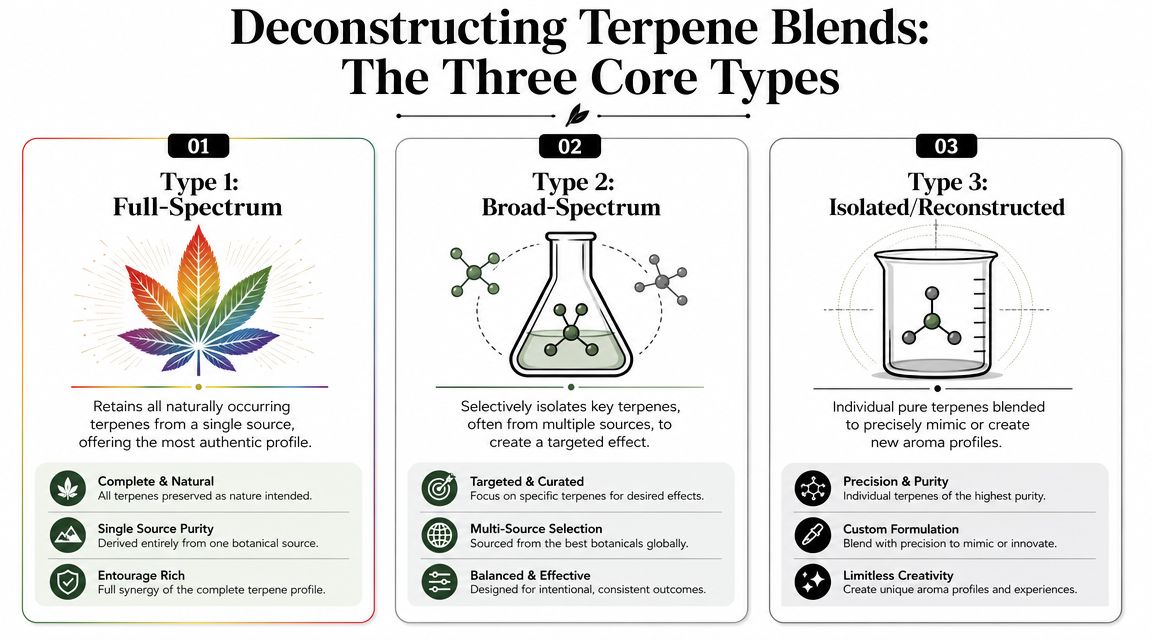
Three blend families you'll actually use
The first is the strain-inspired terpene blend. This is what brands use when they want a SKU to land in a familiar market category such as Blue Dream, OG Kush, or another recognized profile. The goal isn't nostalgia. It's market legibility. Buyers know roughly what they expect from the name, and the blend helps you reproduce that expectation across batches.
The second is the functional blend. These are built around a product concept like relaxation, uplift, or focus. They can be useful for brands that want to move away from strain naming and build their own sensory architecture. The trade-off is that marketing language has to stay disciplined because sensory intention is one thing, guaranteed human effect is another.
The third is the isolate-based custom blend. This is what experienced developers use when they need precise control. You start with individual terpenes and build the profile from the ground up. It takes more bench work, but it's often the cleanest path when you need to replicate a target flavor or correct a profile that is close but not commercially ready.
Source material changes the commercial equation
Medical News Today notes that terpenes occur in many plants, and this matters for sourcing because the difference between cannabis-derived terpenes and botanically derived terpenes affects consistency, cost, and supply strategy. In general, BDTs from plants like pine and citrus offer stronger consistency and scalability for profile replication, while CDTs can deliver a more authentic cannabis aroma but often come with higher cost and more batch variability, as outlined in this overview of terpene sourcing and use.
That's not a philosophical choice. It affects margin, purchasing, and whether your production team can keep a named profile stable.
Here's the quick comparison.
| Blend Type | Primary Goal | Best For | Source Material |
|---|---|---|---|
| Strain-inspired blend | Replicate a familiar cultivar-style profile | Retail-facing SKUs with recognizable names | Often botanical, sometimes cannabis-derived |
| Functional blend | Support a brand concept such as relax or focus | Lifestyle lines and differentiated menu structures | Botanical, custom, or mixed-source |
| Isolate-based custom blend | Fine control over aroma and flavor architecture | Product development, correction work, private-label customization | Individual terpene isolates |
For teams building a repeatable house style, a practical starting point is learning how profile construction works before buying by name alone. This guide on crafting your signature scent through terpene blending is useful for understanding that design logic.
The right blend type depends less on trend language and more on what your SKU has to do on the shelf and on the filling line.
The Science of Sensory and Functional Effects
A good terpene blend works like aroma architecture. It unfolds in stages.
Some compounds hit fast and define the opening impression. Others fill the middle and keep the profile from feeling thin. Others sit deeper in the structure and give the finish weight, persistence, or dryness. If you don't think in layers, you'll keep building blends that smell promising in the bottle and disappointing in the cart.
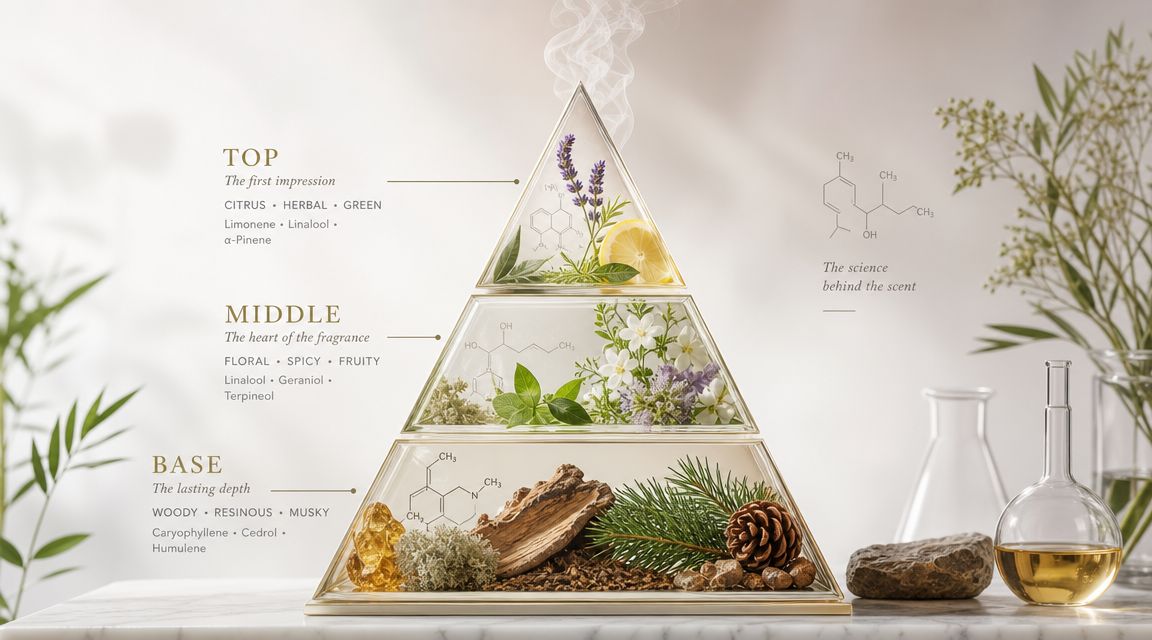
Top, middle, and base notes in cannabis product formulation
In practical terms:
- Top notes create the first read. These are the bright, volatile notes that make a profile seem fresh, sharp, citrusy, piney, or floral on first opening.
- Middle notes carry identity. They allow a blend to feel rounded and strain-inspired instead of one-dimensional.
- Base notes anchor the finish. They can add depth, spice, earth, resin, or body that keeps the profile from disappearing too quickly.
A junior developer often tries to fix a weak blend by adding more of the loudest top note. That usually makes the profile harsher, not better. The better move is to ask what's missing in the middle or what isn't supporting the finish.
What sensory effects are real, and what claims need caution
Formulation and marketing often get mixed together. Terpenes absolutely drive aroma and flavor. They also shape user perception because smell and taste strongly influence how a product is experienced. But that doesn't mean every “uplift” or “relax” claim is settled science.
Healthline notes that the entourage effect remains a hypothesis with limited definitive evidence, and that terpenes clearly affect the sensory profile while claims about consistent psychoactive or therapeutic outcomes should be framed carefully in commercial use. That's a useful standard for formulators working on effect-positioned products, as discussed in this review of cannabis terpenes and the entourage-effect question.
Build sensory intent with confidence. Build therapeutic claims with restraint.
That distinction helps in meetings. If sales asks whether a blend will change the cart experience beyond taste, the careful answer is yes in terms of aroma, flavor, and user perception. The stronger answer about predictable functional outcome still needs caution.
A deeper technical discussion of synergy is useful when you're building layered profiles for finished goods. This article on how different terpenes work together is a practical follow-up for that work.
How Professional Terpene Blends Are Made and Tested
Professional terpene blending starts long before anything touches a distillate beaker. The process begins with selecting source materials, defining a target profile, and deciding whether the job is replication, correction, or invention.
A lot of low-level confusion in the market comes from treating all terpene products like flavor bottles. In an actual manufacturing environment, a terpene blend is a controlled ingredient. It needs to perform the same way in development, pilot runs, and production.
What a serious blend process looks like
At minimum, a blend should be built from known components with known identity. That can mean using individual isolates to reconstruct a target profile, or using a prebuilt profile that has already been validated against a formula target.
The practical workflow usually looks like this:
- Define the target profile: Decide whether you're aiming for a named strain-inspired profile, a house flavor, or a functional concept.
- Select component strategy: Choose cannabis-derived, botanical, or isolate-based inputs based on cost, supply, and sensory goals.
- Create a pilot blend: Bench test in a neutral base or finished oil.
- Evaluate under use conditions: Smell in bottle is not enough. Test in the actual hardware or finished format.
- Lock the formula: Once it works, document ratios, process temperature, and order of operations.
Why analytical testing matters
In a professional context, “terpene blend” can also refer to a certified reference material used for analytical work. Cayman Chemical's Cannabis Terpenes Mixture 2 CRM is one example. It's a precisely quantified multicomponent material used in LC-MS or GC-MS workflows, which shows how the industry approaches terpene verification and calibration in real laboratory settings through products like this cannabis terpenes CRM for GC-MS and LC-MS work.
That matters because reproducibility doesn't come from guesswork. It comes from identity testing, concentration control, and comparing production materials against a defined target.
If your supplier can't support verification, you're not buying a formulation component. You're buying uncertainty.
For teams that are evaluating suppliers or tightening internal QC expectations, this primer on why purity matters in terpene quality standards is worth reviewing alongside your own incoming inspection process.
Formulating Terpenes for Vape Cartridges and Distillate
A cartridge can pass bench aroma, fill cleanly, and still fail once it hits hardware. The usual cause is process control, not profile selection. In vape work, terpene blends are formulation inputs that affect viscosity, flavor delivery, batch consistency, and cartridge-to-cartridge variation. Treat them like precision ingredients, not finishing drops.
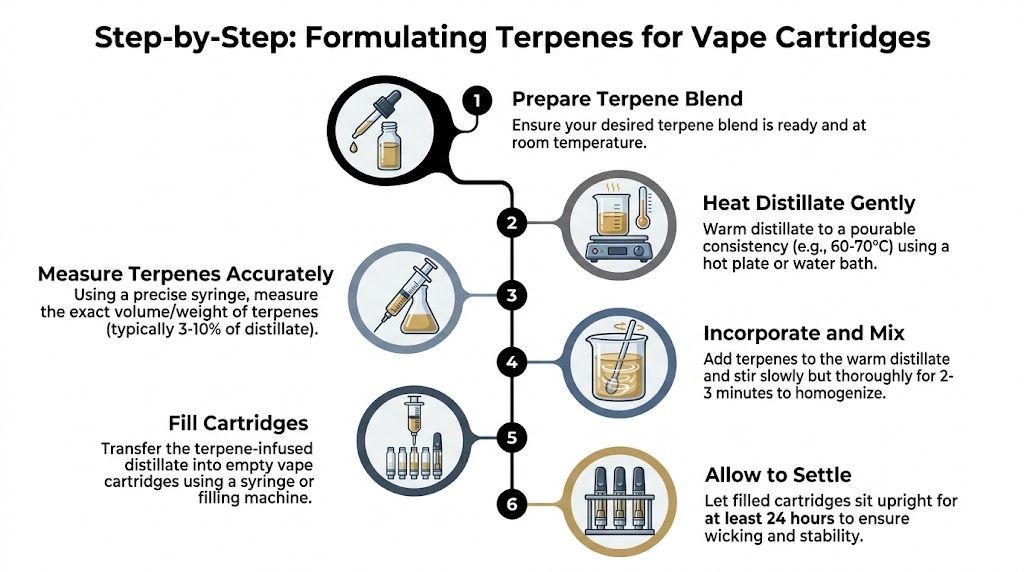
Start with the target loading, not the bottle aroma
Set terpene percentage from the product brief and the hardware, then confirm it in pilot runs. Distillate type, cannabinoid concentration, and atomizer design all change how a blend presents in use. A level that smells impressive in a jar can taste sharp, thin, or harsh after heating.
For most cartridge programs, formulators start low and work upward in controlled increments. That approach protects margin and gives cleaner sensory reads. It also avoids a common commercial mistake. Overdosing terpenes to force impact usually creates a louder profile in QC, then more returns once the cart is in market.
Native character matters too. A heavily refined distillate may need more terpene support to avoid tasting hollow. A base with usable residual aroma often needs less than the team expects.
Heat management decides whether top notes survive production
Temperature is where good blends get damaged. Distillate has to be warm enough to move and mix, but every extra degree increases terpene loss risk, especially in lighter fractions. Terpenebelt Farms outlines a practical handling range for concentrates and explains why lower-temperature mixing protects volatile components in this concentrates formulation guide for terpene handling.
The operating rule is simple. Warm for flow. Add terpenes at the lowest temperature that still gives full homogenization.
I usually hand junior formulators this workflow:
- Pre-warm the base only as much as needed: Reduce viscosity first, then let the oil settle into a controlled mixing range before terpene addition.
- Weigh everything: Volumetric shortcuts create avoidable drift, especially on small pilot batches.
- Add terpenes slowly: Controlled addition prevents localized hot spots and uneven saturation.
- Use steady agitation, not aggressive mixing: You want uniformity without whipping air into the batch.
- Hold, then recheck: Some blends read differently after a short rest, especially in dense distillate systems.
- Test through the intended hardware: Sensory approval in glass is not release approval for a vape SKU.
For teams building or tightening SOPs, this guide on how to use terpenes in vape and oil formulation is a useful reference alongside internal batch records.
The process video below is useful for teams training operators on handling sequence and bench discipline.
Mistakes that ruin otherwise good blends
Production problems usually come from repeatable handling errors, which is good news because they are preventable.
- Adding terpenes to overheated oil: Top notes flash off first, and the finished cart tastes flatter than the retained sample.
- Poor homogenization: Incomplete mixing creates fill-to-fill inconsistency, which shows up as sensory drift across a single lot.
- Using terpenes to hide a weak base: Extra flavoring does not fix oxidation, poor refinement, or off-notes in the distillate. It stacks another defect on top.
- Ignoring hardware interaction: The same blend can perform differently in ceramic, cotton, and different intake designs.
- Skipping a short stability hold before filling: A batch that looks uniform immediately after mixing can still settle or present differently a few hours later.
For formulators, the commercial goal is not maximum aroma. It is a repeatable fill blend that survives production, tastes right in the actual device, and stays consistent across the life of the SKU. Temperature control, accurate dosing, and hardware-based evaluation do more to protect that outcome than constant profile swapping.
Choosing the Right Blend for Your Product Strategy
A common product meeting goes like this. Sales wants a strain name that moves quickly, marketing wants a flavor profile the brand can own, and production wants something they can reproduce lot after lot without constant adjustment. Blend selection sits at the center of that tension.
The right choice depends on the job the SKU needs to do.
Use a strain-inspired terpene blend when the commercial goal is immediate recognition. This is the practical option for crowded vape menus, distributor conversations, and lineups where buyers sort products by familiar profile names. It reduces explanation at the shelf and gives the sales team a shorthand.
Use a functional blend when the brand story matters more than cultivar references. This works well for hemp lines, wellness-positioned products, and multi-market programs where raw material availability changes from state to state. The benefit is a cleaner naming system and fewer portfolio disruptions when a specific strain profile becomes harder to source consistently.
Use a custom blend when differentiation has to survive comparison. House profiles, dessert-style concepts, and corrected blends for difficult bases usually fit here. The trade-off is development time, tighter QC, and more iteration before the profile is ready for scale.
Selection gets easier when you build the portfolio on purpose instead of approving profiles one by one.
Map the line by commercial role:
- Anchor SKU: Familiar profile, broad demand, easy sales story
- Differentiator SKU: Distinct branded identity that separates the line
- Technical SKU: Built around a specific hardware platform, oil behavior, or target experience
- Seasonal or limited run: Controlled test case for new profile directions
That structure prevents a common portfolio mistake. Teams approve several blends that all live in the same sensory lane, then wonder why the menu feels repetitive and cannibalizes itself.
Loading rate belongs in the same discussion. A blend that smells impressive in the bottle can become harsh, muddy, or hardware-specific once it is in a finished cart. Lower inclusion can preserve clarity and help the base extract carry part of the profile. Higher inclusion can make sense when the distillate is too neutral, the target flavor needs stronger top notes, or the SKU is built around a clear aromatic identity. The correct answer comes from the finished device, not from bench aroma.
A good blend decision supports three outcomes at once. The SKU is easier to explain, easier to reproduce, and easier to extend into the next launch.
That is the standard formulators should use. Choose the blend that fits the sales channel, the brand architecture, and the production reality at the same time.
Essential Safety and Regulatory Handling
Concentrated terpenes need to be treated like serious raw materials. They're aromatic, potent, and capable of changing viscosity, throat hit, and handling behavior quickly. Casual bench habits create avoidable safety and quality problems.
Work in a ventilated area. Use gloves and eye protection. Keep containers closed when not in use, especially during active formulation. Don't leave measured terpene aliquots sitting open on a warm bench while you troubleshoot another part of the batch.
Documentation you should ask for every time
A professional purchasing and QA process should include:
- Safety Data Sheets: Your production and compliance teams need them before routine handling.
- Certificates of Analysis: These support identity and consistency review.
- Lot traceability: If a profile drifts, you need to know what entered the batch.
- Usage guidance: Concentrated ingredients require defined handling and incorporation procedures.
The other regulatory discipline is restraint in claims. Keep sensory language separate from implied medical or therapeutic promises. Formulators can design for aroma, flavor, and product character with confidence. Claims beyond that need far more support than most marketing teams assume.
A terpene blend is valuable when it improves reproducibility, SKU clarity, and finished product performance. It becomes risky when teams treat it as unstructured flavoring.
If you're building cartridges, concentrates, or other cannabis product formulation workflows and need repeatable strain-inspired terpene blends, isolates, or formulation resources, Gold Coast Terpenes offers product options and technical materials that can support sourcing, profile development, and batch consistency.