
You're often not troubleshooting a flavor problem when a new cart line comes back inconsistent. You're troubleshooting decarb.
The pattern is familiar in production. One batch pours clean, fills well, and carries the intended top notes. The next batch tastes flatter, darkens faster, or lands outside the expected potency window even though the input material came from the same extractor. Teams usually look first at terpene ratio, hardware, or crude variation. Those matter. But how to decarb wax is often the hidden control point that decides whether the rest of the formulation behaves the way it should.
For product developers working with vape cartridges, infused oils, or edible bases, decarboxylation isn't just about “activating THC.” It's a thermal conversion step that affects potency, aroma retention, blend behavior, and the stability of everything that happens next.
Why Mastering Decarboxylation Is Critical for Formulation
A lot of formulation problems start before any terpene is added back.
A processor decarbs one wax batch a little hot because the oven dial runs warm. Another operator pulls the next tray early because the bubbling looked aggressive and they didn't want to overcook it. Both batches move downstream. Both can still fill into cartridges or blend into edible oil. But they won't behave the same way once you evaluate flavor, viscosity, and finished potency.
That's why decarb belongs in the same conversation as blending, homogenization, and terpene selection. If your team still treats it as a simple prep step, you're leaving too much product quality to chance. Gold Coast Terpenes has a basic explainer on what decarb means, but in a production environment the practical question is different. The question is whether your process converts cannabinoids consistently without stripping more aroma than necessary.
What goes wrong when decarb drifts
Three failure modes show up fast in commercial formulation:
- Potency drift: A batch that isn't fully converted can underperform in an edible base or produce inconsistent active content in a cartridge oil.
- Flavor flattening: A batch held too long or too hot loses more of the volatile character that gave the source extract its identity.
- Poor downstream blending: Partially converted concentrate often behaves less predictably when you try to disperse it evenly into carrier oil or a terpene system.
Practical rule: If the same terpene blend tastes different from batch to batch, check the decarb log before blaming the blend.
Decarb is a process control point
In formulation terms, decarboxylation is a controlled heat-and-time reaction. That sounds obvious, but the production implication matters. You're not heating wax until it “looks done.” You're managing conversion while trying to avoid unnecessary loss.
That changes how a technician should think at the bench. The oven dial isn't enough. The timer isn't enough. Visual behavior matters. Vessel choice matters. Batch depth matters. The target product matters too. A wax decarb intended for a neutral edible oil doesn't have exactly the same priorities as a decarb intended for a strain-inspired vape cartridge.
Treat decarb like a controlled reaction, and the rest of the formulation workflow gets easier. Treat it like a loose kitchen step, and the rest of the workflow has to compensate for avoidable variation.
Decarboxylation Methods for Professional Formulation
The most reliable baseline for wax and shatter is still a narrow oven window. For concentrates, practitioner guidance consistently lands around 230 to 250°F, with many sources converging on 240°F for about 25 to 30 minutes, while the final completion cue is the fine CO2 bubbling diminishing as THCA conversion completes according to Marijuana Packaging's decarboxylation guide.
That's the starting point. In practice, professionals don't just set time and walk away.
The oven method that actually translates to production
For most labs and pilot rooms, the oven method remains the easiest way to standardize.
Use:
- A verified oven: Don't trust the dial alone.
- A separate oven thermometer: It confirms whether your chamber is holding where you think it is.
- A heat-safe vessel: Borosilicate glass or heat-safe silicone both work when handled correctly.
- A lined tray: This helps with handling and spill control.
Run the process like this:
- Preheat and verify the chamber. Wait until the thermometer confirms your target range, not just the oven display.
- Load the wax into a controlled vessel. Avoid spreading it directly on a metal pan. Direct pan contact creates unnecessary hot spots.
- Place the vessel on a lined baking sheet. This makes transfer safer and keeps the heating environment more stable.
- Watch the bubbling pattern. The concentrate will melt, then release fine bubbles as CO2 escapes.
- Pull based on reaction behavior, not just the clock. If bubbling is still active, conversion may still be in progress. If it has largely subsided, the batch is usually near completion.
- Cool before blending. Don't rush hot material directly into the next formulation step unless your process specifically accounts for that transition.
Why operators miss good decarb windows
The common mistake isn't always underheating. It's uneven control.
A lot of ovens cycle harder than operators expect. If your setpoint overshoots, you can lose aroma and darken the material before anyone notices. If the chamber runs cold, you may hit your timer and still have residual acidic cannabinoids left in the batch. That's why serious operators use a thermometer and watch the concentrate itself.
Bubbling is a process signal, not just a visual side effect. Read it like a technician, not like a cook.
A note on sous vide control
Some formulators prefer a sous vide workflow because water-bath systems give tighter thermal control than many shop ovens. That can be useful when you're trying to preserve a more delicate aromatic profile or reduce chamber variability. The trade-off is throughput and handling complexity. You gain precision, but you add packaging steps and slow the workflow.
If you're evaluating that path, this internal guide on sous vide decarb is a useful companion reference for process setup.
Decarboxylation time and temperature chart for concentrates
| Method | Target Cannabinoid | Temperature | Time Range | Formulation Notes |
|---|---|---|---|---|
| Oven decarb | THCA-rich wax or shatter | 230 to 250°F | About 25 to 30 minutes in many practical workflows | Best used with an oven thermometer and visual monitoring of CO2 bubbling |
| Oven decarb | General home and small-batch concentrate baseline | Around 240°F | About 30 to 45 minutes depending on guide and concentrate behavior | Useful as a baseline when building an SOP around wax |
| Oven decarb | THCA to THC | Approximately 220°F to 240°F | About 30 to 45 minutes at 220°F to start conversion, or around 40 minutes at 240°F in one cannabinoid-specific guide | Useful when potency conversion is the main objective |
| Oven decarb | CBDA-rich input | Around 240°F | Roughly 90 minutes | Longer hold can matter for CBD-dominant formulation work |
| Oven decarb | CBGA-rich input | About 220°F | Roughly 60 minutes | Relevant when working with more specialized cannabinoid profiles |
| Bubbling-controlled process | Concentrates of varying purity and density | Stable 230 to 240°F | Roughly 25 to 60 minutes | Read the material. Lower-residue inputs tend to finish faster than denser or wetter extracts |
What works and what doesn't
What works
- Stable heat: Keep the batch in a narrow, verified operating band.
- Shallow, controlled loads: Thick masses heat less evenly.
- Visual endpoint checks: Bubbling gives you real process feedback.
- Clean transfer discipline: Cool, then blend with intention.
What doesn't
- Trusting the oven dial blindly
- Putting concentrate directly on hot metal
- Using one fixed time for every extract type
- Treating all cannabinoid profiles the same
That last point matters more than many operators realize. Not every wax feedstock has the same conversion target, and your decarb SOP should reflect the actual formulation goal.
A Formulation Guide to Terpene Preservation and Reintroduction
Most wax decarb guides stop once the cannabinoids are activated. That's not enough if you're building a cartridge that needs to hit the same sensory target every run.
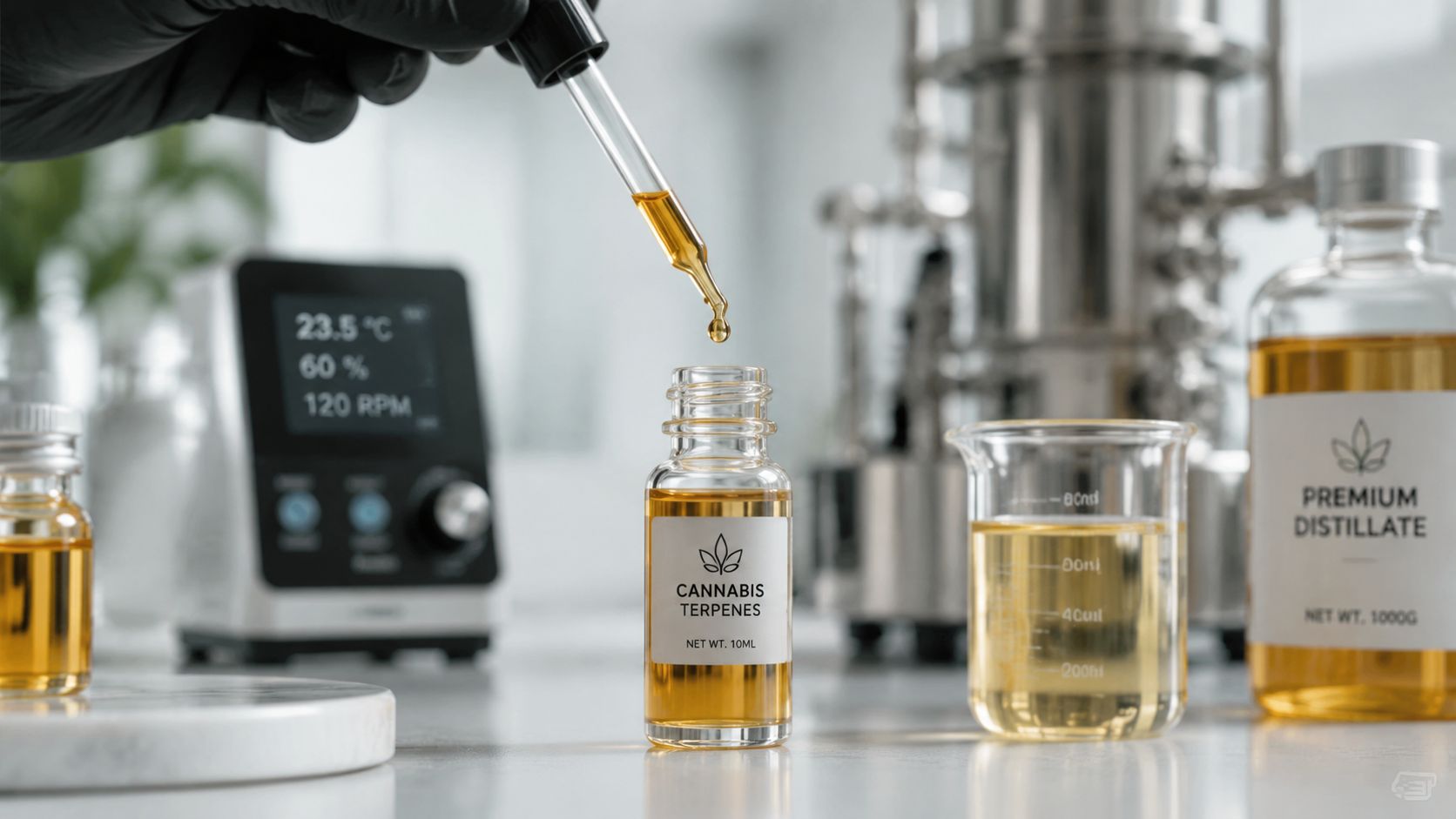
Heat does the job you need on cannabinoids, but it also pushes volatile compounds out of the matrix. The first notes to disappear are often the ones that give a profile lift and definition. In vape work, that loss is obvious. A source extract that smelled bright and layered before decarb can smell flatter, heavier, or less recognizable after it.
Preserve what you can
You can reduce terpene loss, but you won't eliminate it.
Use sealed or partially protected vessels when appropriate. Stay at the lowest effective temperature for the profile you're trying to build. Avoid unnecessary hold time after conversion is effectively complete. Don't keep reheating the same batch because the next station isn't ready.
Those steps help. They don't solve the bigger production issue, which is replication.
Rebuild the profile on purpose
If your product target is a neutral edible oil, native terpene loss may not matter much. If your target is a strain-inspired terpene blend for vape cartridges or a profile-specific infused concentrate, post-decarb reintroduction becomes the primary formulation step.
That means thinking in layers:
- Top notes: Brighter, more volatile aroma contributors that create first impression
- Mid notes: The body of the profile, where citrus, floral, herbal, or fruit character often sits
- Base notes: The grounding layer that gives weight, persistence, and finish
When a decarb step strips the top end, formulators usually notice “missing freshness” before they can describe exactly what changed. The profile isn't wrong in one dramatic way. It just doesn't open correctly.
Native terpene retention helps. Reintroduction is what creates repeatability.
A practical temperature reference is useful when you're trying to decide how aggressively to process before adding aroma back. This terpene temperature chart is worth keeping in the formulation folder for that reason.
Here's a useful visual primer before final blending decisions:
For teams building a terpene profile for cannabis product formulation, isolated compounds and strain-style blends are often the only practical way to restore a specific flavor target after decarb. Gold Coast Terpenes is one example of a supplier offering strain profiles and isolates that formulators can use when they need to rebuild a repeatable aroma system after thermal processing.
Controlling Potency and Cannabinoid Conversion
Potency control starts when you stop treating all acidic cannabinoids as if they convert on the same schedule.
A THCA-heavy wax can often move through decarb on a practical production timeline that works for vape or edible inputs. A CBD-dominant acidic input can require a longer hold if your goal is fuller conversion. That difference matters when you're formulating to a ratio, not just trying to make a batch “active.”
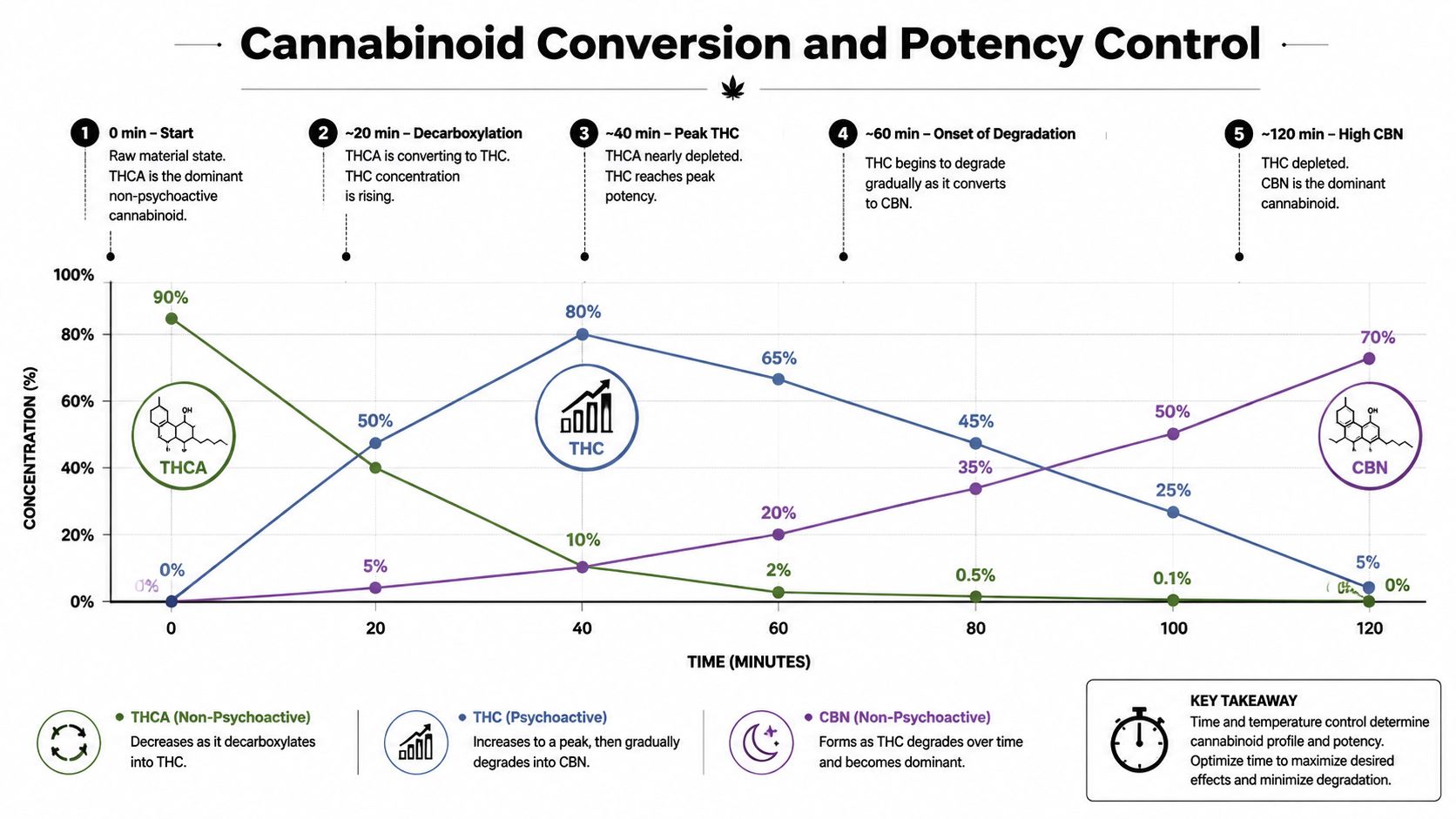
According to Emily Kyle's cannabinoid-specific decarboxylation guide, THCA begins to decarboxylate at approximately 220°F over 30 to 45 minutes, while CBDA often needs around 90 minutes at 240°F, and THC can degrade into CBN if held at 240°F for over 180 minutes. That's why precision matters. A decarb schedule that works for one cannabinoid objective can be the wrong schedule for another.
Read time and temperature as formulation levers
If you're formulating from mixed-cannabinoid input, decarb becomes a compositional tool.
A shorter, controlled run may be enough when your main objective is converting THCA-rich wax for a cartridge base. A longer schedule may be justified if the input carries significant CBDA and the finished product spec depends on that conversion. What you can't do is assume a single generic decarb SOP will hit every potency target cleanly.
The over-processing trap
Teams tend to fear under-decarb more than over-decarb. In formulation, both hurt you.
Under-conversion can leave activity on the table and create inconsistent performance in edible carriers or inhalable oil. Over-processing can shift the cannabinoid profile away from the one you intended and also leave the material darker and less expressive aromatically.
Use this quick decision frame:
- If the goal is a strong THC-forward base, avoid extending the hold once the conversion objective is met.
- If the goal includes CBD conversion from acidic input, build that longer thermal need into the batch plan from the start.
- If the product spec depends on a narrow ratio, don't let operators improvise endpoint calls across shifts.
The right decarb isn't the longest one. It's the one that lands the cannabinoid profile you actually need.
Advanced Decarb Troubleshooting for Formulators
Troubleshooting decarb gets easier once you stop asking, “How long should this always take?” and start asking, “What is this batch telling me?”
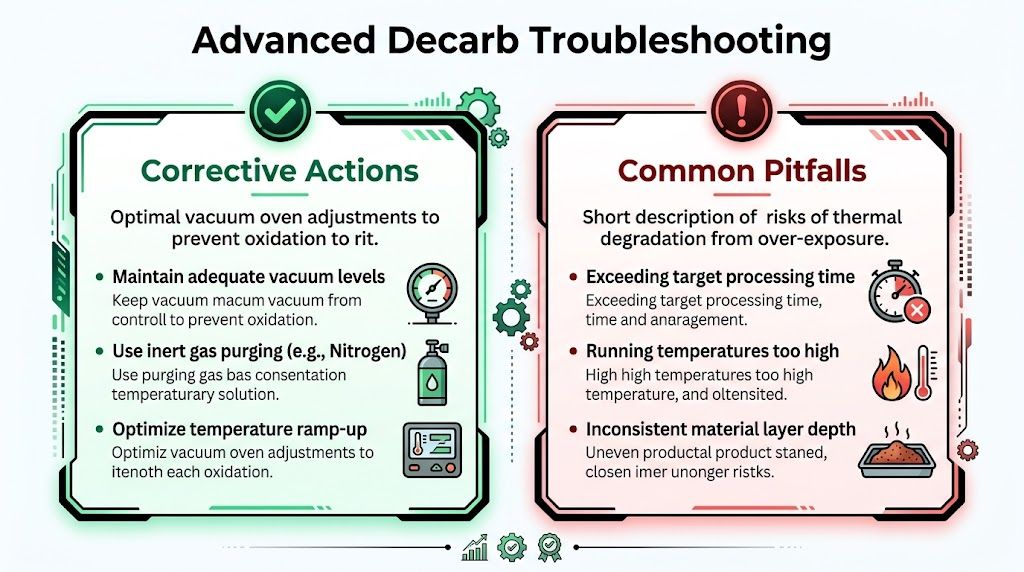
For consistent results, practitioners should treat CO2 bubbling as a direct control benchmark, and the process is considered complete when bubbling subsides, which can take roughly 25 to 60 minutes depending on purity and density, with incomplete bubbling leading to incomplete decarb and poor miscibility in carrier oils according to THC The Herbal Care's concentrate decarb guide.
When the batch bubbles too aggressively
Heavy bubbling can mean more than one thing. Sometimes the material is moving through active conversion. Sometimes the extract has more residual volatiles, moisture, or density-related variation than the last lot.
Do this:
- Reduce the urge to raise heat: More aggressive heating rarely fixes the root issue.
- Give the batch headspace: Use a vessel that can safely handle foam-up behavior.
- Watch for trend, not intensity: You're looking for bubbling to diminish, not for the batch to stay calm from the start.
When large batches heat unevenly
Scale changes the behavior of the same extract.
A shallow load decarbs more evenly than a deep one. If you push too much material into one vessel, the outer portion can look ready while the center still lags. That creates a false endpoint. For pilot and production work, splitting into multiple controlled vessels often gives a cleaner result than forcing a single larger mass through the same thermal profile.
When the endpoint is ambiguous
Some concentrates don't give a neat visual finish. They may stay active-looking longer than expected, or the bubbling may become subtle enough that one operator calls it done and another keeps it in.
Use a confirmation mindset:
- Reheat a small portion gently and observe behavior
- Check how it blends into the intended oil system
- Look for reduced foaming on reheating rather than chasing a perfect visual stillness
If the material resists smooth blending or still foams noticeably when reheated, don't assume the first pass finished the job.
Common avoidable mistakes
A few process errors keep showing up across teams:
- Using too much heat bath intensity
- Letting concentrate contact an exposed hot pan
- Skipping temperature verification
- Applying one standard run time to every consistency
A good decarb SOP doesn't need to be complicated. It needs clear control points, defined vessel geometry, a verified temperature source, and an endpoint rule the whole team reads the same way.
Integrating Decarbed Wax into Your Formulation Workflow
A clean decarb can still be wasted by poor post-processing.
Once the wax comes out of the oven or other controlled setup, handle it like a reactive intermediate, not a finished product. Let it cool enough for safe transfer, but don't let it sit around exposed longer than necessary if aroma retention matters. Move it into the next blend step with the carrier, distillate, or terpene system already prepared.
A short workflow that prevents rework
- Confirm the endpoint before transfer. Don't send questionable material downstream and hope blending fixes it.
- Stabilize temperature for mixing. Material that's too cool can become hard to disperse. Material that's too hot can stress added aromatic components.
- Homogenize fully in the target base. MCT oil, butter, and inhalable terpene systems all behave differently, so mix for uniformity rather than appearance alone.
- Check for phase behavior after blending. Separation is a formulation warning, not just a cosmetic issue.
For cartridge work, decarb and aroma strategy finally meet here. The activated concentrate has to accept the terpene blend evenly and remain fill-ready without creating a profile that tastes cooked or thin. If you're building process documentation around those later steps, this internal resource on how to make cannabis concentrates is a practical reference point for workflow alignment.
A strong formulation process treats decarb, blending, and final sensory adjustment as one connected sequence.
Decarboxylation FAQ for Product Developers
Does solventless material decarb differently than wax or BHO-style concentrates
The core reaction is the same, but the matrix can behave differently. Solventless inputs often carry a different mix of lipids, waxes, and volatile compounds, so the visual cues may not look identical to a cleaner hydrocarbon-style wax. That's why endpoint discipline matters more than copying the exact appearance of another extract class.
How should you think about scaling from lab batches to pilot runs
Don't scale by mass alone. Scale by vessel geometry, heat penetration, and observation protocol. If a small shallow dish gave you a reliable endpoint, a deeper pilot vessel won't necessarily behave the same way at the same timer setting. Keep layer depth controlled, split loads when needed, and train operators on the same bubbling criteria.
Can you partially decarb on purpose for a specific formulation
Yes, in principle, if the product objective calls for retaining some acidic cannabinoids. But that only works if the target profile is intentional and your process control is tight. Partial conversion without a defined reason usually creates inconsistency, not innovation. For most product developers, it's better to decide the desired cannabinoid state first and then build the thermal schedule around that decision.
If you're rebuilding flavor after decarb or developing a more repeatable terpene profile for vape cartridges, Gold Coast Terpenes offers strain-style blends, isolates, and formulation resources that can support post-decarb product development without relying on whatever native aroma survived the heat.