
A lot of formulators end up in the same spot. A batch is acceptable on paper, but the aroma is flat, the flavor won't carry, and the product doesn't feel finished. Someone on the team pulls up a terp spray and asks the obvious question: can we fix this fast?
That's where a raw terp spray review gets interesting for professionals. The consumer version of this conversation is usually about whether a spray makes flower smell louder. The formulator version is tougher. You're asking whether a spray gives you control, whether it scales, whether it holds up in storage, and whether it creates a product you'd want carrying your brand.
RAW Terp Spray sits directly in that shortcut category. It promises speed, simple application, and strain-style aroma without the work of proper blending. I understand the appeal. In production, convenience always looks good right before it causes a consistency problem.
I'm not against every low-friction tool on principle. I am against methods that remove control from the formulation process. That's the lens here. This review looks at RAW Terp Spray as a manufacturing input, not a novelty item, and asks a simple question: does a spray belong in a serious formulation workflow, or is it just a surface fix with commercial downside?
The Formulator's Dilemma with Terpene Sprays
The temptation usually starts with a deadline, not with bad judgment. A pre-roll line needs more aromatic punch. A flower lot looks saleable but uninspiring. A concentrate has the right texture and color, yet the nose is thinner than expected. You don't want to rework the whole batch, so a spray starts to look like an operational solution.
That logic makes sense at first glance. A spray is easy to explain to a production team. It's quick to deploy, and it doesn't require the same process discipline as true terpene integration. For operators under margin pressure, that matters.
Why the shortcut is attractive
Terpene sprays appeal to teams trying to solve three problems at once:
- Speed to correction: You can apply them late in the process instead of rebuilding the formula upstream.
- Lower process friction: No major blending workflow, heating routine, or homogenization step.
- Simple training: Staff can understand spraying faster than they can understand terpene incorporation.
Those are real advantages in a narrow operational sense. The problem is that production convenience and formulation quality are not the same thing.
A tool that saves time on the floor can still create instability in the finished SKU.
Where professionals need to be stricter
A formulator can't evaluate RAW Terp Spray the way a casual buyer would. The right question isn't whether the first aroma impression improves. The right question is whether the material becomes more controllable after application.
For serious product development, that usually means checking a few essential requirements:
- Distribution: Does the terpene load spread evenly?
- Repeatability: Can another operator recreate the same result next week?
- Compatibility: Does the application method fit the product format?
- Brand risk: Will the sensory experience match the expectation you're creating?
If you need a broad primer on the category itself, this overview of what terp spray is is useful context. But in practice, the dilemma is less about defining the product and more about deciding whether it belongs anywhere near premium formulation.
For low-stakes salvage work, maybe. For anything sold on consistency, I'd be cautious from the start.
A Technical Breakdown of Raw Terp Spray
A common production scenario goes like this. A batch is already filled, packaged, or close to release, and the aroma is flatter than expected. A spray product like RAW Terp Spray is built for that moment. It is presented as a post-production aromatic add-on, not as a terpene system designed to be incorporated into the formula from the start.
From a formulation standpoint, that distinction matters more than the marketing angle. RAW Terp Spray comes in a small bottle format, uses strain-style naming, and is sold as a quick sensory modifier. Those choices make it easy to sample and easy to understand commercially. They also place it closer to a corrective tool than a serious production input.

What the product is trying to do
Chemically, products like this aim to place volatile aroma compounds onto the material after primary processing is finished. The commercial promise is simple. Improve the first nose, reinforce a strain-style identity, and do it without changing the existing workflow very much.
The product line also highlights familiar terpene architecture rather than unusually detailed profile design. Beta-caryophyllene appears prominently across multiple variants, which suggests the blends are built around recognizable, broadly useful terpene notes that are easier to market and easier to repeat at a basic sensory level. For formulators, that can be a benefit or a limitation depending on the target SKU.
If you need a refresher on volatility, oxidation, and sensory contribution in terpene systems, this chemistry of terpenes guide is a useful reference.
Market positioning versus formulation positioning
RAW Terp Spray makes sense as a retail-facing product. Small bottles lower trial risk. Strain-named variants are familiar to buyers. The product is easy for a non-technical operator to understand.
Professional formulation asks harder questions. Can the input be specified tightly enough for batch records? Can the sensory effect be reproduced across operators, biomass lots, and storage conditions? Can QA verify what was applied beyond a stronger aroma on day one?
That is where the product starts to look limited.
| Product attribute | What it means to a formulator |
|---|---|
| Small bottle format | Convenient for trials, less practical for controlled production scaling |
| Strain-named variants | Good merchandising language, weak evidence of true profile replication |
| Dominant terpene callouts | Useful starting information, still incomplete for process validation |
| Post-production use | Better suited to correction or enhancement than full formulation design |
One other point matters commercially. Products in this category often win or lose on immediate sensory reaction, which can hide process weaknesses until later. For a premium line, that is a problem. A spray may help a product smell better at first contact while still leaving the formulator with unresolved questions about consistency, retention, and specification control.
The Core Problem with Surface-Level Application
A familiar production scenario goes like this. The batch looks flat, the nose is weak, and someone reaches for a spray bottle because it is faster than reopening the formula. The material smells better within minutes. The process still got less controlled, not more.
That is the main technical objection to surface application. It creates a sensory correction on the outside of the product, while leaving the underlying distribution problem unresolved. For a formulator, that matters because batch quality is judged by repeatable performance across the full lot, not by the first aromatic impression after treatment.
Industry discussion around terp sprays has pointed to the same weak point for years. Deposition is hard to verify, transfer to the product is inconsistent, and operators often measure what left the bottle instead of what stayed on the material, as described in this technical guide on terp spray limitations.
Why spray application loses process control
A spray can look measured without being well controlled. Nozzle output may be consistent, but formulation control depends on different questions. How much adhered. How much flashed off during application. How evenly it spread across varied particle sizes, surface textures, and moisture conditions.
Those variables matter more on the production floor than in a retail demo.
The same technical guide describes several recurring issues:
- Uneven distribution: exposed areas take the load while sheltered areas receive less
- Surface concentration: aroma remains concentrated near the exterior instead of dispersing through the material
- Volatilization during application: some terpene fraction is lost during atomization and handling
- Carrier impact: added ingredients can remain on the product and affect taste, burn, or residue profile
For commercial production, that list translates into a quality control problem. If deposition cannot be verified with confidence, the batch record is documenting an input event, not a confirmed formulation result.
Practical rule: If you cannot verify deposition, you did not control the terpene addition.
Spray coating versus formulation integration
Surface treatment works like cosmetic finishing. It changes the first encounter with the product. It does not guarantee that the profile is integrated into the matrix in a way that survives packaging, handling, or time on shelf.
A proper terpene addition workflow aims for measured dispersion through the usable mass. That is why formulators building repeatable products usually rely on blending methods with defined ratios, mixing controls, and post-addition hold conditions. Teams that need a tighter process can use a more structured guide to using terpenes in formulation as a starting point, then adapt it to their own SOPs and validation standards.
The operational difference is straightforward:
| Method | Production consequence |
|---|---|
| Spray application | Sensory impact is concentrated near treated surfaces |
| Integrated blending | Sensory impact is distributed through the full formulation mass |
| Spray correction | Batch outcome depends heavily on operator technique and contact conditions |
| Measured blending | Batch outcome is easier to reproduce and document |
That distinction becomes expensive when a brand is selling consistency, not just aroma. A loud top note can help a stressed batch pass a quick smell test. It does very little for unit-to-unit agreement, retention through storage, or complaint reduction after launch.
What operators usually miss
Visible coverage is not the same as validated coverage.
The common mistake is treating immediate aromatic lift as proof of successful formulation. On day one, the batch may seem improved. Later, the weak points show up in lot variation, uneven flavor expression, mismatch between aroma and actual consumption experience, or products that open strong and fade fast.
That trade-off may be acceptable for low-value remediation. It is a poor fit for premium flower finishing and a weak foundation for any commercial line that needs reproducible sensory performance.
Performance in Vape Cartridges and Concentrate Formulation
The biggest disconnect in this raw terp spray review shows up when people try to translate a flower-oriented shortcut into concentrate or vape workflows. That's where the method stops looking merely imperfect and starts looking mismatched.
A vape cartridge formula needs homogeneous distribution. A concentrate intended for repeatable sensory performance needs homogeneous distribution. Spraying terpenes onto the outside of a material doesn't create that.
Why it underperforms in concentrates
With shatter, wax, budder, or similar textures, surface application creates a familiar problem. The outside gets aromatic attention, but the mass itself remains uneven. As soon as the product is handled, portioned, or heated, that inconsistency becomes obvious.
You may get a loud opening note. You may not get a coherent flavor path from first contact through finish.
For concentrates, that usually creates three quality issues:
- Patchy sensory release: One portion tastes stronger than another.
- Poor blend identity: The aroma profile doesn't feel integrated into the extract.
- Harshness risk: Surface-heavy terpene loading can hit unevenly when heated.
That's the opposite of what a formulator wants when replicating flavor of strain-inspired terpene blend systems for distillate or concentrate applications.
Why cartridges demand direct blending
Cartridges are even less forgiving. Spraying anything onto bulk oil is a workaround for a process that already has a proper solution. If you're building a vape formula, the correct route is direct terpene incorporation into the oil under controlled conditions.
That gives you the ability to manage:
- Top notes such as bright citrus or volatile fruit accents
- Mid notes that shape the main body of the profile
- Base notes that add depth and persistence in the vapor path
A spray doesn't organize that structure. A blend does.
If the goal is a stable sensory profile for vape cartridges, the terpene system has to be built into the oil, not laid onto it from outside the process.
For teams refining that workflow, this guide on how to use terpenes is closer to the kind of process thinking cartridge development needs.
A short technical walkthrough can help frame that difference in process terms:
The commercial implication
Using a spray in vape production usually signals that the process has drifted away from formulation discipline. It's a patch, not a system. Even if the first pilot seems acceptable, the method leaves too much room for operator variability and too little room for validation.
For premium SKUs, that's hard to defend. If the product category depends on clean flavor, repeatable draw experience, and brand consistency, spray logic belongs outside the cartridge room.
Formulation Compatibility and Usage Guidance
If a team is still considering RAW Terp Spray, the safest approach is to treat it as a limited-use experimental tool, not as a foundation for production. That means being honest about where it fits and where it doesn't.
It may have a role in rough sensory trials or low-stakes external application experiments. It does not fit cleanly into workflows that depend on measured incorporation, especially with refined oils.
Where compatibility breaks down
Winterized distillate, formulated vape oil, and professional diluent systems all depend on proper mixing behavior. Those materials need controlled incorporation so the terpene fraction distributes evenly across the whole batch.
A spray method conflicts with that requirement. It doesn't solve dispersion. It avoids it.
Here's a practical compatibility view:
| Material | Spray fit | Why |
|---|---|---|
| Flower surface treatment | Limited | External aroma adjustment only |
| Concentrates | Weak | Poor homogenization and uneven sensory output |
| Winterized distillate | Poor | Requires true blending, not external application |
| Cart formulations | Poor | Precision matters more than convenience |
Better usage logic for professionals
If you test RAW Terp Spray at all, keep the conditions narrow:
- Use it only for evaluation batches: Never assume pilot aroma equals production suitability.
- Keep it out of validated cart workflows: Cartridges need measured blending, not late-stage correction.
- Document sensory mismatch carefully: Compare smell, taste, and persistence, not just opening nose.
- Watch for residue or texture shifts: Surface treatments can alter the feel of the material in ways teams overlook early.
Don't judge a spray by the first smell off the batch. Judge it after handling, storage, and actual consumption-format testing.
For actual formulation work, use a calculation tool that supports direct incorporation. The mixing ratios calculator is the kind of resource that aligns with blending discipline rather than surface treatment. Gold Coast Terpenes also supplies terpene blends and isolates used in cartridge and concentrate formulation, which is the more compatible route when you need a terpene profile for vape cartridges or a formulation guide for distillate.
A better standard to hold
The easiest mistake is thinking a convenient product deserves a place just because it solves a visible problem. Professional compatibility is a higher standard than that.
Ask these questions before any spray enters a real workflow:
- Can we measure the outcome, not just the input?
- Can another operator reproduce it without drift?
- Does it belong in this product format at all?
- Would we still use this method if the SKU were our flagship release?
That last question usually gives the clearest answer.
Pros and Cons for Professional Product Formulation
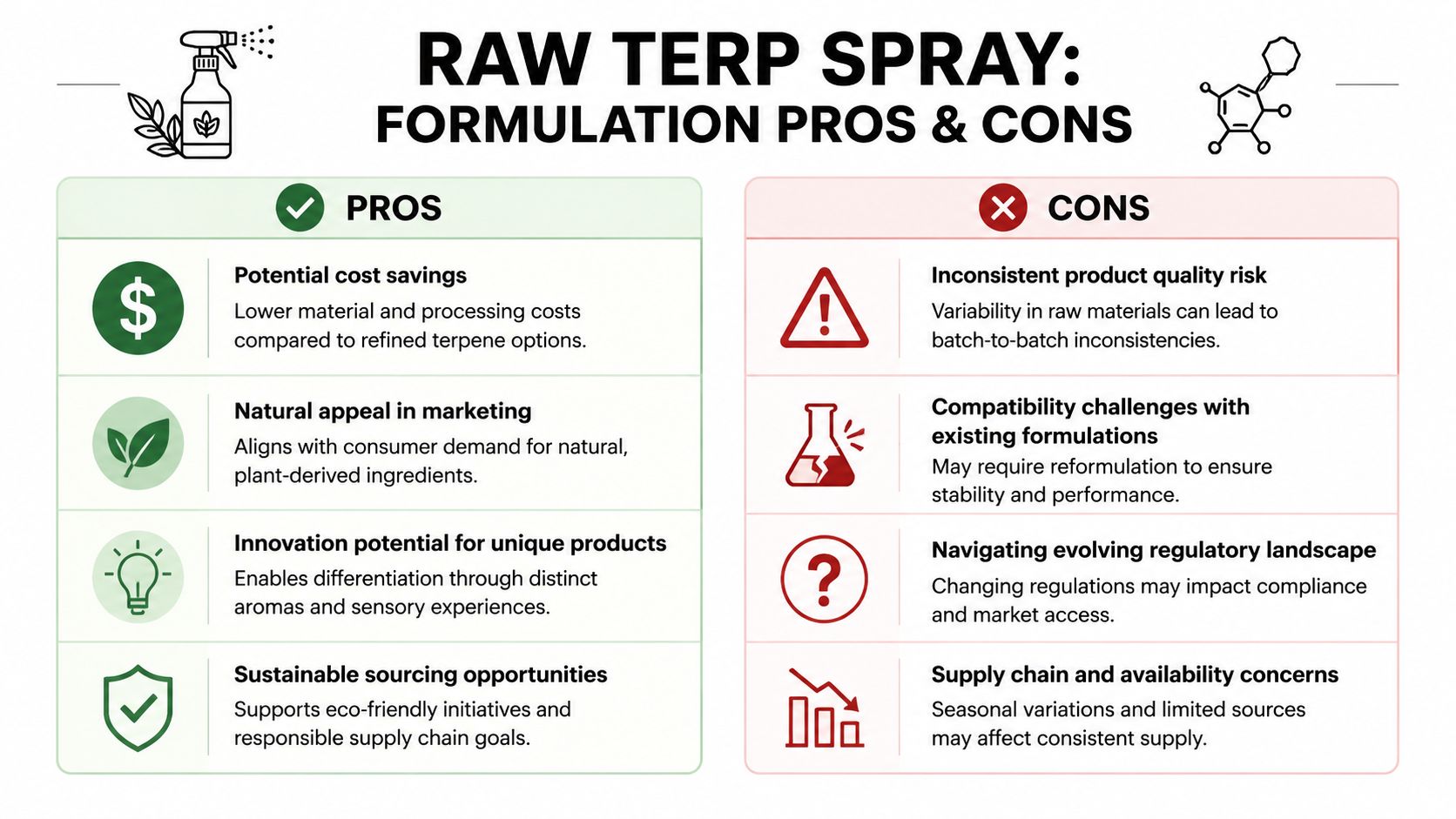
A fair raw terp spray review should admit that spray products do have some operational upside. They exist because they solve a narrow problem quickly. The issue is that their benefits mostly sit on the production side, while their drawbacks show up in the finished product.
For a professional buyer, that imbalance matters.
The case for using a spray
The strongest arguments in favor of RAW Terp Spray are practical, not technical.
- Fast deployment: Teams can apply it without rebuilding a workflow.
- Low barrier to entry: Small-format purchase makes testing easy.
- Useful for cosmetic correction: It can improve initial aroma on low-priority material.
- Simple concept for non-specialists: Staff understand “spray and assess” faster than blend design.
Those advantages are real. They're just narrow.
The reasons formulators hesitate
The downside list is longer because the method asks you to give up control.
- Inconsistent quality risk: Surface application doesn't guarantee uniform result.
- Weak scalability for premium products: What works loosely in a trial often fails under brand scrutiny.
- Sensory mismatch: Strong aroma can collapse into disappointing taste.
- Poor fit for precise systems: Cartridges and refined concentrates need blending discipline.
A side-by-side view makes the trade-off clearer:
| Decision factor | Spray method | Infusion or direct blending |
|---|---|---|
| Speed | Strong | Slower |
| Precision | Weak | Strong |
| Scalability for premium SKUs | Weak | Strong |
| Sensory consistency | Variable | More controllable |
| Brand protection | Riskier | More defensible |
You can scale a measured process. You usually can't scale a shortcut without scaling the inconsistency too.
Where it fits in a business decision
If your goal is to move low-priority inventory with minimal process investment, a spray may have a place. If your goal is formulating strain-inspired terpene blend systems for cannabis product formulation, it probably doesn't.
That distinction is important for brand owners. A low-cost fix can become an expensive reputation problem if the first aroma sells the unit but the actual product experience doesn't support repeat demand.
For teams moving toward more advanced profile work, this guide to building terpene profiles is a more useful direction than any spray-based shortcut. It starts from composition and balance, which is where professionals usually need to be.
Conclusion: Formulating Beyond the Spray
RAW Terp Spray makes sense if you view it as a fast external modifier. It makes far less sense if you view it as a formulation tool.
That's the main takeaway from this raw terp spray review. The product may offer convenience, and convenience has value in some operations. But for formulators, extractors, and brand owners who care about repeatability, sensory alignment, and premium positioning, a spray creates more uncertainty than control.
The technical problem isn't subtle. Surface application is still surface application. It doesn't give you the same command over top notes, mid notes, base notes, dispersion, or batch consistency that direct terpene blending gives you. That gap becomes especially obvious in cartridges, refined oils, and concentrates where the product itself demands homogeneous performance.
There's also a branding issue. Shortcut aroma correction can create a strong first impression while weakening trust in the actual experience. Professionals usually feel that damage before they can quantify it. The SKU gets described as loud on the nose but thin in use. That's not where you want a premium line to land.
If you're building products that need to hold up across batches, the better path is still the old one. Use high-purity liquid terpenes, build the profile deliberately, and integrate it during formulation. That's how you get flavor accuracy, stable expression, and a product spec you can defend internally and commercially.
If you're developing vape oils, concentrates, or strain-inspired blends and want components built for direct formulation instead of surface correction, Gold Coast Terpenes offers terpene blends, isolates, and formulation resources for cartridge and concentrate workflows.