
A batch can pass potency, fill cleanly, and still fail on the shelf because the aroma shifted, the inhale feels thin, or the profile doesn't match the strain name on the box. That usually isn't a cannabinoid problem. It's a formulation problem.
In practice, terpenes and terpenoids are where consistency is won or lost in vape carts, concentrates, and strain-inspired SKUs. They determine whether a profile opens bright and recognizable, settles into the right body, and survives enough of the process to still taste intentional by the time the customer uses it.
Learning terpene theory often occurs in fragments. One guide explains biosynthesis. Another gives a flavor wheel. A vendor sheet lists isolates. None of that is enough when you're trying to build repeatable products for distillate, keep strain-inspired blends accurate, and make decisions around heat, order of operations, and lab verification. The useful question isn't just what these compounds are. It's how their chemistry changes what you should do on the production floor.
Why Terpene Formulation Unlocks Product Consistency
If your carts drift from batch to batch, start by looking at the volatile layer of the formula. Cannabinoids set potency and viscosity behavior, but terpene formulation controls recognition. It's what makes one batch read clearly as citrus-pine, gas-forward, sweet-fruit, or dry spice instead of landing as a flattened generic cannabis note.
That matters because the terpene category is enormous. Terpenes and terpenoids include over 55,000 known natural compounds according to the terpene overview on Wikipedia. In cannabis, the dominant pattern matters commercially. The same source notes common dominant terpenes in cannabis including myrcene at about 43%, β-caryophyllene at about 23%, and limonene at about 16%. For a formulator, those aren't trivia. They're a reminder that profile design starts with ratio discipline, not just ingredient selection.
Consistency comes from controlling the profile architecture
A reliable product team treats terpene work as three linked jobs:
- Sensory control: The aroma has to match the intended cultivar inspiration or house profile.
- Process survival: The compounds selected have to survive your extraction, blending, filling, and hardware conditions.
- Commercial repeatability: The formula needs to scale without turning every production run into a correction exercise.
When teams skip that structure, they usually over-index on one dominant note. A limonene-heavy profile gets mistaken for “freshness.” A myrcene-heavy profile gets used to create “body.” A caryophyllene-heavy profile gets used to fake complexity. All three can work. None work alone.
Practical rule: If a profile only smells right in the beaker and not after filling, the problem isn't your imagination. The formula probably wasn't built for the process.
A good place to tighten first-pass development is ratio planning. A mixing ratios calculator for terpene formulation work helps teams move from rough percentages to repeatable additions, especially when scaling a profile from benchtop trials into production batches.
The Chemical Foundation Terpenes vs Terpenoids
The terminology matters because chemistry decides behavior. In product development, people often use the two words interchangeably, but they aren't identical.
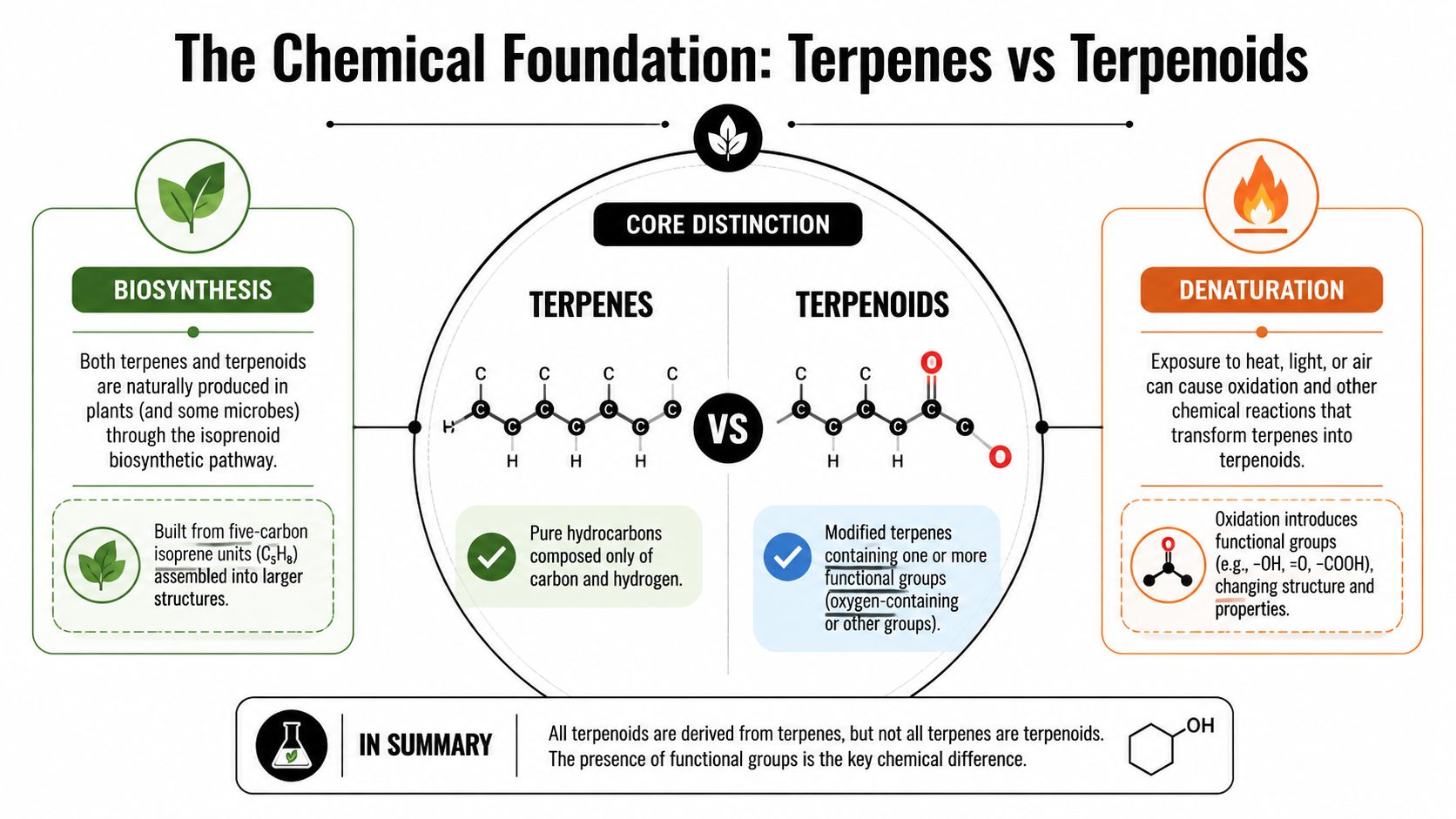
Terpenes are the hydrocarbon framework. Terpenoids are modified versions of those structures, often through oxidation or other functional changes. The easiest way to think about it is raw material versus modified material. The backbone is similar, but the modified version behaves differently in aroma, stability, and interaction with the rest of the formula.
Start with the isoprene building block
The core unit is isoprene with the general formula (C5H8). These units assemble into larger classes. That structure is what gives formulators a practical mental model for predicting volatility and profile role.
Here's the version you should keep in mind during formulation work:
- Monoterpenes: Built from two isoprene units. These often show up as the brighter, faster notes.
- Sesquiterpenes: Built from three isoprene units. These tend to feel heavier and more persistent.
- Diterpenes and higher classes: Important in natural product chemistry, but less often the main practical lever in everyday vape profile design.
This classification isn't just academic naming. It helps you anticipate what may flash off early, what may hold through processing, and what will shape the body of the profile after the first inhale.
Why the distinction matters on the bench
A new formulator often starts by asking which terpene smells closest to the target strain. That's understandable, but incomplete. The better question is which compounds will still be present, balanced, and perceptible after the whole process.
Terpenes and terpenoids are one of the largest and most diverse classes of natural products, and they're primarily produced by plants for ecological roles such as defense and pollination attraction, as described in this explanation of why plants produce so many terpenoid compounds. For us, the useful takeaway is simpler. Structural differences change commercial behavior.
A formula that ignores chemical class usually smells louder at mix time than it does in the finished unit.
That's why strong development teams stop treating terpene selection like flavoring alone. You're not just picking notes. You're picking molecules with different volatility, persistence, and process tolerance.
From Aroma to Action The Entourage Effect in Formulation
A profile becomes commercially useful when it does two jobs at once. It has to smell coherent, and it has to support the intended product positioning. That's where the conversation around entourage becomes practical.

The term gets misused when brands treat it like a vague promise. In formulation, it's more concrete. You're arranging compounds so the sensory output and the cannabinoid system work together in a predictable way. Not mystical. Just ratio-sensitive design.
Top notes mid notes and base notes
For cannabis product formulation, the old perfumery framework is still useful.
- Top notes: Usually the fastest, brightest part of the profile. These are often monoterpene-led and create the first impression.
- Mid notes: They connect the opening to the body, allowing a blend to feel intentional instead of sharp.
- Base notes: These hold the profile together and keep it from collapsing into a thin finish.
If you build only for the opening, the cart smells impressive in the lab and generic in use. If you build only for the base, the formula survives process stress but loses identity.
Entourage is an engineering problem
A practical way to frame entourage is synergy under controlled ratios. That makes it relevant to strain-inspired terpene blend development, especially when you're designing “relax,” “uplift,” or “focus” lines without making the formula feel interchangeable.
Research summarized by Abstrax notes that bioactive properties of terpenes are well documented, including examples such as α-terpineol showing an IC50 of 51.37 µg/ml against lung adenocarcinoma cells and carvacrol and thymol demonstrating strong antibacterial action against S. aureus in experimental contexts, as described in their terpenes and terpenoids research summary. For formulators, the useful commercial lesson is not to make medical claims. It's to recognize that composition can support differentiated positioning beyond simple flavor labeling.
A stronger operational reference is this guide on terpenes and the entourage effect in formulation, which helps translate broad synergy language into profile-building decisions.
Before choosing your final ratio set, it helps to review a quick visual overview of how formulation teams discuss synergy in practice:
What works and what usually fails
What works:
- Building around a clear sensory goal: Citrus-lift, gas-spice, fruit-cream, pine-focus.
- Matching cannabinoid base to profile intensity: Thin aromatic profiles can disappear in heavy matrices.
- Using support terpenes intentionally: A dominant terpene needs secondary structure.
What usually fails:
- Overloading a single familiar isolate: The result reads simple, not strain-specific.
- Confusing strong aroma with balanced aroma: Loud isn't the same as accurate.
- Using entourage as copy instead of a formulation target: If the blend isn't ratio-controlled, the term doesn't help you.
Replicating Strain Profiles A Formulator's Blueprint
Strain replication gets easier when you stop thinking in strain names and start thinking in architecture. A profile is not a single terpene. It's a hierarchy.
The useful breakdown is dominant, secondary, and tertiary compounds. The dominant layer establishes identity. The secondary layer shapes realism. The tertiary layer prevents the profile from tasting flat, overly clean, or one-dimensional.

Build the profile in layers
When formulating a terpene profile for vape cartridges or a strain-inspired terpene blend for distillate, work through the blend in this order:
- Set the dominant identity
Decide what the profile must say first. Is it berry-haze, fuel-earth, citrus-peel, pine-herb? Your leading terpene family handles the heavy lifting.
Add the body
The second layer should explain why the opening makes sense. Without it, the formula smells detached, like a top note pasted onto a neutral oil.
Finish with realism
The last layer is usually subtle. It adds dryness, spice, wood, peel, or floral lift. This subtle addition often dictates whether many strain replicas become convincing or start smelling synthetic.
A practical way to think about Blue Dream or OG-style targets
For a Blue Dream-inspired direction, formulators often think in terms of a brighter, more lifted frame with enough body to keep the profile from turning into generic fruit. For an OG-style direction, the opposite mistake happens. Teams push the heavy notes too hard and lose the volatile character that keeps the blend from feeling muddy.
The right mindset is not “copy the name.” It's “rebuild the sensory logic.” A terpene flavor chart for profile design helps map that logic more cleanly than strain folklore ever will.
Don't chase the loudest note in the target profile. Chase the relationship between the opening, the body, and the finish.
Reverse engineering versus building from scratch
Both methods can work, but they solve different problems.
| Approach | Best use | Common risk |
|---|---|---|
| Reverse engineering | Matching an existing cultivar-inspired SKU | Overfitting to one batch reference |
| Building from scratch | Creating a branded house profile | Losing strain recognizability |
| Hybrid approach | Commercial product lines that need both familiarity and consistency | Too much compromise if the brief isn't clear |
If your team is launching several related SKUs, standardize the base structure first, then adjust the accent layer. That gives you cleaner production, fewer surprises in scale-up, and a more coherent catalog.
Practical Formulation Guide for Cannabis Products
A bench sample can smell exactly right at 10 a.m. and fail by first production fill.
That usually happens when the formula was built around aroma alone, without enough respect for volatility, solubility, and process heat. In commercial cannabis products, terpene work stops being abstract chemistry the moment the blend hits warm oil, sits in a mixing vessel, or moves through a cartridge line. A profile that performs in a vial but collapses in production is not ready for release.
For practical formulation, heat exposure is the first decision point. As noted by Terpene Belt Farms' discussion of terpene effects and processing, sesquiterpenes such as β-caryophyllene and humulene generally hold up better under processing stress, while more volatile monoterpenes such as myrcene and limonene are easier to lose. That matters immediately in vape development. The compounds carrying the bright opening are often the first ones to fade during warm processing and hold time.
Use heat stability as the first filter
For formulating terpene profiles for distillate, start with one question. Which notes need to survive the process, and which notes can be added late enough to stay intact?
Teams that skip that step usually see the same problems in pilot runs:
- The production fill smells flatter than the approved bench sample
- Top notes burn off during hold time or repeated warm handling
- The cart keeps the body of the profile but loses its recognizable opening
- The formula tastes heavier, duller, or harsher than intended
A better build sequence is straightforward. Set the stable backbone first. Then add the more fragile aromatic layer as late as the SOP, equipment, and safety controls allow.
Formulation properties of monoterpenes vs sesquiterpenes
| Property | Monoterpenes (e.g., Limonene, Myrcene) | Sesquiterpenes (e.g., β-Caryophyllene, Humulene) |
|---|---|---|
| Typical sensory role | Top note or bright mid note | Base note or structural body |
| Heat behavior | Higher volatility, easier to lose in processing | Better retention under typical process heat |
| Best process use | Add late when possible | Build the core of heat-exposed products |
| Risk if overused | Thin finish, sharp opening, fast fade | Dense profile, muted lift, less definition |
| Best commercial fit | Freshness, lift, front-end identity | Stability, persistence, profile structure |
Newer formulators often make expensive mistakes at this stage. They keep increasing limonene or myrcene to get more pop in the beaker, then wonder why the first retained sample tastes hollow a week later. Higher terpene load does not fix a weak foundation. In many systems, it makes the formula less stable and less pleasant.
What to use and when
The product format should decide the blend strategy.
- For vape cartridges: Build around components that can tolerate thermal exposure, then restore the volatile top note fraction after the hottest process step.
- For lower-heat products: Preserve delicate aromatics where the process allows it, because the matrix is less punishing.
- For winterized distillate systems: Expect less forgiveness. A cleaner oil base exposes imbalance faster, so proportion errors are easier to taste.
Raw material choice also changes the workflow.
Isolates are useful for correction work. If the blend needs more citrus lift, spice, or woody depth, a single compound can move that attribute without rewriting the whole formula. The trade-off is that isolates demand tighter sensory control. Small dosing errors become obvious quickly, especially in a simple distillate matrix.
Pre-built blends are useful when production repeatability matters more than fine-grain customization. They reduce operator-to-operator variation and make scale-up easier to control. The trade-off is flexibility. If the base blend is close but not exact, there is less room to tune individual notes without affecting the whole profile.
Bench note: The formula that survives mixing, hold time, filling, and storage is the real formula.
Process choices that improve outcomes
A few habits consistently produce better commercial results:
- Control addition timing: Add the most volatile fraction as late as possible.
- Match the blend to the oil: The same terpene profile behaves differently across distillate inputs.
- Check the profile after equilibration: Freshly mixed samples can mislead the panel.
- Track sensory drift during production: Record what changes after mixing, after hold, and after fill.
- Treat terpene load as a sensory and mechanical variable: More is not always better for taste, stability, or hardware performance.
Good formulation work sits between chemistry and manufacturing. The chemistry explains why a profile shifts. The formulation process decides whether that shift becomes a reject, a reformulation, or a SKU that stays consistent at scale.
Testing Safety and Regulatory Compliance
The creative part of terpene work is only half the job. The other half is proof. If you can't verify identity, purity, and consistency, you don't really control the formula.
For professional teams, every terpene input should arrive with a current Certificate of Analysis and support documents that your QA staff can use. That means reviewing the batch documentation, not just filing it. The questions are basic but important. Does the profile match what was ordered? Is the material appropriate for the intended application? Are the records complete enough for your own compliance workflow?
What to check before a blend reaches production
A practical review usually includes these points:
- Batch identity: Confirm the terpene lot matches the internal formulation record.
- Purity review: Make sure the material aligns with your acceptance criteria.
- Application fit: A profile for one category may not be suitable for another process.
- Document control: Your production and QA teams need the same current file set.
This isn't paperwork for its own sake. It protects the formula from drift and the brand from avoidable mistakes.
Why verification matters beyond compliance
Third-party testing also supports commercial consistency. If a profile is described one way on a vendor sheet but behaves differently in incoming review or sensory evaluation, your team needs a basis for accepting, rejecting, or adjusting it.
That's especially important when you're selling THC-free products into broader legal markets. A clean compliance posture gives brand owners more room to distribute without having every expansion turn into a documentation problem.
If you need to explain a formula to operations, QA, and a regulator, the paperwork should tell the same story as the aroma.
For teams building formal purchasing and release procedures, safety documents and compliance resources are useful as part of vendor qualification. The exact internal workflow will vary by company, but the principle doesn't. Verified inputs reduce both formulation risk and operational friction.
The Future of Terpene-Driven Product Design
The next phase of cannabis product development won't be won by louder flavor alone. It will be won by teams that can connect chemistry, sensory design, and production control into one repeatable system.
That shift is already visible in the precision gap. A source summarizing a 2025 Nature study states that terpene cannabimimetic effects were confirmed, yet only 12% of commercial products analyzed in 2024 to 2025 matched optimal terpene to cannabinoid ratios identified in labs, as noted in this discussion of entourage-effect formulation precision. Whether you're building for vape carts, concentrates, or other infused products, the commercial lesson is straightforward. Most products still aren't formulated with enough ratio discipline.
That creates room for better operators.
The teams that stand out will treat terpenes and terpenoids as process-critical ingredients. They'll build profiles with top, mid, and base logic. They'll choose compounds based on heat behavior, not just aroma preference. They'll verify every batch. And they'll stop treating strain replication like branding language when it's really a controlled formulation exercise.
The result is better than a nice smell. It's a catalog that holds together across SKUs, batches, and hardware.
If you're building strain-inspired terpene blends, refining a terpene profile for vape cartridges, or tightening formulation accuracy for distillate, Gold Coast Terpenes offers terpene blends, isolates, and formulation tools that can support that workflow. Start with a target profile, test it under your real process conditions, and adjust from measured results rather than guesswork.