
You can spot the formulation problem before anyone files a complaint. The pre-roll lights, then runs on one side. The first draw smells promising, the second tastes flatter, and by the midpoint the concentrate has shifted the burn enough that airflow starts fighting the product. At that moment, “how do you smoke infused flower” stops being a consumer question and becomes a manufacturing one.
For formulators, extractors, and brand owners, smoking is the final stress test. It tells you whether your flower selection, infusion method, terpene blend, grind, and moisture control work together under heat. Potency may get the sale, but repeat orders come from consistency. If the SKU burns cleanly, carries flavor beyond the first pull, and behaves the same way across batches, the product has been engineered correctly.
Beyond the Basics of Infused Flower
A batch can look excellent on the bench and still fail the moment it meets a flame. The jar opens with strong aroma, the flower looks well coated, and the potency target is on spec. Then the smoke test exposes the underlying formulation: uneven ignition, early flavor drop-off, resin buildup, or a cherry that will not stay stable through the session.
That gap between shelf appeal and smoked performance is where infused flower earns or loses its place in the market.
Infused flower changes more than potency. Adding extract changes mass distribution, surface behavior, airflow, and the temperature profile across the packed material. Those changes affect whether the product burns at a controlled rate, whether the original cultivar character stays recognizable, and whether one unit behaves like the next.
For a formulator, smoking is the final performance test of the SKU. It shows whether the concentrate is integrated or merely sitting on the material, whether the flower can still carry combustion cleanly, and whether the terpene system expresses under heat instead of disappearing after ignition. A product that only smells good in the jar is unfinished.
This is also where many infused flower programs get pushed off course. Teams often chase visible coverage, high assay numbers, or an aggressive aroma burst at pack open. Those choices can help first impression, but they can also create a product that tastes front-loaded, burns inconsistently, or degrades faster in storage because the volatile layer is poorly protected.
The stronger standard is simple. Build infused flower as a repeatable smokable format, not as flower with concentrate added for effect. That means treating the flower as the combustion bed, the extract as a controlled modifier of potency and burn behavior, and the terpene system as part of product function, not just branding.
That is why understanding what terpenes do in cannabis products and why they matter belongs in R&D. In a marketable infused flower SKU, smoking is not the end of the process. It is the point where formulation quality becomes visible.
Formulating for an Optimal Burn and Structure
A pre-roll that looks coated and tests strong can still fail in the first minute of use. The cone starts tunneling, the draw tightens, melted oil pools near the tip, and the flavor turns flat halfway through. That outcome is usually set during formulation, not at the moment of lighting.
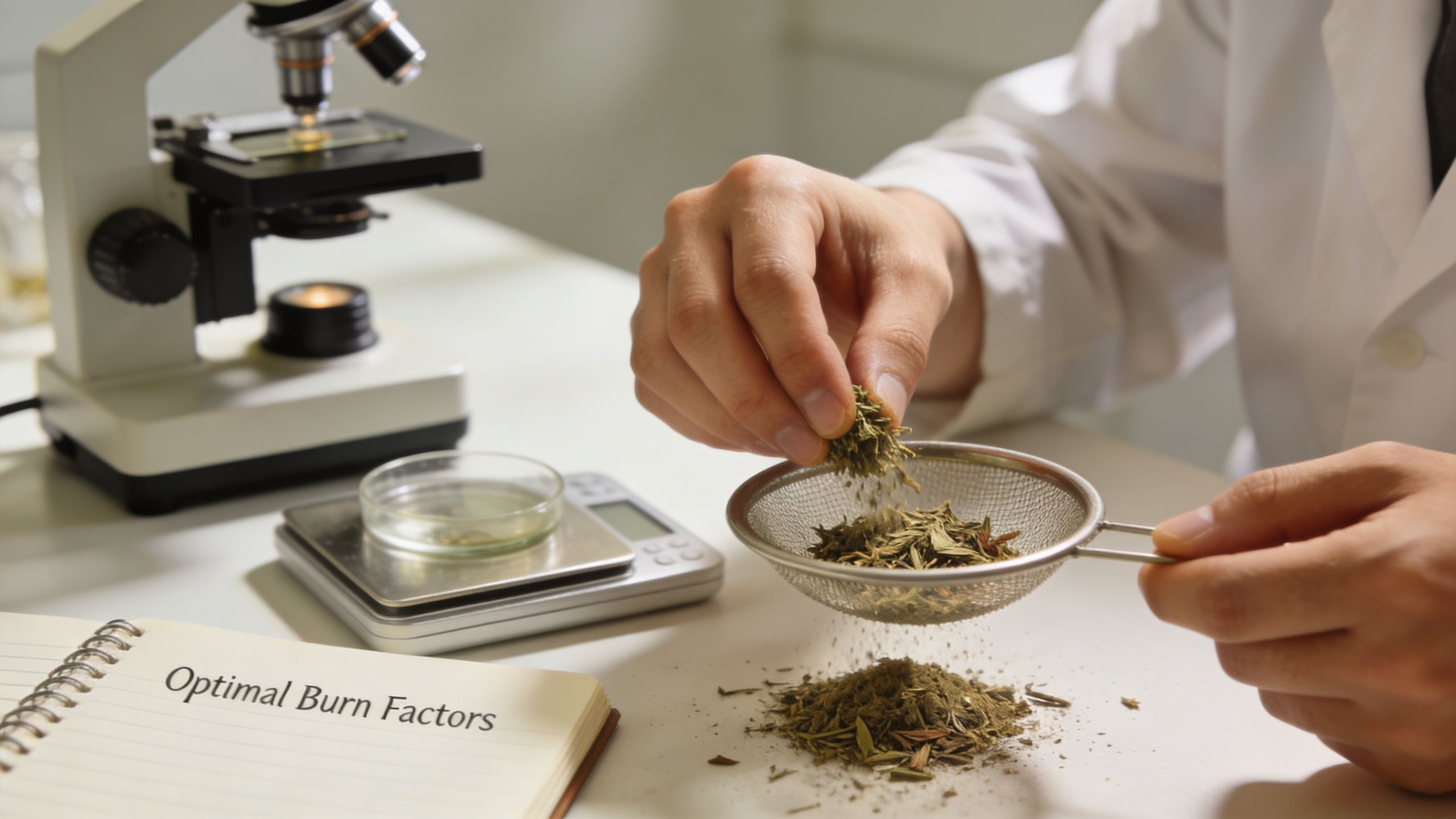
Start with the infusion method
Burn quality depends on where the active load sits and how evenly it is distributed through the flower bed. Heavy surface application gives strong visual impact, but it often creates localized fuel pockets that burn hotter and slower than the surrounding biomass. The result is familiar in production testing. Uneven cherry formation, shifting draw resistance, resin streaking, and a sensory profile that peaks early then drops off.
Injection or controlled internal distribution usually gives better smoking performance because the concentrate is not concentrated in one external layer. That does not mean every internal infusion method is superior. If the extract is too viscous, or if it binds fines into dense clumps, the product can still smoke poorly. The ultimate goal is even dispersion with minimal blockage of natural airflow paths inside the ground flower.
Surface-coated flower also introduces a merchandising trade-off. It can look premium in the jar, while smoking like a compromised product. Formulators building a marketable infused SKU need to choose the better outcome at the burn line.
Control moisture before you chase flavor
Moisture sets structure. Structure sets airflow, ignition behavior, and burn rate.
Teams often spend too much time tuning aroma intensity before they lock down water activity and post-infusion conditioning. That sequence creates avoidable inconsistency. If the biomass is too wet after infusion, the product resists ignition, runs unevenly, and mutes flavor under steam and incomplete combustion. If it is too dry, the cone burns hot, the draw turns harsh, and volatile top notes disappear early.
Use cure and post-infusion equilibration as part of the formulation process. They are not cleanup steps after potency is finished. Flower that was dried and cured correctly gives you a more stable base for adding extract, and proper drying and curing of cannabis before infusion reduces the amount of correction work later.
A premium smokeable product needs internal balance more than visible saturation.
Grind and packing are formulation variables
Particle size controls airflow and heat exposure. It also changes how the extract presents during combustion.
A coarse, open grind usually gives better oxygen movement and a steadier burn path in infused formats. A very fine grind increases surface area, which can help initial ignition but often pushes the product toward faster, hotter combustion and more rapid terpene loss. Once concentrate is added, fine material can mat together and form dense sections that pull unevenly from one unit to the next.
Packing density matters the same way. Loose enough to maintain air channels. Firm enough to keep the cone stable and prevent collapse. There is no universal setting because the right density depends on flower density, extract viscosity, and whether the final format is a bowl load, a hand-packed cone, or a production pre-roll.
That has direct formulation implications:
- Choose flower that keeps its structure after grinding and infusion. Fragile biomass turns into fines and packs too tight.
- Match extract viscosity to the intended format. A formula that works in a bowl can choke a narrow cone.
- Check post-infusion tackiness after a short conditioning period, not just immediately after application.
- Evaluate airflow after filling, because acceptable loose-fill texture can still compact into a restricted draw during manufacturing.
A useful production reference point is below.
Build for burn stability, not just potency
Infused flower is sold on potency, but it is judged on repeatability. If one cone burns clean and the next one tunnels, the formulation is unfinished even if both pass assay. The same applies when the first third tastes loud and the rest smokes like neutral biomass. That usually points to poor extract placement, poor moisture control, or a terpene layer that was added for pack-open impact instead of thermal performance.
From an R&D standpoint, smoking is the final validation step for the SKU. It confirms whether the flower still functions as a combustion bed, whether the infusion changes burn rate in a controlled way, and whether sensory output stays recognizable through the session. Strong infused flower is easy to make on paper. Reliable infused flower takes control of structure, airflow, and heat response before it ever reaches the consumer.
Selecting Terpenes That Survive Combustion
A cone can smell vivid at pack-open, light clean, then lose its identity by the third pull. That failure usually starts in formulation. The terpene layer was built for the jar note instead of the heat path the product has to survive.
For infused flower, smoking is the final performance test. The question is not whether the blend smells attractive before ignition. The question is whether the profile still reads clearly after direct flame, molten extract movement, and repeated heat cycling through the combustion bed.
Build a profile that changes in a controlled way
A smokeable profile needs staged release. Top notes shape the first impression at open and on ignition. Mid notes carry recognizable character once the cherry is established. Base notes keep the product from flattening into hot paper, generic herb, or oil-heavy dullness late in the session.
That staging matters more in infused flower than in plain flower. Distillate can suppress native floral detail. Kief and resin can add weight while muting lift. If the terpene blend depends too heavily on fragile high notes, the first draw can feel expressive and the back half of the smoke can taste empty.
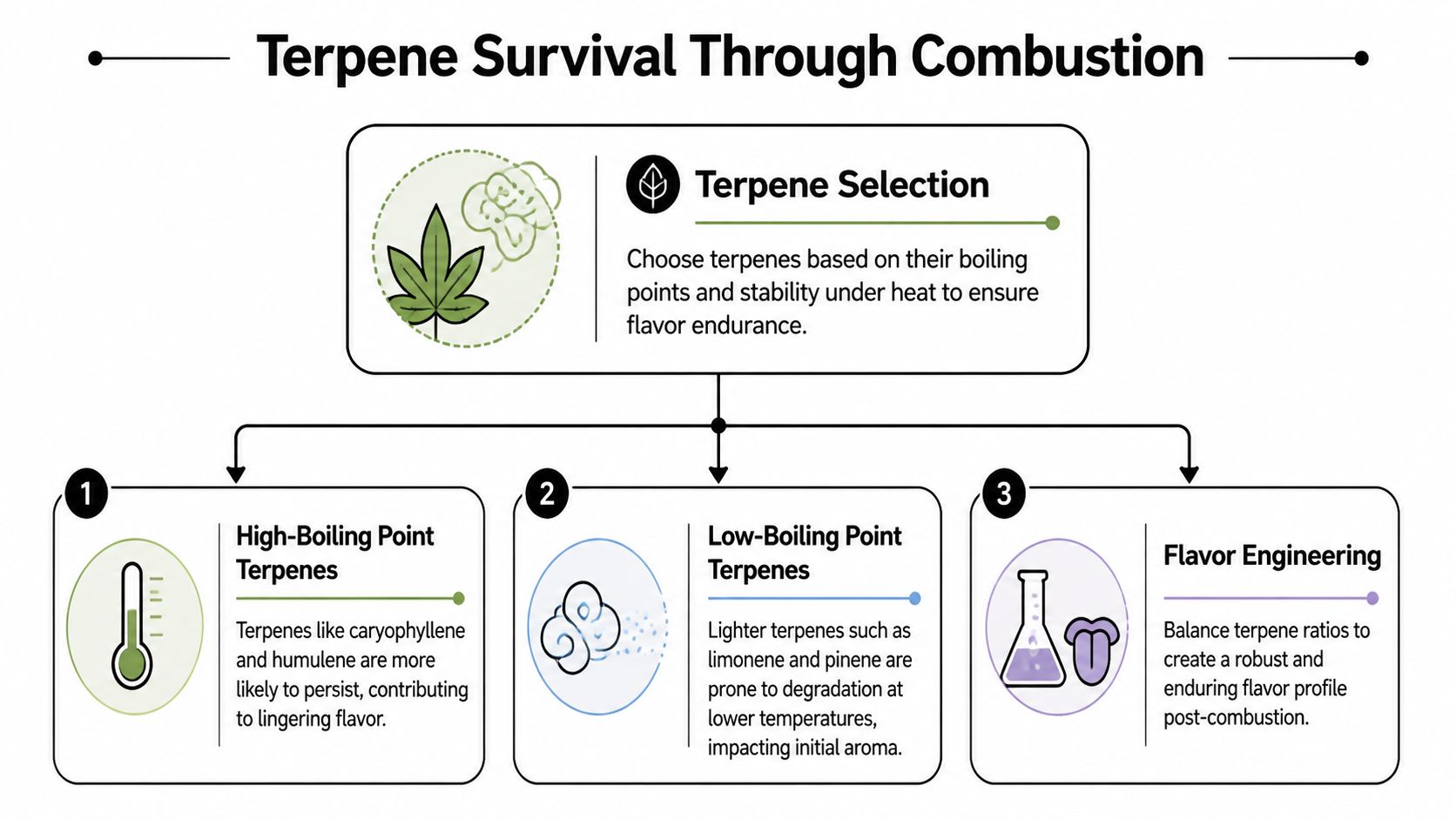
I screen combustion-oriented terpene systems with three practical checks:
- What shows up before flame?
- What is still identifiable after the first few pulls?
- What remains once heat has moved deep into the cone or bowl?
If the answer to all three is the same bright citrus note, the profile usually lacks enough structure for a marketable smoked SKU.
Volatility sets the ceiling
Combustion strips volatile compounds first. That is why a blend that performs well in a cartridge or low-temperature vapor test often underperforms in infused flower. Real smoking conditions include direct flame, uneven oxygen exposure, and sharp localized temperature spikes. The result is selective loss, not uniform expression.
That changes terpene selection. A strain-inspired terpene blend for smoking needs enough top-note material for recognition, but it also needs compounds that hold shape after the first volatile fraction is gone. In practice:
- Top-note role: Limonene and other bright aromatics provide quick recognition and lift.
- Mid-profile role: Beta-caryophyllene often helps maintain definition once oil and smoke density build in the stream.
- Back-end role: Heavier earthy or musky notes can keep the profile from collapsing late, but they still need careful loading so they do not turn muddy under heat.
For formulation work, burning point data for common terpenes is a useful reference when deciding how much of the high-volatility fraction the formula can carry.
A good smoking profile is engineered for attrition.
Choose terpenes for sensory persistence, not just aroma accuracy
Matching a fresh flower cultivar exactly is not always the right target for an infused pre-roll or bowl product. Some native profiles are beautiful in the jar and fragile under combustion. If the commercial goal is repeatable sensory output, the better choice is often a profile that keeps the cultivar's identity while shifting the ratio toward compounds that survive heat with less distortion.
This is one of the main trade-offs in smoked product design. Chasing perfect pack-open mimicry can weaken in-use flavor. Building only for late-session persistence can make the product smell flat on first inspection. Strong formulations balance both. They open with enough lift to signal the intended profile, then settle into a stable mid-session character that still feels deliberate instead of depleted.
Application matters as much as selection
The same terpene blend can behave differently depending on where and how it is applied. A surface-heavy application gives a louder first-light impression, but it also exposes more of the profile to immediate thermal loss. A better-integrated application can reduce that front-loaded pop and improve session consistency.
I treat smoked terpene systems as part of the whole infused matrix, not as a finishing fragrance. Load level, extract compatibility, and distribution pattern all affect what the user tastes. The best result is usually not the loudest aroma at open. It is the SKU that tastes like itself from ignition through the final third.
Matching Formulation to Consumption Method
A customer lights an infused pre-roll and gets a bright first pull, then a side-burn by the second rotation. The same batch in a bowl tastes heavier and dirtier than expected. In a dry herb vaporizer, the profile finally opens up. That gap is the formulation test. Smoking is where your infused flower either proves its design or exposes weak control over distribution, structure, and thermal behavior.
The comparison that matters
Joints, bowls, and dry herb vaporizers ask different things from the same infused material. A formula that sells well in a jar can still fail in use if the matrix was built for the wrong heat pattern or airflow profile.
| Method | Formulation Priority | Key Challenge | Terpene Preservation |
|---|---|---|---|
| Joint or pre-roll | Uniform distribution and controlled cherry formation | Side-burns, changing airflow, and concentrate migration during combustion | Moderate when the infusion is evenly integrated and the cone is not overloaded |
| Pipe or bong | Open airflow and low residue loading | Bowl clogging, localized hot spots, and harsh smoke from dense surface coating | Variable because combustion is concentrated in a small area |
| Dry herb vaporizer | Clean release at lower temperatures | Sticky chamber loading, residue, and poor aerosolization from heavy coatings | Highest of the three when the product is built for low-temperature volatilization |
For a general grounding on end-use behavior, this guide to consuming terpenes gives useful context on why delivery method changes flavor, intensity, and perceived smoothness.
Pre-rolls expose distribution errors first
Pre-rolls give the least forgiveness. Once the cone is filled, the user cannot redistribute a wet pocket, break up a concentrate knot, or reopen a blocked air channel. If the flower and infusion are not homogeneous before packing, combustion will make that obvious.
This infused pre-roll methodology reference is useful because it links user technique to burn performance. The same source recommends corner-lighting with the flame held 0.5 cm from the tip and rotated for 10 to 15 seconds, reports higher cherry-establishment success than full-lighting, notes that runaway burns are common for inexperienced users and can waste material, and states that tapping ash every 1/3 of the length reduces canoeing. The consumer lesson is clear. The formulation lesson is more important. A strong commercial pre-roll should still burn within spec under ordinary use, not only under careful technique.
The same missiondispensaries.com source also states that terpene injection can retain more flavor through the burn than sprayed application. Whether a team uses true injection, internal blending, or another integrated loading method, the practical takeaway is the same. Surface-heavy application creates a louder first impression and a less stable session.
For pre-roll SKUs, I treat smoking as the final QC screen. If the product needs perfect ignition, frequent correction, or unusually gentle draw cadence to stay even, the process window is too tight for scale.
Pipes and bongs punish excess surface oil
A bowl gives fast feedback on structure. Heavy external coating looks dramatic in the tray, but direct flame turns that decision into harshness, residue, and blocked airflow.
Products built for pipes and bongs need to remain mechanically open after infusion. The grind cannot collapse into tacky aggregates. The concentrate phase cannot pool at the top of the pack. The flower still has to behave like flower under flame.
Three signs usually tell you the formulation is ready for bowl use:
- The packed bowl lights without sealing over into a glossy cap
- Draw resistance stays steady through the session
- The spent material is consumed evenly instead of showing charred tops and wet lower pockets
If those conditions are missing, adding more aroma will not fix the experience. The adjustment usually belongs in coating level, particle size, or post-infusion conditioning time.
Dry herb vaporizers reward a different build
Vaporizers shift the target from burn management to controlled release. Lower temperatures preserve more of the intended profile, but they also expose every flaw in infusion compatibility. A formula that performs acceptably under combustion can feel muddy in a vaporizer if the active phase is too heavy, too sticky, or poorly distributed.
This matters for premium SKUs built around distinct sensory identity. Fruit-forward, floral, and confection-style profiles often show their best expression under vaporization, but only if the infused matrix still loads cleanly and allows uniform heating through the chamber.
That creates a practical SKU decision. One product can be tuned for broad acceptability across formats, or separate builds can be developed for combustion and vaporization. The second approach usually gives better consistency, better terpene expression, and fewer customer complaints because the formulation is matched to the way the product is consumed.
Troubleshooting Common Smokable Product Defects
A batch clears potency, looks good in the jar, and still fails the ultimate test once flame hits it. The joint runs. The bowl seals over. Flavor drops out after the first pull. Those are not vague consumer reactions. They are performance defects in the formulation.
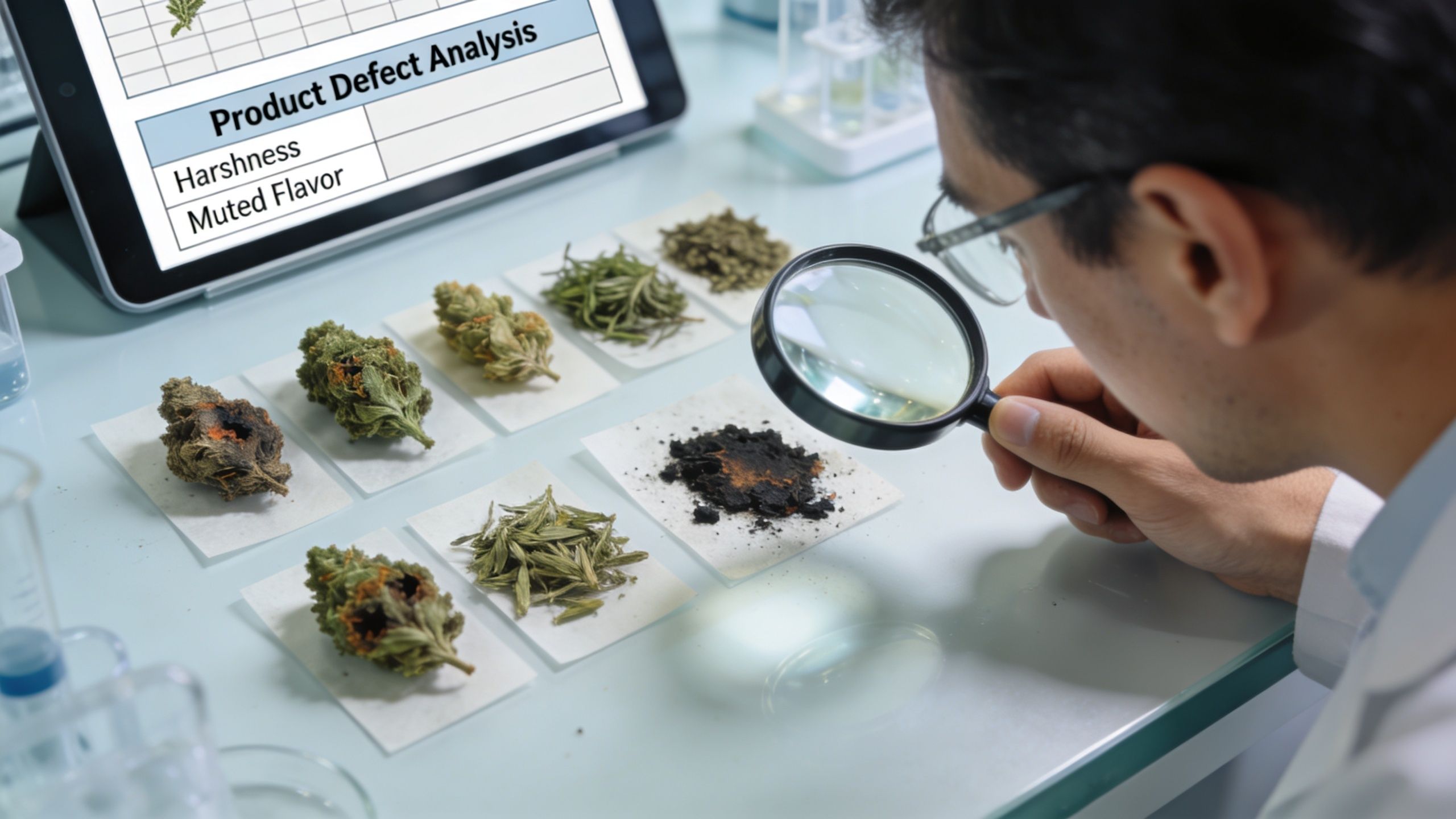
Harshness usually starts with concentration and distribution
Harsh smoke often gets blamed on potency alone. In practice, I see harshness show up more often when the infused phase is applied unevenly, the loading rate is too aggressive for the flower structure, or the product goes into pack-out before it has stabilized.
High-potency flower can still smoke clean if the coating is thin, anchored, and distributed through the lot with control. The failure pattern is easy to spot during burn testing. Early hits feel hot, the cherry darkens, and the throat feel turns sharp long before the session should be peaking. That usually points to hot spots, excess surface oil, or a terpene system that flashes off early and leaves the smoke thin and acrid.
The fix is rarely adding more aroma. Reduce the concentrate burden per particle, tighten your particle size range, and give the batch enough conditioning time to settle before final fill.
Uneven burning is a structure problem first
Canoeing, side-burn, and self-extinguishing bowls often get assigned to rolling or packing. Those issues matter, but they usually expose a deeper formulation problem. If the biomass fraction does not carry the infused phase evenly, the burn path will wander.
Three variables deserve attention first:
- Particle size spread: Oversized pieces create air gaps. Fine material packs dense and restricts airflow. A wide spread gives you both defects in the same unit.
- Infusion uniformity: Concentrate-rich pockets burn slower and wetter than underloaded areas, so the cherry moves around them instead of through them.
- Water activity and post-process hold: Material that is too wet resists ignition. Material that is too dry burns hot and fast. Both conditions flatten consistency lot to lot.
Bench testing should look like final use, not just lab handling. Break down multiple units from the same run. Compare top, center, and bottom fill. Then run combustion tests across several samples, not just one good-looking cone from the tray.
Flavor loss after ignition points to thermal mismatch
Strong jar aroma followed by flat smoke usually means the sensory system was built for cold sniff, not combustion. That defect shows up all the time in infused flower built around fragile top notes or heavily perfumed blends that smell impressive before lighting and disappear seconds into the session.
A smokeable SKU needs middle and base character, not just a loud opening. Terpenes and flavor components have to survive application, storage, ignition, and the heat of repeated draws. If the profile collapses into burnt sugar, generic herb, or oily residue on the palate, the formulation is missing thermal durability.
A quick diagnostic helps. If the unlit sample smells vivid but the first third of the smoke already feels hollow, review terpene selection, addition rate, and when the blend was applied in relation to concentrate and curing. In many cases, the formula is asking volatile notes to carry more of the experience than they can hold under real smoking conditions.
Poor ash and a collapsing cherry usually trace back to excess surface loading
Ash quality is not just a cosmetic issue. In infused flower, dark, greasy, or clumping ash often signals that the active phase is sitting on the outside of the material instead of integrating with it. That changes oxygen flow and interferes with steady combustion.
Watch for a glossy cap at the burn front, frequent relights, or resin collecting ahead of the cherry. Those signs usually mean the formula is oversaturated, under-conditioned, or built on flower that lacks the internal structure to support the infusion level. Reducing total loading can improve the smoking experience more than increasing cannabinoid content ever will.
Reliable products are built around repeatable smoke performance
Novelty gets initial attention. Repeatable burn, stable flavor, and predictable draw get reorders.
The strongest infused flower programs treat smoking as final QC for the SKU. That means documenting defect patterns, linking them back to formulation variables, and rejecting batches that look acceptable on paper but fail in use. Once that standard is in place, harshness, uneven burn, and flavor collapse become development signals instead of customer complaints.
Conclusion Engineering a Superior Smoking Experience
The best answer to how do you smoke infused flower is not a lighter tutorial. It's a formulation standard.
When infused flower performs well, you can usually trace that result back to disciplined choices made long before packaging. The biomass held the right structure. The concentrate was distributed in a way that supported burn instead of fighting it. The terpene system was selected for real thermal conditions, not just for the aroma hit when the jar opens. The intended consumption method shaped the SKU instead of being treated like an afterthought.
That matters because infused flower doesn't behave like standard flower. According to this comparison of infused flower and regular flower, infused flower burns significantly slower because concentrates melt into the flower, causing joints and bowls to last longer. The same source notes that users should start with smaller amounts because of the higher potency, and that while extracts can create ultra-smooth smoke with richer flavor and aroma, vaporization is widely considered the best method for preserving terpenes and cannabinoids with fewer byproducts.
For brands, that creates a clear commercial decision. You can keep treating smoking performance as something the customer figures out, or you can treat it as the final QC standard for the entire formulation process. The second approach produces more stable SKUs, fewer unpleasant surprises at retail, and a stronger case for premium positioning.
A key win isn't just making infused flower stronger. It's making it predictable. That is what customers remember. That is what buyers reorder. And that is what separates a novelty product from a reliable line item.
If you're building a terpene profile for cannabis product formulation, refining a strain-inspired terpene blend for distillate, or replicating flavor of legacy cultivars for vape cartridges and smokable SKUs, Gold Coast Terpenes offers strain-specific blends, isolates, and formulation resources that help teams dial in burn performance, flavor accuracy, and sensory consistency.