
Most advice on what terpene makes you laugh is too simple to be useful in production. “Use limonene” is directionally right, but it’s not a formulation strategy. A cartridge doesn’t create laughter because one isolate was added to a tank. It creates the conditions for an uplifting, socially open, low-friction experience that can make laughter more likely.
That distinction matters if you’re building SKUs, not just naming effects.
A formulator’s job is to shape an outcome that is repeatable across batches. For this category, the outcome isn’t “laughter” as a guaranteed effect. It’s a profile that leans euphoric instead of heavy, bright instead of sleepy, and social instead of inward. That takes terpene selection, dose discipline, and a realistic understanding of what terpenes can and can’t do.
Deconstructing the 'Giggle Effect' for Product Formulation
The market keeps asking the wrong question. “What terpene makes you laugh?” sounds clean, but it leads formulators toward isolate-first thinking and inconsistent products. In production, laughter is not a direct terpene output. It is a downstream expression of a broader state that combines THC intensity, emotional tone, cognitive clarity, and context.
One useful overview from Incatrail Terpenes on laughter, THC dose, and terpene modulation lays out the variables clearly: setting, THC level, current mood, and dose all shape whether a session feels playful or turns tense. That matters in cartridge design because a profile can smell bright and still miss the effect target if the cannabinoid load pushes the user past the comfortable window.

What formulators are engineering
Strip away the consumer language and the target becomes more practical. The goal is to build a profile that reduces friction in the experience while keeping the user mentally present enough to enjoy it.
That usually means four formulation priorities:
- Lower the stress edge: Bright does not mean sharp. If the blend adds tension, the effect loses its social ease.
- Maintain mental activity: Heavy, narcotic terpene weight works against humor and spontaneity.
- Protect clarity: Haze and sensory overload can flatten the light, responsive feeling most brands are trying to create.
- Keep THC in bounds: The terpene layer should shape the ride, not push an already hot base into discomfort.
The same source explains the mechanism in broad practical terms. THC shifts reward and perception in ways that can make ordinary stimuli feel more amusing, but that only holds if the experience stays comfortable. Once the formula crosses into racing, edgy, or disorienting territory, the “giggle effect” usually collapses.
For formulators, that changes the brief. You are not building a “laughing terpene blend.” You are building a repeatable euphoric-social profile with enough headroom to stay pleasant across different users and puff patterns.
A single-note citrus top can point in the right direction, and D-limonene benefits in terpene formulation help explain why it so often anchors this category. But limonene on its own is rarely enough to make the effect stable in a real cartridge. The trade-off is familiar. Push the top note too hard and the blend gets thin, volatile, and anxious. Add too much sedating weight and the profile loses lift.
Where simple formulas fail
I see the same formulation mistake often. A producer starts with a high-THC distillate, adds a bright citrus isolate, keeps total terpenes modest, and expects the cart to read as happy and social. On paper, that sounds fine. In use, it can come across as fast on the inhale, flat in the middle, and edgy by the third pull.
Reliable uplift usually comes from structure, not just direction. The lead terpene sets the opening impression, secondary terpenes shape the body of the effect, and minor components prevent the formula from tipping into either sedation or overstimulation.
That is the core formulation problem to solve. Which terpene leads matters. The support system matters more.
Limonene's Role in Mood-Elevating Formulations
Limonene earns the lead slot in uplifting formulas because it shifts both perception and presentation. On the sensory side, it gives a cartridge an immediate citrus lift that reads as bright, active, and social. On the effect-design side, it is one of the few common terpenes that repeatedly shows up in conversations about lighter mood, lower tension, and a more playful THC expression.
A useful reference point comes from this article on the neuroscience behind cannabis and laughter, which connects limonene with mood-related signaling and reduced anxiety. I would treat that as directional rather than definitive. The practical takeaway for formulators still holds. Limonene is often the fastest way to push a blend away from dullness and toward a cleaner, happier top-end effect.
That does not make it self-sufficient.
In cartridge work, limonene behaves like a true top note. It creates the opening impression, shapes the first few pulls, and helps the profile feel mentally lighter. That is exactly why it works so well as a lead terpene, and exactly why it gets overused. A formula built too heavily around limonene can smell right in the bottle, then feel thin, sharp, or slightly pushy in use.
I see this problem most in distillate systems with a bright citrus target and very little mid-note support. The inhale feels quick. The center of the experience does not hold. By the third pull, the effect can drift from upbeat into scattered, especially when the THC base is already aggressive.
So the job is not "add limonene until it feels energetic." The job is to decide how much limonene the base can carry before the blend loses body. For more technical background on how formulators use this molecule for aroma and effect direction, this guide to D-limonene benefits in terpene formulation is a useful reference.
Why limonene should lead, but not dominate
Limonene is usually the front-end driver in this category because it does three things well:
Sets a positive first impression
Citrus top notes prime the product as bright and active before the cannabinoids fully register.Pulls the effect away from heaviness
In practical formulation terms, limonene helps keep THC from reading overly dense or sedating.Improves flavor-efffect alignment
If a cart tastes lively but feels flat, users notice the mismatch fast. Limonene helps close that gap.
The trade-off is volatility. A limonene-heavy blend can lose balance quickly if the rest of the terpene system is too sparse, too woody, or too narcotic. That is why strong uplifting SKUs rarely succeed on citrus aroma alone.
Common formulation mistakes with limonene
Three errors show up repeatedly in development work:
Using limonene as a substitute for structure
A citrus-forward top note can point the formula in the right direction, but it cannot supply the middle and base needed for a stable effect.Pushing the top note to compensate for weak distillate character
If the cannabinoid base feels flat or harsh, extra limonene usually makes the imbalance more obvious.Ignoring user puff behavior
A blend that feels lively on one short draw can turn edgy under repeated pulls if limonene is carrying too much of the psychoactive direction.
My working rule is simple. Let limonene announce the profile, then make the rest of the formula earn the experience. That approach produces cartridges that stay brighter and more social without tipping into hollow flavor or nervous energy.
Formulating with Uplifting Secondary and Tertiary Terpenes
Limonene gets the credit. Secondary and tertiary terpenes decide whether the cartridge feels playful, clear, and repeatable across more than one pull.
That distinction matters in development. A bright top note can make the first inhale feel promising, but the rest of the terpene system determines whether THC presents as social, scattered, tense, or flat. This overview of terpene synergy and how different terpenes work together aligns with what shows up in formulation work. Effects are shaped by combinations, not by one headline terpene in isolation. A separate review of laughter-associated terpene profiles notes recurring combinations such as ocimene, myrcene, β-caryophyllene, limonene, and pinene, while also acknowledging that ideal ratios are still not well quantified in published research: https://www.namacbd.com/blogs/cbd-thc-info/what-terpenes-are-good-for-euphoria.
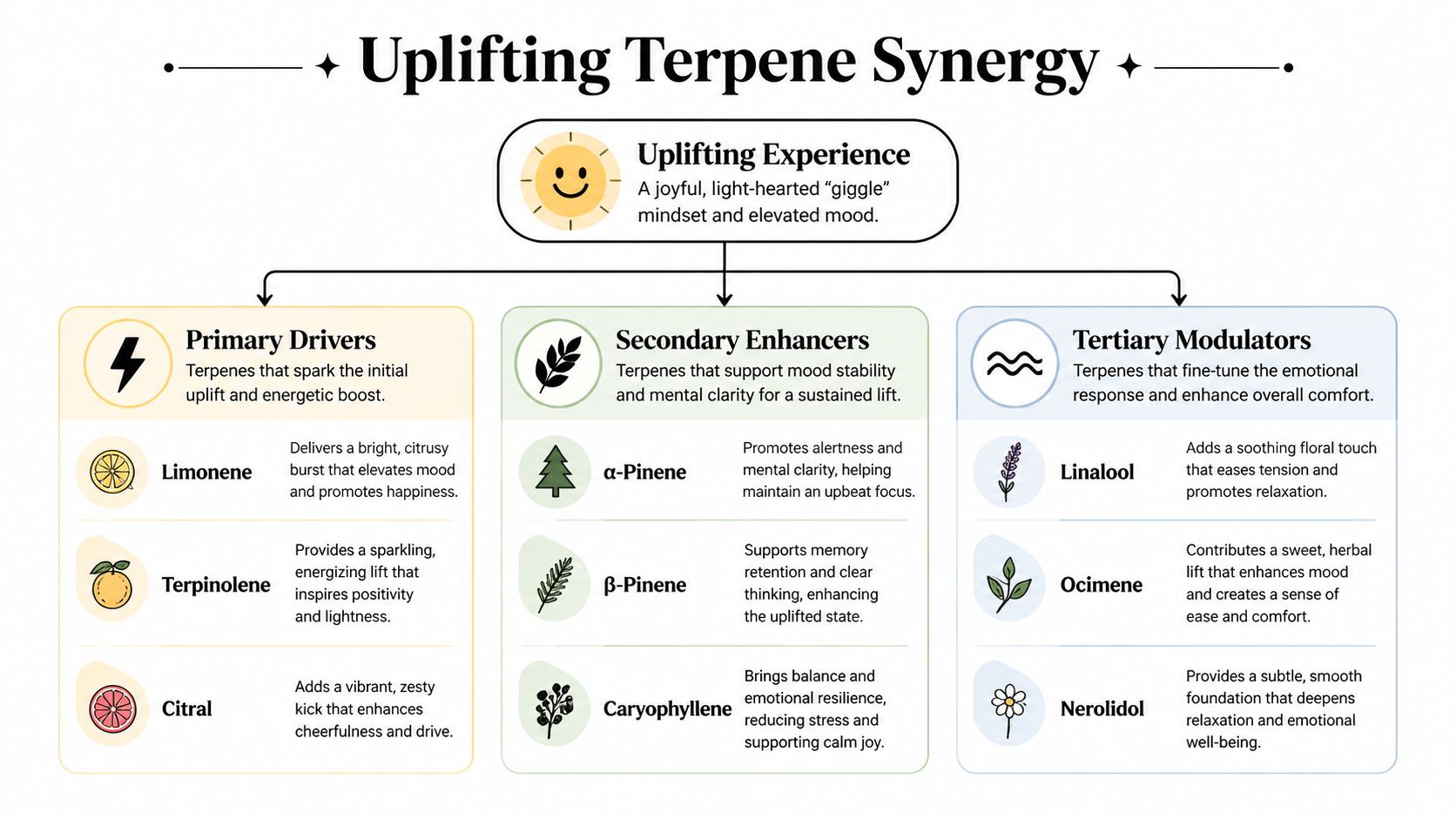
The supporting cast and what each one does
For uplifting cartridges, I treat the secondary layer as effect control, not decoration.
β-Caryophyllene adds restraint. It can soften the scratchy, overactive feel that shows up when citrus and high-THC distillate are doing too much of the work. On the sensory side, it adds weight and keeps the profile from tasting hollow.
Pinene helps preserve definition through the middle of the session. That matters if the target is conversational, alert, and daytime-usable rather than euphoric for five minutes and foggy after that.
Terpinolene pushes a formula toward airy, animated, sometimes slightly eccentric territory. Used carefully, it helps create the playful edge many formulators chase in haze-style or fruit-forward profiles. Used too hard, it can make the blend feel thin or overstimulating.
Ocimene adds buoyancy and aromatic lift. It often works well in tropical, floral, and sativa-coded builds where the brief calls for sparkle without turning sharp.
Top, mid, and base note logic
Percentages matter. Functional position matters just as much.
| Note position | Common terpene role in uplifting blends | Formulation purpose |
|---|---|---|
| Top note | Limonene, terpinolene, ocimene | Fast-onset brightness, aromatic identity, immediate perceived lift |
| Mid note | Pinene | Carries clarity and keeps the experience from collapsing after the opening |
| Base note | β-Caryophyllene, limited myrcene | Adds control, rounds rough edges, prevents a harsh or skeletal finish |
A useful uplifting blend has vertical structure. The opening should feel bright, the middle should stay articulate, and the finish should remain light enough that repeated puffs do not drag the user into heaviness.
What not to overuse
Myrcene is usually the first place these formulas go off course. Small amounts can help knit the blend together and reduce angularity. Push it too far and the profile starts reading soft, dense, or physically heavy, which works against a laughter-adjacent brief.
The same caution applies to “fixing” a weak formula with more top note. If a cartridge lacks mid-body and base control, adding extra limonene, terpinolene, or ocimene usually makes the imbalance more obvious.
The practical rule is straightforward. Build the lift with the top note, shape the mood with the middle, and control the comedown with the base. That is how an uplifting profile becomes something you can reproduce in a vape cartridge instead of a one-hit impression that falls apart in use.
Why Terpene Blends Outperform Isolates for Effect
A single isolate can point a formulation in the right direction. It usually can’t carry the whole sensory and functional load.
That matters because THC is still the main psychoactive actor in most cartridges. Terpenes don’t replace it. They direct it. A better blend doesn’t invent an effect from nothing. It changes how the existing cannabinoid experience is perceived and where it tends to land emotionally.
Why the blend matters more than the headline terpene
A useful mechanism is described in this explanation of laughter-related brain activity and limonene-dominant sativa profiles. It states that cannabis increases blood flow to the cerebellum, right frontal lobe, and left temporal lobe, which are the same regions activated during natural laughter. The same source explains that when THC activates CB1 receptors, it increases dopamine and serotonin, and that limonene-dominant sativa strains create stronger giggly conditions because they combine stress reduction with uplifting cerebral effects.
For formulators, the takeaway isn’t “copy a sativa label.” It’s that an uplifting effect profile works best when the terpene layer supports cerebral energy rather than body heaviness.
A blend does that better than an isolate because each terpene handles a different problem:
- One terpene can open the profile.
- Another can reduce harshness or emotional friction.
- Another can preserve clarity.
- Another can slow the descent into sedation.
That’s why a limonene-only idea often smells right but feels incomplete.
What the entourage effect looks like in practice
When a cartridge lands well, users don’t describe it in technical language. They say it feels bright, easy, social, and fluid. That’s the entourage effect translated into product behavior.
For a more technical view of how multiple terpene classes shape outcome together, this terpene synergy guide gives a useful formulation perspective.
A short visual explanation helps here:
Think of THC as the engine. The terpene blend is the handling package. The engine creates motion, but the handling determines whether the ride feels smooth, twitchy, heavy, or responsive.
The trade-off formulators have to manage
More limonene isn’t always better. More sedative support isn’t always smoother. More exotic terpenes don’t automatically create more nuance.
The winning blend is usually the one that gives enough initial lift to feel unmistakably upbeat, enough support to avoid sharpness, and enough aromatic continuity to remain pleasant through repeated pulls. That’s why blends outperform isolates for effect. They don’t just increase intensity. They control direction.
A Practical Guide to Formulating 'Giggle-Inducing' Profiles
If you’re building for vape cartridges or for distillate, start with a simple rule. Formulate for reliable uplift, not novelty. The best-performing profiles in this lane usually feel obvious on first inhale and still coherent after several draws.
That means building from the top down. Start with the terpene that defines the effect family. Then add support for clarity and stability. Finish by deciding how much softness, sweetness, or haze-like character you want in the tail.
Start with a blend architecture
A workable architecture for this category looks like this:
Lead with limonene
This is the effect anchor and the aromatic entry point.Add a clarity terpene
Pinene is often the easiest tool when the profile feels too fuzzy or too candy-like.Use a stabilizing base
β-Caryophyllene helps stop the blend from feeling thin or nervy.Choose one personality modifier
Terpinolene if you want airy brightness. Ocimene if you want a lighter, more aromatic lift. A restrained amount of myrcene only if the blend feels too dry or angular.
Bench advice: Build your first draft for behavior, not branding. Name the profile after it survives repeated test runs.
Sample uplifting terpene formulations for distillate
The table below gives starting-point blend logic, not guaranteed universal targets. Adjust based on your cannabinoid base, hardware, and desired flavor identity.
| Profile Name | Limonene % | B-Caryophyllene % | Pinene % | Other (e.g., Terpinolene) % | Target Effect & Aroma |
|---|---|---|---|---|---|
| Citrus Lift | High | Low to moderate | Moderate | Low terpinolene | Bright citrus opening, clear-headed uplift, lean finish |
| Social Spark | Moderate to high | Moderate | Moderate | Low ocimene | Easygoing, talkative, balanced citrus-herbal profile |
| Haze-Style Uplift | Moderate | Low | Low to moderate | Moderate terpinolene | Airy, energetic, slightly wild top note with strong cerebral feel |
| Rounded Daytime Blend | Moderate | Moderate | Moderate | Trace myrcene or ocimene | Less sharp, more stable, still upbeat and functional |
Because ideal laughter-specific ratios aren’t quantified in the available data, the right way to use this table is as a decision framework. You’re adjusting profile behavior, not chasing a mythical fixed recipe.
A practical mixing workflow
For cartridge development, keep the process disciplined:
- Build a top-note draft first: If the opening doesn’t read uplifting immediately, the rest of the blend won’t rescue it.
- Test for finish, not just aroma: Some blends smell excellent in concentrate form and flatten out in vapor.
- Watch for sharpness: If the blend feels restless, add more structural support before adding more limonene.
- Reduce sedation early: If the effect brief is social and playful, trim back myrcene before changing the citrus lead.
- Document every revision: Small terpene shifts can move a profile from lively to agitating.
For a practical reference on proportioning and adjustment logic, this guide to using the correct terpene ratios is worth keeping in your formulation workflow.
What usually works best in cartridges
In carts, the most reliable uplifting profiles tend to have three qualities:
Fast aromatic recognition
The user should understand the profile within the first pull.Mid-session coherence
The second and third hits shouldn’t turn muddy or spicy in the wrong way.Controlled emotional lift
The blend should feel open and buoyant, not overclocked.
A final point matters here. If a team asks for a “laughing terpene blend,” translate that brief into production language. Ask whether they want citrus-forward social energy, haze-style mental lift, or balanced daytime euphoria. Those are buildable targets. “Makes you laugh” is only useful after you’ve turned it into a sensory and functional spec.
Ensuring Safety and Stability in Uplifting Blends
An uplifting profile that isn’t stable is a weak product. An uplifting profile built with poor input quality is a liability.
This category is especially sensitive because the terpenes that create brightness are often among the most aromatic and noticeable. If purity is off, oxidation creeps in, or the blend is padded with the wrong additives, the defects show up fast in flavor and user perception.
Purity is not optional
Use high-purity, lab-verified terpenes. If you’re buying isolates or finished blends for cartridges, verify that the supplier can document consistency and composition. Don’t assume a citrus note is limonene-forward in any meaningful formulation sense just because the aroma says “lemon.”
That same discipline applies to safety. Avoid treating common vape diluents as harmless defaults. If your blend strategy depends on adding VG, PG, PEG, or MCT to make the formula easier to work with, fix the formulation process instead of masking it with the wrong carrier.
Stability issues that affect uplifting profiles first
The profiles built around bright top notes tend to show degradation quickly.
Watch these points closely:
- Storage conditions: Heat and light can dull the opening character and distort the intended profile.
- Container exposure: Excess air space can accelerate aroma drift.
- Blend handling: Repeated warming and cooling cycles can change how the formula presents.
- Batch discipline: If the top-note layer moves, the entire “uplifting” identity can shift.
The brighter the profile, the less room you have to be sloppy. Citrus-led blends expose every shortcut.
Quality control should include experience control
Safety isn’t only about contaminant avoidance. It’s also about keeping the formula behavior consistent enough that the user doesn’t get an unexpectedly sharp or heavy result from batch to batch.
That’s one reason side-effect awareness belongs in formulation planning, not just compliance review. This terpene side effects guide is a useful reminder that even well-known terpenes need handling discipline, especially when you’re aiming for a narrow effect window such as upbeat, social, and clear.
The practical standard is simple. If a blend can’t stay stable, taste clean, and behave predictably, it isn’t ready for a commercial uplifting SKU.
Final Thoughts on Crafting Consistent Uplifting Experiences
The short answer to what terpene makes you laugh is still limonene. The useful answer is more demanding.
Limonene is the leading terpene for this effect family because it pushes a formulation toward brightness, reduced tension, and uplifted mood. But no serious formulator should stop there. A repeatable uplifting cartridge comes from synergy, not a single isolate pushed too hard.
What the best formulas get right
The strongest profiles in this category usually share the same design logic:
- They use limonene as the lead, not the whole composition.
- They support it with clarity and stability, often through pinene and β-caryophyllene.
- They treat terpinolene or ocimene as modifiers, not decoration.
- They keep sedative influence restrained unless the brief calls for a softer finish.
- They build around product behavior, not strain mythology.
That’s the difference between a blend that sounds marketable and a blend that performs in hardware.
What to carry into development
If you’re formulating for distillate or vape cartridges, don’t ask for a magical laughter terpene. Ask what combination creates a clean, social, euphoric profile without drifting into tension or sedation.
That shift in language improves the blend immediately. It also makes your testing more honest. You can evaluate brightness, coherence, finish, and effect direction. You can’t evaluate “funny” as a stable production metric.
Good formulation in this category is part chemistry, part sensory design, and part restraint. The teams that get it right usually aren’t chasing the loudest top note. They’re building a profile that opens fast, stays clear, and leaves enough emotional room for the cannabinoid base to feel easy instead of heavy.
If you want a product line that stands out, originality matters. Not in exaggerated claims, but in controlled terpene architecture that creates a distinct, repeatable uplifting signature.
If you’re developing strain-inspired terpene blends, uplifting profiles for vape cartridges, or precise terpene systems for distillate, Gold Coast Terpenes offers natural isolates, strain-specific blends, and formulation resources built for product creators who need consistency, flavor accuracy, and reliable batch performance.