
One run comes out light golden, pours clean, and carries the flavor you expected. The next run is darker, flatter, and harder to bring back with post-process blending. Same strain target. Same oven setting on paper. Different commercial outcome.
That gap is where a lot of margin disappears.
In production, decarb weed color isn't just a cosmetic detail. It's a fast visual read on how your process handled heat, oxygen, time, and volatile compounds. If the decarb step drifts, the rest of the formulation stack gets harder. Potency targets move. Flavor replication gets less accurate. Cartridge color shifts faster on the shelf. Remediation pressure goes up.
Manufacturers that treat color as a controlled process variable usually build more consistent SKUs. Manufacturers that treat it as an afterthought end up chasing the batch with dilution, masking, or excessive post-processing.
Beyond Toasted Why Decarb Color Matters in Formulation
Color control starts paying you back long before a customer sees the finished oil. It affects how easy the batch is to formulate, how much native character survives, and how reliably you can match one production lot to the next.
A lot of teams still use a crude pass-fail standard. If the material looks toasted, they assume it's ready. That approach works poorly in commercial settings because color isn't binary. Green, pale straw, light gold, amber, dark brown, and nearly black all point to different process conditions and different formulation consequences.
Color is a process signal
When cannabis moves from green toward a light golden-brown endpoint, you're usually seeing a useful convergence of reactions rather than a simple surface browning event. In practice, that target zone tends to line up with workable cannabinoid activation while avoiding the darker tones that often come with heavier aroma loss and harsher downstream character.
For extractors and formulators, that matters because a darker base stock usually creates more work later:
- Flavor correction gets harder. A dark, overcooked base can mute bright top notes and push you toward heavier masking profiles.
- Visual consistency suffers. Even before terpene reintroduction, clients notice when one lot pours a cleaner gold and the next leans brown.
- Shelf presentation becomes riskier. Batches that start too dark often give you less room for long-term appearance stability.
Practical rule: If your target product is premium, repeatable, and strain-accurate, decarb color belongs on the batch record alongside time, temperature, vessel depth, and agitation notes.
Why brand owners should care
Brand consistency isn't built only in the terpene room. It starts in the thermal process. If decarb runs hot or uneven, the final product can still pass through filling and packaging, but it won't behave like your benchmark lot.
That's especially important for teams working on:
- Strain-inspired terpene blend development
- Replicating flavor of flower in distillate-based products
- Formulating for vape cartridges
- Cannabis product formulation where aroma accuracy matters
Color also matters because it gives operators a real-time checkpoint. Lab data confirms the batch after the fact. Color helps you intervene while the batch is still salvageable.
What works and what doesn't
What works is a defined endpoint, a validated temperature window, and a repeatable loading method. What doesn't work is running every cultivar, biomass type, and vessel depth through the same generic “bake until brown” routine.
A good SOP treats color as one indicator among several. It doesn't replace testing, but it does help operators make smarter decisions before a bad run turns into a formulation problem.
The Science of Color Change During Decarboxylation
The visible shift in decarb weed color comes from multiple reactions happening at once. Some are desirable. Some are acceptable in moderation. Some are expensive mistakes.
THCA conversion changes more than potency
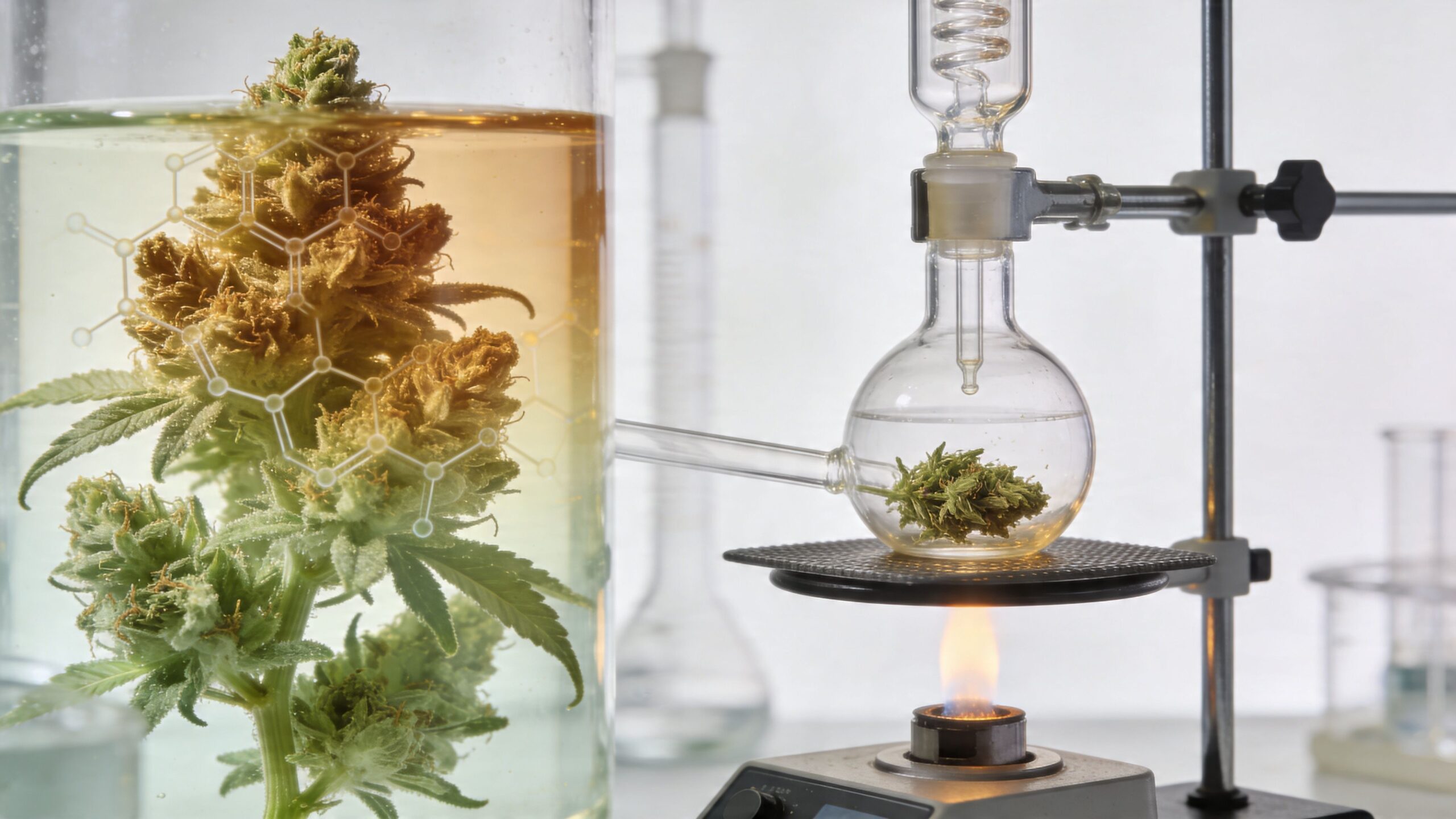
The core reaction is decarboxylation. THCA loses CO2 and becomes THC. That mass change is exact. The THCA-to-THC conversion uses a 0.877 factor, so a sample with 10% THCA yields exactly 8.77% Δ9-THC when fully decarboxylated, which is why potency math and compliance calculations use that equation, as outlined by Orange Photonics in its decarboxylation equation reference.
That chemical change doesn't create color by itself, but it occurs in parallel with the visual shift operators watch for on trays, in jars, or in reactors. The practical value is that color often tracks process progress, even though it can't confirm conversion on its own.
Why green fades and gold appears
Raw plant material starts visibly green because chlorophyll dominates what your eye sees. As heat exposure continues, that bright green look breaks down and gives way to warmer tones. At the same time, browning reactions develop.
A simple way to think about it is bread in a toaster. Early on, moisture leaves and the surface changes only slightly. Keep applying heat and the color turns appealingly golden. Push further and you move from toasted to scorched. Cannabis behaves with the same basic logic, except you're also trying to preserve chemically fragile aromatics while activating cannabinoids.
Three variables do most of the damage or good work:
- Temperature drives the speed of conversion and the rate of aroma loss.
- Time decides whether you land in the useful window or overshoot it.
- Oxygen exposure tends to worsen darkening and oxidative damage.
Browning isn't automatically success
A golden shift usually tells you the process is moving in the right direction. Darker brown doesn't mean “more complete” in any valuable sense for formulation. It often means your thermal load exceeded what the product needed.
That distinction matters because many operators learn on flower visuals and then apply the same intuition to oil or crude. In formulated products, the penalty for overcooking is larger. Once the base takes on a cooked note, you can add aroma back, but you can't fully rebuild the original freshness.
The best decarb runs don't chase the darkest endpoint. They stop when conversion is sufficient and the matrix still gives you room to formulate.
Heat and chemistry move at different speeds
Not every reaction in the vessel progresses on the same timeline. Cannabinoid activation, chlorophyll change, aroma loss, and oxidative browning don't all peak together. That's why two batches can technically decarb while producing different color and flavor outcomes.
This is also why visual control needs process discipline behind it:
- Keep bed depth consistent so heat moves through the material evenly.
- Use a verified oven or reactor profile instead of trusting the dial.
- Record color at the same inspection point each run, under the same lighting.
- Separate activation from flavoring so you're not asking one step to do two incompatible jobs.
Operators who understand the chemistry stop treating color as a mystery. They start reading it as the combined result of heat history, oxygen contact, and material handling.
Interpreting the Color Spectrum from Green to Black
You can read decarb weed color like a production diagnostic. Not perfectly, and never as a substitute for analytics, but well enough to catch drift before it becomes a finished-goods problem.
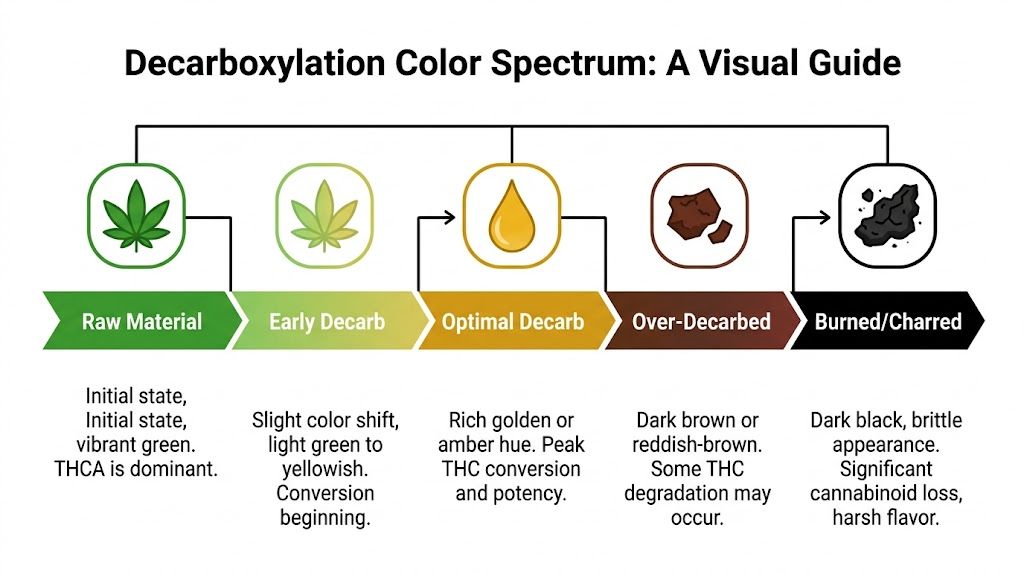
The useful color zones
Each part of the spectrum tells you something different about what probably happened in the vessel.
| Color stage | What it usually indicates | Formulation consequence |
|---|---|---|
| Green | Minimal conversion, raw-acid dominant material | Weak activation and inconsistent downstream dosing |
| Yellow-green to pale straw | Early progress, but not fully where most THC-focused formulations want it | Better than raw, but still likely incomplete for consistent THC-forward use |
| Light golden-brown | Best working zone for many THC-focused processes | Good balance of activation, manageable color, and better aroma retention |
| Dark brown | Extended thermal exposure or excessive heat load | More cooked character and less room for bright flavor reconstruction |
| Black or charred | Severe overprocessing | Harsh sensory profile and poor commercial value |
What optimal looks like
The target isn't “brown.” It's light golden-brown. That visual benchmark aligns with the process window where many operators preserve more value in the batch.
The chemistry behind that caution is straightforward. Terpenes begin degrading above 300°F (149°C), and exceeding 250°F during decarboxylation risks THC converting into CBN. Tests cited by Terrabis showed 0.1% THC-to-CBN conversion after over-decarbing at 250°F for 40 additional minutes, which is why the lighter endpoint matters for preserving both primary cannabinoids and aroma compounds, as detailed in Terrabis on decarboxylation and how to decarb weed.
That same “stop before dark” discipline also fits broader visual QC thinking used across extraction and harvest decisions. The logic behind visual maturity cues is similar to the way processors use a trichome color chart for product formulation to tie appearance back to process timing.
What over-decarbed material does to your product
Dark brown material doesn't just look worse. It behaves worse in flavor-focused formulation. Bright citrus, floral, and volatile fruit notes become harder to hold. The base can take on a toasted or stale edge that keeps showing through, even after careful blending.
Use this simple field check when reviewing a lot:
- If color is light but aroma is still expressive, you're usually still working with a flexible base.
- If color is dark and aroma feels flat, the decarb likely consumed part of your formulation headroom.
- If color is uneven across the batch, suspect load depth, hotspots, or inconsistent particle size before you blame the cultivar.
Later in the process, this visual read often predicts how much post-decarb terpene design work you'll need.
A quick visual summary helps train operators faster than notes alone.
Darker is not a quality signal. In most commercial decarb workflows, darker means you've used up options you would've preferred to keep.
Evidence-Based Decarboxylation Protocols for Color Control
Good color control comes from choosing a process you can repeat. The best profile on paper won't help if your oven cycles aggressively, your trays are overloaded, or your operators interpret “done” differently on every shift.
For THC-oriented production, there is a workable evidence-based starting range. Ideal decarboxylation conditions span 220 to 250°F for 30 to 120 minutes, and a practical target for THCA-rich strains is 230°F for 45 to 50 minutes to reach 95 to 100% activation with optimal color. A separate study cited by TCheck identified maximal THC output at 160°C (320°F) for 7 minutes, while CBD peaked at lower temperatures for longer durations, which is useful context when balancing speed against color and aroma quality, as summarized in TCheck's decarbing guide.
What the numbers mean in real operations
That data doesn't mean every processor should run hot and fast. Short, high-temperature protocols can be attractive for throughput, but they narrow your error margin. Small temperature overshoots become expensive quickly when your goal is a controlled golden endpoint rather than sheer conversion speed.
For most commercial teams trying to protect product value, the practical decision is usually between a slower, more forgiving profile and a faster, tighter one.
Here is a comparison framework that helps on the floor.
Decarboxylation Method Comparison for Color and Terpene Control
| Method | Color Control | Terpene Retention | Oxidation Risk | Best For |
|---|---|---|---|---|
| Atmospheric convection oven | Moderate if calibrated well | Fair to moderate | Higher | Small to mid-scale runs with disciplined SOPs |
| Vacuum oven | Strong | Better than open-air methods | Lower | Premium inputs, lighter color targets, aroma-sensitive workflows |
| Sealed vessel system | Strong if heat transfer is consistent | Better than open tray approaches | Lower | Odor control and tighter repeatability |
| Open tray with inconsistent loading | Weak | Weak | Higher | Not ideal for premium formulation |
| High-temp rapid decarb | Narrow operating window | Lower when mismanaged | Variable | Throughput-focused operations with strong validation |
Protocol choices by material type
Different feedstocks don't tolerate the same process equally well.
- Flower and milled biomass respond strongly to bed depth, tray spread, and agitation discipline. Uneven loading creates uneven color.
- Kief and sifted material heat fast. They can overshoot visually before an operator expects it.
- Crude or partially refined oil tends to hide process drift until aroma and finished color reveal the damage later.
What usually works best is writing separate SOPs by material class rather than forcing one universal decarb profile across all inputs.
Practical operating habits that improve color consistency
If you're trying to tighten a production process, these habits move the needle:
- Calibrate around the chamber temperature. Don't trust the front-panel setting alone.
- Standardize fill depth. Thin and even beats deep and variable almost every time.
- Use fixed observation intervals. Random checks create inconsistent operator decisions.
- Record endpoint color with photos under consistent lighting. Written descriptions drift over time.
- Reserve the fastest profiles for validated systems. Speed narrows your safety margin.
Some teams also benefit from reviewing a dedicated lowest temp for decarboxylation discussion when they want to reduce darkening pressure without stalling the line.
What usually fails
A few habits repeatedly produce dark or inconsistent lots:
- Running overloaded trays because the oven “looks empty”
- Opening the chamber too often and extending total thermal exposure
- Switching particle size between batches without updating the cycle
- Treating all genetics as if they darken at the same pace
Operator note: If you want a stable golden result, control the geometry of the load as tightly as the temperature setpoint. Uneven mass distribution causes more color problems than people like to admit.
Advanced Formulation Strategies for Flavor Integrity
Premium flavor work starts when decarb ends. That separation matters.
Trying to decarb and preserve a finished aroma profile in the same step is where many products lose their edge. Heat activates cannabinoids, but it also strips or distorts the very compounds you later need for strain replication and top-note accuracy.
Decarb first, build flavor second
For commercial formulation, visual color is useful but incomplete. Leafwell notes that a light golden-brown endpoint is the target, that CBDA-dominant hemp may require 266°F for 25 to 30 minutes, and that most terpenes boil below 311°F, which is why the best practice is to add terpene blends post-decarb under low-heat conditions. That guidance is laid out in Leafwell's decarboxylation reference.
That workflow is the one most flavor-focused manufacturers should adopt:
- Decarb the cannabinoid base to the correct endpoint.
- Let the material return to a terpene-safe handling range.
- Add the aroma system after the destructive heat event is over.
- Mix under low-heat conditions.
Why this protects strain accuracy
If you're replicating flavor of a cultivar profile in distillate or building a strain-inspired terpene blend for vape cartridges, the order of operations matters as much as the blend itself.
A practical sensory framework helps:
- Top notes carry the first impression. Citrus, sharp fruit, pine lift, and floral brightness sit here. They're the easiest to lose during heat exposure.
- Mid notes create identity. The recognizable body of a profile tends to sit here.
- Base notes hold longer and give persistence. Heavy spice, earth, and deeper resinous character usually live here.
Over-dark decarb disproportionately punishes top notes. You can still add them back later, but if the base already tastes cooked, those bright notes have to fight through the substrate.
Protecting the base before terpene infusion
Low-oxygen handling after decarb helps preserve the appearance and smell you've managed to keep. In production, that means reducing unnecessary hot exposure, sealing promptly, and avoiding casual transfers between hot containers.
Formulators working on post-decarb blending often review the boiling point of terpenes before setting their infusion and mixing conditions. That's a useful habit because it keeps the thermal logic of the process grounded in the compounds you're trying to protect.
The cleaner your decarbed base is, the less your terpene system has to rescue. That's where premium products separate from merely acceptable ones.
The commercial payoff
When decarb and flavoring are treated as separate controlled steps, a few things improve at once. Color tends to stay cleaner. Strain replication gets easier. SKU-to-SKU consistency becomes more realistic. Teams also gain more freedom to build product lines on the same base stock without carrying cooked notes into every formulation.
That isn't fancy process theory. It's one of the simplest ways to protect value in a flavor-driven manufacturing environment.
Troubleshooting Common Color Issues in Production
Most color failures don't come from one dramatic mistake. They come from ordinary drift. A thermostat runs warmer than expected. One operator loads thicker trays. Another leaves material in longer because the center still looks green.
The fix is to diagnose the failure pattern, not just re-run the same cycle and hope.
Problem runs too dark
Likely causes
- Chamber hotspots
- Excessive time in the oven
- Too much oxygen exposure
- Load depth that's too thick for even heating
What to do
Check actual temperature behavior first. Then review tray geometry, not just setpoint and hold time. If the process is consistently darkening, a lower-oxygen method may be more forgiving.
A specialized workflow can also help with long-term appearance. CBG Biotech notes that post-decarb darkening over 6 to 12 months signals degradation, that standard storage is 70°F in airtight dark containers, and that emerging 2025 vacuum technology is projected to retain 15 to 25% more terpenes while achieving a lighter initial color. That projection is discussed in CBG Biotech's decarboxylation article.
Problem color varies batch to batch
This usually points to process inconsistency rather than chemistry.
Common culprits include:
- Uneven particle size that changes heat uptake
- Variable moisture between lots
- Different bed depths from one tray to another
- Inconsistent stirring or rotation practices
Your corrective action should be procedural. Lock the prep method, loading depth, and inspection timing. Then enforce it. Variation in these basics often explains “mystery” color drift better than genetics do.
Problem the oil looks acceptable but tastes flat
This is the classic sign that the base survived visually better than it survived aromatically. The cannabinoids may be where you want them, but the volatile profile took too much heat.
The solution isn't to push decarb further. It's usually the opposite. Tighten thermal exposure and move flavor work firmly into post-decarb handling. Teams troubleshooting cart-specific issues often benefit from a process note like this guide on how to decarb cart oil, because oil behaves differently than loose biomass.
Problem the batch is pale but underperforming
A light color can be a good sign, but not if conversion didn't finish. This happens when operators become so focused on preserving color that they stop the run too early.
Use a balanced rule set:
- Color should support the endpoint, not define it alone.
- Time and temperature must stay tied to the material type.
- If your color is great but the batch behaves under-activated, your process is too conservative.
A pretty batch that doesn't perform still failed. Color only matters when it aligns with a working formulation outcome.
Conclusion Integrating Color Control into Your SOPs
The easiest way to lose consistency is to treat decarb weed color as an aesthetic side effect. It isn't. In production, color is one of the fastest indicators that your thermal process either protected value or burned through it.
The commercially useful target is not generic browning. It's a controlled, repeatable move into the light golden-brown range while preserving enough character in the base to support clean formulation later. That means managing time, temperature, oxygen exposure, load depth, and handling discipline as one system.
What belongs in the SOP
A strong SOP for color control usually includes:
- Defined loading geometry so every batch heats similarly
- A validated temperature-time profile for each material class
- Standardized visual checks under the same lighting conditions
- Clear stop criteria that combine timing with observed endpoint
- Post-decarb handling rules that limit avoidable darkening and aroma loss
That framework helps operators make the same decision the same way, even across shifts and product lines.
Where profit shows up
Better color control improves more than appearance. It protects formulation flexibility. It reduces the need for corrective blending. It makes strain-inspired products easier to keep on profile. It also gives brand owners a cleaner shot at repeatable carts, concentrates, and infused products that look and taste like they belong under the same label.
In other words, controlling decarb color is not housekeeping. It's product strategy.
The teams that do this well don't rely on luck, vague visual habits, or inherited “oven wisdom.” They run decarb as a measured process, then build flavor on top of a stable base. That's how premium products stay premium.
Once your decarb process is producing a clean, repeatable base, the next step is precise terpene design. Gold Coast Terpenes offers strain-specific blends, isolates, and formulation tools that help manufacturers dial in flavor accuracy for distillate, concentrates, and vape cartridges without relying on guesswork.