
A vape cart line doesn’t drift off target by accident. It drifts because the raw material changed before anyone in formulation had a chance to control it.
One batch comes in loud and bright. The next is flatter, heavier, or oddly hollow in the middle of the aroma. Distillate viscosity behaves differently. The same terpene reintroduction rate doesn’t land the same sensory result. Customer feedback starts sounding familiar: good, but not like last time.
For product developers, that problem usually starts upstream in trichomes on weed. Not in branding, not in packaging, and not in the final fill step. Trichomes are where the plant builds and stores the compounds that later shape flavor accuracy, concentrate quality, and SKU consistency. If you want reliable vape cartridges, stable concentrate outputs, and repeatable strain-inspired terpene blend decisions, you need to read trichomes as production data, not as decoration.
The Formulator's Challenge with Product Inconsistency
A new product developer often inherits inconsistency without seeing the root cause. They get flower or crude that already carries the consequences of harvest timing, rough handling, poor drying, or weak source selection. Then they’re asked to make a repeatable cartridge from material that was never chemically consistent to begin with.
That’s why trichomes matter commercially. They aren’t just part of cultivation. They are the first checkpoint in formulating for vape cartridges and concentrates that have to hit the same sensory target every run.
Why inconsistency shows up in finished SKUs
The symptoms are familiar:
- Flavor drift: A batch that should taste bright and strain-true comes out muted or overripe.
- Aroma imbalance: Top notes fade first, so the profile feels heavy even when the terpene percentage is unchanged.
- Effect mismatch: A cart expected to feel lively lands flatter because the source material matured in a different window.
- Cost creep: Teams compensate for weak starting material by overworking the blend later.
Those fixes rarely work well. You can patch a profile, but you can’t fully rebuild what never made it through harvest and post-harvest intact.
Practical rule: If your terpene addition rate keeps changing to “save” a batch, the problem probably started before extraction.
Trichomes are the controllable variable
For manufacturers, trichomes should be treated like a raw material quality indicator. They tell you whether the plant was harvested early, hit the target window, or stayed too long and moved into a less useful profile for the SKU you’re building.
That matters whether you’re making:
- A terpene profile for distillate
- A strain-inspired terpene blend
- A formulation guide for cannabis product formulation
- A replicating flavor of legacy flower profile project
The formulator’s job isn’t to romanticize the plant. It’s to translate plant biology into process control. If the source trichomes were immature, damaged, or overly oxidized, the final product will ask for compromises somewhere else.
What works and what doesn’t
A practical team builds specs around trichome condition, source genetics, and intended output. A reactive team buys frosty flower, assumes quality, and hopes blending can close the gap.
Here’s the trade-off:
| Approach | Likely outcome |
|---|---|
| Buy based on appearance alone | Sensory variation and more rework |
| Source based on maturity and integrity | Better alignment between raw material and target SKU |
| Treat harvest timing as a grower-only concern | Lost control over formulation inputs |
| Use trichome observations to set intake standards | More predictable extraction and terpene recovery decisions |
Product consistency starts long before the filling line. That’s the primary commercial meaning of trichomes on weed.
Anatomy of the Cannabinoid and Terpene Factory
A lab can receive two flower lots from the same cultivar, both equally frosty at first glance, and still get very different extraction behavior. One lot washes or runs with strong aroma retention and a clean target profile. The other needs correction later through blending, reintroduction, or SKU reassignment. The difference often starts with trichome structure.
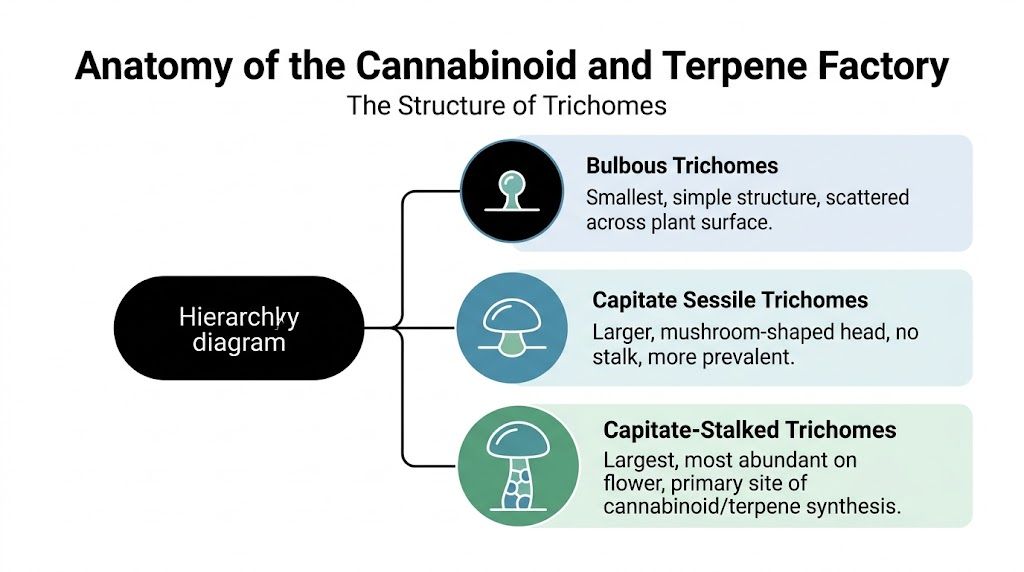
Trichomes are the plant’s resin glands. For product developers, they are the biological sites where much of the chemistry you plan to sell is produced, stored, and exposed to damage. If you want repeatable vape carts or concentrates, “frosty” is not a useful spec. Gland type, head development, and resin integrity are.
Three trichome types and one that usually drives commercial value
Cannabis produces three main trichome classes: bulbous, capitate-sessile, and capitate-stalked.
Bulbous trichomes are small and distributed broadly across plant tissue. Capitate-sessile trichomes sit closer to the surface and contribute to the plant’s protective chemistry. Both matter biologically. In commercial extraction, though, they are rarely the main reason a lot performs well.
Capitate-stalked trichomes usually carry the true formulation value. They present the larger gland heads and resin volume that extraction teams want to preserve. That resin is the starting point for native terpene retention, stronger cannabinoid yield potential, and flower-linked sensory identity in finished oil.
The practical takeaway is simple. A visual assessment should separate “covered in trichomes” from “rich in intact capitate-stalked heads.” Those are not the same condition.
Why structure matters to extraction and formulation
Capitate-stalked trichomes matter because their architecture supports more resin accumulation. More storage capacity changes downstream decisions.
Lots with well-developed gland heads generally give formulators better options for:
- Capturing a more recognizable native aroma
- Building vape SKUs that need stronger cultivar identity
- Reducing how much sensory correction is needed after extraction
- Choosing whether a lot fits live resin, cured resin, or a terpene recovery workflow
That does not mean every stalked-heavy lot is automatically premium. Resin can still be oxidized, smeared, broken, or volatilized before it reaches the lab. But if the plant did not build strong glandular structures in the first place, the extractor starts with less chemical and sensory material to work with.
I train new product developers to watch for that distinction early. Appearance can sell a flower jar. It does not guarantee a stable input for a cartridge line.
What product teams should actually evaluate
A useful intake conversation starts with resin architecture, not marketing language. Ask questions that connect the flower surface to process outcomes:
- Are gland heads intact or ruptured?
- Does the lot show meaningful capitate-stalked development?
- Is the resin likely to support the intended extract style without heavy post-processing correction?
- Will this material preserve enough native character to justify a strain-specific SKU claim?
Those questions matter because formulation is constrained by what the plant built and what post-harvest handling preserved. The closer your team gets to the biology, the fewer surprises show up in sensory review, terpene adjustment, and batch standardization.
Teams that want a stronger scientific base for this can review how plants biosynthesize terpenes and aromatic compounds. It helps explain why gland structure and resin preservation have direct consequences for finished vape and concentrate consistency.
Decoding Trichome Maturity for Target Profile Formulation
A lot can go wrong between intake and a finished cart, but one mistake starts at the plant. A buyer approves a lot because the flower looks frosty, the extractor runs it, and the formulation team still ends up correcting for weak top notes, flat mid-palate, or a profile that drifts batch to batch. In practice, that usually traces back to maturity, not just appearance.
For product development, trichome color is a rough process signal. It helps teams estimate whether a lot is likely to support a bright, strain-faithful vape, a heavier concentrate, or a SKU that will need more post-extraction adjustment to hit spec.
What clear, milky, and amber actually mean for formulation
Clear heads usually indicate immature resin. The plant has started building the gland, but the chemistry has not reached the stage most formulators want for terpene-rich, expressive products. You can still process that material. You just should not expect it to carry a premium sensory profile on its own.
Milky heads are usually the most useful point for formulation work. At that stage, the resin tends to give a stronger balance of potency and aromatic presence, which is why experienced extraction teams often favor it for live resin, cured resin, and flower-forward cartridge programs.
Amber heads mark a later phase. Some product teams want that shift because it can support a rounder, heavier effect profile. The trade-off is usually less freshness and less precision in the top end of the aroma.
That trade-off matters commercially.
A cart sold on citrus lift, floral detail, or loud cultivar fidelity usually performs better when the source material is taken during a mostly milky window. A nighttime SKU built around weight, softness, and duration can tolerate more late maturity. Teams that treat every harvest window as interchangeable end up spending more on blending, terpene correction, and batch matching.
A practical intake framework for target profile decisions
I do not ask whether a lot is "ready." I ask what kind of SKU it is supposed to become. That changes the acceptance standard.
| Trichome look | Likely formulation outcome |
|---|---|
| Mostly clear | Early material. Often thin in aroma and less reliable for premium, strain-specific profiles |
| Mostly milky | Strong candidate for bright, terpene-forward formulations and broad SKU flexibility |
| Milky with some amber | Useful for fuller, rounder profiles with a little more weight |
| Amber dominant | Better fit for intentionally heavier products than for fresh, high-definition flavor targets |
Here, cultivation data becomes formulation data. If sourcing, extraction, and product teams use the same visual language, they can reject weak-fit material sooner and reserve premium lots for SKUs that can justify them. A shared trichome color chart for intake and formulation reviews helps standardize that conversation.
The real cost of waiting too long
Amber is not automatically a defect. It signals a change in resin composition and sensory direction.
That distinction gets missed by brand teams that focus only on THC headline numbers. Consumers do not experience a vape through potency alone. They notice brightness, density, sweetness, gas, finish, and whether the profile still feels alive after extraction and hardware filling. Late-harvest material can support some of those goals, but it usually moves away from crisp aromatic fidelity.
For a formulator, the key question is whether that change is intentional.
If the answer is yes, some amber can be useful. If the brand promise is fresh cultivar expression, too much amber often creates expensive problems later. The lab can concentrate what is there. It cannot restore volatile character that was lost before harvest.
Harvest timing sets the upper limit for what the extractor and formulator can preserve.
Teams get better results when they write maturity targets into raw material specs instead of treating trichome color as grow-room folklore. That turns a visual cue into a QA input. It also gives the brand a better chance of producing repeatable vape and concentrate SKUs with fewer sensory surprises.
For quick visual context, this breakdown is helpful:
Preserving Trichome Integrity from Harvest to Lab
A lot can go wrong in the six hours after cut. I have seen strong material arrive at the lab looking acceptable on paper, then perform like a lower tier lot because the resin was smeared, warmed, and knocked around in transit. The grow team still reports the right cultivar. The extractor still runs the batch. The cartridge still gets filled. What drops is the part customers notice first: aroma definition.
That is why post-harvest handling belongs inside the same QA conversation as extraction yield, terpene retention, and formulation consistency.
Protect the resin before you ask the lab to preserve it
Trichomes are exposed resin glands. Once heads are ruptured, volatilized, or oxidized, the lab is working with a changed input. Extraction can concentrate what remains. It cannot rebuild the original sensory profile.
The highest-value habits are simple:
- Reduce contact: Fewer transfers mean fewer broken heads and less resin left on gloves, bins, and liners.
- Control temperature: Warm harvest rooms, warm transport, and warm staging all push volatile loss in the wrong direction.
- Segregate by intended use: Material intended for terpene-led SKUs should not move through the same rough workflow as bulk extraction biomass.
- Document handling events: If a lot sat too long, got compressed, or moved through an overloaded room, record it. That context helps explain later sensory variance.
Product developers should care about this because handling damage creates formulation problems that look unrelated at first. The cartridge may still hit potency. It just smells flatter, tastes less specific, and needs more correction later.
Selective harvest improves lot consistency
Uniform feedstock starts in the field or trim room, not in a blending tank.
Maturity is rarely identical across an entire plant, and mixed-condition harvests often produce mixed-condition extract. That shows up as wider batch spread in aroma, color, and downstream behavior. For a brand trying to keep one SKU tasting the same from run to run, that spread gets expensive.
A selective harvest approach usually gives better control for:
- Distillate products built around cultivar-matched terpene profiles
- Native terpene capture programs
- Live or cured concentrates sold on aroma fidelity
- Repeatable vape SKUs with a defined sensory target
I tell new product teams to treat harvest selection like ingredient grading. If top lots and average lots get combined too early, the premium fraction is gone before extraction starts.
Rough harvest habits become COAs with weaker sensory value and formulations that need more correction.
Drying and curing protect chemical value, not just appearance
Drying is a preservation step. It sets the condition of the resin that eventually reaches extraction, winterization, terpene recovery, or post-process blending.
Three operating choices matter most. First, keep movement low during hang, rack, or tray handling. Second, hold environmental conditions as steady as possible so one harvest lot does not split into multiple sensory outcomes. Third, maintain lot identity from cut through intake. If a harvest window produced better aromatic expression, protect that advantage instead of averaging it away.
Teams that want a practical cultivation-side reference should review this guide on how to dry and cure pot. It helps formulators understand why two lots with the same strain name can behave very differently in the lab.
Match post-harvest decisions to the product target
There is no single best harvest and handling style for every commercial product. A bright, terpene-forward vape and a heavier, potency-led concentrate do not ask the same things from the plant. The mistake is treating all biomass as interchangeable once it leaves cultivation.
If the product brief calls for fresh cultivar character, protect low-disturbance handling, cooler conditions, and tight lot separation. If the business case is bulk cannabinoid recovery, the process can tolerate more compromise, but the sensory ceiling will be lower from the start.
That trade-off should be intentional. Brands that define it early waste less material, reject fewer batches, and build SKUs that stay recognizable after scale-up.
Applying Trichome Science to Extraction and Formulation
Extraction teams feel trichome quality in the process long before they see it on a label. Better source material behaves differently. It separates differently, smells different in the room, and gives the formulation team better options later.
That’s where plant biology finally meets margin.
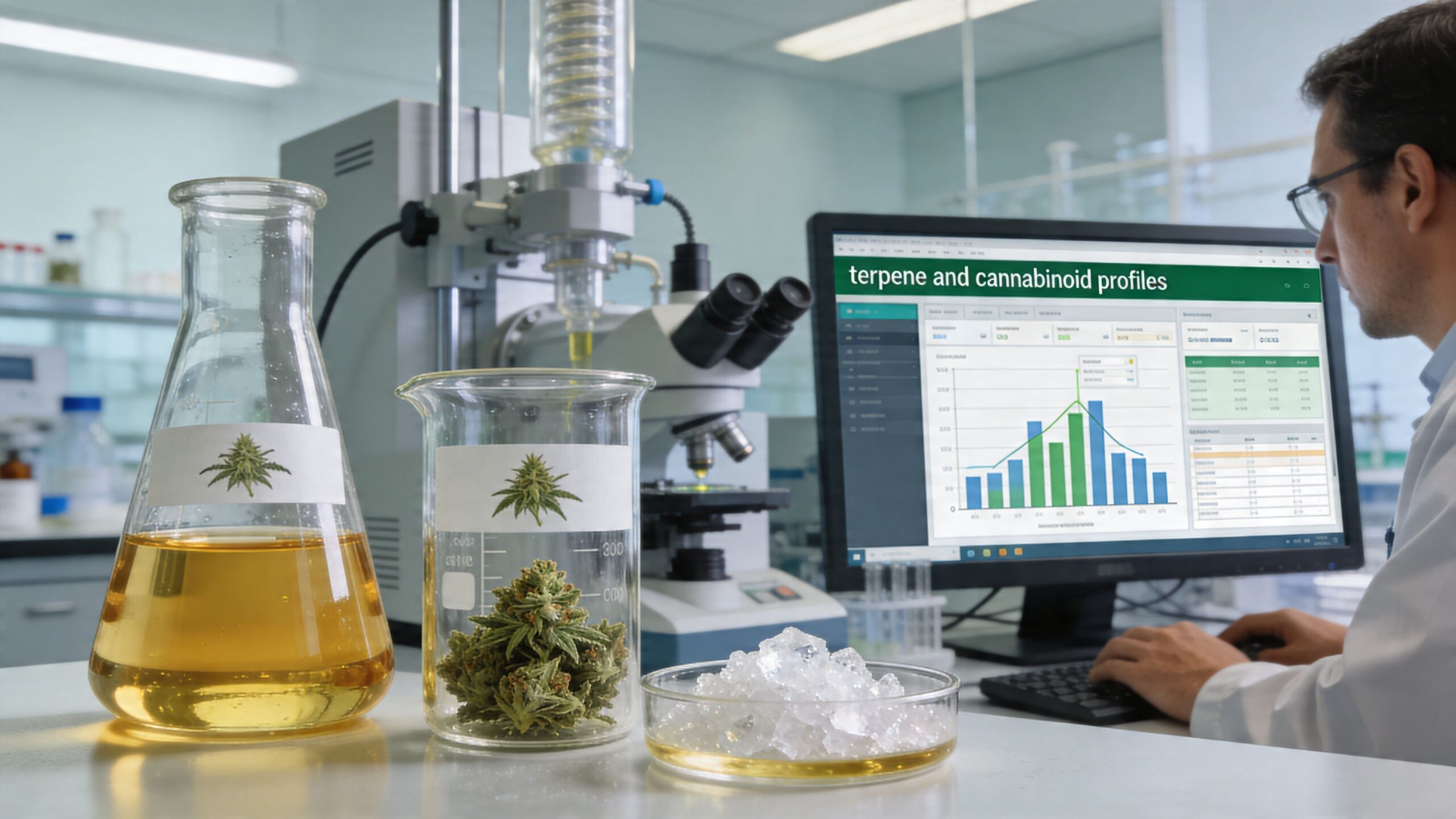
Extraction method should match trichome condition
Not every extraction style benefits from the same starting material condition.
If trichome heads are physically intact and aromatic quality has been preserved, the material is more suitable for processes that depend on maintaining resin character. If the source is already compromised, oxidized, or mechanically damaged, the extractor often shifts toward methods that prioritize cannabinoid capture over preserving a refined sensory fingerprint.
That’s a business decision, not a philosophical one.
A practical way to view this is:
| Starting material condition | Better fit |
|---|---|
| Intact heads, strong aroma, careful post-harvest | Premium concentrate workflows and aroma-led SKUs |
| Average integrity, moderate aroma retention | General extraction with selective terpene reconstruction |
| Damaged or flattened sensory input | Distillate-first workflows where formulation rebuilds the profile |
This is why intake and extraction teams should talk before biomass moves into the queue. The wrong process can waste the strengths of a good lot or expose the weaknesses of a poor one.
Distillate removes variability and creates new responsibility
Distillate solves one problem and creates another.
It gives formulators a more standardized cannabinoid base. But it also strips away much of the original aromatic identity that customers associate with cultivar character. Once that happens, consistency depends on how well you rebuild the profile.
That’s where a strain-inspired terpene blend for distillate becomes a technical exercise rather than a flavoring shortcut.
A reliable workflow usually looks like this:
- Define the target clearly: Decide whether you’re recreating brightness, gas, fruit, dessert, floral lift, or a broader strain memory.
- Map note structure: Build around top, mid, and base note behavior rather than chasing a single loud terpene.
- Match the SKU format: A profile for a cart won’t always behave the same way in a disposable, concentrate jar, or infused pre-roll component.
- Test in the finished matrix: Good aroma in a bottle doesn’t guarantee the same result once heated in hardware.
Top, mid, and base notes in practical formulation
At this stage, newer formulators often oversimplify.
A terpene profile is not just a list of ingredients. It is a structure.
Top notes create the first impression. They deliver lift, brightness, citrus peel, fresh fruit, or volatile sweetness.
Mid notes give identity. They often carry the heart of the profile, where the blend starts resembling a known cultivar direction rather than a generic flavored oil.
Base notes add persistence and weight. They help the profile stay recognizable from inhale through finish.
When teams fail at replicating flavor of flower for vape cartridges, the issue is often structural. They overload the top, flatten the middle, or use too much heavy material that muddies the close.
A profile that smells strong in the bottle can still fail in a cart if the note structure collapses under heat.
Use trichome science to guide reintroduction choices
If the source flower was taken in a milky-forward window and preserved well, the target profile should usually emphasize clarity, lift, and freshness. If the source material leaned later in maturity, a formulator may intentionally build more depth, warmth, and heavier finish into the blend.
That doesn’t mean copying the plant one molecule at a time. It means respecting the chemistry trajectory that trichome development suggested in the first place.
For teams building extraction-informed products, this guide on how to make cannabis concentrates is useful because it ties process choices back to source material characteristics and final product style.
The strongest product developers don’t ask only, “What terpene percentage should we add?” They ask better questions:
- What did the raw material naturally want to become?
- Which parts of that profile survived extraction?
- What needs reconstruction, and what should be left alone?
- Is the goal flavor accuracy, broad inspiration, or a more optimized commercial expression?
That mindset produces cleaner SKU architecture and fewer surprises at scale.
A QA Framework Beyond Visual Inspection
A buyer signs off on a frosty lot on Monday. By Friday, the extract runs thin, the terpene profile feels flat, and the formulation team is rebuilding a SKU that should have worked from the start. That failure usually begins at intake, where appearance gets treated as proof of value.
“Frosty” helps with fast sorting. It does not tell a production team enough to route material with confidence.
Dense visible trichomes can still produce disappointing feedstock if resin heads are immature, damaged, or inconsistent across the lot. Stress during cultivation can also create flower that looks attractive on the bench but performs poorly once it reaches extraction. For product developers, the key question is not whether the flower looks resinous. The question is whether the trichome population supports the target SKU.
Why visual frost can mislead a buyer
Visual review has a place. It catches obvious problems quickly, and it helps a team reject material that never belonged in the building.
It also creates false confidence.
A shiny lot may carry too much variability in head maturity. Another lot may show heavy exterior coverage but weak resin development where it counts. I have seen material that impressed procurement on first look and still forced reformulation later because the aroma, potency, and process behavior did not line up with the intended product.
That is why intake should classify flower by production fit, not by shelf appeal.
A better intake protocol
Use visual inspection as the first screen, then confirm the lot with lab data and a routing decision. That sounds simple, but it changes how a team buys.
At intake, check these factors
- Head maturity: Clear, milky, and amber ratios matter more than broad surface sparkle.
- Physical integrity: Broken heads, smeared resin, compression, and excess handling usually mean lower recovery and weaker aromatic retention.
- Lot uniformity: Mixed maturity often becomes mixed extraction behavior and wider variation in finished SKUs.
- Aroma coherence: A profile that already smells scattered at intake rarely turns more precise after processing.
- Contamination risk: Dust, plant fines, moisture issues, and poor storage conditions can lower both extraction efficiency and formulation quality.
Then confirm with analytics
- Cannabinoid testing: Verifies whether the lot matches the potency range needed for the intended product.
- Terpene profiling: Shows whether the aromatic structure supports a strain-style cart, a live-style concentrate, or a rebuild.
- Moisture and water activity: Helps predict storage stability and processing risk.
- Lot-to-lot comparison: Protects repeat SKUs from gradual drift that visual checks often miss.
This is how a team stops buying flower as a commodity and starts buying feedstock with a defined use case.
What a modern QA culture looks like
Strong QA programs give cultivation, procurement, extraction, and formulation the same intake language. That alignment matters because each group sees a different failure mode. Procurement sees price pressure. Extraction sees yield loss. Formulation sees aroma gaps and unstable SKU performance. QA has to connect all three before a purchase becomes a problem.
| Weak QA culture | Strong QA culture |
|---|---|
| “It looks good, run it.” | “Which SKU is this lot suited for?” |
| Procurement buys on appearance and price | Procurement buys on fit, test data, and process value |
| Potency and aroma are assumed | Potency and aroma are confirmed before routing |
| Mixed lots get blended to hide inconsistency | Mixed lots are flagged, segmented, or rejected |
| Rework is treated as part of production | Rework is tracked back to sourcing and intake failure |
For cannabis product formulation, that shift improves margin as much as it improves quality. Better intake standards reduce rescue blending, cut avoidable terpene reconstruction, and protect high-value material from being wasted on the wrong extraction path.
The best teams do not ask whether a lot looks premium. They ask whether it can produce a repeatable result at commercial scale.
Conclusion From Plant Biology to Brand Equity
The commercial value of trichomes isn’t abstract. They shape the raw chemistry that determines how a concentrate extracts, how a cart tastes, and whether a customer recognizes your product the second time they buy it.
That’s why trichomes on weed deserve attention from product developers, not just growers. Capitate-stalked structure tells you where the value sits. Maturity tells you what kind of profile the plant is offering. Post-harvest handling determines how much of that value survives long enough to reach the lab. QA tells you whether the lot belongs in a premium SKU, a distillate rebuild, or nowhere at all.
Teams that understand those links make better decisions earlier. They source more selectively. They route material more intelligently. They build terpene profile for vape cartridges projects from stronger inputs. They spend less time correcting preventable variation.
That’s how plant biology becomes brand equity. A repeatable product line doesn’t come from guesswork or marketing language. It comes from reading the source material correctly, protecting it through process, and formulating with a clear target in mind.
When a brand gets that right, consistency stops being a happy accident. It becomes a system.
If you’re developing strain-inspired terpene blends, building a terpene profile for distillate, or improving flavor accuracy for vape cartridges, Gold Coast Terpenes offers strain-specific profiles, isolates, and formulation-friendly resources built for manufacturers, extractors, and product teams.