
Most advice on how to make live resin at home gets the core issue backward. It treats live resin like a simple kitchen-scale extraction project. It isn’t. It’s a tightly controlled hydrocarbon process built around frozen biomass, solvent management, purge control, and lab-grade safety.
If you’re a brand owner or formulator, the smarter question isn’t how to copy an internet tutorial. It’s how to understand what makes live resin valuable, then decide which parts belong in your operation and which parts should stay in licensed extraction environments.
For product development, the prize is usually not the extraction spectacle. It’s the aroma fidelity, strain accuracy, and repeatable terpene profile for cannabis product formulation. That shifts the conversation from DIY blasting to controlled formulation.
The Risks of Making Live Resin at Home
The most popular DIY advice is also the least responsible. A lot of content around how to make live resin at home centers on open-blasting butane into glassware with improvised ventilation. That is not a serious production method. It’s a fire risk with weak process control and poor consistency.
From 2023-2025, U.S. Fire Administration reports showed over 150 cannabis extraction-related fires annually, with 70% tied to amateur butane blasting in homes, according to this overview of risky open-blasting practices and related fire data. The same source notes that these methods can cause over 50% terpene loss.
That should change how you frame the entire project.
What online DIY guides get wrong
Open blasting gets presented as if the main challenge is yield. It isn’t. The first challenge is ignition risk. The second is solvent handling. The third is that even if nothing catches fire, the operator still has weak control over temperature, flow, retention, and purge.
A new brand owner should read those trade-offs like this:
- Safety risk comes first. Hydrocarbon vapor management is not optional.
- Quality suffers fast. A process that claims to protect aroma can still strip it out through poor handling.
- Scale makes the gap wider. If a method barely works once, it won’t support a product line.
Practical rule: If a process depends on improvised ventilation, consumer-grade vessels, or hand-waved purge steps, it isn’t a production method. It’s a liability.
Why professionals don’t treat this like a home project
Professional teams use enclosed systems, controlled chilling, solvent recovery, and documented procedures. They also build around facility safety standards that home setups don’t replicate. That’s why the better operational move is often to separate extraction from formulation.
You don’t need to make hydrocarbons your in-house competency just because you want a live-resin-style sensory result. If your end goal is a believable strain-inspired terpene blend for vape cartridges, the profile matters more than the stunt.
For operators building SKUs, the cleaner path is to source compliant extract inputs, then focus on blend architecture, hardware compatibility, and repeatable flavor targets. That keeps you closer to product development and farther from preventable accidents.
A safety framework belongs in every formulation business. This cannabis terpene safety reference is the kind of operational reading that makes more sense for product teams than another open-blasting video.
Preparing Biomass for Peak Terpene Preservation
The first part of live resin that deserves real respect is the biomass workflow. If the harvest window is off, or the freeze is delayed, the rest of the process starts with compromised material. That’s true whether you’re running extraction yourself or buying from a licensed partner.
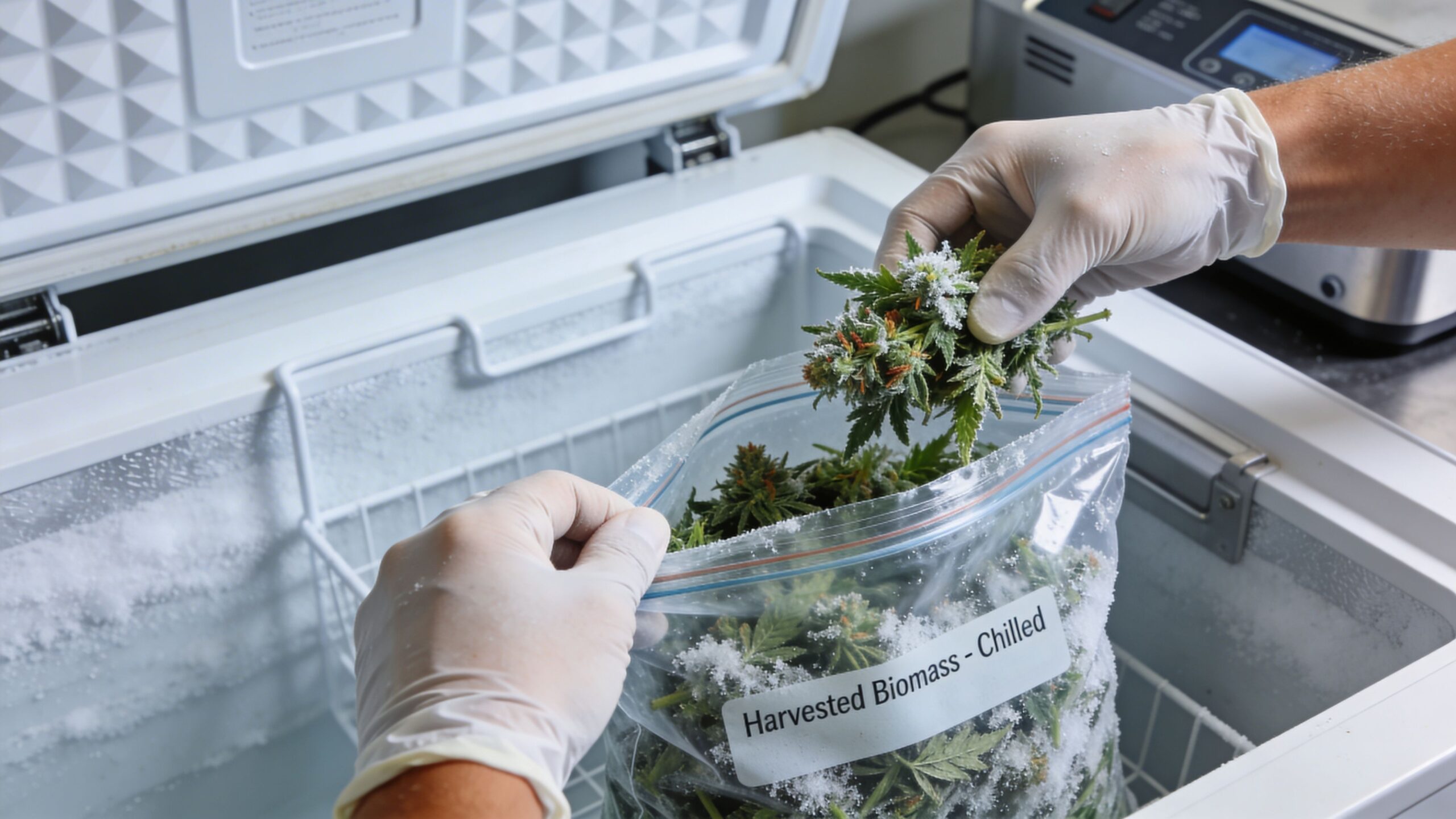
A strong live resin workflow starts with trichome-dense strains like Gelato or Wedding Cake, then moves immediately into flash-freezing at -20°F to -40°F for 24-48 hours, which helps prevent the 30-50% terpene loss associated with traditional drying and curing, according to this live resin biomass preparation guide.
Fresh frozen changes the entire input
Fresh frozen isn’t just a storage choice. It defines the chemistry of the run. Traditional drying changes the aromatic balance before extraction even begins. Live resin developed as a response to that problem.
For formulators, this matters because source material determines what kind of profile you can expect downstream. If the biomass never carried a strong volatile layer into extraction, the final oil won’t magically recover it later.
Three things deserve close attention:
- Genetic fit: Dense trichome coverage and expressive aroma matter more than popularity.
- Harvest timing: Material needs to come down at the right maturity, not just when the room schedule allows.
- Cold-chain discipline: Once you commit to fresh frozen, delays work against the whole point of the method.
Where small operators make preventable mistakes
A lot of amateur errors happen before solvent touches the plant. Mishandling biomass creates inconsistency that later gets blamed on equipment.
One documented issue is packing. The same source notes that poor packing affects 30% of amateur runs and can reduce yield by up to 40%. That’s not a minor optimization issue. That’s a sign the operator doesn’t have control of the extraction bed.
Here’s what experienced teams watch for:
| Biomass issue | What it does to the run | Why formulators should care |
|---|---|---|
| Delayed freezing | Weakens volatile aroma retention | Target profile starts flatter |
| Wet, uneven material handling | Makes extraction behavior less predictable | Batch-to-batch flavor drifts |
| Overpacked column loading | Restricts solvent movement | Output quality and recovery suffer |
Frozen material is only valuable if the operator preserves its structure and handles it consistently. Fresh frozen is not a shortcut. It’s a stricter workflow.
Why this matters even if you never extract in-house
Brand owners often assume biomass preparation is the extractor’s problem. It is. But it’s also your flavor problem, your spec problem, and eventually your customer complaint problem.
If you’re buying extract for carts, concentrates, or blends, ask how the producer handles fresh-frozen intake. Ask what strains they freeze, how quickly material moves into cold storage, and whether the process was designed to preserve aroma rather than just maximize throughput.
It also helps to understand the opposite workflow. This drying and curing reference is useful because it shows why dried flower and live-resin inputs produce different formulation starting points.
Understanding Professional Hydrocarbon Extraction Systems
The biggest gap between internet advice and real extraction is the machine itself. A professional closed-loop hydrocarbon system is not a dressed-up version of open blasting. It’s a different category of process.
What the system is doing
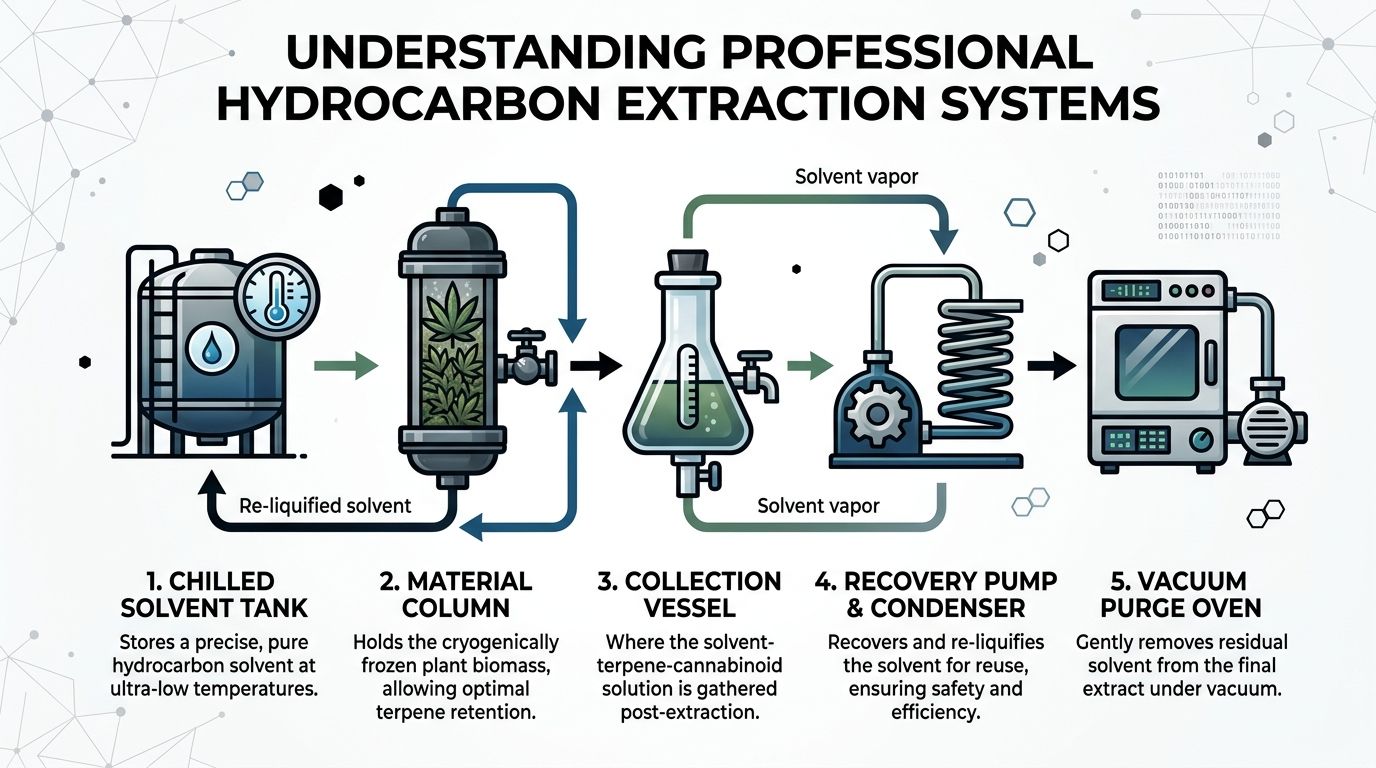
At a practical level, the system has to chill solvent, move it through frozen biomass, collect the dissolved compounds, and recover the solvent without releasing dangerous vapor into the room. Each stage affects aroma retention and process safety.
That’s where solvent choice becomes important. A 70% propane/30% butane blend can extract up to 30% more terpenes than pure butane, reaching 4-8% terpene content, and propane’s -44°F boiling point helps with extraction from biomass frozen at -50°F, according to this professional live resin extraction reference. The same source states the resulting extract can reach up to 95% THC with five times more terpenes than standard extracts, and that advanced methods can cut solvent needs by 80%.
Those numbers explain why professionals tune blends instead of treating “butane” as a single generic input.
Why closed-loop matters
Closed-loop systems are built to contain, recover, and reuse solvent. That changes both safety and economics. It also gives the operator process control that home setups don’t have.
The critical components usually include:
- Chilled solvent tank for stable low-temperature input
- Material column loaded with frozen biomass
- Collection vessel where extracted compounds accumulate
- Recovery pump and condenser to pull solvent back out of the system
- Vacuum purge equipment for the finishing stage
That architecture is why professional operators can tune extraction conditions instead of guessing.
Licensed hydrocarbon extraction belongs in engineered environments with ventilation, recovery systems, and trained operators. A home garage is not a substitute for a classified lab.
The business lesson for brand owners
If you’re building a brand, you don’t need to become a hydrocarbon specialist to make better products. You need to understand enough about the process to know what to outsource and what to control internally.
Control these parts internally:
- Profile target
- Acceptable aroma window
- Hardware fit for vape cartridges
- Batch approval standards
- Post-extraction formulation logic
Outsource these parts unless you already have the compliant infrastructure:
- Hydrocarbon extraction
- Solvent management
- Hazard mitigation
- Facility engineering
A lot of teams burn time trying to own every step. In practice, strong operators draw a cleaner line. They let licensed extractors handle hazardous processing, then build value in formulation, blending, and product consistency.
What works and what does not
A short comparison makes the gap clear:
| Approach | What works | What fails |
|---|---|---|
| Closed-loop hydrocarbon extraction | Temperature control, solvent recovery, repeatability | Higher capital and compliance burden |
| Open blasting | Low barrier to entry | Safety risk, poor control, inconsistent aroma |
| Formulating live-resin-style profiles into finished oil | Repeatable flavor direction, safer product development path | Requires disciplined sensory and blending work |
This broader guide to cannabis concentrates helps put live resin in context. For most new brands, understanding the family of concentrate workflows is more useful than trying to imitate the riskiest one.
Post-Processing Demystified Purging and Winterization
Extraction doesn’t end when the oil leaves the column. The output still needs cleanup and finishing. Many people underestimate how much skill is required to produce a stable, clean concentrate that still smells like the source material.
Live resin emerged in 2013 and uses fresh-frozen material to avoid the losses tied to drying. The professional process ends with purging in a vacuum oven at 85-105°F under -29 inHg for 24-72 hours, removing 99.9% of residual solvents and yielding material in the 65-95% THC range with up to 5 times more terpenes than BHO, according to this live resin process overview.
Purging is a balancing act
Purging sounds simple when it’s reduced to “remove the solvent.” In reality, the operator is balancing cleanup against aroma preservation. Too aggressive, and the profile gets stripped. Too weak, and residual solvent remains a problem.
That’s why purge conditions matter so much:
- Heat drives solvent off
- Vacuum lowers the pressure needed for removal
- Time determines how complete the cleanup becomes
Each variable affects the others. The operator isn’t just drying the extract. They’re trying to remove what shouldn’t stay while protecting what should.
A bad purge can leave two kinds of damage. Obvious contamination, or a clean-looking extract that lost its aromatic identity.
Where winterization fits
Winterization often enters the workflow when the final use case needs cleaner oil behavior, especially in inhalable formats. The point is to reduce fats, waxes, and lipids that can cloud performance and mute the finished profile.
For formulators, the takeaway is straightforward. The cleaner the bulk oil, the easier it is to predict how it will behave in a cartridge or concentrate blend. But cleanup steps also create another opportunity for sensory drift.
That’s why experienced product teams don’t assume extraction alone will carry the entire aromatic burden of the SKU. They evaluate the extract after post-processing, then decide whether the profile is complete or needs refinement.
Why terpene knowledge matters after extraction
At this stage, understanding volatility becomes more useful than romantic ideas about “full spectrum.” Some aromatic compounds leave early. Others remain longer and shape the body of the profile.
A practical reference for that thinking is this terpene boiling point guide. It helps explain why top notes often disappear first, why a purge can flatten brightness, and why post-process formulation can restore realism when the base extract smells incomplete.
If you formulate vapes or concentrates, at this stage, your mindset changes. Extraction creates the base. Post-processing decides how much character survives. Formulation decides whether the final product hits the target.
Replicating Live Resin Profiles for Product Formulation
For many brands, the safest and most scalable answer to how to make live resin at home is: don’t. Learn the process, source compliant extract, and rebuild the sensory target through formulation.
That’s especially relevant when you’re working on a terpene profile for distillate, a strain-inspired terpene blend for vape cartridges, or a repeatable aroma target across multiple batches.
Start with sensory architecture
A believable live-resin-style formulation usually breaks into three layers:
Top notes
These create the first impression. They’re the bright, sharp, volatile elements that jump out when a cartridge is opened or the vapor lands up front.
In practical formulation work, top notes often define whether a profile reads as citrus, tropical, candy, floral, or sharp gas. They also disappear fastest if you overheat the oil or use weak storage practices.
Mid notes
At this stage, the strain character starts to feel specific. The middle carries the body of the aroma and gives shape to the first impression. If the top notes announce the profile, the middle explains it.
Mid notes often determine whether a blend feels realistic or generic. A profile can open well and still fail here if it collapses into a flat sweet note with no structure.
Base notes
Base notes stay longer and anchor the blend. They add weight, depth, spice, earth, wood, pepper, or heavy sweetness depending on the target.
Without a solid base, a cartridge can smell loud in the bottle but thin in use. A good base holds the profile together through repeated heating cycles.
Good live-resin-style formulation isn’t about making a blend louder. It’s about making the top, middle, and base behave like they belong to the same plant.
Build from a target, not from a pile of isolates
A common mistake is starting with whatever terpene isolates are on hand and trying to “make it strain-like” afterward. That usually produces a cartoon version of the profile.
A better workflow looks like this:
- Define the target clearly. Pick a strain family, harvest style, and intended product format.
- Decide what the product needs to smell like in hardware. A profile that works in a jar won’t always translate cleanly in a cartridge.
- Separate aroma from density. Some profiles need lift. Others need body.
- Add in small revisions. Change one part of the architecture at a time.
- Re-test after the blend sits. Freshly mixed aroma can mislead you.
A practical example for vape formulation
Say you’re developing a strain-inspired terpene blend for vape cartridges based on a dark fruit profile. The target is not just “sweet.” It needs layered fruit up top, a saturated middle, and enough grounding in the base so it doesn’t smell like candy flavoring.
Your evaluation might look like this:
| Layer | What you want | What to avoid |
|---|---|---|
| Top | Bright fruit lift | Harsh citrus spike or artificial sweetness |
| Middle | Dense jammy body | One-note syrup character |
| Base | Soft depth and grip | Muddy pepper overload |
In this kind of profile, formulators often look to compounds such as Limonene, Myrcene, and Beta-Caryophyllene because they help shape brightness, body, and structure. The exact blend depends on the target and on how the oil performs in hardware.
For commercial development, it helps to review established strain profile terpene blends for formulation work and compare them against your sensory target rather than improvising from scratch.
Replicating flavor of a live resin style profile
If you’re replicating flavor of a live resin cartridge, think in terms of correction passes:
- First pass for identity: Does it point in the right strain direction?
- Second pass for realism: Does it smell like plant expression instead of confectionery flavor?
- Third pass for hardware translation: Does the profile stay intact after repeated heating?
Some teams stop after the first pass because the bottle smells impressive. That’s where products go off track. Vape performance exposes weak blend design quickly.
You also need a practical calculation workflow. This terpene mixing calculator for cannabis product formulation is useful because it keeps development grounded in repeatable inputs rather than rough estimation.
When to use a ready-made profile and when to customize
A prebuilt profile makes sense when:
- You need fast SKU development
- The target is a familiar market profile
- You want tighter batch consistency
- Your team is small and needs fewer formulation variables
Custom refinement makes sense when:
- The cartridge hardware is muting the top note
- The base oil is pushing the aroma in the wrong direction
- You’re building a signature line that needs stronger differentiation
- The target sits between known strain references
For a fruit-forward example, a product like Forbidden Fruit terpene profile for vape cartridges and distillate gives formulators a practical reference point. Even if you customize from there, starting with a coherent profile is usually more productive than building blind.
What works in commercial formulation
The teams that do this well usually follow the same discipline:
- They document each version
- They test in final hardware
- They judge aroma after rest time
- They protect the top note
- They stop chasing novelty and start chasing repeatability
That last point matters. A great live-resin-style product doesn’t need to be chaotic to feel authentic. It needs to be recognizable, stable, and believable every time the customer opens the package.
A Final Word on Safety Legality and Quality
There are two very different ways to answer the question of how to make live resin at home.
One path treats hydrocarbons like a DIY shortcut. That path brings fire risk, legal exposure, inconsistent output, and a lot of hidden process failure. It also pulls your company toward the hardest part of the workflow to manage safely.
The other path is the one serious operators usually choose. Learn how live resin works. Respect what fresh-frozen material and professional extraction do well. Then build your advantage in formulation, profile control, and finished-product consistency.
The strategic choice for a brand owner
If you own the brand, your job isn’t to prove that you can run every machine yourself. Your job is to release products that are safe, coherent, and repeatable.
That means asking better questions:
- Is the extract input compliant and clean?
- Does the aroma profile match the SKU promise?
- Does the cartridge deliver the same sensory result across batches?
- Can the product be scaled without changing identity?
Those are formulation questions. They are also better business questions than “Can we blast this in-house?”
The strongest operators understand the extraction process well enough to respect its limits, then put their energy where brands win. In the finished product.
Safety and legality are operational issues
Hydrocarbon extraction carries legal and regulatory consequences that don’t disappear because a tutorial made it look easy. If your operation isn’t built for hazardous solvent handling, trying to improvise that capability creates risk far beyond one batch.
Even when the extraction itself is outsourced, quality still depends on what you do next. Poor terpene selection, weak mixing discipline, and sloppy hardware validation can ruin good oil just as quickly as bad extraction can.
That’s why the highest-value skill for many new operators is not hydrocarbon technique. It’s formulating authentic, stable, strain-accurate profiles for commercial use.
A good product developer knows what live resin should smell like, what processing tends to remove, and how to rebuild that character with precision. That approach is safer, more scalable, and much easier to standardize across a product line.
If you’re developing vape carts, concentrates, or strain-inspired SKUs, Gold Coast Terpenes gives you the practical tools to build authentic profiles without taking on the hazards of DIY hydrocarbon extraction. You can source strain-specific blends, isolates like Limonene, Myrcene, and Beta-Caryophyllene, and formulation resources that support flavor accuracy, repeatability, and cleaner commercial scale-up.