
The question, "does CBD show up in a blood test?" is one that every cannabis product formulator must be able to answer with confidence. The short answer is no, standard drug screenings are not designed to detect cannabidiol.
The more critical issue for product manufacturers, however, is the residual tetrahydrocannabinol (THC) that can be present in certain CBD extracts. Even legally compliant trace amounts of THC can accumulate in a user's system, leading to a positive drug test result and creating significant liability for your brand. This guide is for formulators, extractors, and manufacturers who need to understand the technical nuances of CBD, THC, and drug testing to build verifiably compliant and defensible products.
What Formulators Must Know About CBD and Blood Tests
In the context of cannabis product formulation, discussing drug tests is fundamentally a conversation about risk management. While pure CBD is not a target for standard drug screenings, the type of CBD extract you select as your base ingredient directly determines the risk of a positive test for the end-user.
Your brand's reputation is directly tied to the formulation choices you make. A positive test result from a "CBD" product is almost always attributable to THC exposure from the raw materials selected. This guide will outline how to control this risk, beginning with your cannabinoid base.
Let's first clarify how standard drug tests differentiate between CBD and THC.
How CBD and THC Appear in Standard Blood Screenings
| Factor | Cannabidiol (CBD) | Tetrahydrocannabinol (THC) |
|---|---|---|
| Primary Target | Not targeted by standard panels. | The primary target of all cannabis drug tests. |
| Metabolite Screened | CBD produces distinct metabolites, but they are not screened for. | Tests screen for THC-COOH, a key THC metabolite. |
| Detection Risk | Effectively zero from pure, isolated CBD. | High, as this is the specific compound tests are designed to identify. |
| Cross-Reactivity | Does not cause a false positive for THC on its own. | Not applicable; it is the compound being detected. |
As the table illustrates, the test is specifically engineered to detect THC. Therefore, CBD products only become a liability if they contain THC.
The Critical Role of Extract Selection
Every formulation begins with the cannabinoid extract. Your choice at this stage establishes the risk profile for your customers and, consequently, for your brand.
Full-Spectrum: This extract contains the full profile of the source plant, including cannabinoids, terpenes, and up to 0.3% THC by dry weight. While federally legal, consistent use can lead to THC accumulation and a potential positive test result.
Broad-Spectrum: Similar to full-spectrum but has undergone a remediation process to remove THC. This is a lower-risk option, but its purity is entirely dependent on the efficacy of the remediation technique.
CBD Isolate: The purest form available—99%+ pure CBD. All other compounds, including THC, have been systematically removed, providing a clean, reliable, and compliant foundation for formulation.
For any formulator committed to customer safety and brand integrity, starting with a pure CBD isolate or a verifiably THC-free broad-spectrum distillate is the only method to ensure compliance. This strategy eliminates any ambiguity regarding THC content.
The primary objective is a product that delivers a consistent, safe, and predictable experience. By understanding these extract distinctions, you can make informed sourcing decisions that protect all stakeholders.
The most effective strategy is to begin with pure, isolated cannabinoids and then reintroduce specific terpene profiles to achieve the desired flavor and effect. Learn more by reading our CBD isolate vs. broad-spectrum vs. full-spectrum extracts in our detailed guide.
The Science of How Your Body Processes Cannabinoids
To fully appreciate why pure CBD is not a liability in drug testing, it's essential to understand its metabolic pathway compared to THC. The two cannabinoids are processed very differently by the body, which is the key to what a blood test will—or will not—detect.
THC is a lipophilic, or "fat-loving," compound. It is stored in the body's adipose (fat) tissue long after consumption. From these fat cells, it slowly releases a metabolite called THC-COOH, which is the precise compound that drug tests are designed to identify. This slow-release process can continue for days or even weeks.

The Short Lifespan of CBD in the Bloodstream
CBD, in contrast, is cleared from the system much more rapidly. It does not bioaccumulate in fat tissue to the extent that THC does. Instead, the liver metabolizes it quickly, clearing it from the bloodstream with high efficiency.
For formulators, the critical takeaway is this: while CBD is transiently present in blood post-consumption, it is cleared rapidly. Standard drug tests do not screen for CBD or its primary metabolites, such as 7-OH-CBD, so its brief appearance is a non-issue from a compliance standpoint.
It is this rapid metabolic clearance that makes CBD a safe component for formulations. The detection window is so brief that it is practically irrelevant for nearly all screening protocols.
Metabolic Pathways and Detection Windows
When CBD is ingested, it is metabolized by the liver via the Cytochrome P450 enzyme system. This process breaks it down into metabolites, primarily 7-hydroxy-CBD (7-OH-CBD) and 7-carboxy-CBD (7-COOH-CBD). Crucially, these compounds have short biological half-lives and are not the targets of standard cannabinoid tests.
This metabolic behavior allows for confident formulation. When you create a vape product using pure CBD isolate and then rebuild the aromatic profile with THC-free botanical terpenes, you are developing a product that works with this biological process, not against it. The CBD simply does not persist long enough to pose a testing risk.
The scientific literature supports this. Research demonstrates that while CBD is technically detectable in blood immediately following use, its detection window is orders of magnitude shorter than THC's. For instance, one study found that even at peak concentration, CBD was only detected in the whole blood of 60% of participants and was completely undetectable just one hour later. This transient presence is why CBD itself is not a risk for a positive drug test result. You can explore the full findings on cannabinoid blood concentrations for a deeper analysis.
This distinction is fundamental for brands. It demonstrates that the most effective way to protect end-users is to formulate with verifiably pure ingredients, such as THC-free distillates and precisely crafted terpene blends. Your product's safety and your customer's peace of mind are built on this metabolic science. To learn more about these core differences, review our guide on how CBD and THC differ from each other.
Why Full-Spectrum CBD Can Be a Risky Choice
The "entourage effect"—the synergistic interaction of various cannabis compounds—is a compelling concept in product development. However, achieving this effect using full-spectrum extracts introduces significant real-world challenges related to drug testing and legal compliance.
For brand owners and formulators, understanding how even legally compliant concentrations of THC can become a liability is non-negotiable. It is a matter of protecting your business and, more importantly, your customers.
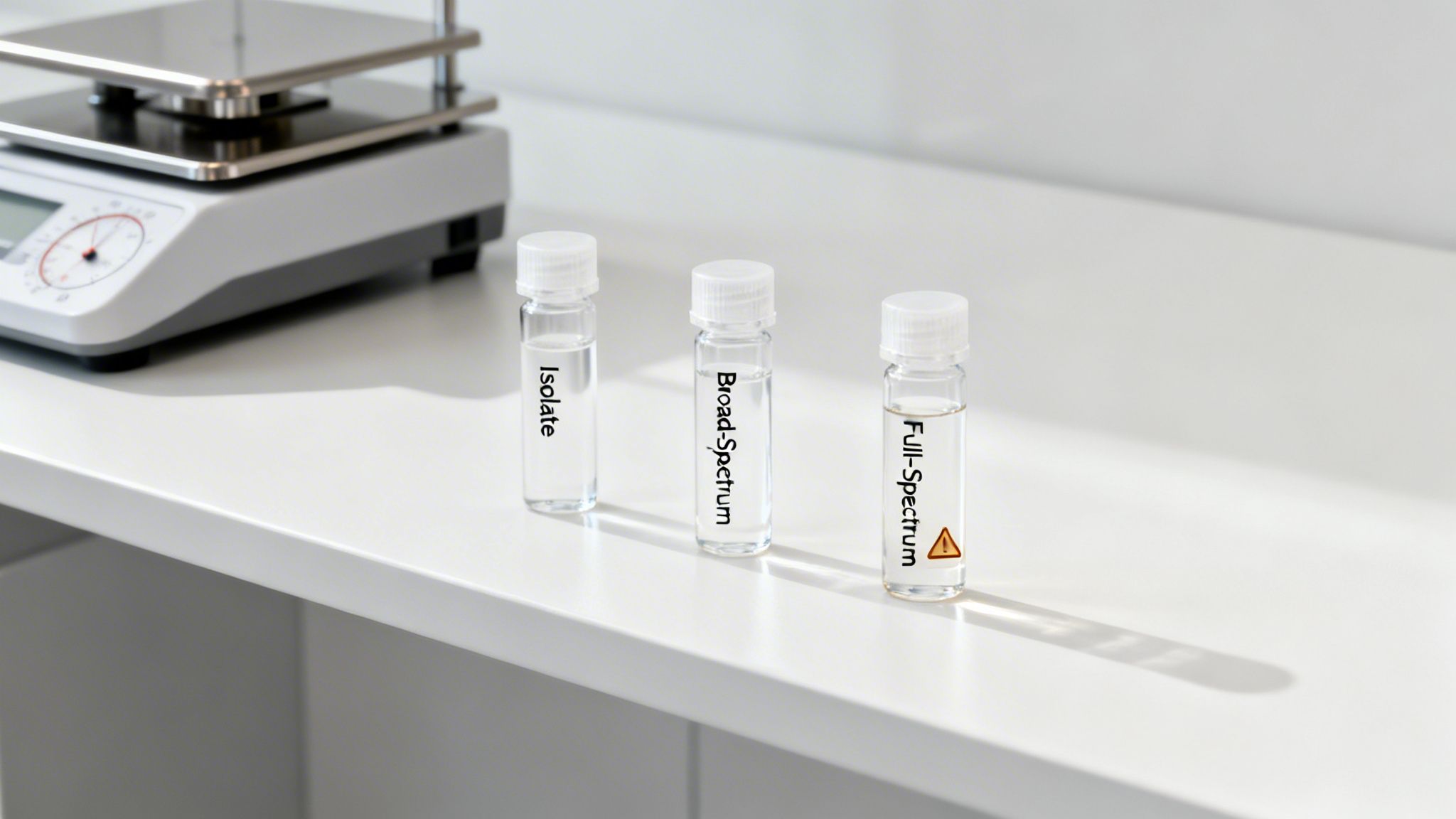
The core of the issue lies in the three primary types of CBD extract available for formulation. Each carries a distinct risk profile, and your selection ultimately determines the potential for a positive drug test result.
The Three Types of CBD Extract
Choosing an extract involves a trade-off between phytochemical complexity and final product purity. This choice directly impacts the risk passed on to the consumer.
Full-Spectrum CBD: This is a whole-plant extract containing all cannabinoids and terpenes from the source material, which includes THC up to the federal legal limit of 0.3%. While a small percentage, this is the single greatest source of compliance issues.
Broad-Spectrum CBD: This extract represents a middle ground. It begins as a full-spectrum oil and undergoes an additional remediation step to remove THC. While many other plant compounds are retained, its safety is entirely contingent on the thoroughness of the THC removal process.
CBD Isolate: This is the purest and safest option. It consists of 99%+ pure CBD, with all other cannabinoids, terpenes, and traces of THC having been removed. It provides a clean, predictable, and fully THC-free ingredient base.
If you are formulating a product for any individual subject to drug testing—such as athletes, first responders, or professionals in zero-tolerance industries—using a full-spectrum extract is an indefensible risk. The only responsible approach is to utilize a pure CBD isolate or a broad-spectrum distillate with third-party lab verification confirming it is 100% free of THC.
This is not merely about adhering to legal percentages on paper; it's about understanding how the human body metabolizes these compounds over time.
How "Legal" THC Levels Can Trigger a Failed Test
The primary danger with full-spectrum products is not a single dose but the cumulative effect of chronic, low-level exposure.
THC is fat-soluble, meaning the body does not simply excrete it. Instead, it stores THC and its primary metabolite, THC-COOH, in adipose tissues.
Consider an individual using your full-spectrum product daily. Each dose introduces a small, legal amount of THC into their system. Day after day, these small amounts are deposited and stored.
This process is analogous to a piggy bank: a single penny is insignificant, but daily deposits eventually accumulate into a meaningful sum. Similarly, the stored THC-COOH can build up until its concentration is high enough to be released back into the blood and urine, triggering a positive result on a standard drug test.
At that point, your customer has failed a test, and your product is the source of the problem.
As a formulator, this is a critical concept to master. While the entourage effect is a desirable goal, attempting to achieve it with a THC-containing ingredient creates a predictable and avoidable liability.
A more sophisticated and responsible strategy is to start with a clean, THC-free base like CBD isolate. From there, you can construct your own "entourage" by reintroducing specific, isolated terpenes to replicate the profile of a target cultivar like Blue Dream or OG Kush. This provides the best of both worlds: a complex, effective product without the associated compliance risks.
Formulation Strategies for Verifiably Compliant Products
Moving from theory to practice, let's discuss how to build a product that you can confidently market as THC-free. For formulators, this process is about exercising control and precision, beginning with raw material selection.
The objective is to create a product that definitively answers "does CBD show up in a blood test?" with a no, because you have systematically eliminated the compounds that trigger a positive result. The guiding principle is simple: start clean and maintain cleanliness throughout the process. By taking full control of your ingredients, you remove all guesswork and risk.
Sourcing Your Cannabinoid Foundation
Your first and most critical decision is selecting the right cannabinoid base. This choice establishes the compliance standard for your entire product line. To build a product you can stand behind, you have two reliable options.
CBD Isolate: This is the gold standard for compliance. As a crystalline powder of 99%+ pure CBD, all other components—cannabinoids, terpenes, and waxes—have been removed. Starting with isolate provides a blank slate that is verifiably free from THC.
Broad-Spectrum Distillate: A close second, this highly refined oil has undergone a specific remediation process to remove THC while retaining some minor cannabinoids. The key here is that its safety is entirely dependent on the efficacy of the remediation. You must source this from a supplier who provides transparent and thorough third-party testing.
Choosing one of these two foundations is the most effective way to mitigate the number one cause of positive drug tests: THC contamination. You are no longer relying on hope that trace amounts are low enough; you are starting with a base you know is clean.
Rebuilding Profiles with Precision and Terpenes
Once you have secured your pure, THC-free cannabinoid base, you can begin the creative process of building back the desired aroma, flavor, and experience. This is where terpenes become your most valuable tool. Instead of inheriting the risks of a full-spectrum extract, you can achieve a more consistent and controlled result by adding isolated botanical terpenes.
This modular approach grants you total control over the finished product. You can perfectly replicate the profile of a legendary cannabis strain or design a completely novel blend from the ground up, all without introducing a single unwanted molecule.
This layer-by-layer strategy enables the creation of highly sophisticated products. For example, you can take your pure CBD isolate and add a strain-inspired terpene blend for vape cartridges that precisely mimics the sweet, berry notes of Blue Dream. You deliver the authentic experience consumers demand, but without any compliance liabilities.
If you aim to differentiate your brand, this is the path forward. You can learn more about finding the right partners in our guide on where to buy terpenes for your formulation needs.
Mandating Third-Party Lab Testing and COAs
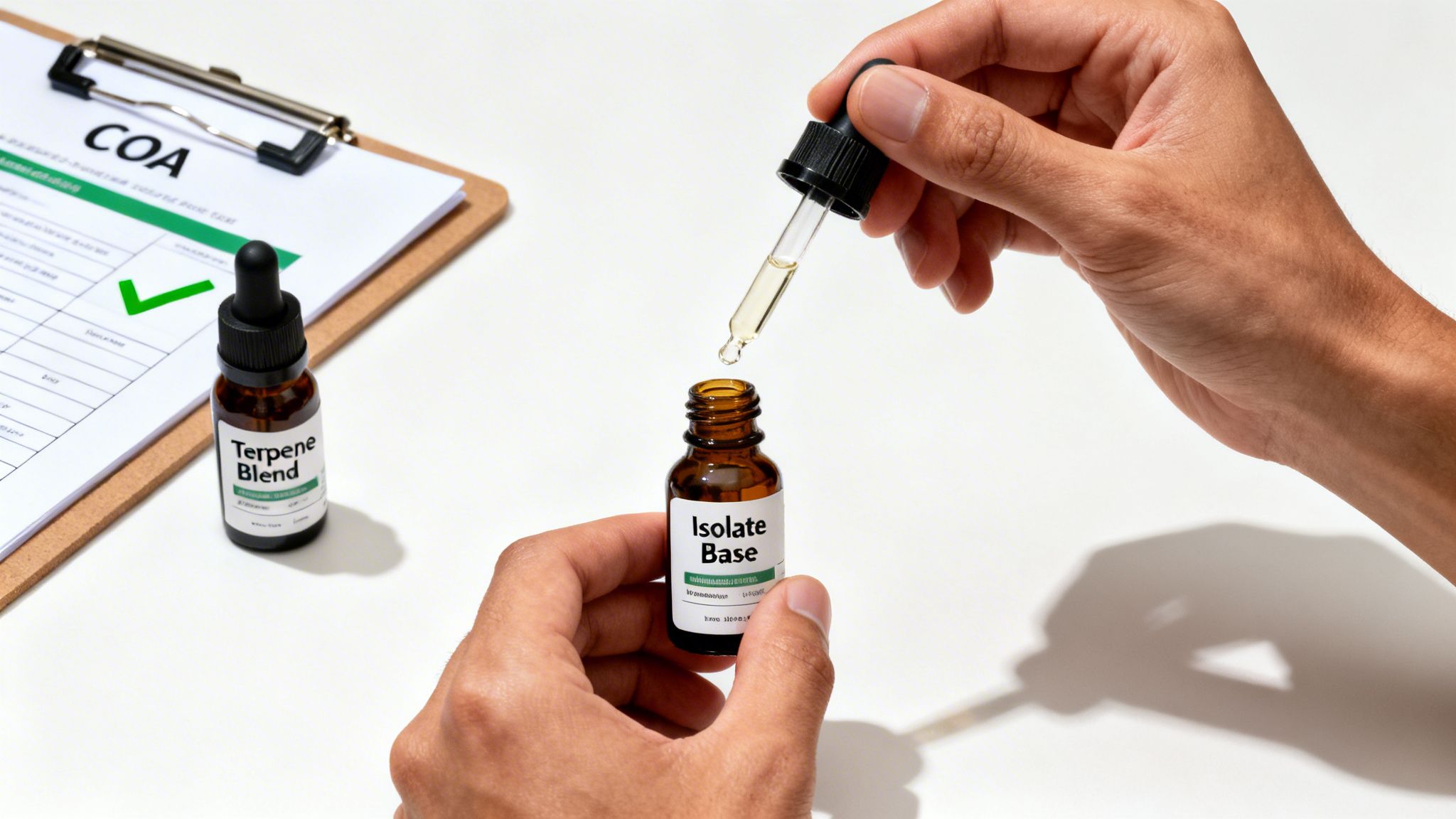
Your formulation strategy is incomplete without verification. Requiring comprehensive third-party lab tests for every ingredient and finished batch is not just good practice—it is essential. The Certificate of Analysis (COA) is your documented proof of compliance.
When reviewing a COA for an isolate or broad-spectrum distillate, go directly to the cannabinoid profile. You are looking for one specific compound: Delta-9 THC. The result must be listed as "ND" (Non-Detect) or show a value below the "Limit of Quantification" (LOQ).
This documentation is your ultimate defense. It is the hard data proving you have performed due diligence to create a safe, compliant, and THC-free product. This is what builds trust with distributors and end-users, and it is what will make your brand resilient.
How Advanced Testing Can Protect Your Brand
For formulators aiming to lead the industry, it's not enough to simply create a compliant product. You must know how to defend it with robust science. As analytical technology advances, it provides a powerful tool to shield your brand from false claims and build unshakeable customer trust.
The most significant developments are no longer just about detecting THC; they are about understanding the complete context of cannabinoid use.
Modern laboratories can now analyze the specific ratios of different cannabinoid metabolites in a blood sample. This is a major advancement. Instead of a simple "positive" or "negative" for THC, these advanced tests can generate a detailed profile of the type of product an individual consumed.
This reframes the question from "does CBD show up in a blood test?" to the more critical inquiry: "Can a test prove my customer used a compliant CBD product, not illicit marijuana?" The answer is increasingly yes, and for brands that prioritize purity, this is a significant competitive advantage.
The Power of Metabolite Ratios
The key lies in the THC/CBD metabolite ratio. When an individual consumes a CBD-dominant product, the chemical signature left in their blood is starkly different from that of a high-THC cannabis user. Advanced testing can differentiate between the two.
A blood sample with high levels of CBD metabolites but non-detectable or trace levels of THC metabolites tells a clear story. It points directly to the use of a CBD product and helps distinguish it from the use of recreational marijuana.
This is your brand's scientific defense mechanism. If a customer ever faces a disputed drug test after using your verifiably pure product, this type of metabolite analysis provides a concrete, scientific basis to challenge the result. It proves your formulation strategy is about creating a scientifically defensible product, not just narrowly passing a test.
This level of detail is becoming increasingly critical. For instance, a 2021 study demonstrated that analyzing these blood metabolite ratios could identify recent cannabis use with 96% accuracy—a major improvement over simply screening for THC. These methods provide a much clearer picture of consumption habits, and you can read the full research on metabolite ratio accuracy to see the progress in this field.
Creating a Scientifically Defensible Product
This evolution in testing underscores how much every formulation choice matters. From sourcing pure CBD isolate to selecting specific terpenes, each decision contributes to your product's final chemical fingerprint.
- Purity is Your Best Defense: By starting with THC-free ingredients, you are not just ensuring compliance. You are building a product with a chemical signature that will stand up to the most rigorous analytical methods.
- Confidence Backed by Data: When you formulate with precision and have comprehensive COAs to prove it, you create an unbroken chain of trust from raw material to finished good.
- Building for the Future: As testing becomes even more sophisticated, brands that have already committed to these high standards will be far ahead of the competition. You will be recognized as a leader in safety and transparency.
You are essentially engineering a product that leaves a specific, identifiable, and compliant "fingerprint" in a user's system. That is what it takes to thrive in a mature, data-driven market. To get a better sense of the technologies driving this, you can explore the latest in terpene extraction and analysis innovations.
Ultimately, insisting on lab-verified, pure ingredients is not just a good habit—it is your brand’s best insurance policy. It transforms your product from another item on the shelf into a scientifically validated formulation built to win in a sophisticated industry.
Your Top Questions, Answered by an Expert
As a product formulator, you operate on the front lines of compliance and innovation. You require clear, direct answers to ensure your products are safe, effective, and trustworthy. Let’s address the most common technical questions we receive regarding CBD, THC, and drug testing.
Can the Tiny Amount of THC in Full-Spectrum CBD Really Trigger a Positive Test?
Yes, it absolutely can. This is perhaps the single most critical misconception in the industry. The federally legal 0.3% THC limit may seem negligible, but it is frequently the direct cause of failed drug tests.
The issue is bioaccumulation. THC’s primary metabolite, THC-COOH, is lipophilic (fat-soluble). Therefore, if an individual consumes a full-spectrum product daily, that metabolite is not simply excreted. It accumulates in their adipose tissues over time.
This can be visualized as a slow, steady drip filling a container. Each dose contributes a small amount. Eventually, the total concentration can easily surpass the detection threshold of a standard drug test. This places your customers in a difficult position and creates a significant liability for your brand.
I'm Using a THC-Free Isolate, So I Can Skip the COA, Right?
Absolutely not. A Certificate of Analysis (COA) from a reputable third-party laboratory is the only way to prove that your "THC-free" ingredient is, in fact, free of THC. You must verify your source materials—accepting a supplier's claim without data is a risk you cannot afford.
Bottom line: Always demand a recent, batch-specific COA for every cannabinoid ingredient you procure, and then test your final product as well. This documentation is your proof of due diligence. When the question "does CBD show up in a blood test?" arises, your COAs demonstrate you've done everything possible to eliminate the actual risk factor: THC.
Are There Any Terpenes I Should Avoid to Prevent a False Positive?
No. This is another common myth. Terpenes are aromatic compounds—such as Myrcene, Limonene, or Beta-Caryophyllene—that define a plant's scent and flavor profile. They are structurally distinct from cannabinoids and contain zero THC.
Terpenes will not, and cannot, cause a user to fail a drug test for THC. The risk always originates from the cannabinoid extract itself, specifically from residual THC that was not adequately removed during processing.
For complete creative control and peace of mind, the best practice is to formulate with pure, isolated botanical terpenes. This allows you to craft complex and sophisticated aromatic and flavor profiles without ever introducing the risk of THC contamination. You can explore the possibilities by reviewing our library of strain-inspired terpene blends.
Can a Blood Test Tell the Difference Between CBD from Hemp and THC from Marijuana?
Yes, sophisticated confirmatory tests can. An initial immunoassay screening test is basic; it simply detects the presence of the THC-COOH metabolite above a certain threshold. However, if that screen returns a positive result, a confirmation test using methods like Gas Chromatography-Mass Spectrometry (GC/MS) or Liquid Chromatography-Mass Spectrometry (LC/MS) can provide much deeper insight.
These advanced analytical techniques can measure the specific concentrations and ratios of different cannabinoid metabolites in the sample.
Therefore, if a blood sample shows high levels of CBD metabolites but virtually no THC metabolites, it provides a clear and compelling narrative. It constitutes strong scientific evidence that the individual consumed a compliant hemp-derived product, not high-THC marijuana. For brands that formulate responsibly with pure ingredients, this science provides a robust defense.
At Gold Coast Terpenes, we empower you to formulate with absolute confidence. We provide lab-verified, THC-free botanical terpenes so you can build the compliant, effective, and consistent products your customers deserve. See what you can create by exploring our full selection at https://www.goldcoastterpenes.com.