
For product formulators and manufacturers, the choice of a terpene supplier is a foundational business decision. The question isn't just "where to buy terpenes," but "where to find a partner for formulation." Sourcing requires more than scrolling through marketplaces; it demands a verified, direct-from-manufacturer supplier who guarantees the purity and consistency essential for scaling your brand.
Why Your Supplier Choice Defines Product Success
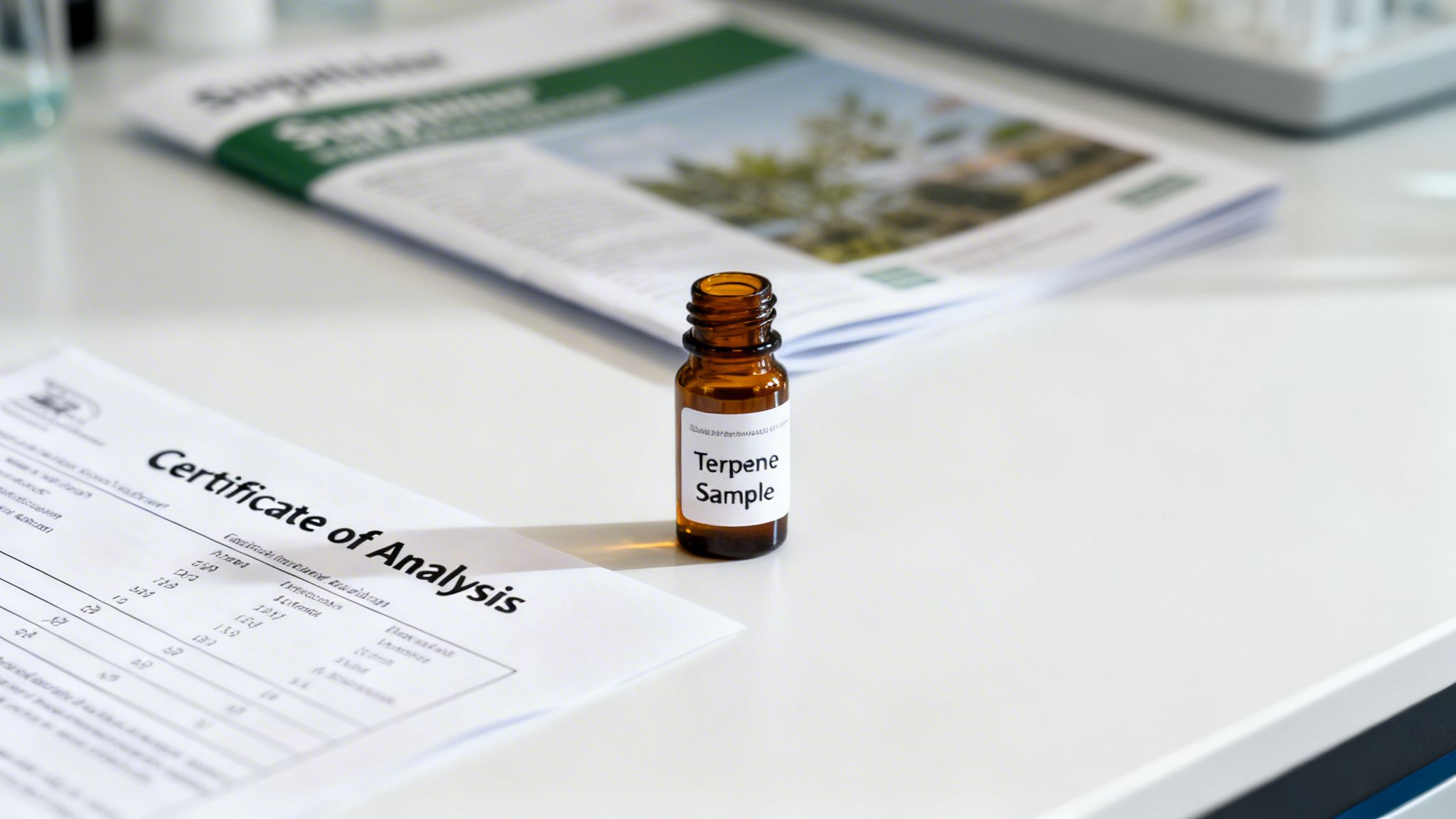
This decision is not merely about procuring an ingredient; it's about defining your brand's sensory signature. Your supplier directly controls the final aromatic and flavor profile of your product—from the initial scent upon opening the package to the authentic experience in every use of a vape cartridge.
A misstep in sourcing leads to tangible consequences. An inconsistent or impure terpene profile can trigger product recalls, damage vape hardware, and, most critically, erode the customer trust you've worked to build.
Aligning Supplier Specialization with Formulation Goals
Begin by analyzing a supplier's core competency. Not all are interchangeable. Some excel at creating strain-specific profiles, making them ideal partners for crafting authentic cannabis vape formulations. Their blends are meticulously engineered to replicate the exact aromatic notes—from top notes to base notes—of well-known cultivars.
Conversely, if you are formulating for beverages or edibles, you may require a supplier specializing in bulk quantities of individual isolates like D-limonene or Linalool. (You can learn more about specific isolates in our guide to the benefits and characteristics of D-Limonene.) Understanding a supplier's strengths ensures you select the right partner for your specific application.
A true formulation partner provides more than raw materials. They offer comprehensive transparency, expert formulation resources, and a supply chain designed to scale alongside your brand's growth.
Key Indicators of a High-Caliber Supplier
Ultimately, the best place to buy terpenes is from a company that functions as an extension of your R&D team. They should readily provide:
- Batch-Specific Certificates of Analysis (COAs): This is non-negotiable. A COA is your verification of purity and consistency, confirming each batch is free from contaminants and diluents like VG, PG, or MCT oil.
- Comprehensive Formulation Resources: A supportive supplier is invested in your success. Look for tools like mixing calculators, Safety Data Sheets (SDS), and educational guides that facilitate accurate, repeatable results in your lab.
- A Scalable Inventory: Assess their capacity to support your growth. Your supplier must be equipped to handle everything from small R&D sample orders to large-scale bulk shipments for full production runs.
Choosing a supplier is a long-term strategic decision. Prioritizing transparency, quality, and robust support isn't just about securing an ingredient—it's about building a reliable foundation for your brand's success.
How to Vet and Qualify a Terpene Supplier
Once you have a shortlist of potential suppliers, the critical vetting process begins. This stage separates generic resellers from true formulation partners. Your choice directly impacts your product’s quality, consistency, and brand reputation. An unqualified partner can delay production schedules or, worse, deliver a product that shatters customer trust.
The market is saturated with various players: resellers moving boxes, bulk commodity distributors focused on volume, and specialized formulation experts. For serious product developers, only the latter is a viable option. A genuine partner understands the nuances of creating a strain-inspired terpene blend for vape cartridges and possesses the documentation to substantiate their claims.
The Vetting Checklist: Non-Negotiable Documentation
Before considering a purchase order, a supplier must meet baseline transparency standards. If they cannot provide the following, move on. Professionals do not take shortcuts on compliance.
- Publicly Accessible Safety Data Sheets (SDS): Essential for safety and regulatory compliance. Any credible supplier will feature these prominently on their website for every product.
- Batch-Specific Certificates of Analysis (COA): A generic COA is a major red flag. You require a detailed analysis for the exact batch you are purchasing to confirm its purity and precise profile.
- Total Ingredient Transparency: The supplier must affirm—without hesitation—that their blends are free from VG, PG, PEG, MCT, or any other diluents. Undeclared cutting agents will compromise flavor and can damage vape hardware.
A supplier’s willingness to provide comprehensive documentation reflects their confidence in their product. If they create obstacles to accessing an SDS or a batch-specific COA, they are not a serious partner for your business.
This process is more than a formality. Imagine launching a new line of vape cartridges only to receive complaints about a harsh, chemical aftertaste. The culprit is almost always a low-grade terpene blend diluted with unlisted agents. Such an error doesn't just impact sales; it can permanently damage your brand's reputation.
With the global terpenes market valued at approximately USD 862.6 million in 2023, the number of suppliers is increasing. This documented proof of quality is what distinguishes reliable professionals from the noise. You can read more about the growing demand for natural ingredients in the terpene industry and understand why this verification is paramount.
Asking Technically-Focused Questions
When you engage with a potential supplier, your inquiries should extend far beyond pricing. The conversation should center on quality control and formulation support. These questions will quickly differentiate a technical expert from a mere distributor.
Begin by probing their quality control measures. "How do you ensure batch-to-batch consistency?" A top-tier supplier will detail their internal testing protocols, from raw material vetting to final blend analysis. They should also be able to explain how their terpene profile for cannabis product formulation is constructed, including how they balance top, mid, and base notes to achieve an authentic and stable aromatic experience.
Next, inquire about formulation support. Do they provide guidance on mixing ratios for different concentrate viscosities? Do they offer practical tools, like a terpene formulation guide, to help your team achieve precise and repeatable outcomes? A supplier invested in your success will provide the necessary tools and expertise.
Finally, discuss sourcing. Are their terpenes botanically derived, cannabis-derived, or synthetic? Each source has different implications for your product's flavor profile, cost structure, and regulatory standing. A knowledgeable supplier will articulate the advantages and disadvantages of each, guiding you to the optimal choice for your product line. Through these pointed questions, you can confidently identify a partner that meets your standards for quality and scalability.
Documentation Deep Dive: COAs, Consistency, and Sourcing
You have a shortlist of potential suppliers. Now, the technical validation begins. This process goes beyond a cursory glance at a Certificate of Analysis (COA). Executing this diligence correctly protects your product, your brand, and your customers.
Your objective is to verify three core pillars: purity, safety, and consistency. A sophisticated website or marketing materials are irrelevant if the terpenes are contaminated or vary between orders. A common failure point for formulators is when a new batch of terpenes does not match the last, ruining an entire production run of a perfectly crafted strain-inspired terpene blend for vape cartridges.

This flowchart represents the absolute minimum standard. If a supplier fails these fundamental checks on documentation and transparency, they are not a viable partner.
Deconstructing the Certificate of Analysis
The COA is the primary data source for your ingredient. Do not just scan it—interrogate it. The first data point to verify is the batch number. A generic COA untied to a specific batch is a significant red flag, suggesting either inconsistent testing protocols or an attempt to obscure data.
Next, analyze the purity report. Do the top three to five listed terpenes align with the expected profile? A Jack Herer profile should be dominated by Terpinolene, Caryophyllene, and Pinene. If the results show a high concentration of an incongruous or inexpensive isolate, it may indicate poor formulation or cost-cutting with fillers.
Finally, a complete COA must include a full contaminant panel. This is non-negotiable and should test for:
- Heavy Metals: Arsenic, lead, mercury, and cadmium.
- Pesticides: A comprehensive screen for common agricultural chemicals.
- Residual Solvents: Byproducts of extraction processes, such as acetone or ethanol.
- Microbials: Mold, mildew, and other biological contaminants.
A clean, batch-specific COA is not a premium feature; it is the standard requirement for entry into the professional supply chain.
The Critical Importance of Batch-to-Batch Consistency
Imagine your customers embrace a new vape cartridge for its precise flavor profile. Six months later, a new batch is released with a noticeably different taste. This is a brand-killer, and the root cause is often an inconsistent terpene supply.
A professional supplier’s reputation is built on consistency. They should be able to provide COAs from several previous batches of the same profile to demonstrate the stability and repeatability of their formulation.
Do not hesitate to ask direct questions about their quality control systems. How do they guarantee the Blue Dream profile sold today will be identical to the one purchased in six months? They must speak confidently about their raw material sourcing, internal standard operating procedures (SOPs) for blending, and final quality assurance testing. Vague responses indicate a supplier that cannot be relied upon for scaling your business.
Understanding Terpene Source and Its Impact on Formulation
The origin of your terpenes directly affects your product's flavor, cost, and regulatory compliance. There are three primary source types:
- Botanically-Derived Terpenes (BDTs): Sourced from various plants like citrus, pine, and lavender. BDTs are the industry standard for their scalability, cost-effectiveness, and legal compliance, as they are free of cannabinoids.
- Cannabis-Derived Terpenes (CDTs): Extracted directly from cannabis, offering the most authentic aroma. However, CDTs are significantly more expensive, face numerous legal and regulatory hurdles, and are notoriously difficult to source with consistency. A deep understanding of plant biology is required to work with them effectively. Our article on the differences between male vs female cannabis plants provides more context on how genetics shape these compounds.
- Synthetic Terpenes: Created in a laboratory. While cost-effective and consistent, they often lack the aromatic complexity of natural terpenes and can impart a harsh, chemical-like flavor.
For most brands, high-quality botanically-derived terpenes provide the optimal balance of authenticity, scalability, and compliance. Regardless of your choice, always secure a sample from the exact batch you intend to purchase to ensure what you test in R&D is what you receive in production.
Navigating Global Sourcing and Regional Markets
Knowing where to buy terpenes requires a global perspective on your supply chain. Understanding the major production hubs, their specializations, and their limitations allows you to make strategic sourcing decisions that balance cost, quality, and logistics.
The global terpene market is concentrated in North America, Europe, and the Asia-Pacific region. North America has established itself as the premier source for high-quality, strain-specific profiles engineered for the cannabis and vape industries. Its stringent regulatory environment and proximity to the largest consumer market make it the primary choice for brands that cannot compromise on quality or compliance.
The North American Advantage for Formulation
For formulators in the cannabis product space, sourcing from North America is the most logical choice. Suppliers in this region are deeply integrated into the industry and understand the technical demands of vape manufacturers and extractors.
Data supports this position. North America currently dominates the global market, accounting for 40-45% of total terpene consumption. With the market projected to reach USD 0.81 billion by 2026, the region's influence continues to expand. It is the central hub for reliable, high-purity ingredients. You can review the data in research on the global terpenes market.
Partnering with a U.S.-based supplier offers clear advantages:
- Regulatory Compliance: These suppliers operate within a complex framework of federal and state regulations, ensuring their products are formulated for compliance.
- Simplified Logistics: Domestic shipping eliminates the complexities of international customs, tariffs, and the risk of shipment seizure.
- Market Proximity: Faster lead times and access to the latest profile innovations give you a competitive edge.
The Risks of Sourcing from Asia-Pacific
The Asia-Pacific region, particularly China, is a major manufacturer of bulk chemical and botanical extracts, including simple terpene isolates. The primary draw is often lower pricing, which can be viable for large-scale industrial applications outside of the cannabis sector.
However, for a formulator creating a specific terpene profile for cannabis product formulation, this route is fraught with risk. The geographical distance creates logistical delays, and verifying quality and consistency from afar is a significant challenge.
When sourcing internationally, you sacrifice direct oversight. A U.S.-based supplier with global shipping capabilities offers the best of both worlds—American quality standards with a worldwide reach, mitigating the risks of foreign sourcing.
The probability of receiving a substandard or inconsistent product is substantially higher. Purity standards that are acceptable in one market may not meet the stringent requirements for vape products in the U.S. or Europe. Without a trusted partner, you risk encountering purity issues, unlisted diluents, or batch-to-batch variations that disrupt your production schedule.
The optimal strategy for most brands is to partner with a U.S.-based supplier that offers worldwide shipping. This model provides terpenes that meet high U.S. quality standards while servicing an international customer base, de-risking your global supply chain. For more in-depth guidance, our terpene formulation resources are available to assist you.
Putting Your Terpenes to Work: From Lab Bench to Production

You have completed the rigorous process of supplier vetting and qualification. The next phase is implementation: translating those carefully sourced terpenes into a consistent, high-performance product. This is where precise formulation techniques are paramount.
This stage bridges sourcing and full-scale production. Every variable, from mixing ratios to homogenization methods, directly impacts your product's final flavor, aroma, and stability.
From Sample Request to Bulk Order
Before committing to a bulk purchase, testing is mandatory. Always initiate the process with samples. Be specific in your request: you require a sample from the exact batch you intend to purchase. This is the only way to guarantee that the profile you validate in R&D is what you will receive in your bulk shipment.
Use the sampling phase to clarify key logistical details. Obtaining this information upfront is crucial for managing budgets and production timelines.
Inquire about:
- Minimum Order Quantity (MOQ): What is the smallest volume available for purchase post-sample approval? This determines your initial capital expenditure.
- Bulk Pricing Tiers: At what volumes do price breaks occur? Understanding the discount structure allows for efficient scaling.
- Lead Times: What is the turnaround time from order placement to delivery? Factor this into your production schedule to avoid downtime.
A professional supplier will provide clear, direct answers, signaling transparency and reliability.
Benchtop Testing and Formulation Protocols
With samples in hand, it is time for benchtop formulation. The objective is to determine the optimal concentration for your specific application, whether you are formulating with distillate for vape cartridges or developing other products. The goal is a "sweet spot" that delivers an authentic flavor profile without being overpowering.
For vape cartridge formulations, a starting point of 5-7% terpene concentration by weight is a good benchmark. For a 1-gram cartridge, this equates to 0.05g to 0.07g of terpenes. It is always advisable to begin at the lower end of this range and titrate upwards.
A common and costly formulation error is oversaturation. Excessive terpene levels can create a harsh, chemical-like taste and may cause the blend to separate or leak from the hardware. Always start with a lower concentration.
The mixing technique is as critical as the ratio. Terpenes must be fully homogenized into the concentrate to ensure a stable, consistent final product.
Homogenization Protocol:
- Gently warm your concentrate to reduce its viscosity. A target temperature range is 60-70°C (140-158°F).
- Use a calibrated scale to accurately weigh your terpenes. Precision is non-negotiable.
- Slowly introduce the terpenes to the warm concentrate while mixing. A magnetic stirrer is ideal for achieving complete homogenization.
- Continue mixing for several minutes until the solution is entirely uniform, with no visible streaks or signs of separation.
Document Everything for Repeatable Success
Meticulously document every step of the testing process. Your lab notes are the foundation of your standard operating procedures (SOPs), ensuring you can replicate successful formulations with precision.
For each test, record:
- Supplier Name and Terpene Profile (e.g., Gold Coast Terpenes, Sour Diesel)
- The Batch Number of the terpenes
- Concentrate type and its corresponding batch number
- The exact mixing ratio used (e.g., 5.5% by weight)
- Homogenization temperature and mixing duration
- Sensory notes on aroma and flavor
- Performance data, such as vapor quality and cartridge stability
This level of detailed documentation is a hallmark of professional product development. When you achieve the perfect formulation—such as a Sour Diesel profile with its signature pungent, fuel-like aroma—you need the data to replicate it flawlessly. To understand what defines this specific profile, review our guide to the Sour Diesel strain and its characteristics.
By implementing rigorous testing and documentation protocols, you can transform high-quality ingredients into a reliably excellent product that builds brand loyalty.
Common Questions in Terpene Sourcing for Formulation
Formulators know that sourcing terpenes involves navigating a complex landscape of technical and logistical challenges. Below are answers to some of the most pressing questions from product developers.
What Are the Biggest Red Flags to Watch for in a Terpene Supplier?
The primary red flag is a lack of transparency. If a supplier is unwilling to provide batch-specific Certificates of Analysis (COAs), cease engagement immediately. The same applies to Safety Data Sheets (SDS); these documents are mandatory for ensuring lab safety and regulatory compliance.
Be wary of ambiguous responses regarding blend composition. A reputable partner will proudly state that their terpenes are pure and contain zero diluents such as VG, PG, PEG, or MCT oil. An inability to provide a clear answer or a refusal to supply samples for R&D are definitive warning signs.
A supplier’s transparency is a direct reflection of their quality. If they make you dig for basic documentation or can't provide clear answers about what's in their blends, it's best to walk away. They should be proud to prove their product's purity.
Can I Buy Small Batches of Terpenes for R&D?
Yes, and this should be a standard part of your vetting process. Any credible supplier understands the importance of R&D and will offer sample kits or small-volume purchasing options. This step is not just for flavor selection; it is a critical part of qualifying the supplier.
The key is to insist that your sample is drawn from the same batch you intend to purchase in bulk. This is the only method to ensure the profile you validate in the lab will be identical to the one used in your full production run, protecting you from costly batch-to-batch inconsistencies.
How Do I Ensure Terpenes Are Legally Compliant?
The most straightforward approach is to source from a supplier that provides botanically-derived terpenes (BDTs). Since BDTs are not sourced from cannabis, they are completely free of THC, CBD, and other cannabinoids. This makes them federally legal in the United States and compliant in most international markets. Always verify with your supplier that their products are cannabinoid-free and that they can provide documentation to support this claim.
International logistics can introduce complexities. For instance, the Asia-Pacific region is a major hub for terpene manufacturing, but its regulatory landscape can be difficult to navigate. This is why partnering with a supplier experienced in global logistics is crucial. A competent global partner will manage the intricacies of your country’s import regulations, simplifying your supply chain.
What is the Difference Between Food-Grade and Inhalable-Grade Terpenes?
This is a critical safety distinction. "Food-grade" certifies that a substance is safe for ingestion. However, safety for ingestion does not imply safety for inhalation.
An inhalable-grade terpene is formulated and tested specifically for safety when vaporized. The focus is on absolute purity to ensure the absence of any harmful compounds that could become toxic when heated.
When formulating products like vape cartridges, you must confirm that your supplier provides terpenes explicitly designed and tested for inhalation. Never make assumptions. A reputable supplier will readily provide documentation verifying their products are safe for this specific application.
At Gold Coast Terpenes, our mission is to empower formulators with the tools and high-quality ingredients needed to create exceptional products. Our library includes over 50 strain-specific profiles and pure isolates, all supported by batch-specific COAs and comprehensive safety documentation. We provide the consistency and reliability your brand depends on.
Explore our lab-tested, formulation-ready terpene profiles today.