
For cannabis product formulators, the term "food grade terpenes" is not a suggestion—it's a foundational requirement. You wouldn't use industrial-grade salt from a de-icing truck in a gourmet kitchen, and the same principle applies here. For anyone creating products intended for consumption, the distinction between food-grade and lower-purity grades is critical for safety, consistency, and brand integrity.
What Are Food Grade Terpenes? A Formulation Perspective
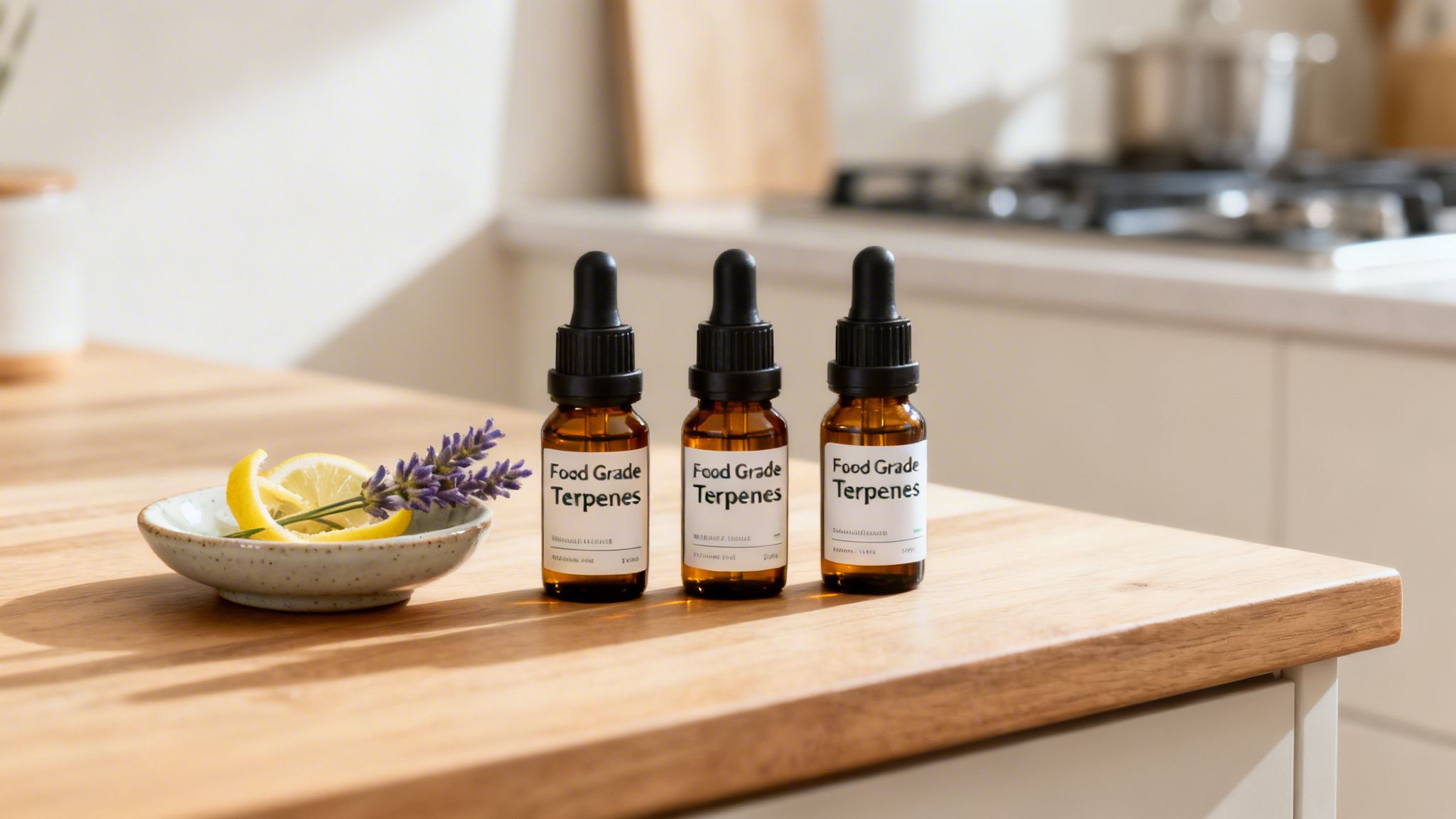
When a terpene blend is designated "food grade," it serves as a technical guarantee for the formulator. It certifies that these aromatic compounds have been purified and rigorously tested to meet strict safety standards, confirming their suitability for human consumption via ingestion, inhalation, or topical application. This is the non-negotiable benchmark for formulating edibles, vape cartridges, tinctures, and beverages.
This standard verifies that the terpenes are free from contaminants such as heavy metals, pesticides, and residual solvents. It’s what separates a premium, reliable product from a low-quality, high-risk one. While many common terpenes, like Limonene and Linalool, are designated GRAS (Generally Recognized as Safe) by the FDA, the responsibility falls on the terpene supplier to substantiate this status with comprehensive documentation.
Why Purity Is a Commercial Asset
Opting for food-grade terpenes is more than a safety protocol; it's a strategic business decision. It signals to your partners and customers a commitment to quality, which builds brand equity and mitigates risk. Formulating with pure, tested ingredients ensures replicable results in every batch. This level of consistency is crucial for scaling production without compromising the specific flavor and aromatic experience your customers expect.
Market data validates this approach. The food and beverage sector is the largest consumer of terpenes, accounting for over 32% of the USD 862.6 million global market in 2023. As consumer preference shifts away from artificial additives—driving a 25% increase in demand for natural ingredients—utilizing GRAS-listed food-grade terpenes has become a commercial necessity.
For a formulator, 'food grade' means reliability. It confirms every drop is manufactured for predictable results, a commitment essential for consumer trust and brand integrity.
Understanding the Different Grades of Terpenes
Not all terpenes are created equal, and for a formulator, this distinction is critical to avoid catastrophic product failures. The quality originates at the source material—even factors like the differences between male and female plants can impact the final raw inputs. Using an inappropriate grade can ruin product batches and damage your brand's reputation.
This reference table clarifies the critical differences for product development.
Terpene Grades At A Glance
| Grade Type | Purity Standard | Common Applications | Safe for Consumption? |
|---|---|---|---|
| Food Grade | Highest purity; free from contaminants; GRAS. | Edibles, beverages, vapes, tinctures, topicals. | Yes |
| Technical Grade | Lower purity; may contain impurities. | Fragrances, cleaning products, industrial solvents. | No |
| Crude | Unrefined; inconsistent composition. | Starting material for further purification. | Absolutely Not |
As the table shows, the choice is clear. Food Grade is the only standard suitable for products intended for human consumption. Technical Grade terpenes are intended for industrial applications like cleaners and air fresheners—they are not safe for consumption. Crude terpenes are merely raw, unrefined starting material that requires significant processing and should never be used in a finished consumer product.
Ultimately, selecting the correct grade is the first and most critical decision in the formulation process, directly impacting product safety, flavor accuracy, and brand trust.
Understanding Purity Standards And Lab Testing

In terpene formulation, 'purity' is not about concentration. For a professional formulator, true purity is defined by the verified absence of any substance that could compromise your product, damage equipment, or harm your brand's reputation.
This is why stringent quality control and transparent third-party lab testing are paramount. A "food grade" label is meaningless without empirical data to support it. That claim must be substantiated by a reputable, independent laboratory, proving the terpenes are free from residual solvents, pesticides, heavy metals, and other potential contaminants.
Reading A Certificate Of Analysis (CoA)
The Certificate of Analysis (CoA) is your most crucial due diligence tool. It is the product's official report card, providing a detailed chemical breakdown of the specific batch you are purchasing. Understanding how to interpret a CoA is a fundamental skill for any product developer.
A valid CoA must clearly present several key pieces of information:
- Batch Number: Links the report directly to the specific product vials, ensuring full traceability.
- Testing Date: A recent date confirms the analysis is current, as terpene profiles can degrade over time.
- Third-Party Lab Info: Testing must be conducted by an accredited, independent lab to eliminate any potential for biased reporting.
- Full Terpene Profile: It must list every detected terpene and its precise percentage, not just the dominant compounds.
The most critical section, however, is the complete safety and contaminant screening. A CoA without this is functionally worthless for professional formulation, as it fails to verify the product's safety for consumer use.
What Is GC-MS And Why It Matters
The industry's gold standard for this analysis is Gas Chromatography-Mass Spectrometry (GC-MS). This two-stage process ensures both molecular identity and purity.
First, Gas Chromatography (GC) separates the complex terpene blend into its individual compounds. The sample is vaporized and propelled through a long column; lighter molecules travel faster than heavier ones, emerging one by one.
As each compound exits, it enters the Mass Spectrometer (MS), which acts as a molecular fingerprinting station. It fragments each molecule and measures its unique mass, creating a distinct signature that confirms its identity (Is that really Linalool?) and quantity.
The precision of GC-MS allows labs not only to verify a terpene profile but also to detect contaminants down to parts per million (ppm) or even parts per billion (ppb).
This level of detail is non-negotiable. A GC-MS safety panel confirms that residual extraction solvents like butane or ethanol are well below legal safety thresholds. For formulators developing inhalable products, such as vapes designed to showcase the effects of isolates like D-Limonene, this verification is an absolute necessity.
Ultimately, partnering with a supplier who provides a clear, comprehensive CoA for every batch is not a bonus; it is a fundamental requirement for protecting your product, your customers, and your business.
How North American Market Leadership Benefits Formulators
While North America's dominance in the global terpene market might seem like a simple industry statistic, it represents a significant strategic advantage for your business. This leadership translates directly into a more robust supply chain and access to flavor innovations that were previously unattainable.
The 2018 Farm Bill was a pivotal moment, catalyzing investment and research into the U.S. hemp industry. This created a fiercely competitive landscape that forced suppliers to rapidly advance their capabilities, leading to more sophisticated, reliable, and strain-specific terpene profiles. As a formulator, you are the direct beneficiary of this progress.
This means you can now source food grade terpenes with exceptional batch-to-batch consistency and purity. The days of supply chain uncertainty are over. A stable, domestic market provides the solid foundation needed to scale production without logistical disruptions.
Why a Domestic Market Matters
Partnering with a US-based supplier provides a clear competitive edge. You gain direct access to the epicenter of terpene innovation, where leading suppliers are constantly refining their processes to meet the demands of a sophisticated market. This translates to shorter lead times, fewer shipping complexities, and a level of quality control that is difficult to secure from overseas sources.
The data confirms this advantage. North America accounts for approximately 40% of the global terpenes market, a share projected to reach USD 460.60 million by 2025, with the U.S. alone comprising USD 363.41 million. This growth is fueled by a significant shift in consumer demand: 60% of consumers now state a preference for plant-based additives, and in the premium sector, demand for natural terpenes outpaces synthetics 3:1. You can explore the full market dynamics to see how these trends can inform your product strategy.
When you partner with a U.S. supplier, you're not just buying a product. You are integrating into a powerful ecosystem built on competition, innovation, and stringent quality standards, ensuring your terpenes are both consistent and at the forefront of flavor science.
Tangible Benefits for Product Manufacturing
This market leadership offers concrete advantages that directly impact your product quality and bottom line. Sourcing from a leader in the North American market provides:
- A Resilient Supply Chain: Domestic sourcing insulates you from international shipping delays, customs issues, and global disruptions, ensuring you get the ingredients you need on schedule.
- Unmatched Quality and Consistency: The competitive U.S. market has established rigorous, third-party lab testing as the industry norm. This is your guarantee that every batch of food grade terpenes meets precise purity and safety specifications.
- Direct Access to Innovation: You gain access to the latest and most in-demand strain-inspired profiles, from timeless classics like the energetic Sour Diesel strain to novel fruit-forward blends, enabling product differentiation.
- Efficient Bulk Pricing: A mature market creates economies of scale. High-volume domestic production and streamlined logistics translate to more competitive pricing for wholesale and bulk orders, directly benefiting your manufacturing budget.
Ultimately, selecting a North American terpene supplier is a strategic decision that enhances your product, strengthens your operations, and positions your brand for long-term growth.
A Practical Guide to Terpene Formulation
This is where art and science converge to transform raw inputs into a premium product. Successful formulation is about more than adding flavor; it’s about engineering a specific and memorable sensory experience.
Incorporating food grade terpenes into bases like winterized distillate or MCT oil is a straightforward process when approached systematically. Think like a perfumer building a fragrance; you are carefully layering aromatic notes to create a cohesive and complex profile.
Building a Balanced Flavor Profile
Every successful blend is built on a structured plan. Like a musical chord, each terpene has a specific role. Understanding these roles is key to creating a product that is consistent, nuanced, and differentiated.
- Top Notes: These are the initial, most volatile aromatics. They provide the first impression and dissipate quickly. Examples include the bright citrus of Limonene or the crisp pine of Alpha-Pinene.
- Mid Notes: As the top notes fade, the mid notes emerge. These form the heart of the blend, adding body and character. This layer includes floral terpenes like Linalool or the robust, hoppy notes of Humulene.
- Base Notes: These heavy, less volatile molecules anchor the entire profile. They provide depth and a lasting finish. Myrcene delivers a classic earthy, musky foundation, while Beta-Caryophyllene adds a spicy, peppery undertone.
An effective formulation balances these layers to achieve a desired outcome. For example, to replicate the Sour Diesel profile, you would blend its signature sharp, gassy top notes with complementary earthy base notes to deliver the authentic, full-bodied experience consumers expect.
Precise Dosing and Safe Handling
With your profile mapped, execution requires precision. Terpenes are highly concentrated, and minor miscalculations can compromise an entire batch.
For accurate and repeatable results, always measure by weight, not volume. A digital scale with a precision of at least 0.01g is an essential piece of lab equipment.
The following table provides baseline starting points for various product types. Always begin with small test batches to perfect your ratios before scaling to full production.
Formulation Starting Points For Different Products
| Product Type | Recommended Terpene % (by weight) | Key Formulation Goal | Example Terpene Notes |
|---|---|---|---|
| Vape Cartridges | 5-10% | Viscosity control and authentic flavor | A balanced mix of top, mid, and base notes. |
| Concentrates (Shatter, Wax) | 1-5% | Reintroduce lost aroma and enhance effects | Focus on bright top notes like Limonene. |
| Edibles & Tinctures | <1% | Add subtle flavor without bitterness | Use light, fruity, or minty terpenes. |
| Topicals & Creams | 0.5-2% | Aromatic appeal and sensory experience | Floral or earthy notes like Linalool or Pinene work well. |
A small amount goes a long way, particularly in edibles where the flavor can easily become overpowering.
For a 100g batch of distillate targeting a 7% concentration, you would need exactly 7g of your terpene blend. Precision is non-negotiable.
Safety protocols are also critical. Terpenes are sensitive to heat, light, and oxygen, which can degrade their potency and aroma. Always work in a well-ventilated area, wear appropriate PPE (gloves, safety glasses), and store terpene containers tightly sealed in a cool, dark environment.
Homogenization for Consistent Results
Simply stirring terpenes into a viscous concentrate is insufficient. This will result in "hot spots"—pockets of intense flavor—and an inconsistent final product. Proper homogenization is required to ensure uniformity.
Begin by gently warming your base concentrate to approximately 100-120°F (38-49°C). This will lower its viscosity, making it more workable.
Once fluid, slowly introduce the pre-weighed terpene blend while stirring continuously. A magnetic stirrer is the ideal tool for this task, as it creates a vortex that ensures even distribution. Allow the mixture to stir for several minutes until the batch is a single, homogenous liquid.
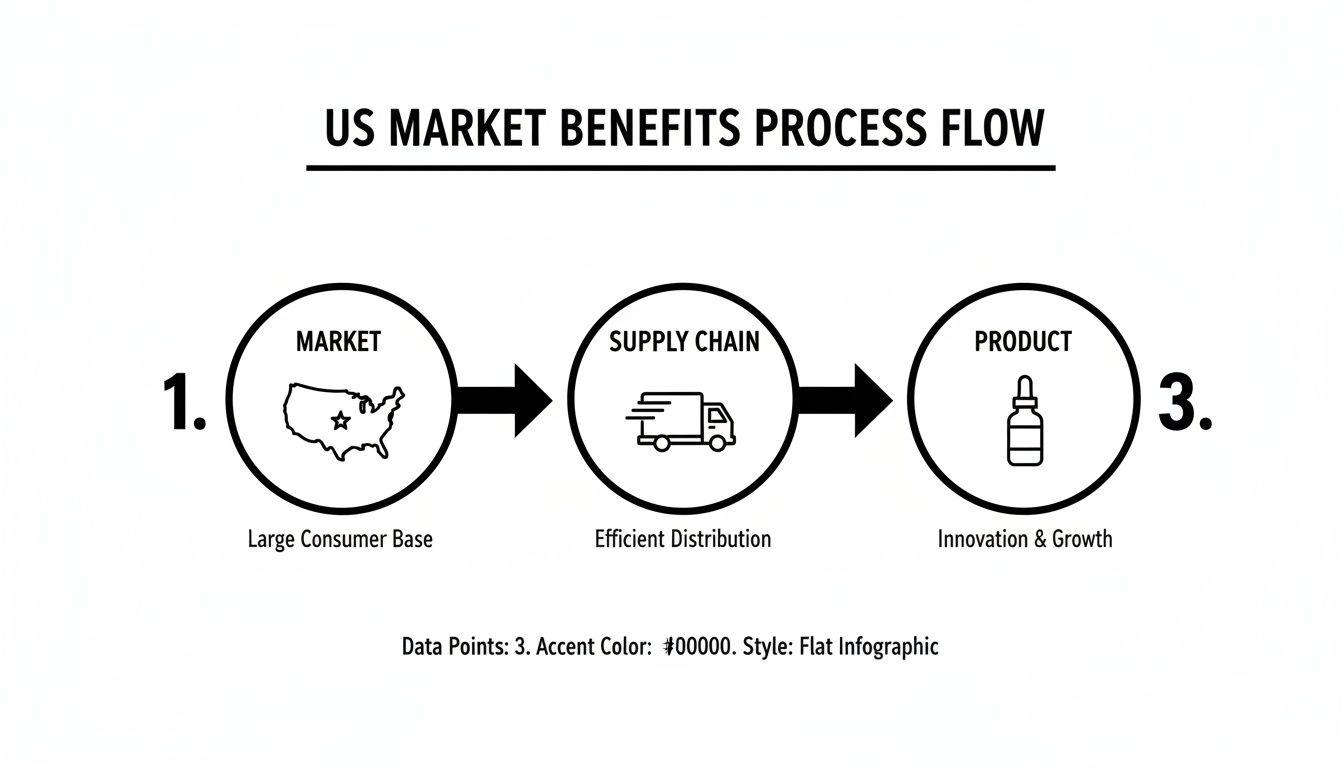
As this graphic illustrates, creating a high-quality product is the final step, built upon a stable market and a reliable supply chain. By mastering these formulation techniques, you ensure that superior ingredients are transformed into exceptional finished goods.
Navigating Regulatory And Labeling Requirements
You've formulated a superior product. Now you must navigate the complex regulatory landscape to ensure compliance. Formulating with food grade terpenes places you at the intersection of state-level cannabis laws and federal FDA guidelines.
Accurate labeling is not a mere bureaucratic task; it is the cornerstone of consumer trust and a critical liability shield. Your ingredient list must be transparent, accurate, and fully compliant.
Crafting Compliant Ingredient Lists
When listing terpenes on a product label, specificity is required. FDA guidelines mandate that ingredients be listed by their common or usual names. For terpenes, this means identifying the individual compounds.
Vague terms like "natural flavors" are insufficient. A compliant ingredient list for a product formulated with food grade terpenes should read:
- Ingredients: Cannabis Distillate, Terpenes (Beta-Caryophyllene, D-Limonene, Myrcene, Linalool).
This level of detail demonstrates to consumers and regulators that you have precise control over your formulation. It is especially critical for edibles and tinctures, which fall directly under food regulations. This is why partnering with a supplier who provides a complete breakdown of every isolate in their blends is essential for compliance.
Transparent sourcing and accurate labeling are not just regulatory hurdles; they are invaluable business assets. They protect your company, build consumer trust, and position your products for success in a crowded marketplace.
The Problem With Cutting Agents
Not long ago, the use of cutting agents like Propylene Glycol (PG), Vegetable Glycerin (VG), and MCT oil was common in vape formulations. Today, their inclusion is a significant red flag for quality and a regulatory minefield. Many states have banned these additives in inhalable products due to safety concerns.
Formulating without these diluents is now a key differentiator for premium products. A clean, modern vape formulation should contain only two primary components: the cannabinoid concentrate and the terpene blend. By using high-quality food grade terpenes to achieve the desired flavor and viscosity, you create a product that is superior, safer, and more compliant. Our ready-to-use flavor packs for cartridges, for instance, are formulated without any cutting agents, providing a pure and compliant base for your products.
State-Specific Cannabis Regulations
While the FDA sets overarching guidelines for food and beverages, the cannabis industry is regulated by a complex patchwork of state laws. Each state has its own specific requirements for testing, labeling, and permissible ingredients. This necessitates a thorough understanding of the regulations in every market where your products are sold.
A product that is fully compliant in California may require different labeling or additional testing to be sold in Colorado or Oregon. Staying abreast of these nuances is critical for any brand aiming for multi-state expansion.
How To Choose The Right Terpene Supplier
Your terpene supplier is more than a vendor; they are a partner in quality control and a gatekeeper for your brand's reputation. A superior supplier provides not just terpenes, but also consistency, verified safety, and the assurance that every batch meets specification. This decision is not about minimizing cost, but about building a reliable supply chain that enables scalable growth.
Vetting a supplier requires due diligence. A trustworthy company operates with full transparency, making lab reports and Certificates of Analysis (CoA) readily accessible for every batch. This documentation is the only empirical proof that the product you are purchasing is pure and safe.
Radical Transparency And Documentation
A supplier's approach to documentation is a strong indicator of their quality standards. If you must search extensively for a CoA, or if they provide a generic or outdated report, it is a major red flag. A legitimate supplier will proudly display comprehensive, third-party lab reports that verify their food grade terpenes are free from contaminants like pesticides, heavy metals, or residual solvents.
Your supplier vetting checklist should include:
- Publicly Available CoAs: Every batch should have a unique, easily accessible CoA.
- Full Purity Panels: The lab report must include a complete contaminant screening, not just a terpene profile.
- Traceability: The product must have a clear batch number that links directly to its specific lab report.
This level of transparency is the foundation of a dependable supply chain.
Product Selection And Formulation Resources
Purity is the prerequisite, but an excellent supplier also provides the tools for innovation. Look for a partner with an extensive and evolving catalog of both strain-specific profiles and individual isolates. This variety allows you to either accurately replicate a popular strain or develop a novel, proprietary blend. Access to high-purity isolates, such as those detailed in our D-Limonene benefits guide, provides the building blocks to fine-tune your product's aroma and flavor with precision.
Beyond the products, the best partners offer resources to facilitate your success. Formulation guides, online mixing calculators, and knowledgeable technical support are indicators of a company invested in your success, not just their own sales.
The global terpenes market is projected to grow from USD 885.1 million in 2022 to USD 1,824.2 million by 2032. With natural sources comprising over 60% of the market and the food & beverage industry consuming over 32% of all terpenes, supply chain reliability has never been more critical. You can review terpene market growth projections to understand why a scalable partner is essential.
Business Support And Scalability
Finally, assess the practical aspects of the partnership. Does the supplier offer wholesale programs and bulk pricing? More importantly, can they fulfill large orders reliably without compromising quality or consistency? As your brand scales, you need a supplier whose operational capacity can grow with you.
Selecting the right supplier is a strategic decision that impacts everything from product safety to brand perception. By prioritizing transparency, product selection, and robust business support, you are not just buying terpenes—you are building a partnership that enables the creation of a trusted, successful brand.
Your Top Questions About Food Grade Terpenes
We've covered extensive ground, but specific questions often arise during formulation. This section addresses common technical challenges faced by product manufacturers working with food grade terpenes.
Can I Use Any Food Grade Terpene In A Vape Cartridge?
No. This is a critical distinction. A substance that is GRAS (Generally Recognized as Safe) for ingestion is not automatically safe for inhalation. Vaporization introduces unique safety considerations related to thermal degradation.
When formulating for inhalation, you must use terpenes from a supplier who specifically tests their products for this application. The primary responsibility is to confirm they are 100% free of cutting agents like VG, PG, PEG, or MCT oil. A transparent and comprehensive Certificate of Analysis (CoA) is the only way to verify this, serving as the ultimate safeguard for your customers and your brand.
What Is The Best Way To Store Terpenes?
To preserve their potency and aromatic integrity, terpenes must be protected from their primary enemies: oxygen and UV light. Exposure to these elements will degrade the delicate compounds.
Always store terpenes in their original airtight, amber glass containers in a cool, dark environment. A refrigerator is ideal. Avoid freezing, as extreme cold can cause certain isolates to crystallize and fall out of solution. When stored correctly, terpenes will maintain their full profile for a year or longer.
Chemically, a molecule of Linalool is identical whether it's sourced from lavender or cannabis. The difference lies in sourcing, scalability, and regulation.
Botanically-Derived Vs. Cannabis-Derived Terpenes: What's The Difference?
The primary difference is logistical and regulatory, not chemical.
Botanically-derived terpenes are extracted from a wide variety of federally legal plants, such as citrus, pine, and flowers. This sourcing method offers significant advantages: they are not subject to federal prohibition, they are easier to produce at scale with high consistency, and they avoid the complex supply chain issues associated with cannabis.
Cannabis-derived terpenes are extracted directly from the cannabis plant. While they offer a certain "authentic" appeal, they present numerous challenges, including strict state-by-state regulations, inconsistent supply, and significantly higher production costs. For most commercial manufacturers, high-purity botanical terpenes provide the same molecular building blocks and performance without the regulatory and financial burdens.
How Do I Calculate The Right Terpene Ratio For My Distillate?
Achieving the ideal balance is crucial for performance and flavor. A standard starting point for most vape cartridge formulations is a terpene concentration of 5-10% by weight.
The calculation is straightforward: multiply the total weight of your distillate by your target percentage.
For example, for 100 grams of distillate and a target 7% terpene profile:
100g (distillate) x 0.07 = 7g of terpenes
Best practice dictates starting with a small test batch to evaluate viscosity and flavor before committing to a full production run. To streamline this process, an online mixing calculator can help you achieve precise and repeatable results every time.
Ready to formulate with confidence? At Gold Coast Terpenes, we provide lab-verified, food-grade botanical terpenes that are free from fillers and designed for consistency. Explore our extensive library of strain profiles and isolates to create your next best-selling product today at https://www.goldcoastterpenes.com.