
For any professional formulating cannabis products, the Material Safety Data Sheet (MSDS) for limonene is a mission-critical document. Now globally standardized as the Safety Data Sheet (SDS), its purpose remains the same. This isn't a compliance checkbox; it's the operational manual for safely handling, storing, and blending this foundational terpene into vape cartridges, distillates, and other formulated goods.
Your Quick Guide to the Limonene SDS in Formulation
Mastering the limonene SDS is fundamental to creating safe, compliant, and high-quality cannabis products. This document details the physical, chemical, and health hazards of pure limonene isolate. For formulators, this information is the bedrock of Standard Operating Procedures (SOPs), dictating Personal Protective Equipment (PPE) requirements and shaping the entire lab risk management strategy.
Ignoring the details in an SDS invites operational risk, from safety incidents and product inconsistency to regulatory action. For example, knowing the flash point is essential for developing safe heating and mixing protocols. Similarly, understanding the skin sensitization warnings dictates the precise handling precautions required for your team.
Key MSDS Data for Formulators
To get started, the infographic below points out three of the most immediate things you need to know when you open a bottle of limonene: its primary hazard, the PPE you need, and the basic handling rules.

This serves as an instant reminder: limonene is a flammable liquid, and proper hand and eye protection are the bare minimum before work begins.
The ability to interpret and apply SDS information is a core competency for any serious product developer. It ensures team safety and protects the integrity of your formulations. While safety is paramount, it’s also important to understand the terpene's role as a top note in flavor profiles; you can dive deeper into what makes D-Limonene so special in our other guides. Comprehensive knowledge, from olfactory properties to handling hazards, enables better product development.
How to Source and Verify a Limonene MSDS
Obtaining the correct Safety Data Sheet (SDS)—often still called an MSDS—is the first step in operating a safe and compliant laboratory. There is only one valid source for this document: the manufacturer or supplier who provided the limonene.
This is a critical control point. The SDS is specific to their product, accounting for its purity, formulation, and potential trace impurities. A generic sheet found online is inadequate and non-compliant. Your supplier's document ensures that the data you use for risk assessment, like flash points and PPE guidelines, corresponds to the actual material in your inventory.
Verifying Your Supplier's SDS
Once you have the official SDS, take a few moments to cross-reference the key safety info with public databases. This "trust but verify" step validates your safety protocols and provides an additional layer of assurance.
- Check Regulatory Agencies: Reference the websites for major regulatory bodies like the Occupational Safety and Health Administration (OSHA) in the U.S. or the European Chemicals Agency (ECHA) to compare information.
- Consult Major Chemical Suppliers: Large, reputable chemical manufacturers often provide public safety data that serve as excellent secondary references.
- Focus on Critical Metrics: During comparison, concentrate on essential data points: hazard classifications, flash point, toxicity data (LD50), and required personal protective equipment. If discrepancies arise, contact your supplier immediately for clarification.
This verification process is especially important for anyone formulating cannabis products. Building a strong foundation of knowledge is key, and while you're focused on safety protocols, it never hurts to also deepen your understanding of plant science, like the differences between male vs. female cannabis plants.
Decoding Hazard Identification in Section 2
If you only review one section of an SDS before starting work, make it Section 2. This is the executive summary for safety, and for limonene, it’s absolutely critical. It outlines all potential risks, enabling you to understand the material's hazards before the container is even opened.
This section utilizes the Globally Harmonized System (GHS), the international standard for chemical safety communication. It employs standardized symbols (pictograms), signal words, and hazard statements that are universally understood.

Translating GHS Pictograms and Statements
While the pictograms provide an immediate visual warning, the actionable intelligence lies in the hazard codes (H-statements) and precautionary codes (P-statements). For formulators, understanding these codes is non-negotiable for building safe lab procedures.
Here’s a breakdown of the common codes on a limonene SDS and their practical implications on the production floor:
H226 Flammable liquid and vapor: The flame pictogram is not decorative. Limonene has a relatively low flash point, meaning its vapors can easily ignite from a stray spark, static discharge, or hot surface at ambient temperatures. This mandates storage away from ignition sources and requires grounding of containers during transfers.
H317 May cause an allergic skin reaction: The exclamation mark pictogram highlights this risk. This is a significant concern for formulators. Minor, repeated dermal contact can lead to sensitization, resulting in an allergic reaction upon subsequent exposure. This is why nitrile gloves and lab coats are mandatory.
H304 May be fatal if swallowed and enters airways: This serious warning is represented by the health hazard pictogram. If accidentally ingested, limonene can be aspirated into the lungs, causing severe chemical pneumonitis—a life-threatening emergency. This reinforces the need for a strict "no food or drink" policy in any area where terpenes are handled.
Treat these codes as direct operational directives, not as background compliance text. H317 dictates why gloves must be worn every time. H226 determines where you can store your terpenes and how you should engineer your mixing processes. Internalizing these warnings is the foundation of responsible and safe product development.
Analyzing Fire and Explosion Risks
For any facility that mixes, heats, or stores limonene in bulk, understanding its flammability is a fundamental component of operational safety. The MSDS for limonene provides the quantitative data that must drive your fire prevention strategy. Let's translate those technical numbers into actionable knowledge for a formulator.
Limonene is classified as a flammable liquid, meaning its vapor can readily ignite at temperatures found in a typical lab or production environment. The risk is elevated during common procedures like liquid transfers or mixing, where vapor generation is highest.
Key Flammability Metrics From the MSDS
The SDS contains extensive data, but a few key metrics are critical for managing fire and explosion hazards. This is true whether you're working with pure isolates or creating complex strain-inspired terpene blends.
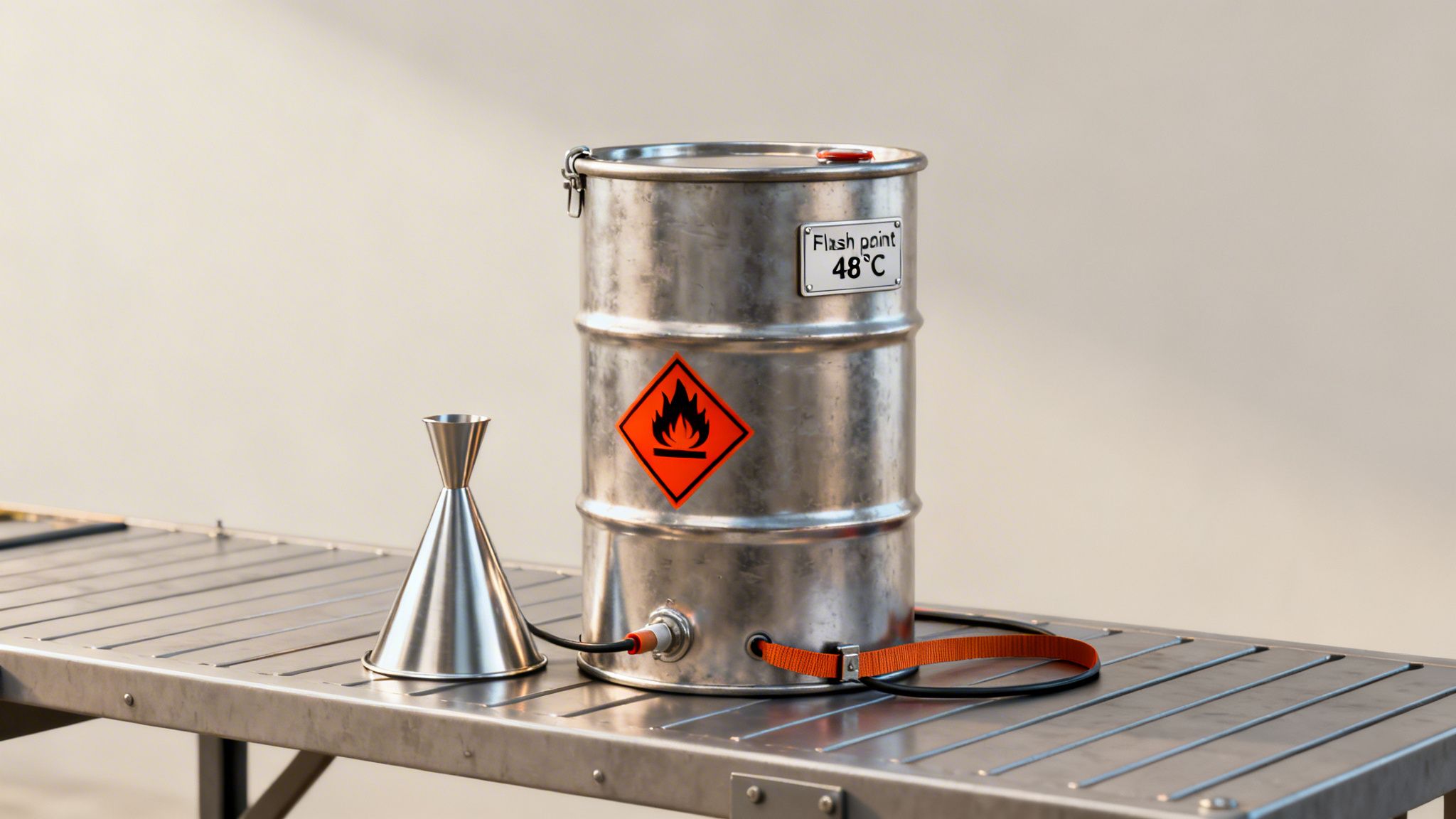
Flash Point: The lowest temperature at which limonene produces enough vapor to form an ignitable mixture with air. For d-Limonene, the flash point is approximately 48°C (118°F). This relatively low temperature means that common heat sources like a nearby hot plate, unrated motor, or static discharge could trigger ignition.
Auto-ignition Temperature: The temperature at which limonene will spontaneously ignite without an external ignition source. This is much higher, typically around 237°C (459°F). While less of a concern for routine handling, it is critical data for designing high-heat processes or selecting equipment.
Explosive Limits (LEL/UEL): The Lower and Upper Explosive Limits define the concentration range of limonene vapor in air required to support combustion. According to OSHA's public resources, limonene's LEL is 0.7% and its UEL is 6.1%. This narrow window is need-to-know information, especially when formulating for vape cartridges, as it identifies the precise conditions where an ignition risk is greatest.
Practical Ignition Risks in Formulation
Applying this data is what prevents incidents. A significant and often underestimated ignition source is static electricity.
Example Scenario: During the transfer of limonene from a large metal drum to a smaller, ungrounded container, the flow of the liquid can generate a static charge. If this charge accumulates and discharges as a spark—and the vapor concentration happens to fall between 0.7% and 6.1%—that spark is sufficient to cause a flash fire. This is why strict grounding and bonding procedures are non-negotiable safety protocols when transferring flammable liquids.
Understanding Health Hazards and Exposure Limits
Beyond flammability, the msds for limonene details several direct health risks that every formulator must manage. Section 2 (Hazard Identification) and Section 11 (Toxicological Information) provide the specific data that should directly inform your lab's Standard Operating Procedures (SOPs).
The most common occupational risks involve dermal and respiratory exposure. Limonene is a known skin irritant (H315) and can cause an allergic skin reaction known as sensitization (H317) with repeated contact. The aspiration hazard (H304) is even more critical—it can be fatal if swallowed and subsequently enters the lungs. This single data point mandates the use of gloves, eye protection, and a strict no-food-or-drink policy in the lab.
Translating Technical Data into Practical Safety
The SDS provides the technical data, such as LD50 (Lethal Dose, 50%) values and workplace exposure limits, that form the basis of a quantitative risk assessment.
LD50 (Oral): This metric indicates the dose required to be lethal to 50% of a test population. Canadian health data reports an oral LD50 of 4,400 mg/kg for male rats. While this suggests low acute toxicity from ingestion alone, it is the aspiration hazard that poses the more immediate and severe risk. For a deeper analysis, the full Canadian substance assessment offers extensive toxicological data.
Dermal Effects: Limonene is classified as a Skin Sensitizer in Category 1B. In practice, this means repeated exposure can trigger a permanent allergic response. Studies have documented erythema (redness) and edema (swelling) within 24-72 hours, sometimes followed by desquamation (skin peeling) by day seven.
Exposure Limits: The Workplace Environmental Exposure Level (WEEL) is set at 30 ppm (parts per million) as a time-weighted average over an 8-hour workday. This guideline is established to protect workers from potential kidney effects associated with long-term vapor inhalation.
Anyone formulating for distillate or blending terpenes must internalize these values. The data is clear: the fact that limonene is naturally derived does not diminish the risks of the concentrated isolate. It demands the same rigorous handling protocols as any other laboratory chemical. This information is precisely why proper ventilation, consistent use of PPE, and robust spill-response plans are non-negotiable components of safe operations.
Implementing Proper Handling and Storage Protocols
This is where SDS data becomes operational practice. Translating the technical information from a msds for limonene into real-world Standard Operating Procedures (SOPs) is what ensures worker safety. It involves converting precautionary statements into the daily routines of your lab and warehouse teams.
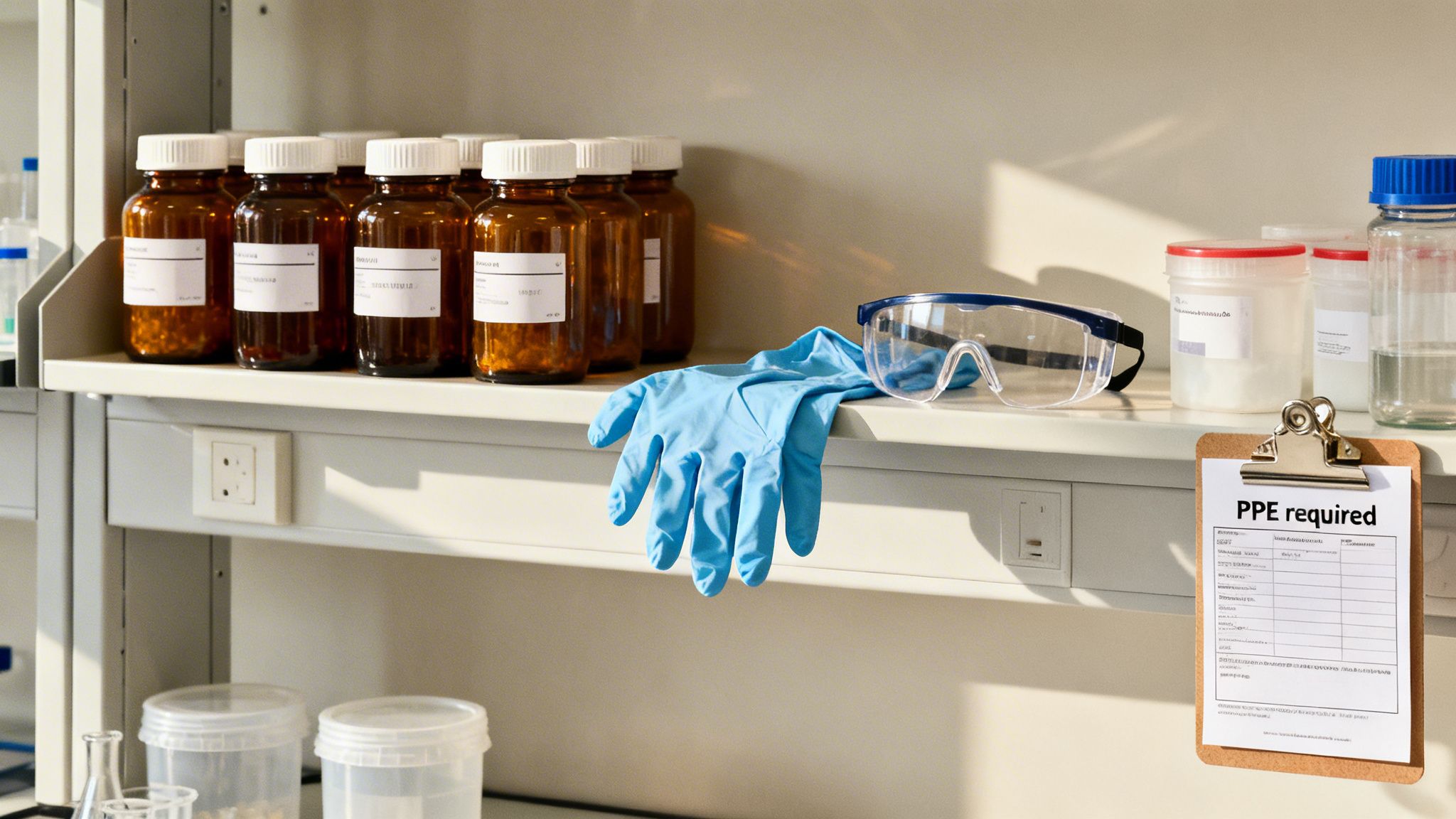
The MSDS provides a clear directive on required Personal Protective Equipment (PPE). These are not suggestions but minimum requirements for handling limonene safely, especially given its potential for skin sensitization and splash-related eye irritation. Consistent use of appropriate PPE is non-negotiable for preventing accidents and long-term health issues.
Required PPE for Handling Limonene
Based on the hazard statements in any limonene SDS, the PPE requirements for your team are clear. When working with pure limonene, personnel must be equipped with the following, at a minimum:
- Chemical Splash Goggles: These are distinct from standard safety glasses. Goggles that form a seal around the eyes are required to provide effective protection from splashes during pouring or mixing operations.
- Nitrile Gloves: As a solvent, limonene can degrade weaker materials like latex. Nitrile offers superior chemical resistance. Gloves should be replaced immediately upon any direct contact with limonene.
- Lab Coat or Chemical-Resistant Apron: This is the primary barrier to protect skin and clothing from incidental drips and spills. Given that limonene is a known skin irritant, this is mandatory.
This checklist directly connects the technical language of an MSDS to the practical, actionable steps required in a laboratory setting, justifying each protocol with specific safety data.
Limonene Handling and PPE Checklist
| Safety Protocol | MSDS Justification (Section/Statement) | Best Practice Example |
|---|---|---|
| Always wear sealed goggles | Section 8: Exposure Controls/Personal Protection – "Wear safety glasses with side shields (or goggles)." | When transferring limonene from a 1-gallon jug to a 250mL beaker, the formulator wears tight-fitting chemical splash goggles, not just safety glasses. |
| Use nitrile gloves | Section 8: "Wear protective gloves/protective clothing/eye protection/face protection." Specifies compatible materials. | A lab tech changes nitrile gloves immediately after a small drip contacts their hand while blending terpenes, preventing skin absorption. |
| Work in a ventilated area | Section 7: Handling and Storage – "Use only outdoors or in a well-ventilated area." | All limonene formulation is done inside a fume hood with the sash at the appropriate height to ensure proper airflow and vapor removal. |
| Keep away from heat sources | Section 2: Hazard Identification – "Flammable liquid and vapor." | The limonene storage cabinet is located in a cool room, at least 15 feet away from any heating elements, centrifuges, or other spark-producing equipment. |
| Ground large containers | Section 7: Handling and Storage – "Keep container tightly closed. Ground/bond container and receiving equipment." | When pumping limonene from a 55-gallon drum into a mixing vessel, both containers are connected with grounding clamps to prevent static electricity buildup. |
Adhering to these steps ensures that your team is not just compliant, but is actively creating a safe work environment based on the specific chemical properties of limonene.
Best Practices for Limonene Storage
Storage protocols are as critical as handling procedures. As a flammable liquid, limonene requires specific storage conditions outlined in the MSDS, which should be incorporated into your facility's design and daily operations. Proper storage prevents degradation, minimizes fire risk, and ensures regulatory compliance.
A common error is treating terpenes as inert ingredients. They are not. Limonene's low flash point and susceptibility to oxidation demand a dedicated storage strategy. Failure to follow it can degrade complex flavor profiles, such as those found when replicating the character of strains where you wonder if Sour Diesel is Indica or Sativa, and create a significant fire hazard.
Ensure your storage area is:
- Well-Ventilated: To prevent the accumulation of flammable vapors.
- Away from Ignition Sources: No sparks, open flames, or high-heat equipment nearby.
- Tightly Sealed and Grounded: Keep containers tightly sealed to prevent oxidation and vapor release. Large metal containers must be grounded during transfers to prevent static discharge.
Managing Environmental Impact and Disposal
While immediate workplace safety is a primary focus, the limonene MSDS also highlights a critical external consideration: its environmental impact. Section 12 (Ecological Information) contains data essential for responsible manufacturing, shaping disposal procedures and spill response protocols.
The key information is that limonene is classified as a marine pollutant, carrying the hazard statement H410: Very toxic to aquatic life with long-lasting effects. This is not a generic warning; it is based on ecotoxicity data demonstrating that even minor releases into waterways can cause significant damage to local ecosystems.
Understanding Ecotoxicity Data
The environmental warnings on a limonene SDS are derived from scientific metrics like LC50 (Lethal Concentration, 50%) and EC50 (Effective Concentration, 50%). These values indicate the concentration of a substance that is lethal to 50% of a test population (e.g., fish) or causes a non-lethal effect in 50% of another (e.g., daphnia).
Aquatic ecotoxicity data reveals limonene's potency. Some safety data sheets report an LC50 of just 0.72 mg/L for fathead minnows over a 96-hour period—a concentration that earns it an "acutely toxic" classification. Other sources classify it as a Chronic Aquatic Hazard Category 1 substance. For a complete data set, you can always explore the full safety data sheet from chemical suppliers.
This data reinforces a critical operational rule: Limonene waste must never be disposed of down a sink or drain. Doing so is a major compliance violation and a direct environmental threat.
Compliant Disposal Procedures
Due to its hazardous classification, all limonene waste—from spills, expired inventory, or container rinsate—must be managed as hazardous material.
- Segregate Your Waste: All limonene-contaminated materials (e.g., absorbent pads, used gloves, empty bottles) must be collected in a dedicated, clearly labeled, and sealed hazardous waste container.
- Follow Regulations: Disposal must comply with all local, state, and federal regulations for hazardous waste, which typically requires collection by a licensed environmental services company.
- Manage Spills Correctly: Spill kits must contain inert absorbent materials like vermiculite or sand, not water. The objective is to contain and absorb the liquid for proper disposal, preventing any release to drains or soil.
Common Questions About the Limonene SDS
Let's conclude with practical answers to the questions most frequently asked by formulators regarding the MSDS for limonene. This serves as a final checklist to resolve common points of confusion on safety and compliance.
What’s the Difference Between an MSDS and a COA?
This is the most common point of confusion. While both documents are essential, they serve entirely different functions.
- MSDS/SDS (Safety Data Sheet): This document addresses safety and hazards. It is the guide to the chemical's flammability, health risks, required PPE, and emergency procedures. It defines how to handle the material safely.
- COA (Certificate of Analysis): This document addresses quality and purity. It provides test results for a specific batch, verifying potency (e.g., >95% limonene) and confirming the absence of contaminants like heavy metals or pesticides. It validates the product's identity and quality.
The simplest distinction: The SDS protects your team. The COA protects your product and your customers. Both are indispensable.
How Often Does a Limonene SDS Need to Be Updated?
OSHA regulations require a manufacturer to update an SDS within three months of becoming aware of significant new hazard information. As a formulator, it is your responsibility to ensure you have the most current version from your supplier.
A best practice is to request an updated SDS annually or with each new bulk purchase order. This proactive step keeps your safety protocols current and your compliance documentation in order.
Does the SDS Apply to Diluted Limonene Products?
Yes, but the hazard profile changes with concentration. The SDS for pure limonene applies to the undiluted isolate. Once you formulate it into a carrier oil for a vape cartridge, you have created a new mixture with a different set of hazards.
For example, a blend containing only 5% limonene will have a much higher flash point and lower skin irritation potential than 100% limonene. If you are the manufacturer of that finished blend, you are responsible for creating a new SDS that accurately reflects the hazards of your product. This is a critical step for compliant labeling and B2B sales.
At Gold Coast Terpenes, we provide comprehensive safety documentation for all our products, empowering you to formulate with confidence. Explore our lab-verified terpene isolates and strain profiles to ensure quality and consistency in every batch.