
For the professional formulator, D-Limonene is much more than a pleasant citrus aroma. This powerhouse monoterpene is a cornerstone ingredient for creating top-tier cannabis products, valued for its remarkable ability to improve viscosity, brighten flavor profiles, and act as a natural solvent.
Understanding its chemical properties and functional roles is the first step to leveraging D-Limonene in commercial formulations.
What Is D-Limonene in Product Formulation?
At its core, D-Limonene is a monocyclic monoterpene, a class of organic compounds known for their distinct aromatics and functional roles. It's found in high concentrations in the peels of citrus fruits like lemons and oranges, responsible for their sharp, zesty character. For product development, its value lies in its molecular structure (C₁₀H₁₆) and the functional benefits that structure provides.
It should be viewed as a foundational tool, not just a fragrance. While a consumer might only notice the fresh scent, a formulator sees a workhorse molecule solving critical production challenges, from thinning viscous distillates to elevating the entire sensory experience of a final product.
The Aromatic and Functional Backbone
In terpene formulation, isolates are categorized by their aromatic weight—top, middle, and base notes. D-Limonene is a classic top note, a critical role in blend architecture.
- High Volatility: It evaporates quickly, making it one of the first aromas perceived. It delivers the crucial first impression of a product.
- Bright and Sharp Scent: Its distinct citrus punch provides an immediate burst of freshness that can define a product's aromatic identity.
- Lifting Agent: When combined with heavier, earthier terpenes, D-Limonene prevents the overall profile from becoming muddy or dull. It literally lifts other aromas.
Its function as a top note is key to creating aromas with depth and character. Without the initial "pop" from D-Limonene, many blends would fall flat and fail to capture consumer attention. It sets the stage for the middle notes (like Beta-Caryophyllene) and base notes (like Myrcene) to emerge, creating a complete and satisfying sensory journey.
For formulators, D-Limonene is a strategic tool. It delivers an immediate aromatic impact while simultaneously improving the physical consistency of the concentrate, making it essential for high-quality vape and distillate products.
Beyond the Scent: A Natural Solvent
Here is where D-Limonene demonstrates its greatest value to a formulator: its power as a natural solvent. This property stems from its non-polar chemical nature, which allows it to easily dissolve other non-polar compounds, like cannabinoid oils and other terpenes. If you want to dive deeper into how different terpenes interact, our guide to strain-inspired terpene blends is an excellent resource.
This solvent capability is why D-Limonene is the industry-standard diluent for high-viscosity distillates. It effectively lowers viscosity without requiring undesirable cutting agents like PG, VG, or MCT oil. The result is a cleaner, purer product that flows perfectly in vape hardware and delivers a smooth, consistent experience.
This dual-action capability—providing both potent flavor and essential function—makes D-Limonene one of the most versatile and indispensable terpene isolates on any formulator's bench.
How D-Limonene Improves Product Performance
For professionals formulating cannabis products, D-Limonene's value extends far beyond its citrus scent. Its functional properties solve two of the biggest challenges in production: managing the viscosity of thick extracts and constructing flavor profiles that are vibrant and distinct.
D-Limonene is a potent, natural solvent, making it one of the most valuable tools for working with high-purity cannabinoid distillates. THC or CBD distillate can be as thick as cold molasses, creating significant problems for vape cartridge filling and performance. This high viscosity leads to clogged hardware, inconsistent vaporization, and a poor end-user experience.
This is where D-Limonene excels. Its molecular structure allows it to mix seamlessly with cannabinoid oils, effectively thinning them. By adding a precise amount, a formulator can transform a viscous, unworkable extract into a smooth, flowable oil. It’s the ideal solution for filling vape cartridges without resorting to controversial additives like Propylene Glycol (PG) or Vegetable Glycerin (VG).
Achieving Optimal Viscosity for Vape Cartridges
Finding the perfect oil consistency is a careful balancing act. If it’s too thick, the oil won’t saturate the wick, resulting in a burnt "dry hit." If it's too thin, the cartridge will leak. D-Limonene provides the control needed to dial in that perfect flow.
- A Natural Solution: It’s a clean, plant-derived diluent, which aligns with consumer demand for transparent and natural ingredients.
- Better Performance: An oil with the correct viscosity flows consistently to the heating element, guaranteeing a smooth, full-flavored vaporization every time.
- Hardware Compatibility: By adjusting viscosity, you can ensure your oil performs optimally in a wide range of vape hardware, from standard ceramic coils to advanced pod systems.
This solvent power is precisely why D-Limonene is a fixture in any serious formulator's toolkit. It’s a simple, elegant solution to a complex manufacturing problem, improving everything from production efficiency to the final customer experience. For a closer look at building unique flavor blends, check out our guide on formulating with terpenes.
Enhancing Flavor Profiles
Beyond its technical utility, D-Limonene is an essential tool for flavor architecture. As a top note, it is the first aromatic compound perceived and grabs the consumer's attention. It prevents a flavor profile from feeling too heavy or one-dimensional.
Many popular terpene blends are built on a foundation of heavier, earthier notes from terpenes like Myrcene (musky, fruity) or Beta-Caryophyllene (spicy, woody). While crucial for creating depth, these isolates alone can sometimes result in a flat profile.
D-Limonene functions as the "lifting agent." Its bright, sharp citrus aroma cuts through heavier scents, adding a splash of energy that makes the entire blend feel more alive and complex.
This technique is key whether replicating the classic profile of a citrus-heavy strain or developing a novel flavor from scratch. A strategic addition of D-Limonene can elevate a good blend to a great one, creating a memorable sensory experience. This dual mastery of function and flavor is what makes D-Limonene so valuable in the formulation of cannabis products.
A Practical Guide to Formulating with D-Limonene
Understanding D-Limonene’s functions is one thing; applying it to create a superior product is another. Let's translate theory into practice and walk through the steps for using D-Limonene to manage viscosity and build a precise flavor profile.
Success boils down to two factors: usage rates and synergistic pairings with other terpenes. Mastering these allows you to create a stable, effective product that delivers a consistent experience every time.
Nailing the Right Usage Rates
There is no single "correct" amount of D-Limonene. The optimal usage rate is entirely dependent on the formulation goal. Are you aiming for a subtle aromatic lift, or do you need to significantly reduce the viscosity of a thick concentrate? The objective dictates the concentration.
Start by defining D-Limonene's role in your formula.
For a Subtle Flavor Pop (1% – 3% by weight): In this low range, D-Limonene acts as a bright top note. It can lift an entire blend without dominating it, adding a fresh citrus character that prevents heavier profiles from feeling dull. This is the sweet spot for creating complex, nuanced flavors.
For Major Viscosity Reduction (5% – 15% by weight): When working with thick, honey-like distillates for vape cartridges, a higher concentration is necessary. A starting point of 5-10% is typically sufficient to turn a stubborn concentrate into a smooth, flowable oil. For exceptionally thick extracts, you may need to go as high as 15%, but always conduct small-batch testing first to avoid over-thinning, which can lead to leaky hardware.
The image below summarizes the versatile roles D-Limonene can play in your product.
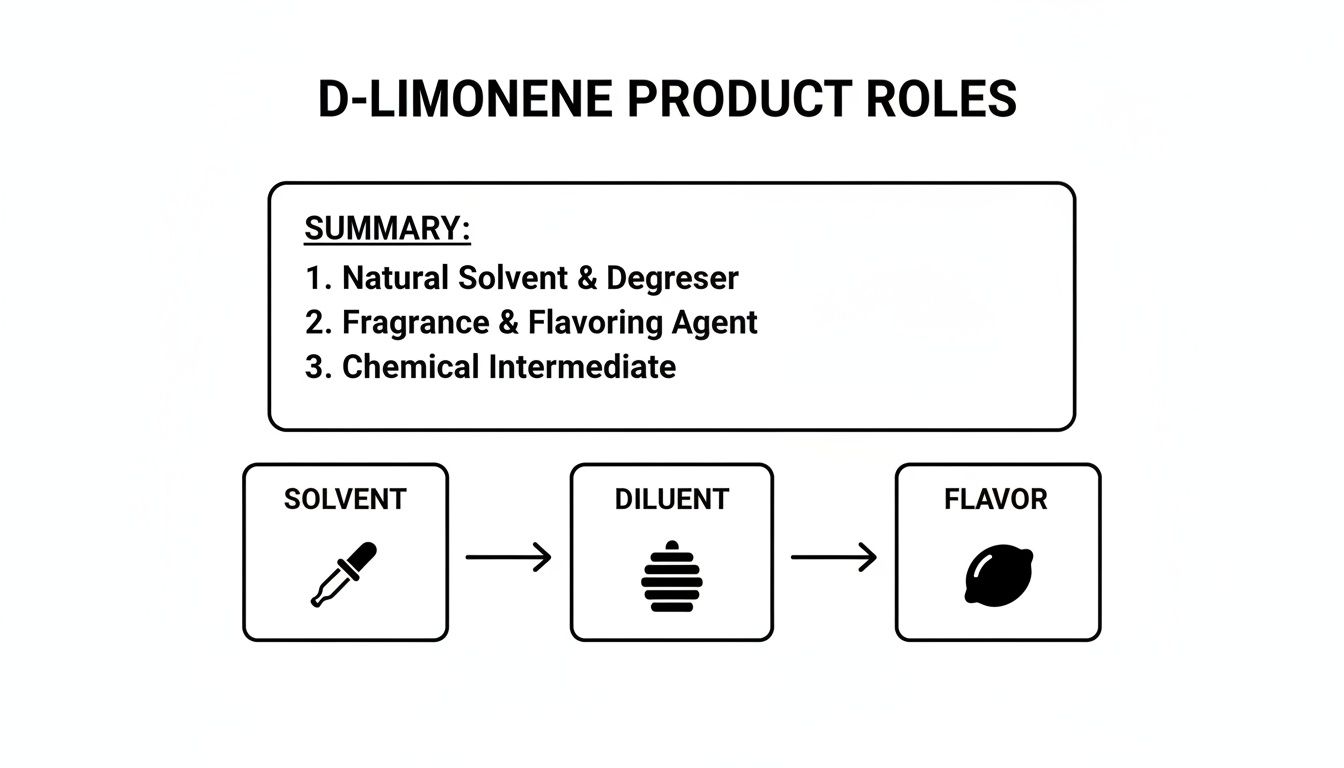
As shown, it is a true multi-tool—acting as a natural solvent, a powerful diluent, and a critical flavoring agent.
To provide further clarity, here is a quick reference table for specific formulation goals.
D-Limonene Formulation Guide for Different Product Goals
| Formulation Goal | Suggested D-Limonene % (by weight) | Recommended Terpene Pairings | Expected Outcome |
|---|---|---|---|
| Thinning Thick Distillate | 8-12% | Beta-Caryophyllene, Terpinolene | A smooth, easily vapable oil with a bright, slightly spicy citrus profile. The viscosity is ideal for standard vape hardware. |
| Brightening an Earthy Profile | 2-4% | Myrcene, Linalool | Lifts heavy, earthy notes with a sharp citrus edge. The result is a more balanced, approachable aroma that feels fresh and complex. |
| Creating a "Citrus-Forward" Strain | 5-7% | Alpha-Pinene, Beta-Pinene | A dominant, vibrant citrus aroma and flavor. Pinene adds a crisp, clean backdrop that accentuates the limonene. |
| Nuanced Flavor Complexity | 1-3% | Linalool, Geraniol | A sophisticated, perfume-like bouquet where citrus is a supporting note. Adds a touch of zest to a primarily floral blend. |
This table serves as a solid starting point, but remember that the best formulations come from experimentation and iterative small-batch testing.
Mastering Terpene Synergy
D-Limonene rarely works in isolation. Its true power is unlocked when paired with other terpenes to build a specific sensory experience. Understanding its interactions with different mid and base notes is the key to advanced formulation.
Think of it like constructing a musical chord. D-Limonene is the high, bright note that captures attention, but it requires deeper, richer tones to create a full, satisfying sound. For inspiration, you can explore our library of strain-inspired terpene blends to see how these combinations work in practice.
Formulation Pro-Tip: When mixing, always add D-Limonene last, especially if applying heat. Its high volatility means it evaporates easily. Adding it at the end of the process ensures more of its bright citrus aroma is retained in the final product.
Effective Terpene Pairings
With Myrcene: A classic combination for good reason. D-Limonene's sharp citrus cuts through the sweet, musky notes of Myrcene. Together, they form the foundation of countless "tropical" or "fruity" profiles, creating a perfect balance of bright and earthy.
With Linalool: For a more sophisticated profile, the zest of D-Limonene blended with the floral, lavender-like scent of Linalool creates elegant, perfume-quality aromas. This pairing is ideal for profiles that require less overt cannabis character.
With Beta-Caryophyllene: For adding spice, this is the go-to pairing. The peppery kick of Beta-Caryophyllene provides a warm, rich counterpoint to D-Limonene’s bright citrus. The combination is complex and satisfying, reminiscent of spiced orange or fresh citrus peel.
Ensuring a Stable Homogenized Blend
Once ratios are determined, the final step is ensuring a perfectly mixed and stable product. While D-Limonene is an excellent solvent for cannabinoids, an improper mixing process can still lead to separation and inconsistency.
The solution is gentle heat and thorough agitation. First, warm the cannabinoid distillate slightly to reduce its viscosity. Then, slowly introduce the terpene blend while stirring continuously until the mixture is completely uniform.
The industry standard is to use a magnetic stirrer on a low-speed, low-heat setting. This method guarantees a homogenous and stable final product that will perform reliably, whether in a vape cartridge or a dab-ready concentrate. For more foundational knowledge, our terpene formulation guide is a valuable resource.
Replicating Authentic Strain Profiles with D-Limonene
Moving beyond simple blending into the art of strain replication requires a deep understanding of terpene synergy. It is not enough to combine a few popular isolates. Creating a product that genuinely replicates the aroma and flavor of a specific cultivar requires a methodical, perfumer-like approach to layering scents.
Iconic citrus-forward strains like Super Lemon Haze or Tangie are not defined by a single compound. They are a carefully balanced orchestra of top, middle, and base notes where D-Limonene plays the lead but does not perform solo.

For formulators seeking to capture the essence of these sought-after genetics, D-Limonene is the essential top note. Its high volatility delivers the initial, bright pop of citrus that makes a strain instantly recognizable. But that zesty introduction needs a solid foundation of other terpenes to create a full, memorable experience. This is where true formulation craft begins.
Deconstructing a Classic Citrus Profile
Building an authentic strain profile is like reverse-engineering a complex flavor. It begins by identifying the key aromatic players and their roles. In any "Haze," "Tangie," or "Lemon" variety, D-Limonene is almost always the dominant terpene.
The Top Note (The Hook): D-Limonene provides the immediate, sharp, and sweet citrus hit. It is the first aroma perceived and sets the stage for the rest of the profile.
The Mid-Notes (The Body): This is where terpenes like Beta-Caryophyllene and Terpinolene add complexity. Beta-Caryophyllene brings a spicy, peppery undertone that balances the sweetness of limonene, while Terpinolene can add a hazy, floral, and slightly woody character.
The Base Notes (The Foundation): Myrcene is a common base note that adds a subtle, earthy fruitiness. It grounds the brighter top notes and gives the final aroma a lingering, full-bodied finish, preventing it from feeling thin or one-dimensional.
This layered methodology is crucial. Without the spicy mid-notes and earthy base, a blend high in D-Limonene would smell like a household cleaner, not a premium cannabis profile. The authentic character emerges when these components work in harmony. To see how these isolates interact in practice, exploring a library of strain-inspired terpene blends can offer valuable examples.
Building Profiles with Precision Ratios
Authentic replication is a game of ratios. The difference between a convincing Super Lemon Haze and a generic citrus blend is often a matter of a few percentage points. The goal is a profile that is consistent from the bottle to the final vaped product.
In strain replication, D-Limonene is the bright spotlight, but the supporting terpenes are the stage crew that makes the show work. The magic is in the specific balance—often, a 2:1:1 ratio of Limonene to Caryophyllene and Myrcene is a solid starting point for many classic citrus strains.
Consider formulating a profile inspired by a strain known for sharp lemon and spicy haze notes. You would begin with D-Limonene as the dominant isolate, perhaps starting at 40-50% of the total terpene blend.
Next, you would layer in the mid-notes. Beta-Caryophyllene might constitute 20-25% of the mix to provide the signature spicy kick. To round it out, a foundational base note like Myrcene at 10-15% would add a touch of sweetness and depth. The remaining percentage can be filled with trace terpenes to add unique, subtle character.
Achieving Consistency and Market Appeal
The primary advantage of using individual terpene isolates to build profiles is consistency. Botanically derived profiles can exhibit variation from batch to batch. By building from the ground up with pure isolates, you guarantee that your product will have the exact same flavor and aroma every single time.
This reliability is a significant asset for brand owners. When a customer purchases a "Lemon Haze" cartridge, they expect it to taste like Lemon Haze. Meeting that expectation consistently builds brand loyalty and trust. By mastering terpene synergy with D-Limonene as a cornerstone, your brand can deliver reliable, authentic products that stand out in a crowded market.
The Functional and Therapeutic Side of D-Limonene
Flavor, aroma, and viscosity are primary formulation concerns. However, with D-Limonene, there is another layer to consider: its functional properties. Today's consumers are more educated and seek products that offer a specific experience. Understanding the science behind terpenes allows you to meet that demand.
When D-Limonene is added to a formulation, you tap into the demand for products often described as 'uplifting' or 'clarifying.' This is not mere marketing; it is about grounding product development in science and leveraging the entourage effect to create targeted and effective products.
What the Research Says
Scientific studies have consistently demonstrated that D-Limonene possesses interesting biological activities. While it is absolutely critical to avoid making direct medical claims about finished products, understanding the well-documented properties of an isolate like D-Limonene can guide formulation strategy and help you connect with a more discerning audience.
Two of the most-discussed properties are its antioxidant and anti-inflammatory effects. These terms point to how D-Limonene functions at a cellular level.
- Antioxidant Power: Research suggests D-Limonene can help protect the body from oxidative stress by neutralizing free radicals. This is a core concept in cellular health and a significant selling point for wellness-focused consumers.
- Anti-inflammatory Effects: The compound has also been shown to help regulate inflammatory pathways, making it a suitable ingredient for products aimed at comfort and physical well-being.
By selecting terpenes with these well-researched characteristics, you are building a product that is not only sensorially appealing but also functionally aligned with consumer needs.
When you select terpenes for their functional potential, you are no longer just replicating a flavor. You are crafting an experience with a purpose, one that's designed to be specific and repeatable. That's how you build brand loyalty and justify a premium price point.
Weaving Science into Your Brand Story
One of the most compelling research areas for D-Limonene is its potential role in chemoprevention. The scientific literature, particularly from animal studies, provides formulators with a powerful narrative. For example, D-Limonene has shown significant promise in cancer prevention studies on rodents.
In a landmark 1992 study, female rats given a potent carcinogen saw a 72% decrease in mammary tumors by the 18th week when their diet was supplemented with high-dose D-Limonene. You can find more details on these chemopreventive findings here.
To be clear: this is not about claiming your vape cartridge prevents cancer. It is about understanding the deep scientific foundation of your ingredients. This knowledge empowers you to speak with confidence about the quality and intention behind your formulas. D-Limonene shifts from being a simple flavor additive to a cornerstone ingredient chosen for its robust scientific backing. This level of detail adds depth and credibility to your product's story, resonating with distributors, retailers, and discerning consumers who want to know why your product is superior.
Handling and Storing D-Limonene Isolate Like a Pro
D-Limonene is listed as GRAS (Generally Recognized as Safe) for use in food and flavors, but this applies to diluted forms. When working with concentrated D-Limonene isolate, it must be treated with professional respect. The same chemical properties that make it an excellent solvent demand careful handling in a lab or production environment.
Proper safety protocols are not just about compliance. They are about protecting your team, preserving ingredient purity, and ensuring a perfect final product every time. A single handling error can compromise an entire batch, impacting both the bottom line and product quality.
PPE and Ventilation
When handling pure D-Limonene, personal protective equipment (PPE) is non-negotiable. It is a potent solvent that can strip natural oils from the skin, potentially leading to irritation or dermatitis with repeated exposure.
- Gloves: Nitrile gloves offer effective protection against terpenes.
- Eye Protection: Always wear safety glasses or goggles to prevent splashes.
- Lab Coat: A lab coat protects clothing and skin from direct contact.
Proper ventilation is also critical. D-Limonene is highly volatile, and its strong citrus aroma can quickly saturate an enclosed space. Always work in a well-ventilated area or, ideally, under a fume hood. This prevents vapor buildup and ensures a safe workspace.
For formulators, safe handling isn't just a regulatory checkbox—it's a core component of quality control. The integrity of your D-Limonene isolate directly impacts the stability and sensory profile of every product you create. Sourcing from suppliers who provide comprehensive safety data is a must.
Storage Best Practices for Isolate Integrity
To maintain the quality and shelf life of your D-Limonene, proper storage is essential. Its two greatest enemies are oxygen and light. Exposure to air and UV light causes D-Limonene to oxidize, breaking it down into other compounds that can create undesirable, off-note aromas.
Follow these simple rules to keep your isolate in optimal condition:
- Use Airtight Containers: Always store D-Limonene in containers with a tight seal. Glass or stainless steel are ideal.
- Minimize Headspace: As the isolate is used, transfer the remainder to smaller containers. Less empty space means less oxygen available for degradation.
- Keep it in the Dark: Store containers in a cool, dark place, away from sunlight or bright facility lighting. Amber glass bottles are excellent for this purpose.
By integrating these safety and storage habits into your standard operating procedures, you ensure the D-Limonene used in your products is as pure, potent, and effective as possible, leading to the consistent results your brand depends on.
Putting D-Limonene to Work: Your Questions Answered
Let's address the practical application questions that arise during formulation. When you're in the lab trying to perfect a blend, you need functional answers. Here are some of the most common questions we receive from formulators working with D-Limonene, focused on real-world solutions for vape and concentrate challenges.
How Much D-Limonene Should I Use in My Formulation?
There is no universal percentage—it depends entirely on your starting material and desired outcome. However, we can provide reliable starting points.
- For Flavor Enhancement: To add a bright, citrusy top note, a small amount is sufficient. Start with 1-3% by weight. This is typically enough to lift the overall profile without overpowering the other terpenes in your blend.
- For Viscosity Reduction: When working with thick distillates for vape cartridges, a higher concentration is needed. A good starting range is 5-10%. For particularly viscous extracts, you may need to increase this toward 15%.
The key takeaway is to start with a low concentration and titrate up. Run small test batches to determine the ideal ratio for your specific concentrate before scaling to full production.
Will D-Limonene Cause My Blend to Separate?
No, this is a common misconception. When mixed correctly, D-Limonene is an excellent solvent and is fully miscible with cannabinoid oils and other terpenes. It should not cause separation.
If you observe separation in a D-Limonene blend, the issue is almost always the mixing process, not a chemical incompatibility. Thorough homogenization is critical. Use gentle, consistent agitation—potentially with low heat—to ensure all components are fully integrated into a stable solution.
What Role Does D-Limonene Play in a Flavor Profile?
Think of D-Limonene as the ultimate top note. It delivers the initial zesty, citrus burst that is perceived first. It makes the first impression.
One of its greatest strengths is its ability to "lift" heavier, earthier profiles that might otherwise feel dull. It cuts through richer base notes, making the entire flavor experience feel more vibrant and dynamic. It works exceptionally well alongside terpenes like the musky Myrcene or woody Pinene, creating a sharp, pleasant contrast that adds significant complexity.
At Gold Coast Terpenes, we provide formulators with the tools to create exceptional products with unwavering consistency. Our high-purity, lab-verified D-Limonene and other isolates offer precise control over every batch. Explore our selection at Gold Coast Terpenes to get started.